SUBSCRIBE TO OUR FREE NEWSLETTER
Daily news & progressive opinion—funded by the people, not the corporations—delivered straight to your inbox.
5
#000000
#FFFFFF
To donate by check, phone, or other method, see our More Ways to Give page.
Daily news & progressive opinion—funded by the people, not the corporations—delivered straight to your inbox.
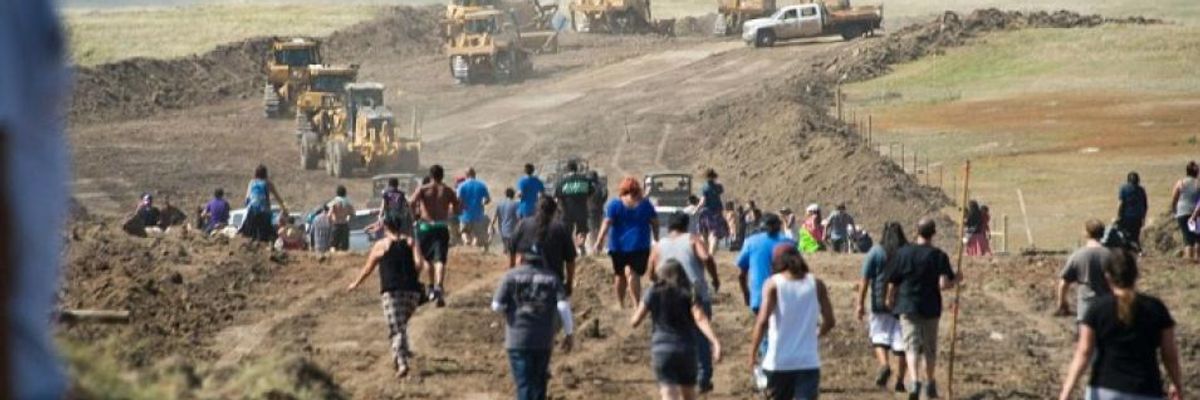
Activists in North Dakota confront pipeline construction activities. A Texas bill would impose steep penalties for such protests. (Photo: Speak Freely/ACLU)
A bill making its way through the Texas legislature would make protesting pipelines a third-degree felony, the same as attempted murder.
"It's an anti-protest bill, favoring the fossil fuel industry, favoring corporations over people." -- Frankie Orona, executive director of the Society of Native Nations
H.B. 3557, which is under consideration in the state Senate after passing the state House earlier this month, ups penalties for interfering in energy infrastructure construction by making the protests a felony. Sentences would range from two to 10 years.
The legislation was authored by Republican state Rep. Chris Paddie. It passed the state House May 7 on a 99 to 45 vote, with two abstentions. The bill is being cosponsored in the state Senate by Republican state Sen. Pat Fallon.
In remarks on the state House floor during the bill's passage, Paddie sought to assuage the fears of those who believe the legislation will target non-violent protest.
"This bill does not affect those who choose to peacefully protest for any reason," said Paddie. "It attaches liability to those who potentially damage or destroy critical infrastructure facilities."
But opponents of the measure don't agree, pointing to the bill's language.
"It's an anti-protest bill, favoring the fossil fuel industry, favoring corporations over people," Frankie Orona, executive director of the Society of Native Nations, told The Austin American-Statesman.
The legislation is "is criminalizing conscientious, caring people who are the canaries for their communities," activist Lori Glover told The Texas Observer.
A hearing on the law in the state Senate Committee on Natural Resources and Economic Development on Wednesday drew opponents of the measure to speak out against the law, but it's unclear if their testimony will make a difference.
The Texas bill is just the latest piece of legislation at the state level to target pipeline protests. In the wake of a spike in anti-pipeline actions over the past few years, Grist reported Tuesday, a number of states have come down on environmental activists.
The effort to punish pipeline protestors has spread across states with ample oil and gas reserves in the last two years and, in some cases, has garnered bipartisan support. Besides Louisiana, four other states -- Oklahoma, North Dakota, South Dakota and Iowa -- have enacted similar laws after protests against the Dakota Access Pipeline generated national attention and inspired a wave of civil disobedience.
The bill is drawing national attention as well.
"Texas aims to make pipeline protest a third-degree felony, same as attempted murder," climate activist Bill McKibben tweeted on Friday.
In a tweet, the advocacy group Public Citizen described the legislation as "an oil and gas backed effort to squash environmental protest."
"This needs to be a nation-wide story," the group said.
Dear Common Dreams reader, It’s been nearly 30 years since I co-founded Common Dreams with my late wife, Lina Newhouser. We had the radical notion that journalism should serve the public good, not corporate profits. It was clear to us from the outset what it would take to build such a project. No paid advertisements. No corporate sponsors. No millionaire publisher telling us what to think or do. Many people said we wouldn't last a year, but we proved those doubters wrong. Together with a tremendous team of journalists and dedicated staff, we built an independent media outlet free from the constraints of profits and corporate control. Our mission has always been simple: To inform. To inspire. To ignite change for the common good. Building Common Dreams was not easy. Our survival was never guaranteed. When you take on the most powerful forces—Wall Street greed, fossil fuel industry destruction, Big Tech lobbyists, and uber-rich oligarchs who have spent billions upon billions rigging the economy and democracy in their favor—the only bulwark you have is supporters who believe in your work. But here’s the urgent message from me today. It's never been this bad out there. And it's never been this hard to keep us going. At the very moment Common Dreams is most needed, the threats we face are intensifying. We need your support now more than ever. We don't accept corporate advertising and never will. We don't have a paywall because we don't think people should be blocked from critical news based on their ability to pay. Everything we do is funded by the donations of readers like you. When everyone does the little they can afford, we are strong. But if that support retreats or dries up, so do we. Will you donate now to make sure Common Dreams not only survives but thrives? —Craig Brown, Co-founder |
A bill making its way through the Texas legislature would make protesting pipelines a third-degree felony, the same as attempted murder.
"It's an anti-protest bill, favoring the fossil fuel industry, favoring corporations over people." -- Frankie Orona, executive director of the Society of Native Nations
H.B. 3557, which is under consideration in the state Senate after passing the state House earlier this month, ups penalties for interfering in energy infrastructure construction by making the protests a felony. Sentences would range from two to 10 years.
The legislation was authored by Republican state Rep. Chris Paddie. It passed the state House May 7 on a 99 to 45 vote, with two abstentions. The bill is being cosponsored in the state Senate by Republican state Sen. Pat Fallon.
In remarks on the state House floor during the bill's passage, Paddie sought to assuage the fears of those who believe the legislation will target non-violent protest.
"This bill does not affect those who choose to peacefully protest for any reason," said Paddie. "It attaches liability to those who potentially damage or destroy critical infrastructure facilities."
But opponents of the measure don't agree, pointing to the bill's language.
"It's an anti-protest bill, favoring the fossil fuel industry, favoring corporations over people," Frankie Orona, executive director of the Society of Native Nations, told The Austin American-Statesman.
The legislation is "is criminalizing conscientious, caring people who are the canaries for their communities," activist Lori Glover told The Texas Observer.
A hearing on the law in the state Senate Committee on Natural Resources and Economic Development on Wednesday drew opponents of the measure to speak out against the law, but it's unclear if their testimony will make a difference.
The Texas bill is just the latest piece of legislation at the state level to target pipeline protests. In the wake of a spike in anti-pipeline actions over the past few years, Grist reported Tuesday, a number of states have come down on environmental activists.
The effort to punish pipeline protestors has spread across states with ample oil and gas reserves in the last two years and, in some cases, has garnered bipartisan support. Besides Louisiana, four other states -- Oklahoma, North Dakota, South Dakota and Iowa -- have enacted similar laws after protests against the Dakota Access Pipeline generated national attention and inspired a wave of civil disobedience.
The bill is drawing national attention as well.
"Texas aims to make pipeline protest a third-degree felony, same as attempted murder," climate activist Bill McKibben tweeted on Friday.
In a tweet, the advocacy group Public Citizen described the legislation as "an oil and gas backed effort to squash environmental protest."
"This needs to be a nation-wide story," the group said.
A bill making its way through the Texas legislature would make protesting pipelines a third-degree felony, the same as attempted murder.
"It's an anti-protest bill, favoring the fossil fuel industry, favoring corporations over people." -- Frankie Orona, executive director of the Society of Native Nations
H.B. 3557, which is under consideration in the state Senate after passing the state House earlier this month, ups penalties for interfering in energy infrastructure construction by making the protests a felony. Sentences would range from two to 10 years.
The legislation was authored by Republican state Rep. Chris Paddie. It passed the state House May 7 on a 99 to 45 vote, with two abstentions. The bill is being cosponsored in the state Senate by Republican state Sen. Pat Fallon.
In remarks on the state House floor during the bill's passage, Paddie sought to assuage the fears of those who believe the legislation will target non-violent protest.
"This bill does not affect those who choose to peacefully protest for any reason," said Paddie. "It attaches liability to those who potentially damage or destroy critical infrastructure facilities."
But opponents of the measure don't agree, pointing to the bill's language.
"It's an anti-protest bill, favoring the fossil fuel industry, favoring corporations over people," Frankie Orona, executive director of the Society of Native Nations, told The Austin American-Statesman.
The legislation is "is criminalizing conscientious, caring people who are the canaries for their communities," activist Lori Glover told The Texas Observer.
A hearing on the law in the state Senate Committee on Natural Resources and Economic Development on Wednesday drew opponents of the measure to speak out against the law, but it's unclear if their testimony will make a difference.
The Texas bill is just the latest piece of legislation at the state level to target pipeline protests. In the wake of a spike in anti-pipeline actions over the past few years, Grist reported Tuesday, a number of states have come down on environmental activists.
The effort to punish pipeline protestors has spread across states with ample oil and gas reserves in the last two years and, in some cases, has garnered bipartisan support. Besides Louisiana, four other states -- Oklahoma, North Dakota, South Dakota and Iowa -- have enacted similar laws after protests against the Dakota Access Pipeline generated national attention and inspired a wave of civil disobedience.
The bill is drawing national attention as well.
"Texas aims to make pipeline protest a third-degree felony, same as attempted murder," climate activist Bill McKibben tweeted on Friday.
In a tweet, the advocacy group Public Citizen described the legislation as "an oil and gas backed effort to squash environmental protest."
"This needs to be a nation-wide story," the group said.