

SUBSCRIBE TO OUR FREE NEWSLETTER
Daily news & progressive opinion—funded by the people, not the corporations—delivered straight to your inbox.
5
#000000
#FFFFFF
To donate by check, phone, or other method, see our More Ways to Give page.
Daily news & progressive opinion—funded by the people, not the corporations—delivered straight to your inbox.
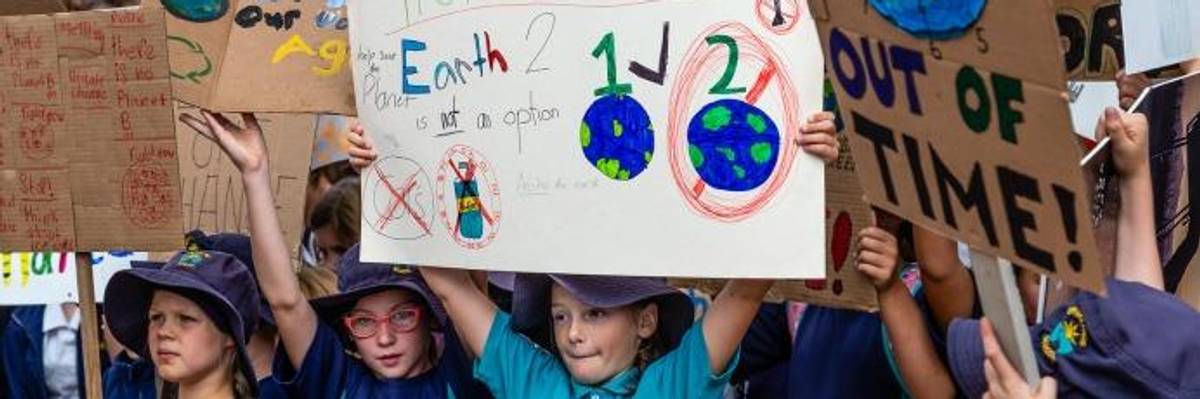
Young climate campaigners march in Blenheim, New Zealand on March 15, 2019. (Photo: Phil Norton/flickr/cc)
The world is "facing a climate emergency" and is "not on track" to limit global warming to 1.5 degrees Celsius, United Nations Secretary-General Antonio Guterres said Sunday.
Speaking in Auckland alongside New Zealand's Prime Minister, Jacinda Ardern, Guterres said, "Climate change is running faster than what we are."
Despite clear manifestations of the climate and ecological crises--including record warm temperatures, a million species at risk of extinction, and atmosphere carbon levels at historic highs--global political leadership is not taking action in line with the needed urgency and scope, he said.
"We are facing a paradox," said Guterres.
"We are feeling clearly by what happens on the ground that things are getting worse, even worse than it was forecast," he added, referencing the recent storms in Mozambique and increasingly frequent droughts.
"We are seeing everywhere a clear demonstration that we are not on track to achieve the objectives defined in the Paris Agreement," Guterres said. "The paradox is that as things are getting worse on the ground, political will seems to be fading."
One outlier to such inaction, said Guterres, is New Zealand. The U.N. chief applauded the country for "leadership" in tackling the climate crisis. It recently unveiled a proposal to be carbon neutral by 2050--though some climate campaigners said that deadline is two decades too late.
On Monday, speaking to a group of youth in Auckland, Guterres praised "the very important leadership that youth around the world is providing" on the climate crisis.
Guterres also laid out steps he said governments should take:
First, shift taxes from salaries to carbon. We must tax pollution not people.
Second stop subsidies to fossil fuels. Taxpayers' money should not be used to boost hurricanes, to spread drought and heatwaves, to bleach corals, or to melt glaciers.
Finally, stop the construction of new coal plants by 2020. We want a green economy not a grey economy in the world.
"We cannot allow for a runaway climate change," Guterres said Sunday. "We need to protect the lives of all people and we need to protect our planet."
Dear Common Dreams reader, It’s been nearly 30 years since I co-founded Common Dreams with my late wife, Lina Newhouser. We had the radical notion that journalism should serve the public good, not corporate profits. It was clear to us from the outset what it would take to build such a project. No paid advertisements. No corporate sponsors. No millionaire publisher telling us what to think or do. Many people said we wouldn't last a year, but we proved those doubters wrong. Together with a tremendous team of journalists and dedicated staff, we built an independent media outlet free from the constraints of profits and corporate control. Our mission has always been simple: To inform. To inspire. To ignite change for the common good. Building Common Dreams was not easy. Our survival was never guaranteed. When you take on the most powerful forces—Wall Street greed, fossil fuel industry destruction, Big Tech lobbyists, and uber-rich oligarchs who have spent billions upon billions rigging the economy and democracy in their favor—the only bulwark you have is supporters who believe in your work. But here’s the urgent message from me today. It's never been this bad out there. And it's never been this hard to keep us going. At the very moment Common Dreams is most needed, the threats we face are intensifying. We need your support now more than ever. We don't accept corporate advertising and never will. We don't have a paywall because we don't think people should be blocked from critical news based on their ability to pay. Everything we do is funded by the donations of readers like you. When everyone does the little they can afford, we are strong. But if that support retreats or dries up, so do we. Will you donate now to make sure Common Dreams not only survives but thrives? —Craig Brown, Co-founder |
The world is "facing a climate emergency" and is "not on track" to limit global warming to 1.5 degrees Celsius, United Nations Secretary-General Antonio Guterres said Sunday.
Speaking in Auckland alongside New Zealand's Prime Minister, Jacinda Ardern, Guterres said, "Climate change is running faster than what we are."
Despite clear manifestations of the climate and ecological crises--including record warm temperatures, a million species at risk of extinction, and atmosphere carbon levels at historic highs--global political leadership is not taking action in line with the needed urgency and scope, he said.
"We are facing a paradox," said Guterres.
"We are feeling clearly by what happens on the ground that things are getting worse, even worse than it was forecast," he added, referencing the recent storms in Mozambique and increasingly frequent droughts.
"We are seeing everywhere a clear demonstration that we are not on track to achieve the objectives defined in the Paris Agreement," Guterres said. "The paradox is that as things are getting worse on the ground, political will seems to be fading."
One outlier to such inaction, said Guterres, is New Zealand. The U.N. chief applauded the country for "leadership" in tackling the climate crisis. It recently unveiled a proposal to be carbon neutral by 2050--though some climate campaigners said that deadline is two decades too late.
On Monday, speaking to a group of youth in Auckland, Guterres praised "the very important leadership that youth around the world is providing" on the climate crisis.
Guterres also laid out steps he said governments should take:
First, shift taxes from salaries to carbon. We must tax pollution not people.
Second stop subsidies to fossil fuels. Taxpayers' money should not be used to boost hurricanes, to spread drought and heatwaves, to bleach corals, or to melt glaciers.
Finally, stop the construction of new coal plants by 2020. We want a green economy not a grey economy in the world.
"We cannot allow for a runaway climate change," Guterres said Sunday. "We need to protect the lives of all people and we need to protect our planet."
The world is "facing a climate emergency" and is "not on track" to limit global warming to 1.5 degrees Celsius, United Nations Secretary-General Antonio Guterres said Sunday.
Speaking in Auckland alongside New Zealand's Prime Minister, Jacinda Ardern, Guterres said, "Climate change is running faster than what we are."
Despite clear manifestations of the climate and ecological crises--including record warm temperatures, a million species at risk of extinction, and atmosphere carbon levels at historic highs--global political leadership is not taking action in line with the needed urgency and scope, he said.
"We are facing a paradox," said Guterres.
"We are feeling clearly by what happens on the ground that things are getting worse, even worse than it was forecast," he added, referencing the recent storms in Mozambique and increasingly frequent droughts.
"We are seeing everywhere a clear demonstration that we are not on track to achieve the objectives defined in the Paris Agreement," Guterres said. "The paradox is that as things are getting worse on the ground, political will seems to be fading."
One outlier to such inaction, said Guterres, is New Zealand. The U.N. chief applauded the country for "leadership" in tackling the climate crisis. It recently unveiled a proposal to be carbon neutral by 2050--though some climate campaigners said that deadline is two decades too late.
On Monday, speaking to a group of youth in Auckland, Guterres praised "the very important leadership that youth around the world is providing" on the climate crisis.
Guterres also laid out steps he said governments should take:
First, shift taxes from salaries to carbon. We must tax pollution not people.
Second stop subsidies to fossil fuels. Taxpayers' money should not be used to boost hurricanes, to spread drought and heatwaves, to bleach corals, or to melt glaciers.
Finally, stop the construction of new coal plants by 2020. We want a green economy not a grey economy in the world.
"We cannot allow for a runaway climate change," Guterres said Sunday. "We need to protect the lives of all people and we need to protect our planet."

