SUBSCRIBE TO OUR FREE NEWSLETTER
Daily news & progressive opinion—funded by the people, not the corporations—delivered straight to your inbox.
5
#000000
#FFFFFF
To donate by check, phone, or other method, see our More Ways to Give page.
Daily news & progressive opinion—funded by the people, not the corporations—delivered straight to your inbox.
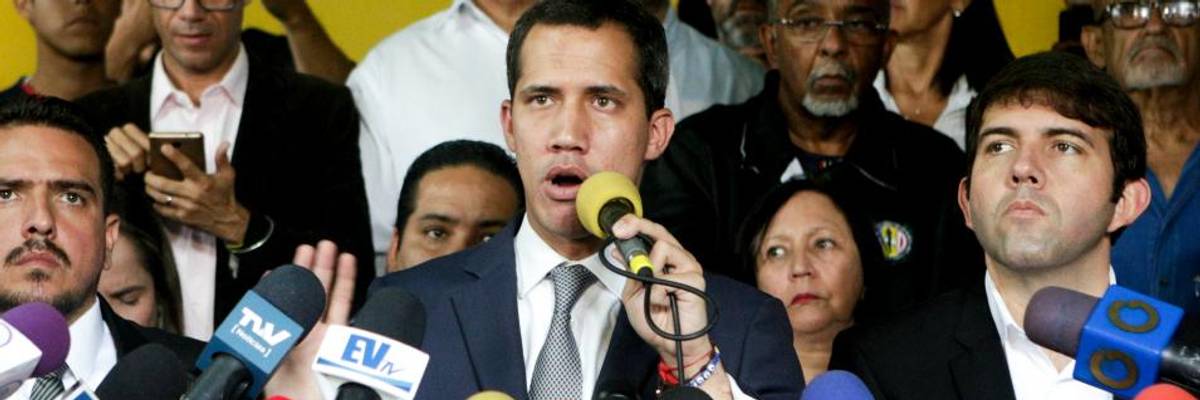
Venezuelan opposition leader Juan Guaido--who attempted to spark a military coup last week with expressed U.S. backing--speaks during a press conference at the headquarters of political party Un Nuevo Tiempo on May 03, 2019 in Caracas, Venezuela. (Photo: Eva Marie Uzcategui/Getty Images)
For all its bluster about "standing with the Venezuelan people," the Trump administration is under fire for refusing to give protected status to asylum-seekers from that nation even as the State Department and White House have worked overtime to support a coup and impose sanctions - both of which have served to further destabilize a country in the midst of a political and economic crisis.
As the Guardian reports on Sunday:
The United Nations estimated 5.3 million Venezuelans will have fled by the end of 2019, but the Trump administration has resisted calls - including those from Republicans - to put in place immigration programs that would let a tiny portion of them seek protection in the US.
Instead, its efforts have been focused on pushing for opposition leader, Juan Guaido, to replace Nicolas Maduro, and repeating calls for the "freedom" of Venezuelans, who face chronic food and medicine shortages in the collapsing country.
A report released late last month by the Center for Economic and Policy Research, authored by economists Mark Weisbrot and Jeffrey Sachs, warned that U.S.-imposed economic sanctions against Venezuela have been "a death sentence for tens of thousands of people" and that the nation's humanitarian crisis--and the associated political turmoil--will worsen as long as the sanctions are kept in place.
So while U.S. Secretary of State Mike Pompeo and national security advisor John Bolton have repeatedly gone in front of U.S. television cameras to proclaim that the Trump administration is operating on behalf of the Venezuelan people and for their benefit, Weisbrot and Sachs argue the evidence shows that U.S. sanctions have "exacerbated Venezuela's economic crisis and made it nearly impossible to stabilize the economy, contributing further to excess deaths." The impacts of the sanctions regime, they said, "disproportionately harmed the poorest and most vulnerable Venezuelans."
The fact that the administration is openly pushing for a coup by right-wing forces in Venezuela while simultaneously refusing to provide asylum status to Venezuelans who are fleeing the violence or economic hardship, say critics, is just further evidence that Trump, vice president Mike Pence, Pompeo, and Bolton should not be simply taken at their word when it comes to their motivations.
"Here you have the administration standing with Venezuelans seeking freedom - and banning them from seeking that freedom in the United States," Nazanin Ash, the International Rescue Committee's (IRC's) vice-president of policy and advocacy, told the Guardian.
"What this administration has demonstrated again and again over the last several years," Ash added, "is that crises and vulnerability ... have not been the factors that have moved them."
Dear Common Dreams reader, It’s been nearly 30 years since I co-founded Common Dreams with my late wife, Lina Newhouser. We had the radical notion that journalism should serve the public good, not corporate profits. It was clear to us from the outset what it would take to build such a project. No paid advertisements. No corporate sponsors. No millionaire publisher telling us what to think or do. Many people said we wouldn't last a year, but we proved those doubters wrong. Together with a tremendous team of journalists and dedicated staff, we built an independent media outlet free from the constraints of profits and corporate control. Our mission has always been simple: To inform. To inspire. To ignite change for the common good. Building Common Dreams was not easy. Our survival was never guaranteed. When you take on the most powerful forces—Wall Street greed, fossil fuel industry destruction, Big Tech lobbyists, and uber-rich oligarchs who have spent billions upon billions rigging the economy and democracy in their favor—the only bulwark you have is supporters who believe in your work. But here’s the urgent message from me today. It's never been this bad out there. And it's never been this hard to keep us going. At the very moment Common Dreams is most needed, the threats we face are intensifying. We need your support now more than ever. We don't accept corporate advertising and never will. We don't have a paywall because we don't think people should be blocked from critical news based on their ability to pay. Everything we do is funded by the donations of readers like you. When everyone does the little they can afford, we are strong. But if that support retreats or dries up, so do we. Will you donate now to make sure Common Dreams not only survives but thrives? —Craig Brown, Co-founder |
For all its bluster about "standing with the Venezuelan people," the Trump administration is under fire for refusing to give protected status to asylum-seekers from that nation even as the State Department and White House have worked overtime to support a coup and impose sanctions - both of which have served to further destabilize a country in the midst of a political and economic crisis.
As the Guardian reports on Sunday:
The United Nations estimated 5.3 million Venezuelans will have fled by the end of 2019, but the Trump administration has resisted calls - including those from Republicans - to put in place immigration programs that would let a tiny portion of them seek protection in the US.
Instead, its efforts have been focused on pushing for opposition leader, Juan Guaido, to replace Nicolas Maduro, and repeating calls for the "freedom" of Venezuelans, who face chronic food and medicine shortages in the collapsing country.
A report released late last month by the Center for Economic and Policy Research, authored by economists Mark Weisbrot and Jeffrey Sachs, warned that U.S.-imposed economic sanctions against Venezuela have been "a death sentence for tens of thousands of people" and that the nation's humanitarian crisis--and the associated political turmoil--will worsen as long as the sanctions are kept in place.
So while U.S. Secretary of State Mike Pompeo and national security advisor John Bolton have repeatedly gone in front of U.S. television cameras to proclaim that the Trump administration is operating on behalf of the Venezuelan people and for their benefit, Weisbrot and Sachs argue the evidence shows that U.S. sanctions have "exacerbated Venezuela's economic crisis and made it nearly impossible to stabilize the economy, contributing further to excess deaths." The impacts of the sanctions regime, they said, "disproportionately harmed the poorest and most vulnerable Venezuelans."
The fact that the administration is openly pushing for a coup by right-wing forces in Venezuela while simultaneously refusing to provide asylum status to Venezuelans who are fleeing the violence or economic hardship, say critics, is just further evidence that Trump, vice president Mike Pence, Pompeo, and Bolton should not be simply taken at their word when it comes to their motivations.
"Here you have the administration standing with Venezuelans seeking freedom - and banning them from seeking that freedom in the United States," Nazanin Ash, the International Rescue Committee's (IRC's) vice-president of policy and advocacy, told the Guardian.
"What this administration has demonstrated again and again over the last several years," Ash added, "is that crises and vulnerability ... have not been the factors that have moved them."
For all its bluster about "standing with the Venezuelan people," the Trump administration is under fire for refusing to give protected status to asylum-seekers from that nation even as the State Department and White House have worked overtime to support a coup and impose sanctions - both of which have served to further destabilize a country in the midst of a political and economic crisis.
As the Guardian reports on Sunday:
The United Nations estimated 5.3 million Venezuelans will have fled by the end of 2019, but the Trump administration has resisted calls - including those from Republicans - to put in place immigration programs that would let a tiny portion of them seek protection in the US.
Instead, its efforts have been focused on pushing for opposition leader, Juan Guaido, to replace Nicolas Maduro, and repeating calls for the "freedom" of Venezuelans, who face chronic food and medicine shortages in the collapsing country.
A report released late last month by the Center for Economic and Policy Research, authored by economists Mark Weisbrot and Jeffrey Sachs, warned that U.S.-imposed economic sanctions against Venezuela have been "a death sentence for tens of thousands of people" and that the nation's humanitarian crisis--and the associated political turmoil--will worsen as long as the sanctions are kept in place.
So while U.S. Secretary of State Mike Pompeo and national security advisor John Bolton have repeatedly gone in front of U.S. television cameras to proclaim that the Trump administration is operating on behalf of the Venezuelan people and for their benefit, Weisbrot and Sachs argue the evidence shows that U.S. sanctions have "exacerbated Venezuela's economic crisis and made it nearly impossible to stabilize the economy, contributing further to excess deaths." The impacts of the sanctions regime, they said, "disproportionately harmed the poorest and most vulnerable Venezuelans."
The fact that the administration is openly pushing for a coup by right-wing forces in Venezuela while simultaneously refusing to provide asylum status to Venezuelans who are fleeing the violence or economic hardship, say critics, is just further evidence that Trump, vice president Mike Pence, Pompeo, and Bolton should not be simply taken at their word when it comes to their motivations.
"Here you have the administration standing with Venezuelans seeking freedom - and banning them from seeking that freedom in the United States," Nazanin Ash, the International Rescue Committee's (IRC's) vice-president of policy and advocacy, told the Guardian.
"What this administration has demonstrated again and again over the last several years," Ash added, "is that crises and vulnerability ... have not been the factors that have moved them."