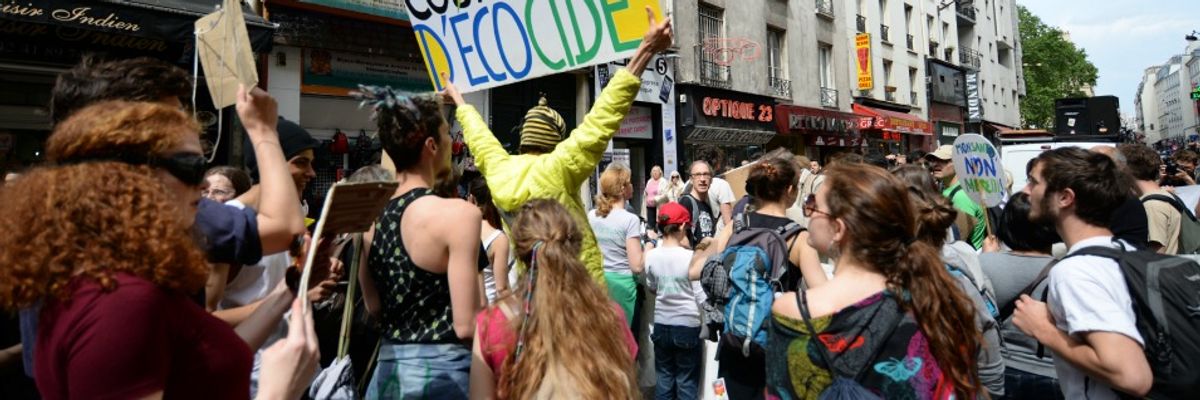
Protesters attended a demonstration against the chemical company Monsanto in 2016 in France. On Thursday, a French court found Monsanto guilty of poisoning a farmer. (Photo: Pascal.Van/Flickr/cc)
'Huge Victory': French Court Finds Monsanto Guilty of Poisoning Farmer
"Monsanto needs to realize that we are not going to be silent anymore. We are not going to roll over and play dead."
Monsanto was ordered to pay restitution to a French farmer who developed a neurological disease after using its weedkiller--the latest victory for the chemical giant's former customers who want to hold the company accountable for selling poisonous pesticides.
A court in Lyon, France, ordered Monsanto Thursday to immediately pay Paul Francois EUR50,000 ($56,000) for the legal fees he incurred as he fought the company, and said the full amount it would be required to pay him would be announced in an upcoming ruling. Francois is seeking EUR1 million ($860,000).
Francois expressed relief at the news of his victory, which came 15 years after he first became ill and 12 years after he took action against Monsanto.
"It's a huge sigh of relief. It's been a 12-year battle," Francois told reporters. "Twelve years where my life had to be put on hold and my family had to suffer because they were subjected to this battle."
Francois began experiencing memory loss, headaches, and fainting in 2004 after accidentally inhaling the Monsanto-made weedkiller Lasso, which contained the chemical monochlorobenzene. Three years later, France made monochlorobenzene illegal and pulled Lasso from the market.
Monochlorobenzene had already been outlawed in Canada, Belgium, and the U.K. years earlier, and Francois argued in his lawsuit that Monsanto knew long before Lasso was pulled from the French market that it was dangerous.
The court ruled that Monsanto should have included a warning on Lasso's label.
"Mr. Francois justifiably concludes that the product, due to its inadequate labeling that did not respect applicable regulations, did not offer the level of safety he could legitimately expect," the court said.
On social media, public health advocates praised the decision.
Francois's victory comes after he won previous lawsuits against the company in 2012 and 2015, only to have those decisions appealed. The company said Thursday it expected to appeal the latest ruling.
Monsanto faces thousands of lawsuits from people all over the world who say its use of other dangerous chemicals, including the carcinogenic pesticide glyphosate, caused them to develop health problems.
"I don't see how [Monsanto] can win," one plaintiff told the Guardian this week in a report about the pending lawsuits. "The world is against them."
Last year, a court in San Francisco delivered the first legal victory against Monsanto regarding its use of dangerous chemicals. The court ordered the company to pay Dewayne Johnson, a groundskeeper, $80 million after he developed non-Hodgkins lymphoma after years of using the weedkiller Roundup, which contains glyphosate.
"Monsanto needs to realize that we are not going to be silent anymore," John Barton, a farmer who also developed non-Hodgkins lymphona and who is part of another lawsuit in California, told the Guardian. "We are not going to roll over and play dead... People should be warned that this stuff is everywhere and we should be careful of this product."
We are at a crossroads
This country and this world are at a monumental crossroads. In a few short weeks, US voters will have an opportunity to beat back the forces of fascism and confront the billionaires who are rigging the economy, our media system, and our democracy, making it increasingly impossible for ordinary people to get by. We’re not just talking about the election. We’re talking about what must be done once these fascist elements are vanquished from power. We need a bolder set of solutions than what either major party has so far been willing to offer and a working-class movement ready to fight like hell for it. Trump didn't emerge from nowhere. The conditions that fueled MAGA authoritarianism were created by decades of radical neoliberal economic policies and a corrupt political system dominated by corporate interests. They slashed taxes on the super-rich, promising that the benefits would trickle down. They said giveaways to the corporate titans would make life more affordable for the rest of us. It was all bullshit. And when a bitter, betrayed populace searches for someone to blame, right-wing demagogues have little trouble finding scapegoats. People know when they're being lied to, but you won't hear any of this from the corporate media. Only independent journalism—powered and funded by people who believe in building a better world—can deliver truly trustworthy daily news. Our Fall Campaign is underway, and we need your help. To power our newsroom through the rest of the year, we need to raise $125,000 by midnight on October 31. So if you share our vision, please contribute whatever you can to sustain our work. |
Monsanto was ordered to pay restitution to a French farmer who developed a neurological disease after using its weedkiller--the latest victory for the chemical giant's former customers who want to hold the company accountable for selling poisonous pesticides.
A court in Lyon, France, ordered Monsanto Thursday to immediately pay Paul Francois EUR50,000 ($56,000) for the legal fees he incurred as he fought the company, and said the full amount it would be required to pay him would be announced in an upcoming ruling. Francois is seeking EUR1 million ($860,000).
Francois expressed relief at the news of his victory, which came 15 years after he first became ill and 12 years after he took action against Monsanto.
"It's a huge sigh of relief. It's been a 12-year battle," Francois told reporters. "Twelve years where my life had to be put on hold and my family had to suffer because they were subjected to this battle."
Francois began experiencing memory loss, headaches, and fainting in 2004 after accidentally inhaling the Monsanto-made weedkiller Lasso, which contained the chemical monochlorobenzene. Three years later, France made monochlorobenzene illegal and pulled Lasso from the market.
Monochlorobenzene had already been outlawed in Canada, Belgium, and the U.K. years earlier, and Francois argued in his lawsuit that Monsanto knew long before Lasso was pulled from the French market that it was dangerous.
The court ruled that Monsanto should have included a warning on Lasso's label.
"Mr. Francois justifiably concludes that the product, due to its inadequate labeling that did not respect applicable regulations, did not offer the level of safety he could legitimately expect," the court said.
On social media, public health advocates praised the decision.
Francois's victory comes after he won previous lawsuits against the company in 2012 and 2015, only to have those decisions appealed. The company said Thursday it expected to appeal the latest ruling.
Monsanto faces thousands of lawsuits from people all over the world who say its use of other dangerous chemicals, including the carcinogenic pesticide glyphosate, caused them to develop health problems.
"I don't see how [Monsanto] can win," one plaintiff told the Guardian this week in a report about the pending lawsuits. "The world is against them."
Last year, a court in San Francisco delivered the first legal victory against Monsanto regarding its use of dangerous chemicals. The court ordered the company to pay Dewayne Johnson, a groundskeeper, $80 million after he developed non-Hodgkins lymphoma after years of using the weedkiller Roundup, which contains glyphosate.
"Monsanto needs to realize that we are not going to be silent anymore," John Barton, a farmer who also developed non-Hodgkins lymphona and who is part of another lawsuit in California, told the Guardian. "We are not going to roll over and play dead... People should be warned that this stuff is everywhere and we should be careful of this product."
Monsanto was ordered to pay restitution to a French farmer who developed a neurological disease after using its weedkiller--the latest victory for the chemical giant's former customers who want to hold the company accountable for selling poisonous pesticides.
A court in Lyon, France, ordered Monsanto Thursday to immediately pay Paul Francois EUR50,000 ($56,000) for the legal fees he incurred as he fought the company, and said the full amount it would be required to pay him would be announced in an upcoming ruling. Francois is seeking EUR1 million ($860,000).
Francois expressed relief at the news of his victory, which came 15 years after he first became ill and 12 years after he took action against Monsanto.
"It's a huge sigh of relief. It's been a 12-year battle," Francois told reporters. "Twelve years where my life had to be put on hold and my family had to suffer because they were subjected to this battle."
Francois began experiencing memory loss, headaches, and fainting in 2004 after accidentally inhaling the Monsanto-made weedkiller Lasso, which contained the chemical monochlorobenzene. Three years later, France made monochlorobenzene illegal and pulled Lasso from the market.
Monochlorobenzene had already been outlawed in Canada, Belgium, and the U.K. years earlier, and Francois argued in his lawsuit that Monsanto knew long before Lasso was pulled from the French market that it was dangerous.
The court ruled that Monsanto should have included a warning on Lasso's label.
"Mr. Francois justifiably concludes that the product, due to its inadequate labeling that did not respect applicable regulations, did not offer the level of safety he could legitimately expect," the court said.
On social media, public health advocates praised the decision.
Francois's victory comes after he won previous lawsuits against the company in 2012 and 2015, only to have those decisions appealed. The company said Thursday it expected to appeal the latest ruling.
Monsanto faces thousands of lawsuits from people all over the world who say its use of other dangerous chemicals, including the carcinogenic pesticide glyphosate, caused them to develop health problems.
"I don't see how [Monsanto] can win," one plaintiff told the Guardian this week in a report about the pending lawsuits. "The world is against them."
Last year, a court in San Francisco delivered the first legal victory against Monsanto regarding its use of dangerous chemicals. The court ordered the company to pay Dewayne Johnson, a groundskeeper, $80 million after he developed non-Hodgkins lymphoma after years of using the weedkiller Roundup, which contains glyphosate.
"Monsanto needs to realize that we are not going to be silent anymore," John Barton, a farmer who also developed non-Hodgkins lymphona and who is part of another lawsuit in California, told the Guardian. "We are not going to roll over and play dead... People should be warned that this stuff is everywhere and we should be careful of this product."