SUBSCRIBE TO OUR FREE NEWSLETTER
Daily news & progressive opinion—funded by the people, not the corporations—delivered straight to your inbox.
5
#000000
#FFFFFF
To donate by check, phone, or other method, see our More Ways to Give page.
Daily news & progressive opinion—funded by the people, not the corporations—delivered straight to your inbox.
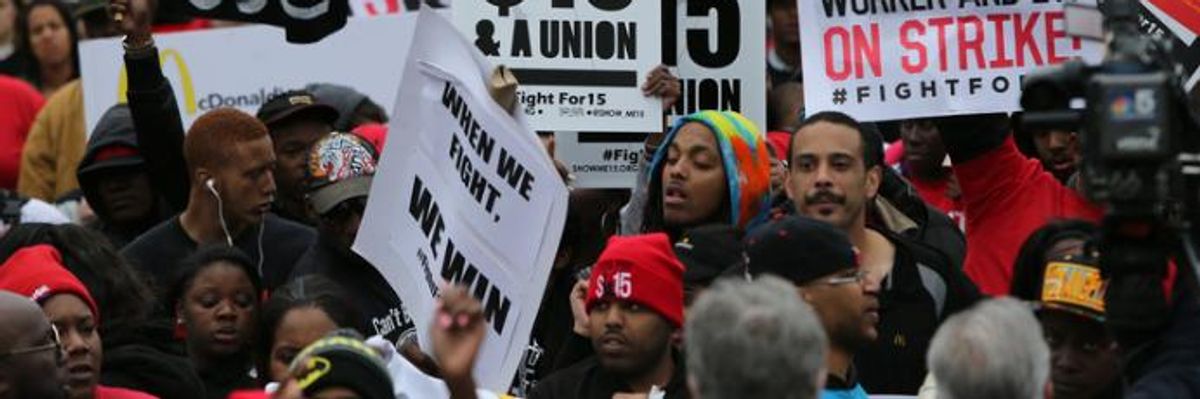
Activists and workers carry signs as they demonstrate near the McDonald's Oak Brook campus during an SEIU-backed Fight for $15 rally. (Photo: Antonio Perez/Chicago Tribune)
The Congressional Progressive Caucus is fighting back against an attempt by centrist Democrats to undercut the push for a $15 federal minimum wage with legislation that would allow lower hourly pay in "rural areas."
"We want to pass a full $15 minimum wage bill," Rep. Pramila Jayapal (D-Wash.) told Politico in an interview. "We're very clear about that. Being in Congress means leading, and we need to lead on minimum wage."
"Low-income areas would be locked in to lower wages. We don't have differentiated payments for Social Security."
--Rep. Bobby Scott
Politico first reported Thursday that leaders of the Progressive Caucus are "lobbying fellow Democrats to help extinguish" the moderate faction's proposal, which is expected to be introduced on Thursday.
The moderates' legislation--led by Rep. Terri Sewell (D-Ala.)--would establish a "regional wage" adjusted to local cost of living, as opposed to the $15 federal minimum proposed by the Raise the Wage Act.
But Rep. Bobby Scott (D-Va.), the lead author of the Raise the Wage Act, said a regional wage would harm low-income families.
"Low-income areas would be locked in to lower wages," Scott told Politico. "We don't have differentiated payments for Social Security."
An anonymous progressive aide echoed Scott, telling Politico that the "regional minimum wage proposal is a clear attempt to water down the Raise the Wage Act."
" Poverty wages shouldn't be acceptable anywhere in America," the aide said.
Progressive activists have also expressed opposition to regional wage plans.
In a letter to the Washington Post published late Wednesday, Rev. William Barber of the Poor People's Campaign and Mary Kay Henry of the Service Employees International Union said a regional wage "would exacerbate existing racial and geographic disparities that have kept millions of workers behind for decades."
"Half of black workers across the country live in states where the minimum wage has stayed at or below $7.25 an hour, most concentrated in the South," Barber and Henry wrote. "And, ironically, while a regional wage would harm black workers, especially black women, the worst, it would end up hurting workers of all colors by keeping a decent wage floor perpetually out of reach."
On Thursday, the Fight for $15 movement held a nationwide "Raise the Wage Call-In Day," urging Americans to pressure their representatives to back a $15 minimum wage.
The inter-party dispute between centrists and progressives over the Raise the Wage Act comes after a recent survey sponsored by the National Employment Law Project found that 65 percent of voters in Democratic-led swing districts support raising the federal minimum wage to $15 an hour.
The fight between the Progressive Caucus and moderate Democrats over the $15 minimum wage is part of a broader struggle between the two factions over the direction of the party.
On Thursday, Jayapal publicly criticized centrist DCCC chair Cheri Bustos (D-Ill.) for her public attacks on the party's progressive wing, which is pushing for bold policies like a federal $15 minimum wage and Medicare for All.
"We will continue to push for our voice to be recognized," Jayapal tweeted.
Dear Common Dreams reader, It’s been nearly 30 years since I co-founded Common Dreams with my late wife, Lina Newhouser. We had the radical notion that journalism should serve the public good, not corporate profits. It was clear to us from the outset what it would take to build such a project. No paid advertisements. No corporate sponsors. No millionaire publisher telling us what to think or do. Many people said we wouldn't last a year, but we proved those doubters wrong. Together with a tremendous team of journalists and dedicated staff, we built an independent media outlet free from the constraints of profits and corporate control. Our mission has always been simple: To inform. To inspire. To ignite change for the common good. Building Common Dreams was not easy. Our survival was never guaranteed. When you take on the most powerful forces—Wall Street greed, fossil fuel industry destruction, Big Tech lobbyists, and uber-rich oligarchs who have spent billions upon billions rigging the economy and democracy in their favor—the only bulwark you have is supporters who believe in your work. But here’s the urgent message from me today. It's never been this bad out there. And it's never been this hard to keep us going. At the very moment Common Dreams is most needed, the threats we face are intensifying. We need your support now more than ever. We don't accept corporate advertising and never will. We don't have a paywall because we don't think people should be blocked from critical news based on their ability to pay. Everything we do is funded by the donations of readers like you. When everyone does the little they can afford, we are strong. But if that support retreats or dries up, so do we. Will you donate now to make sure Common Dreams not only survives but thrives? —Craig Brown, Co-founder |
The Congressional Progressive Caucus is fighting back against an attempt by centrist Democrats to undercut the push for a $15 federal minimum wage with legislation that would allow lower hourly pay in "rural areas."
"We want to pass a full $15 minimum wage bill," Rep. Pramila Jayapal (D-Wash.) told Politico in an interview. "We're very clear about that. Being in Congress means leading, and we need to lead on minimum wage."
"Low-income areas would be locked in to lower wages. We don't have differentiated payments for Social Security."
--Rep. Bobby Scott
Politico first reported Thursday that leaders of the Progressive Caucus are "lobbying fellow Democrats to help extinguish" the moderate faction's proposal, which is expected to be introduced on Thursday.
The moderates' legislation--led by Rep. Terri Sewell (D-Ala.)--would establish a "regional wage" adjusted to local cost of living, as opposed to the $15 federal minimum proposed by the Raise the Wage Act.
But Rep. Bobby Scott (D-Va.), the lead author of the Raise the Wage Act, said a regional wage would harm low-income families.
"Low-income areas would be locked in to lower wages," Scott told Politico. "We don't have differentiated payments for Social Security."
An anonymous progressive aide echoed Scott, telling Politico that the "regional minimum wage proposal is a clear attempt to water down the Raise the Wage Act."
" Poverty wages shouldn't be acceptable anywhere in America," the aide said.
Progressive activists have also expressed opposition to regional wage plans.
In a letter to the Washington Post published late Wednesday, Rev. William Barber of the Poor People's Campaign and Mary Kay Henry of the Service Employees International Union said a regional wage "would exacerbate existing racial and geographic disparities that have kept millions of workers behind for decades."
"Half of black workers across the country live in states where the minimum wage has stayed at or below $7.25 an hour, most concentrated in the South," Barber and Henry wrote. "And, ironically, while a regional wage would harm black workers, especially black women, the worst, it would end up hurting workers of all colors by keeping a decent wage floor perpetually out of reach."
On Thursday, the Fight for $15 movement held a nationwide "Raise the Wage Call-In Day," urging Americans to pressure their representatives to back a $15 minimum wage.
The inter-party dispute between centrists and progressives over the Raise the Wage Act comes after a recent survey sponsored by the National Employment Law Project found that 65 percent of voters in Democratic-led swing districts support raising the federal minimum wage to $15 an hour.
The fight between the Progressive Caucus and moderate Democrats over the $15 minimum wage is part of a broader struggle between the two factions over the direction of the party.
On Thursday, Jayapal publicly criticized centrist DCCC chair Cheri Bustos (D-Ill.) for her public attacks on the party's progressive wing, which is pushing for bold policies like a federal $15 minimum wage and Medicare for All.
"We will continue to push for our voice to be recognized," Jayapal tweeted.
The Congressional Progressive Caucus is fighting back against an attempt by centrist Democrats to undercut the push for a $15 federal minimum wage with legislation that would allow lower hourly pay in "rural areas."
"We want to pass a full $15 minimum wage bill," Rep. Pramila Jayapal (D-Wash.) told Politico in an interview. "We're very clear about that. Being in Congress means leading, and we need to lead on minimum wage."
"Low-income areas would be locked in to lower wages. We don't have differentiated payments for Social Security."
--Rep. Bobby Scott
Politico first reported Thursday that leaders of the Progressive Caucus are "lobbying fellow Democrats to help extinguish" the moderate faction's proposal, which is expected to be introduced on Thursday.
The moderates' legislation--led by Rep. Terri Sewell (D-Ala.)--would establish a "regional wage" adjusted to local cost of living, as opposed to the $15 federal minimum proposed by the Raise the Wage Act.
But Rep. Bobby Scott (D-Va.), the lead author of the Raise the Wage Act, said a regional wage would harm low-income families.
"Low-income areas would be locked in to lower wages," Scott told Politico. "We don't have differentiated payments for Social Security."
An anonymous progressive aide echoed Scott, telling Politico that the "regional minimum wage proposal is a clear attempt to water down the Raise the Wage Act."
" Poverty wages shouldn't be acceptable anywhere in America," the aide said.
Progressive activists have also expressed opposition to regional wage plans.
In a letter to the Washington Post published late Wednesday, Rev. William Barber of the Poor People's Campaign and Mary Kay Henry of the Service Employees International Union said a regional wage "would exacerbate existing racial and geographic disparities that have kept millions of workers behind for decades."
"Half of black workers across the country live in states where the minimum wage has stayed at or below $7.25 an hour, most concentrated in the South," Barber and Henry wrote. "And, ironically, while a regional wage would harm black workers, especially black women, the worst, it would end up hurting workers of all colors by keeping a decent wage floor perpetually out of reach."
On Thursday, the Fight for $15 movement held a nationwide "Raise the Wage Call-In Day," urging Americans to pressure their representatives to back a $15 minimum wage.
The inter-party dispute between centrists and progressives over the Raise the Wage Act comes after a recent survey sponsored by the National Employment Law Project found that 65 percent of voters in Democratic-led swing districts support raising the federal minimum wage to $15 an hour.
The fight between the Progressive Caucus and moderate Democrats over the $15 minimum wage is part of a broader struggle between the two factions over the direction of the party.
On Thursday, Jayapal publicly criticized centrist DCCC chair Cheri Bustos (D-Ill.) for her public attacks on the party's progressive wing, which is pushing for bold policies like a federal $15 minimum wage and Medicare for All.
"We will continue to push for our voice to be recognized," Jayapal tweeted.