SUBSCRIBE TO OUR FREE NEWSLETTER
Daily news & progressive opinion—funded by the people, not the corporations—delivered straight to your inbox.
5
#000000
#FFFFFF
To donate by check, phone, or other method, see our More Ways to Give page.
Daily news & progressive opinion—funded by the people, not the corporations—delivered straight to your inbox.
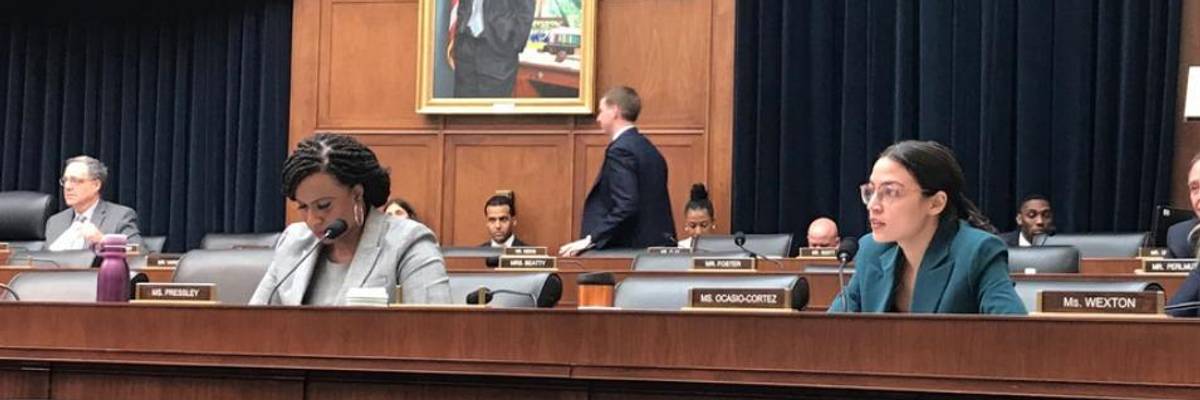
Rep. Alexandria Ocasio-Cortez (D-N.Y.) questioned Wells Fargo Timothy Sloan about his company's investments on Tuesday. (Photo: @EmilyKinery/Twitter)
Rep. Alexandria Ocasio-Ocasio (D-NY) proved once again her verbal interrogation skills on Tuesday as she grilled Wells Fargo CEO Timothy Sloan over the financial giant's dubious investments and won applause for holding his feet to the fire.
The freshman congresswoman questioned bank CEO Timothy Sloan about two issues for which corporations are rarely directly held accountable--the bank's financing of human rights abuses as well as environmental disasters.
On the issue of Wells Fargo's relationship with the private prison industry and the Trump administration's child detention policy, Ocasio-Cortez asked sharply: "Mr. Sloan, why was the bank involved in the caging of children?"
In his response, Sloan announced that the bank is in the process of cutting ties with one group and has already stopped financing another--information that wasn't publicly known before the hearing.
The congresswoman refused to accept Sloan's claim that despite Wells Fargo's financing and debt-financing of GEO Group and CoreCivic, "we weren't directly involved in that," before moving on to the bank's investments in fossil fuel-extracting companies which have worsened the climate crisis, trampled human rights, and endangered the country's drinking water supply.
Questioning Sloan about its financing of companies that build pipelines including the Dakota Access Pipeline (DAPL) in South Dakota and the Keystone XL Pipeline, Ocasio-Cortez asked whether his bank should be held responsible for the environmental havoc wreaked by its investments.
Despite warnings from the Lakota Sioux about the danger of building DAPL, Ocasio-Cortez said, "it was built anyway, and has leaked at least five times."
"The Keystone XL in particular had one leak that sent 210,000 gallons across South Dakota," she added. "Why shouldn't the bank be held responsible for the clean-up of disasters of these projects?"
When Sloan attempted to deny that the leaks have happened--despite easily accessible information to the contrary--Ocasio-Cortez humored him.
"So hypothetically, if there was a leak from the Dakota Access Pipline, why shouldn't Wells Fargo pay for the clean-up of it if it paid for the construction of the pipeline itself?" she asked.
On social media, the progressive lawmaker's supporters wrote that Ocasio-Cortez's work on the House Financial Services and Oversight Committees has helped bring the experiences and struggles of marginalized groups--like immigrants and the indigenous activists who led the fight against DAPL--to the forefront in Congress.
Dear Common Dreams reader, It’s been nearly 30 years since I co-founded Common Dreams with my late wife, Lina Newhouser. We had the radical notion that journalism should serve the public good, not corporate profits. It was clear to us from the outset what it would take to build such a project. No paid advertisements. No corporate sponsors. No millionaire publisher telling us what to think or do. Many people said we wouldn't last a year, but we proved those doubters wrong. Together with a tremendous team of journalists and dedicated staff, we built an independent media outlet free from the constraints of profits and corporate control. Our mission has always been simple: To inform. To inspire. To ignite change for the common good. Building Common Dreams was not easy. Our survival was never guaranteed. When you take on the most powerful forces—Wall Street greed, fossil fuel industry destruction, Big Tech lobbyists, and uber-rich oligarchs who have spent billions upon billions rigging the economy and democracy in their favor—the only bulwark you have is supporters who believe in your work. But here’s the urgent message from me today. It's never been this bad out there. And it's never been this hard to keep us going. At the very moment Common Dreams is most needed, the threats we face are intensifying. We need your support now more than ever. We don't accept corporate advertising and never will. We don't have a paywall because we don't think people should be blocked from critical news based on their ability to pay. Everything we do is funded by the donations of readers like you. When everyone does the little they can afford, we are strong. But if that support retreats or dries up, so do we. Will you donate now to make sure Common Dreams not only survives but thrives? —Craig Brown, Co-founder |
Rep. Alexandria Ocasio-Ocasio (D-NY) proved once again her verbal interrogation skills on Tuesday as she grilled Wells Fargo CEO Timothy Sloan over the financial giant's dubious investments and won applause for holding his feet to the fire.
The freshman congresswoman questioned bank CEO Timothy Sloan about two issues for which corporations are rarely directly held accountable--the bank's financing of human rights abuses as well as environmental disasters.
On the issue of Wells Fargo's relationship with the private prison industry and the Trump administration's child detention policy, Ocasio-Cortez asked sharply: "Mr. Sloan, why was the bank involved in the caging of children?"
In his response, Sloan announced that the bank is in the process of cutting ties with one group and has already stopped financing another--information that wasn't publicly known before the hearing.
The congresswoman refused to accept Sloan's claim that despite Wells Fargo's financing and debt-financing of GEO Group and CoreCivic, "we weren't directly involved in that," before moving on to the bank's investments in fossil fuel-extracting companies which have worsened the climate crisis, trampled human rights, and endangered the country's drinking water supply.
Questioning Sloan about its financing of companies that build pipelines including the Dakota Access Pipeline (DAPL) in South Dakota and the Keystone XL Pipeline, Ocasio-Cortez asked whether his bank should be held responsible for the environmental havoc wreaked by its investments.
Despite warnings from the Lakota Sioux about the danger of building DAPL, Ocasio-Cortez said, "it was built anyway, and has leaked at least five times."
"The Keystone XL in particular had one leak that sent 210,000 gallons across South Dakota," she added. "Why shouldn't the bank be held responsible for the clean-up of disasters of these projects?"
When Sloan attempted to deny that the leaks have happened--despite easily accessible information to the contrary--Ocasio-Cortez humored him.
"So hypothetically, if there was a leak from the Dakota Access Pipline, why shouldn't Wells Fargo pay for the clean-up of it if it paid for the construction of the pipeline itself?" she asked.
On social media, the progressive lawmaker's supporters wrote that Ocasio-Cortez's work on the House Financial Services and Oversight Committees has helped bring the experiences and struggles of marginalized groups--like immigrants and the indigenous activists who led the fight against DAPL--to the forefront in Congress.
Rep. Alexandria Ocasio-Ocasio (D-NY) proved once again her verbal interrogation skills on Tuesday as she grilled Wells Fargo CEO Timothy Sloan over the financial giant's dubious investments and won applause for holding his feet to the fire.
The freshman congresswoman questioned bank CEO Timothy Sloan about two issues for which corporations are rarely directly held accountable--the bank's financing of human rights abuses as well as environmental disasters.
On the issue of Wells Fargo's relationship with the private prison industry and the Trump administration's child detention policy, Ocasio-Cortez asked sharply: "Mr. Sloan, why was the bank involved in the caging of children?"
In his response, Sloan announced that the bank is in the process of cutting ties with one group and has already stopped financing another--information that wasn't publicly known before the hearing.
The congresswoman refused to accept Sloan's claim that despite Wells Fargo's financing and debt-financing of GEO Group and CoreCivic, "we weren't directly involved in that," before moving on to the bank's investments in fossil fuel-extracting companies which have worsened the climate crisis, trampled human rights, and endangered the country's drinking water supply.
Questioning Sloan about its financing of companies that build pipelines including the Dakota Access Pipeline (DAPL) in South Dakota and the Keystone XL Pipeline, Ocasio-Cortez asked whether his bank should be held responsible for the environmental havoc wreaked by its investments.
Despite warnings from the Lakota Sioux about the danger of building DAPL, Ocasio-Cortez said, "it was built anyway, and has leaked at least five times."
"The Keystone XL in particular had one leak that sent 210,000 gallons across South Dakota," she added. "Why shouldn't the bank be held responsible for the clean-up of disasters of these projects?"
When Sloan attempted to deny that the leaks have happened--despite easily accessible information to the contrary--Ocasio-Cortez humored him.
"So hypothetically, if there was a leak from the Dakota Access Pipline, why shouldn't Wells Fargo pay for the clean-up of it if it paid for the construction of the pipeline itself?" she asked.
On social media, the progressive lawmaker's supporters wrote that Ocasio-Cortez's work on the House Financial Services and Oversight Committees has helped bring the experiences and struggles of marginalized groups--like immigrants and the indigenous activists who led the fight against DAPL--to the forefront in Congress.