SUBSCRIBE TO OUR FREE NEWSLETTER
Daily news & progressive opinion—funded by the people, not the corporations—delivered straight to your inbox.
5
#000000
#FFFFFF
To donate by check, phone, or other method, see our More Ways to Give page.
Daily news & progressive opinion—funded by the people, not the corporations—delivered straight to your inbox.
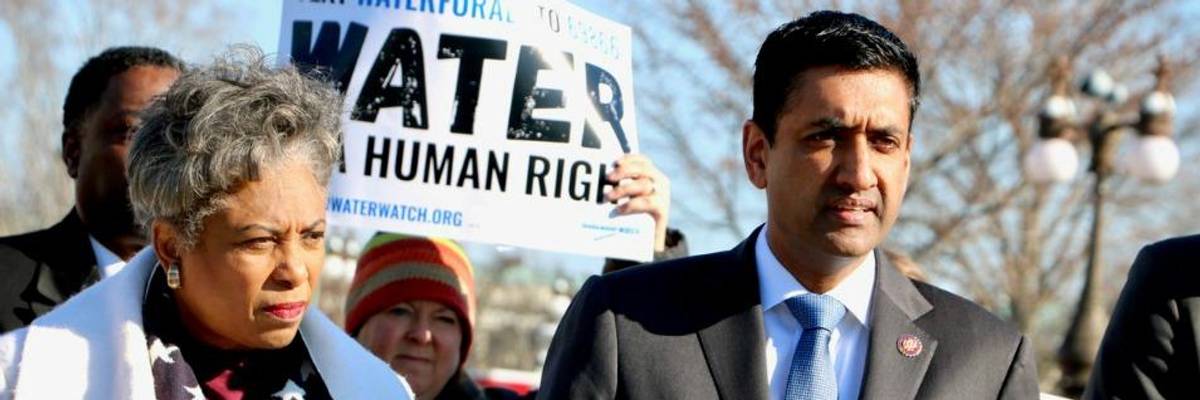
Reps. Brenda Lawrence (D-Mich.) and Ro Khanna (D-Calif.) are among the progressive lawmakers who introduced the WATER Act on Thursday. (Photo: Alex Wong/Getty Images)
Progressive lawmakers introduced sweeping legislation to deliver water justice to people across the country amid skyrocketing water bills for families across the U.S., recent drinking water crises in states including Michigan, Ohio, and regulatory inaction to eliminate toxic chemicals in water sources used by millions of Americans.
The Water Affordability, Transparency, Equity and Reliability (WATER) Act of 2019 would create a $35 billion trust fund to invest in water infrastructure improvements across the United States. The legislation will be a step toward making sure public water services are functional and guaranteeing safe, clean, and affordable for American households, its sponsors say.
Reps. Ro Khanna (D-Calif.), Brenda Lawrence (D-Mich.), and Ilhan Omar (D-Minn.) were among the members who introduced the bill in the House Thursday, while Sen. Bernie Sanders (I-Vt.) proposed companion legislation in the Senate.
"This is such common sense," Khanna said at a press conference with his co-sponsors, noting that the bill would create between 750,000 and one million jobs for people to participate in repairing water infrastructure around the country.
"It would cost $35 billion a year to have upgraded water infrastructure in this country," Khanna said. "Let's put that into perspective, that's about five percent of the military budget, and that's what it would take to make sure every American has clean drinking water."
The bill was introduced on the heels of reports that the Environmental Protection Agency (EPA) is delaying a plan to set limits on Per- and Polyfluoroalkyl Substances, or PFAS, in drinking water and soil.
"Such explicit pollution of American water, combined with the rising climate crisis and an anti-science White House, only makes this bill even more crucial," said Wenonah Hauter, executive director of Food & Water Watch, in a statement.
"Drinking water--safe, clean, affordable drinking water is a human rights issue," said Lawrence. "There is not a human being who can live on this earth without water and we are treating it as if it's a luxury."
The legislation also follows a number of high-profile drinking water crises in a number of states in recent years, including in Ohio, Kentucky, and, perhaps most famously, Flint, Michigan--where old pipes have left the city still lacking safe water four and a half years after the poisoning of its municipal supplies first captured national attention.
"It is unacceptable for one of the richest countries in the world to have communities that are still struggling in having safe and clean drinking water," said Omar. "Our water infrsatructure is in a state of emergency."
The bill "addresses water contamination, affordability, and justice in one fell swoop," said Hauter. "It promotes union labor and job creation while prioritizing disadvantaged communities, rural households, indigenous communities, and schools. When it comes to water, this is the progressive, just legislation America needs."
Dear Common Dreams reader, It’s been nearly 30 years since I co-founded Common Dreams with my late wife, Lina Newhouser. We had the radical notion that journalism should serve the public good, not corporate profits. It was clear to us from the outset what it would take to build such a project. No paid advertisements. No corporate sponsors. No millionaire publisher telling us what to think or do. Many people said we wouldn't last a year, but we proved those doubters wrong. Together with a tremendous team of journalists and dedicated staff, we built an independent media outlet free from the constraints of profits and corporate control. Our mission has always been simple: To inform. To inspire. To ignite change for the common good. Building Common Dreams was not easy. Our survival was never guaranteed. When you take on the most powerful forces—Wall Street greed, fossil fuel industry destruction, Big Tech lobbyists, and uber-rich oligarchs who have spent billions upon billions rigging the economy and democracy in their favor—the only bulwark you have is supporters who believe in your work. But here’s the urgent message from me today. It's never been this bad out there. And it's never been this hard to keep us going. At the very moment Common Dreams is most needed, the threats we face are intensifying. We need your support now more than ever. We don't accept corporate advertising and never will. We don't have a paywall because we don't think people should be blocked from critical news based on their ability to pay. Everything we do is funded by the donations of readers like you. When everyone does the little they can afford, we are strong. But if that support retreats or dries up, so do we. Will you donate now to make sure Common Dreams not only survives but thrives? —Craig Brown, Co-founder |
Progressive lawmakers introduced sweeping legislation to deliver water justice to people across the country amid skyrocketing water bills for families across the U.S., recent drinking water crises in states including Michigan, Ohio, and regulatory inaction to eliminate toxic chemicals in water sources used by millions of Americans.
The Water Affordability, Transparency, Equity and Reliability (WATER) Act of 2019 would create a $35 billion trust fund to invest in water infrastructure improvements across the United States. The legislation will be a step toward making sure public water services are functional and guaranteeing safe, clean, and affordable for American households, its sponsors say.
Reps. Ro Khanna (D-Calif.), Brenda Lawrence (D-Mich.), and Ilhan Omar (D-Minn.) were among the members who introduced the bill in the House Thursday, while Sen. Bernie Sanders (I-Vt.) proposed companion legislation in the Senate.
"This is such common sense," Khanna said at a press conference with his co-sponsors, noting that the bill would create between 750,000 and one million jobs for people to participate in repairing water infrastructure around the country.
"It would cost $35 billion a year to have upgraded water infrastructure in this country," Khanna said. "Let's put that into perspective, that's about five percent of the military budget, and that's what it would take to make sure every American has clean drinking water."
The bill was introduced on the heels of reports that the Environmental Protection Agency (EPA) is delaying a plan to set limits on Per- and Polyfluoroalkyl Substances, or PFAS, in drinking water and soil.
"Such explicit pollution of American water, combined with the rising climate crisis and an anti-science White House, only makes this bill even more crucial," said Wenonah Hauter, executive director of Food & Water Watch, in a statement.
"Drinking water--safe, clean, affordable drinking water is a human rights issue," said Lawrence. "There is not a human being who can live on this earth without water and we are treating it as if it's a luxury."
The legislation also follows a number of high-profile drinking water crises in a number of states in recent years, including in Ohio, Kentucky, and, perhaps most famously, Flint, Michigan--where old pipes have left the city still lacking safe water four and a half years after the poisoning of its municipal supplies first captured national attention.
"It is unacceptable for one of the richest countries in the world to have communities that are still struggling in having safe and clean drinking water," said Omar. "Our water infrsatructure is in a state of emergency."
The bill "addresses water contamination, affordability, and justice in one fell swoop," said Hauter. "It promotes union labor and job creation while prioritizing disadvantaged communities, rural households, indigenous communities, and schools. When it comes to water, this is the progressive, just legislation America needs."
Progressive lawmakers introduced sweeping legislation to deliver water justice to people across the country amid skyrocketing water bills for families across the U.S., recent drinking water crises in states including Michigan, Ohio, and regulatory inaction to eliminate toxic chemicals in water sources used by millions of Americans.
The Water Affordability, Transparency, Equity and Reliability (WATER) Act of 2019 would create a $35 billion trust fund to invest in water infrastructure improvements across the United States. The legislation will be a step toward making sure public water services are functional and guaranteeing safe, clean, and affordable for American households, its sponsors say.
Reps. Ro Khanna (D-Calif.), Brenda Lawrence (D-Mich.), and Ilhan Omar (D-Minn.) were among the members who introduced the bill in the House Thursday, while Sen. Bernie Sanders (I-Vt.) proposed companion legislation in the Senate.
"This is such common sense," Khanna said at a press conference with his co-sponsors, noting that the bill would create between 750,000 and one million jobs for people to participate in repairing water infrastructure around the country.
"It would cost $35 billion a year to have upgraded water infrastructure in this country," Khanna said. "Let's put that into perspective, that's about five percent of the military budget, and that's what it would take to make sure every American has clean drinking water."
The bill was introduced on the heels of reports that the Environmental Protection Agency (EPA) is delaying a plan to set limits on Per- and Polyfluoroalkyl Substances, or PFAS, in drinking water and soil.
"Such explicit pollution of American water, combined with the rising climate crisis and an anti-science White House, only makes this bill even more crucial," said Wenonah Hauter, executive director of Food & Water Watch, in a statement.
"Drinking water--safe, clean, affordable drinking water is a human rights issue," said Lawrence. "There is not a human being who can live on this earth without water and we are treating it as if it's a luxury."
The legislation also follows a number of high-profile drinking water crises in a number of states in recent years, including in Ohio, Kentucky, and, perhaps most famously, Flint, Michigan--where old pipes have left the city still lacking safe water four and a half years after the poisoning of its municipal supplies first captured national attention.
"It is unacceptable for one of the richest countries in the world to have communities that are still struggling in having safe and clean drinking water," said Omar. "Our water infrsatructure is in a state of emergency."
The bill "addresses water contamination, affordability, and justice in one fell swoop," said Hauter. "It promotes union labor and job creation while prioritizing disadvantaged communities, rural households, indigenous communities, and schools. When it comes to water, this is the progressive, just legislation America needs."