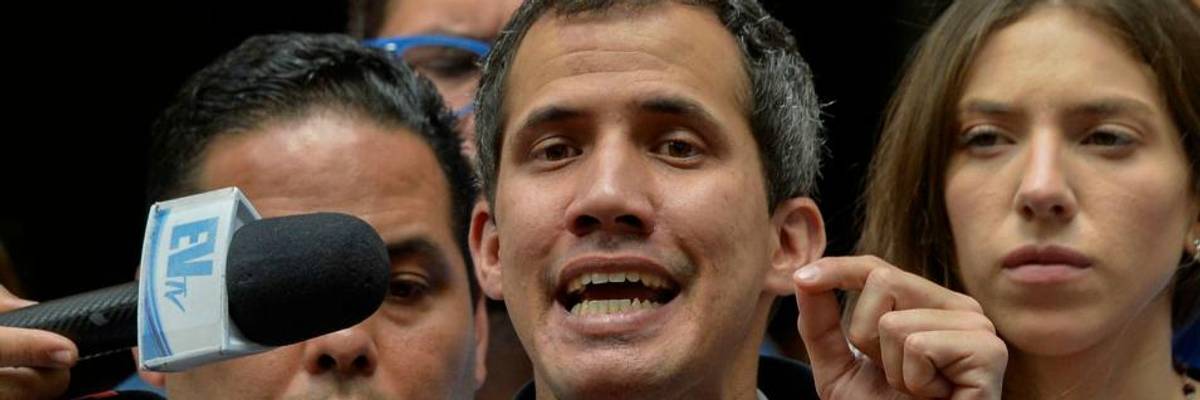
Venezuelan opposition leader Juan Guaido speaks at a press conference on Sunday, January 20, 2019. (Photo: Sky News)
Continuing Long History of Supporting US-Backed Regime Change, NYT Hands Venezuela Opposition Leader Op-Ed Megaphone
"Absolutely disgusting that the New York Times is giving Juan Guaidó space to appeal to governments around the world to support his efforts at a coup."
Adding another chapter to its long history of supporting U.S.-backed coups in Latin America, the New York Times editorial team on Wednesday gave Venezuelan opposition leader Juan Guaido prime op-ed real estate to call on governments of the world stand with him and the Trump administration as they attempt to overthrow elected President Nicolas Maduro "with the minimum of bloodshed."
"The future of Venezuela's revolution is for Venezuelans to decide, not us. All that can come of more intervention now is more crisis, and maybe even war."
--Peter Certo, OtherWords
After noting that he and his fellow National Assembly lawmakers have been holding "clandestine meetings with members of the armed forces and the security forces" to pressure them to abandon Maduro, Guaido appealed directly to the international community as he works to complete what Latin America experts have decried as an attempted coup d'etat that--if successful--will only plunge the country deeper into political and economic chaos.
"Mr. Maduro's time is running out, but in order to manage his exit with the minimum of bloodshed, all of Venezuela must unite in pushing for a definitive end to his regime," Guaido declared. "For that, we need the support of pro-democratic governments, institutions, and individuals the world over."
While Venezuelan opposition leader's article was immediately touted by hawkish Sen. Marco Rubio (R-Fla.)--who reportedly played a key behind-the-scenes role in orchestrating the Trump administration's decision to formally recognize Guaido as "interim president" last week--progressive critics were appalled by the Times' decision to hand a megaphone to the figure leading what has been condemned as an illegitimate effort to overthrow an elected government.
Guaido's Times op-ed comes as anti-war advocates and progressive members of Congress continue to ramp up their opposition to regime change and call for peaceful negotiations to completely avert bloodshed.
In an opinion piece for the Washington Post on Wednesday, Rep. Ro Khanna (D-Calif.) argued that while "Maduro is an authoritarian leader who has presided over unfair elections, failed economic policies, extrajudicial killings by police, food shortages and cronyism with military leaders," U.S. intervention in Venezuela's internal political affairs will only "make a bad situation even worse."
"Both the Venezuelan and American people will be better served by a negotiated solution between Maduro and Guaido than by a conflict that leads to increased instability and violence."
--Rep. Ro Khanna
"The Trump administration's embrace of the self-proclaimed new leader of Venezuela, Juan Guaido, reeks of the highly ambitious social engineering that has been at the cornerstone of neoconservative thinking for a century. The old gang is back at it," Khanna wrote. "Both the Venezuelan and American people will be better served by a negotiated solution between Maduro and Guaido than by a conflict that leads to increased instability and violence."
As Common Dreams reported, President Donald Trump's national security adviser John Bolton has continued to lob threats at Venezuela's current government this week, and the White House on Monday seized billions of dollars in assets connected to the country's state-owned oil company--a move that critics said further increased the risk of violent escalation.
"They'll tell you this about restoring 'democracy' and 'human rights' in the South American country," Peter Certo, editorial manager for the Institute for Policy Studies in Washington, D.C., wrote of the White House's actions. "But one look at the administration officials driving the putsch perishes the thought."
Highlighting the long anti-democratic records of Bolton, Secretary of State Mike Pompeo, and newly appointed Venezuela envoy Elliot Abrams--all of whom have backed authoritarians leaders, death squads, and illegal wars throughout their careers in government--Certo concluded that the U.S. must abandon its push for regime change and "back regional dialogue and diplomacy."
"The future of Venezuela's revolution is for Venezuelans to decide, not us," Certo argued. "All that can come of more intervention now is more crisis, and maybe even war."
We are at a crossroads
This country and this world are at a monumental crossroads. In a few short weeks, US voters will have an opportunity to beat back the forces of fascism and confront the billionaires who are rigging the economy, our media system, and our democracy, making it increasingly impossible for ordinary people to get by. We’re not just talking about the election. We’re talking about what must be done once these fascist elements are vanquished from power. We need a bolder set of solutions than what either major party has so far been willing to offer and a working-class movement ready to fight like hell for it. Trump didn't emerge from nowhere. The conditions that fueled MAGA authoritarianism were created by decades of radical neoliberal economic policies and a corrupt political system dominated by corporate interests. They slashed taxes on the super-rich, promising that the benefits would trickle down. They said giveaways to the corporate titans would make life more affordable for the rest of us. It was all bullshit. And when a bitter, betrayed populace searches for someone to blame, right-wing demagogues have little trouble finding scapegoats. People know when they're being lied to, but you won't hear any of this from the corporate media. Only independent journalism—powered and funded by people who believe in building a better world—can deliver truly trustworthy daily news. Our Fall Campaign is underway, and we need your help. To power our newsroom through the rest of the year, we need to raise $125,000 by midnight on October 31. So if you share our vision, please contribute whatever you can to sustain our work. |
Adding another chapter to its long history of supporting U.S.-backed coups in Latin America, the New York Times editorial team on Wednesday gave Venezuelan opposition leader Juan Guaido prime op-ed real estate to call on governments of the world stand with him and the Trump administration as they attempt to overthrow elected President Nicolas Maduro "with the minimum of bloodshed."
"The future of Venezuela's revolution is for Venezuelans to decide, not us. All that can come of more intervention now is more crisis, and maybe even war."
--Peter Certo, OtherWords
After noting that he and his fellow National Assembly lawmakers have been holding "clandestine meetings with members of the armed forces and the security forces" to pressure them to abandon Maduro, Guaido appealed directly to the international community as he works to complete what Latin America experts have decried as an attempted coup d'etat that--if successful--will only plunge the country deeper into political and economic chaos.
"Mr. Maduro's time is running out, but in order to manage his exit with the minimum of bloodshed, all of Venezuela must unite in pushing for a definitive end to his regime," Guaido declared. "For that, we need the support of pro-democratic governments, institutions, and individuals the world over."
While Venezuelan opposition leader's article was immediately touted by hawkish Sen. Marco Rubio (R-Fla.)--who reportedly played a key behind-the-scenes role in orchestrating the Trump administration's decision to formally recognize Guaido as "interim president" last week--progressive critics were appalled by the Times' decision to hand a megaphone to the figure leading what has been condemned as an illegitimate effort to overthrow an elected government.
Guaido's Times op-ed comes as anti-war advocates and progressive members of Congress continue to ramp up their opposition to regime change and call for peaceful negotiations to completely avert bloodshed.
In an opinion piece for the Washington Post on Wednesday, Rep. Ro Khanna (D-Calif.) argued that while "Maduro is an authoritarian leader who has presided over unfair elections, failed economic policies, extrajudicial killings by police, food shortages and cronyism with military leaders," U.S. intervention in Venezuela's internal political affairs will only "make a bad situation even worse."
"Both the Venezuelan and American people will be better served by a negotiated solution between Maduro and Guaido than by a conflict that leads to increased instability and violence."
--Rep. Ro Khanna
"The Trump administration's embrace of the self-proclaimed new leader of Venezuela, Juan Guaido, reeks of the highly ambitious social engineering that has been at the cornerstone of neoconservative thinking for a century. The old gang is back at it," Khanna wrote. "Both the Venezuelan and American people will be better served by a negotiated solution between Maduro and Guaido than by a conflict that leads to increased instability and violence."
As Common Dreams reported, President Donald Trump's national security adviser John Bolton has continued to lob threats at Venezuela's current government this week, and the White House on Monday seized billions of dollars in assets connected to the country's state-owned oil company--a move that critics said further increased the risk of violent escalation.
"They'll tell you this about restoring 'democracy' and 'human rights' in the South American country," Peter Certo, editorial manager for the Institute for Policy Studies in Washington, D.C., wrote of the White House's actions. "But one look at the administration officials driving the putsch perishes the thought."
Highlighting the long anti-democratic records of Bolton, Secretary of State Mike Pompeo, and newly appointed Venezuela envoy Elliot Abrams--all of whom have backed authoritarians leaders, death squads, and illegal wars throughout their careers in government--Certo concluded that the U.S. must abandon its push for regime change and "back regional dialogue and diplomacy."
"The future of Venezuela's revolution is for Venezuelans to decide, not us," Certo argued. "All that can come of more intervention now is more crisis, and maybe even war."
Adding another chapter to its long history of supporting U.S.-backed coups in Latin America, the New York Times editorial team on Wednesday gave Venezuelan opposition leader Juan Guaido prime op-ed real estate to call on governments of the world stand with him and the Trump administration as they attempt to overthrow elected President Nicolas Maduro "with the minimum of bloodshed."
"The future of Venezuela's revolution is for Venezuelans to decide, not us. All that can come of more intervention now is more crisis, and maybe even war."
--Peter Certo, OtherWords
After noting that he and his fellow National Assembly lawmakers have been holding "clandestine meetings with members of the armed forces and the security forces" to pressure them to abandon Maduro, Guaido appealed directly to the international community as he works to complete what Latin America experts have decried as an attempted coup d'etat that--if successful--will only plunge the country deeper into political and economic chaos.
"Mr. Maduro's time is running out, but in order to manage his exit with the minimum of bloodshed, all of Venezuela must unite in pushing for a definitive end to his regime," Guaido declared. "For that, we need the support of pro-democratic governments, institutions, and individuals the world over."
While Venezuelan opposition leader's article was immediately touted by hawkish Sen. Marco Rubio (R-Fla.)--who reportedly played a key behind-the-scenes role in orchestrating the Trump administration's decision to formally recognize Guaido as "interim president" last week--progressive critics were appalled by the Times' decision to hand a megaphone to the figure leading what has been condemned as an illegitimate effort to overthrow an elected government.
Guaido's Times op-ed comes as anti-war advocates and progressive members of Congress continue to ramp up their opposition to regime change and call for peaceful negotiations to completely avert bloodshed.
In an opinion piece for the Washington Post on Wednesday, Rep. Ro Khanna (D-Calif.) argued that while "Maduro is an authoritarian leader who has presided over unfair elections, failed economic policies, extrajudicial killings by police, food shortages and cronyism with military leaders," U.S. intervention in Venezuela's internal political affairs will only "make a bad situation even worse."
"Both the Venezuelan and American people will be better served by a negotiated solution between Maduro and Guaido than by a conflict that leads to increased instability and violence."
--Rep. Ro Khanna
"The Trump administration's embrace of the self-proclaimed new leader of Venezuela, Juan Guaido, reeks of the highly ambitious social engineering that has been at the cornerstone of neoconservative thinking for a century. The old gang is back at it," Khanna wrote. "Both the Venezuelan and American people will be better served by a negotiated solution between Maduro and Guaido than by a conflict that leads to increased instability and violence."
As Common Dreams reported, President Donald Trump's national security adviser John Bolton has continued to lob threats at Venezuela's current government this week, and the White House on Monday seized billions of dollars in assets connected to the country's state-owned oil company--a move that critics said further increased the risk of violent escalation.
"They'll tell you this about restoring 'democracy' and 'human rights' in the South American country," Peter Certo, editorial manager for the Institute for Policy Studies in Washington, D.C., wrote of the White House's actions. "But one look at the administration officials driving the putsch perishes the thought."
Highlighting the long anti-democratic records of Bolton, Secretary of State Mike Pompeo, and newly appointed Venezuela envoy Elliot Abrams--all of whom have backed authoritarians leaders, death squads, and illegal wars throughout their careers in government--Certo concluded that the U.S. must abandon its push for regime change and "back regional dialogue and diplomacy."
"The future of Venezuela's revolution is for Venezuelans to decide, not us," Certo argued. "All that can come of more intervention now is more crisis, and maybe even war."