SUBSCRIBE TO OUR FREE NEWSLETTER
Daily news & progressive opinion—funded by the people, not the corporations—delivered straight to your inbox.
5
#000000
#FFFFFF
To donate by check, phone, or other method, see our More Ways to Give page.
Daily news & progressive opinion—funded by the people, not the corporations—delivered straight to your inbox.
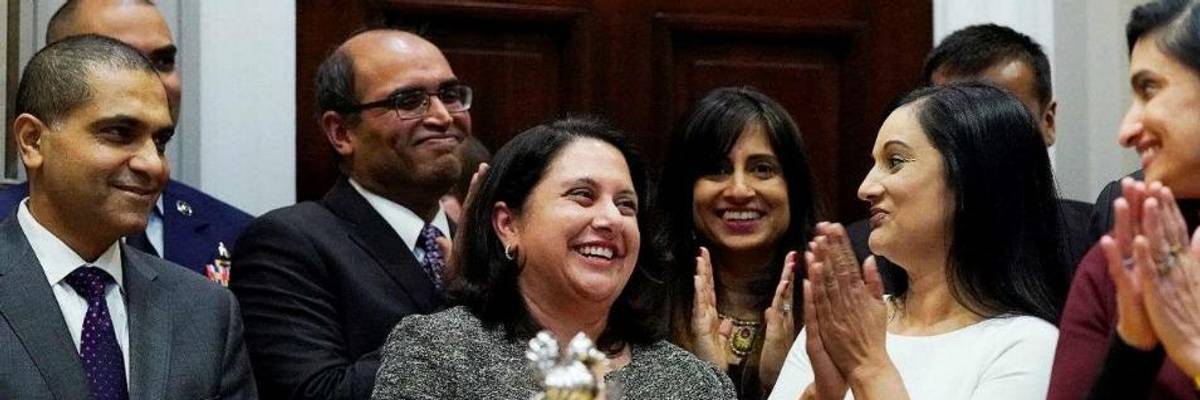
Neomi Rao, President Donald Trump's pick to replace Supreme Court Justice Brett Kavanaugh on the U.S. Court of Appeals for the D.C. Circuit, wrote in the early 1990s that women who are sexually assaulted after becoming drunk are partiually to blame for their attacks. (Photo: Twitter)
President Donald Trump is hoping to fill Supreme Court Justice Brett Kavanaugh's former seat on the U.S. Court of Appeals for the D.C. Circuit with a former law professor whose early writings on the government and justice betrayed misogynist and bigoted views--leaving critics concerned on Monday that the president is remaking the country's second-highest court in his own image.
As Buzzfeed reported, Neomi Rao is currently an administrator in Trump's Office of Information and Regulatory Affairs who has never served as a judge. Before her career in government and as a law professor, Rao attended Yale University, graduating in 1995. During her time at Yale and just after graduating Rao wrote a number of troubling essays and articles about rape survivors, the poor, and race relations.
"She didn't just carve out a conservative political position in these writings, she affirmatively attacked the equal dignity of the kinds of people who most need the protections of law that our constitution guarantees." --Marge Baker, People for the American WayOne article for the Yale Herald, written in 1994, garnered much of the condemnation aimed at Rao. The nominee wrote that if a woman who has been raped drank "to the point where she can no longer choose, well, getting to that point was part of her choice," and suggested that she's therefore partially to blame for the crime.
The Leadership Conference on Civil and Human Rights called the comments "disturbing" and said a record of such views should disqualify Rao from consideration for the D.C. Circuit court, from which presidents have often selected Supreme Court nominees.
Rao was nominated last November to replace Kavanaugh after he was confirmed as Trump's second Supreme Court pick. The Senate adjourned at the end of December with her confirmation still pending, but Rao's nomination is expected to be resubmitted by the White House.
Other writings that were submitted to the Senate Judiciary Committee after Rao's initial nomination included a 1996 Weekly Standard article in which she dismissed race as a "hot money-making issue" for activist and author Cornel West and called the LGBTQ rights movement a "trendy" political moment.
Also in the 1996 in the Weekly Standard, Rao called affirmative action "the anointed dragon of liberal excess."
A year earlier, she had taken aim at affirmative action as well as "women's rights, special rights for the handicapped, and welfare for the indigent and lazy," as evidence that "elitism is a forgotten and embarrassing concept" in an article for the Yale Free Press.
A spokesperson for Rao told Buzzfeed that the views she had expressed were "intentionally provocative"--but critics argue that her crudely-worded hostility toward those with disabilities, women, and people who rely on government assistance has since been mirrored by the president who nominated her for the judgeship.
"Neomi Rao's columns are consistent with this administration's support of candidates who make racially insensitive statements and comments hostile to sexual assault survivors. She shouldn't be awarded a seat on the second highest court in the country," said Nan Aron, president of Alliance for Justice, on Twitter.
Aron also told Buzzfeed that "Rao had decades to disavow what she wrote in college and had not."
"The statements made by Neomi Rao are alarming evidence of her unfitness for the bench," said Marge Baker of People for the American Way. "No one who reads these writings can possibly believe that people of color, survivors of sexual assault, and LGBT people can expect an equal hearing in her courtroom. She didn't just carve out a conservative political position in these writings, she affirmatively attacked the equal dignity of the kinds of people who most need the protections of law that our constitution guarantees."
"The Senate needs to make clear that its constitutional responsibility to ensure equal justice outweighs politics and partisanship," Baker added.
This country and this world are at a monumental crossroads. US voters have an opportunity to beat back the forces of fascism and confront the billionaires who are rigging the economy, our media system, and our democracy, making it increasingly impossible for ordinary people to get by. We’re not just talking about the election. We’re talking about what must be done once these fascist elements are vanquished from power. We need a bolder set of solutions than what either major party has so far been willing to offer and a working-class movement ready to fight like hell for it. Trump didn't emerge from nowhere. The conditions that fueled MAGA authoritarianism were created by decades of radical neoliberal economic policies and a corrupt political system dominated by corporate interests. They slashed taxes on the super-rich, promising that the benefits would trickle down. They said giveaways to the corporate titans would make life more affordable for the rest of us. It was all bullshit. And when a bitter, betrayed populace searches for someone to blame, right-wing demagogues have little trouble finding scapegoats. People know when they're being lied to, but you won't hear any of this from the corporate media. Only independent journalism—powered and funded by people who believe in building a better world—can deliver truly trustworthy daily news. If you share our vision, please contribute whatever you can to sustain our work. |
President Donald Trump is hoping to fill Supreme Court Justice Brett Kavanaugh's former seat on the U.S. Court of Appeals for the D.C. Circuit with a former law professor whose early writings on the government and justice betrayed misogynist and bigoted views--leaving critics concerned on Monday that the president is remaking the country's second-highest court in his own image.
As Buzzfeed reported, Neomi Rao is currently an administrator in Trump's Office of Information and Regulatory Affairs who has never served as a judge. Before her career in government and as a law professor, Rao attended Yale University, graduating in 1995. During her time at Yale and just after graduating Rao wrote a number of troubling essays and articles about rape survivors, the poor, and race relations.
"She didn't just carve out a conservative political position in these writings, she affirmatively attacked the equal dignity of the kinds of people who most need the protections of law that our constitution guarantees." --Marge Baker, People for the American WayOne article for the Yale Herald, written in 1994, garnered much of the condemnation aimed at Rao. The nominee wrote that if a woman who has been raped drank "to the point where she can no longer choose, well, getting to that point was part of her choice," and suggested that she's therefore partially to blame for the crime.
The Leadership Conference on Civil and Human Rights called the comments "disturbing" and said a record of such views should disqualify Rao from consideration for the D.C. Circuit court, from which presidents have often selected Supreme Court nominees.
Rao was nominated last November to replace Kavanaugh after he was confirmed as Trump's second Supreme Court pick. The Senate adjourned at the end of December with her confirmation still pending, but Rao's nomination is expected to be resubmitted by the White House.
Other writings that were submitted to the Senate Judiciary Committee after Rao's initial nomination included a 1996 Weekly Standard article in which she dismissed race as a "hot money-making issue" for activist and author Cornel West and called the LGBTQ rights movement a "trendy" political moment.
Also in the 1996 in the Weekly Standard, Rao called affirmative action "the anointed dragon of liberal excess."
A year earlier, she had taken aim at affirmative action as well as "women's rights, special rights for the handicapped, and welfare for the indigent and lazy," as evidence that "elitism is a forgotten and embarrassing concept" in an article for the Yale Free Press.
A spokesperson for Rao told Buzzfeed that the views she had expressed were "intentionally provocative"--but critics argue that her crudely-worded hostility toward those with disabilities, women, and people who rely on government assistance has since been mirrored by the president who nominated her for the judgeship.
"Neomi Rao's columns are consistent with this administration's support of candidates who make racially insensitive statements and comments hostile to sexual assault survivors. She shouldn't be awarded a seat on the second highest court in the country," said Nan Aron, president of Alliance for Justice, on Twitter.
Aron also told Buzzfeed that "Rao had decades to disavow what she wrote in college and had not."
"The statements made by Neomi Rao are alarming evidence of her unfitness for the bench," said Marge Baker of People for the American Way. "No one who reads these writings can possibly believe that people of color, survivors of sexual assault, and LGBT people can expect an equal hearing in her courtroom. She didn't just carve out a conservative political position in these writings, she affirmatively attacked the equal dignity of the kinds of people who most need the protections of law that our constitution guarantees."
"The Senate needs to make clear that its constitutional responsibility to ensure equal justice outweighs politics and partisanship," Baker added.