SUBSCRIBE TO OUR FREE NEWSLETTER
Daily news & progressive opinion—funded by the people, not the corporations—delivered straight to your inbox.
5
#000000
#FFFFFF
To donate by check, phone, or other method, see our More Ways to Give page.
Daily news & progressive opinion—funded by the people, not the corporations—delivered straight to your inbox.
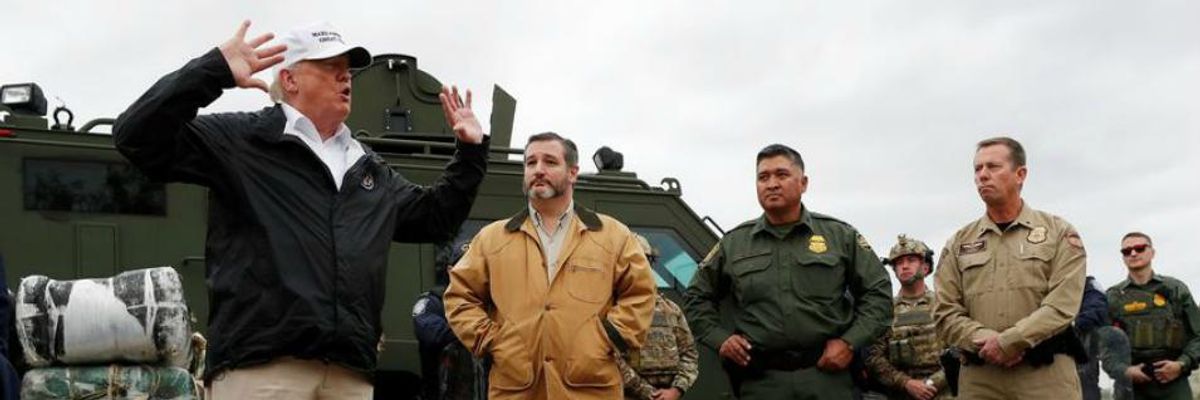
President Donald Trump speaks to reporters as he visits the banks of the Rio Grande River with U.S. Sen. Ted Cruz and U.S. Customs and Border Protection officers and agents during a visit to the U.S.-Mexico border on Thursday, January 10, 2019. (Photo: Leah Millis/Reuters)
As President Donald Trump continues to escalate his threat to declare a national emergency to construct a wall along the U.S.-Mexico border--and amid reports that his administration is already laying the groundwork for the declaration--legal experts and progressive critics warned against the notion that the move would be a mere political "stunt" and argued it would spark a full-blown constitutional crisis.
"If he can claim anything is a crisis to get what he wants, there is no meaningful balance of power."
--Stephen Miles, Win Without War
"This is a constitutional crisis, plain and simple," Stephen Miles, director of Win Without War, wrote in a series of tweets on Thursday following Trump's brief visit to the border, where he said he will "most likely" make good on his threats to declare a national emergency.
"The constitution gives Congress solely the power to appropriate funds," Miles added. "They have done so and Trump is planning to unilaterally take those funds and use them for another purpose for his own political agenda... If he can claim anything is a crisis to get what he wants, there is no meaningful balance of power."
While many legal experts have argued that declaring a national emergency to fund the construction of a border wall would be an illegal abuse of power, Miles argued that there is "no reason to believe" the courts--and particularly not the conservative-dominated Supreme Court--will stop Trump from bypassing Congress to construct a border wall that most Americans don't want.
In a recent piece for the New York Times, Yale law professor Bruce Ackerman argued that not only would Trump's proposed emergency declaration be illegal, "but if members of the armed forces obeyed his command, they would be committing a federal crime."
"No president in the last twoo centuries has invoked emergency power to fund a policy goal after failing to secure approval from Congress."
--Kristen Clarke, Lawyers' Committee on Civil Rights Under Law
"What this all adds up to is a potential crisis much graver than whatever immigration emergencies the president has in mind: A legally ignorant president forcing our troops to choose between his commands and the rule of law in a petty political struggle over a domestic political question," Ackerman concluded.
While it is not at all clear when or even if the president will declare a national emergency, Kristen Clarke--president and executive director of the Lawyers' Committee on Civil Rights Under Law--echoed Miles and others in arguing that the move would spark a constitutional crisis.
"If Trump invokes 'emergency' powers to build his wall, this would thrust the nation into a constitutional crisis," Clarke wrote. "No president in the last two centuries has invoked emergency power to fund a policy goal after failing to secure approval from Congress."
Warnings about the dire implications of Trump's possible national emergency declaration over a non-existent crisis came as NBC News reported on Thursday that the president is considering a plan to divert billions of dollars away from from disaster relief and prevention efforts in Puerto Rico, Texas, and California to fund the construction of "315 miles of barrier along the U.S.-Mexico border."
"Under the proposal," NBC reported, "Trump could dip into the $2.4 billion allocated to projects in California, including flood prevention and protection projects along the Yuba River Basin and the Folsom Dam, as well as the $2.5 billion set aside for reconstruction projects in Puerto Rico, which is still recovering from Hurricane Maria."
In a statement, Rep. Nydia Velazquez (D-N.Y.) said it "would be beyond appalling for the president to take money from places like Puerto Rico that have suffered enormous catastrophes, costing thousands of American citizens lives, in order to pay for Donald Trump's foolish, offensive, and hateful wall."
"Siphoning funding from real disasters to pay for a crisis manufactured by the president is wholly unacceptable and the American people won't fall for it," Velazquez added.
This country and this world are at a monumental crossroads. US voters have an opportunity to beat back the forces of fascism and confront the billionaires who are rigging the economy, our media system, and our democracy, making it increasingly impossible for ordinary people to get by. We’re not just talking about the election. We’re talking about what must be done once these fascist elements are vanquished from power. We need a bolder set of solutions than what either major party has so far been willing to offer and a working-class movement ready to fight like hell for it. Trump didn't emerge from nowhere. The conditions that fueled MAGA authoritarianism were created by decades of radical neoliberal economic policies and a corrupt political system dominated by corporate interests. They slashed taxes on the super-rich, promising that the benefits would trickle down. They said giveaways to the corporate titans would make life more affordable for the rest of us. It was all bullshit. And when a bitter, betrayed populace searches for someone to blame, right-wing demagogues have little trouble finding scapegoats. People know when they're being lied to, but you won't hear any of this from the corporate media. Only independent journalism—powered and funded by people who believe in building a better world—can deliver truly trustworthy daily news. If you share our vision, please contribute whatever you can to sustain our work. |
As President Donald Trump continues to escalate his threat to declare a national emergency to construct a wall along the U.S.-Mexico border--and amid reports that his administration is already laying the groundwork for the declaration--legal experts and progressive critics warned against the notion that the move would be a mere political "stunt" and argued it would spark a full-blown constitutional crisis.
"If he can claim anything is a crisis to get what he wants, there is no meaningful balance of power."
--Stephen Miles, Win Without War
"This is a constitutional crisis, plain and simple," Stephen Miles, director of Win Without War, wrote in a series of tweets on Thursday following Trump's brief visit to the border, where he said he will "most likely" make good on his threats to declare a national emergency.
"The constitution gives Congress solely the power to appropriate funds," Miles added. "They have done so and Trump is planning to unilaterally take those funds and use them for another purpose for his own political agenda... If he can claim anything is a crisis to get what he wants, there is no meaningful balance of power."
While many legal experts have argued that declaring a national emergency to fund the construction of a border wall would be an illegal abuse of power, Miles argued that there is "no reason to believe" the courts--and particularly not the conservative-dominated Supreme Court--will stop Trump from bypassing Congress to construct a border wall that most Americans don't want.
In a recent piece for the New York Times, Yale law professor Bruce Ackerman argued that not only would Trump's proposed emergency declaration be illegal, "but if members of the armed forces obeyed his command, they would be committing a federal crime."
"No president in the last twoo centuries has invoked emergency power to fund a policy goal after failing to secure approval from Congress."
--Kristen Clarke, Lawyers' Committee on Civil Rights Under Law
"What this all adds up to is a potential crisis much graver than whatever immigration emergencies the president has in mind: A legally ignorant president forcing our troops to choose between his commands and the rule of law in a petty political struggle over a domestic political question," Ackerman concluded.
While it is not at all clear when or even if the president will declare a national emergency, Kristen Clarke--president and executive director of the Lawyers' Committee on Civil Rights Under Law--echoed Miles and others in arguing that the move would spark a constitutional crisis.
"If Trump invokes 'emergency' powers to build his wall, this would thrust the nation into a constitutional crisis," Clarke wrote. "No president in the last two centuries has invoked emergency power to fund a policy goal after failing to secure approval from Congress."
Warnings about the dire implications of Trump's possible national emergency declaration over a non-existent crisis came as NBC News reported on Thursday that the president is considering a plan to divert billions of dollars away from from disaster relief and prevention efforts in Puerto Rico, Texas, and California to fund the construction of "315 miles of barrier along the U.S.-Mexico border."
"Under the proposal," NBC reported, "Trump could dip into the $2.4 billion allocated to projects in California, including flood prevention and protection projects along the Yuba River Basin and the Folsom Dam, as well as the $2.5 billion set aside for reconstruction projects in Puerto Rico, which is still recovering from Hurricane Maria."
In a statement, Rep. Nydia Velazquez (D-N.Y.) said it "would be beyond appalling for the president to take money from places like Puerto Rico that have suffered enormous catastrophes, costing thousands of American citizens lives, in order to pay for Donald Trump's foolish, offensive, and hateful wall."
"Siphoning funding from real disasters to pay for a crisis manufactured by the president is wholly unacceptable and the American people won't fall for it," Velazquez added.