
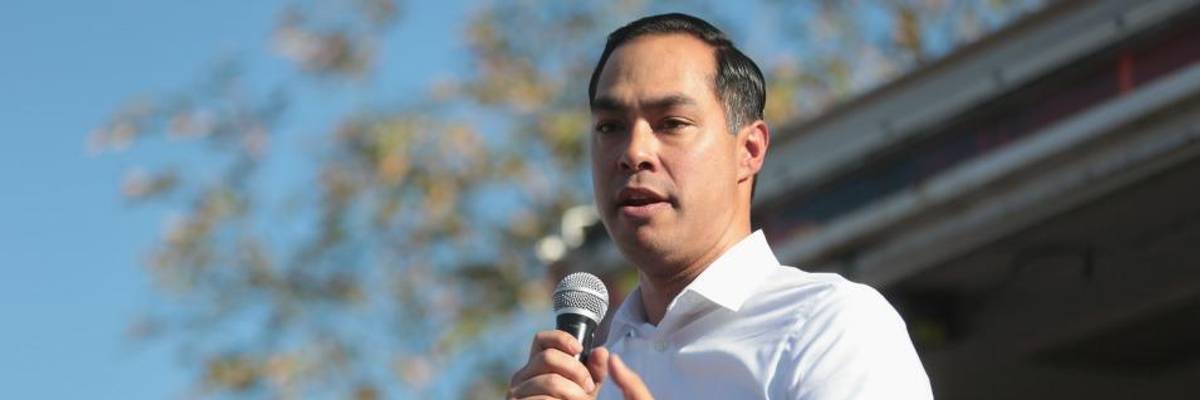
Former San Antonio mayor and Housing and Urban Development Secretary Julian Castro said Sunday that he favors a 70 percent tax rate for Americans who earn $10 million per year. (Photo: Gage Skidmore/Flickr/cc)
As Critics Struggle to Portray 70% Tax Rate for Rich as Unrealistic, Dems Get Behind Idea Ahead of 2020 Election
Julián Castro said unequivocally on Sunday that he supports "folks at the top paying [their] fair share"
Rep. Alexandria Ocasio-Cortez's (D-N.Y.) unflinching support for taxing the wealthiest Americans at a rate doubling what they currently pay each year made waves among conservatives over the weekend--but at least one likely Democratic presidential candidate's backing of the proposal may indicate that it may soon get broader support from the party.
On ABC's "The Week," former Housing and Urban Development Secretary Julian Castro unequivocally told George Stephanopoulos that he has "no problem" forcing Americans who make more than $10 million per year to pay far more than they currently pay in taxes.
"There was a time in this country where the top marginal tax rate was over 90 percent, even during Reagan's era in the 1980s it was around 50 percent. So do I support, in order to have something like Medicare for all, that we ask folks that are in the top .05 percent or .5 percent or top one percent to pay more? ...Yeah, I support that." --Julian Castro
"I can support folks at the top paying [their] fair share," Castro said when Stephanopoulos asked if he would back the wealthiest households being taxed at 60 to 70 percent, as Ocasio-Cortez said on "60 Minutes" on Sunday, daring critics to call the proposal "radical."
The former San Antonio mayor, who is expected to make an announcement next weekend regarding a potential 2020 run, cited historical precedent for a higher top marginal tax rate.
"There was a time in this country where the top marginal tax rate was over 90 percent, even during Reagan's era in the 1980s it was around 50 percent. So do I support, in order to have something like Medicare for all, that we ask folks that are in the top .05 percent or .5 percent or top one percent to pay more? ...Yeah, I support that," Castro said.
Castro pointed out how simply ensuring that the 16,000 Americans earning more than $10 million per year pay their fair share, which would generate $720 billion over 10 years according to the Washington Post, would pay for a universal healthcare system that would lighten the burden on American families who are forced to prop up the for-profit insurance industry every year by paying exorbitant premiums.
The former Obama official urged "that we get more serious about making sure the corporations pay their fair share, and that we're smart about understanding how instead of folks having to pay sky high premiums to companies that are seeking a profit to deliver health care that we can have a better system where people can get good healthcare and have peace of mind, even if that means that we rearrange where those dollars go."
Indivisible co-founder Ezra Levin praised Castro for unapologetically speaking up for an idea that Republicans spent the weekend scoffing at on social media.
Republicans attempted to attack Ocasio-Cortez's proposal--but were able to only by entirely misrepresenting what she said on "60 Minutes," suggesting that she supports taxing all Americans' income at 70 percent.
At the Washington Post, Tory Newmyer wrote that political observers should "expect other Democratic 2020 hopefuls to go there soon, too." Castro is the first probable 2020 candidate to openly support taxing the wealthy at a specific, significantly higher rate, while Sen. Elizabeth Warren (D-Mass.), who announced that she was forming an exploratory committee late last month, has also pointed to the top tax rate that was "well above 50 percent" in the post-World War II era when CNBC's John Harwood asked whether "it's wrong for more than half of somebody's marginal income to be taken."
Meanwhile, economist Paul Krugman pointed out that Ocasio-Cortez and Castro are arguing for tax reform that has been supported by "top public finance economists...for some time" and that the proposal is "not at all outlandish."
At Jacobin, Matt Bruenig also wrote about high top marginal tax rates that currently, particularly in Sweden, where households earning more than $98,000 are currently taxed at a 70 percent rate--making Ocasio-Cortez's proposal seem "quite modest by comparison."
"What a 70 percent tax rate would look like is thus much less hypothetical than people imagine it to be," wrote Bruenig. "Sweden is not perfect but it's a successful high-income country where ordinary people have a higher standard of living than their U.S. peers."
Sweden is consistently lauded for its robust social welfare system and ranked third on U.S. New & World Report's annual list of countries with the best quality of life--a list on which the U.S. did not appear.
We are at a crossroads
This country and this world are at a monumental crossroads. In a few short weeks, US voters will have an opportunity to beat back the forces of fascism and confront the billionaires who are rigging the economy, our media system, and our democracy, making it increasingly impossible for ordinary people to get by. We’re not just talking about the election. We’re talking about what must be done once these fascist elements are vanquished from power. We need a bolder set of solutions than what either major party has so far been willing to offer and a working-class movement ready to fight like hell for it. Trump didn't emerge from nowhere. The conditions that fueled MAGA authoritarianism were created by decades of radical neoliberal economic policies and a corrupt political system dominated by corporate interests. They slashed taxes on the super-rich, promising that the benefits would trickle down. They said giveaways to the corporate titans would make life more affordable for the rest of us. It was all bullshit. And when a bitter, betrayed populace searches for someone to blame, right-wing demagogues have little trouble finding scapegoats. People know when they're being lied to, but you won't hear any of this from the corporate media. Only independent journalism—powered and funded by people who believe in building a better world—can deliver truly trustworthy daily news. Our Fall Campaign is underway, and we need your help. To power our newsroom through the rest of the year, we need to raise $125,000 by midnight on October 31. So if you share our vision, please contribute whatever you can to sustain our work. |
Rep. Alexandria Ocasio-Cortez's (D-N.Y.) unflinching support for taxing the wealthiest Americans at a rate doubling what they currently pay each year made waves among conservatives over the weekend--but at least one likely Democratic presidential candidate's backing of the proposal may indicate that it may soon get broader support from the party.
On ABC's "The Week," former Housing and Urban Development Secretary Julian Castro unequivocally told George Stephanopoulos that he has "no problem" forcing Americans who make more than $10 million per year to pay far more than they currently pay in taxes.
"There was a time in this country where the top marginal tax rate was over 90 percent, even during Reagan's era in the 1980s it was around 50 percent. So do I support, in order to have something like Medicare for all, that we ask folks that are in the top .05 percent or .5 percent or top one percent to pay more? ...Yeah, I support that." --Julian Castro
"I can support folks at the top paying [their] fair share," Castro said when Stephanopoulos asked if he would back the wealthiest households being taxed at 60 to 70 percent, as Ocasio-Cortez said on "60 Minutes" on Sunday, daring critics to call the proposal "radical."
The former San Antonio mayor, who is expected to make an announcement next weekend regarding a potential 2020 run, cited historical precedent for a higher top marginal tax rate.
"There was a time in this country where the top marginal tax rate was over 90 percent, even during Reagan's era in the 1980s it was around 50 percent. So do I support, in order to have something like Medicare for all, that we ask folks that are in the top .05 percent or .5 percent or top one percent to pay more? ...Yeah, I support that," Castro said.
Castro pointed out how simply ensuring that the 16,000 Americans earning more than $10 million per year pay their fair share, which would generate $720 billion over 10 years according to the Washington Post, would pay for a universal healthcare system that would lighten the burden on American families who are forced to prop up the for-profit insurance industry every year by paying exorbitant premiums.
The former Obama official urged "that we get more serious about making sure the corporations pay their fair share, and that we're smart about understanding how instead of folks having to pay sky high premiums to companies that are seeking a profit to deliver health care that we can have a better system where people can get good healthcare and have peace of mind, even if that means that we rearrange where those dollars go."
Indivisible co-founder Ezra Levin praised Castro for unapologetically speaking up for an idea that Republicans spent the weekend scoffing at on social media.
Republicans attempted to attack Ocasio-Cortez's proposal--but were able to only by entirely misrepresenting what she said on "60 Minutes," suggesting that she supports taxing all Americans' income at 70 percent.
At the Washington Post, Tory Newmyer wrote that political observers should "expect other Democratic 2020 hopefuls to go there soon, too." Castro is the first probable 2020 candidate to openly support taxing the wealthy at a specific, significantly higher rate, while Sen. Elizabeth Warren (D-Mass.), who announced that she was forming an exploratory committee late last month, has also pointed to the top tax rate that was "well above 50 percent" in the post-World War II era when CNBC's John Harwood asked whether "it's wrong for more than half of somebody's marginal income to be taken."
Meanwhile, economist Paul Krugman pointed out that Ocasio-Cortez and Castro are arguing for tax reform that has been supported by "top public finance economists...for some time" and that the proposal is "not at all outlandish."
At Jacobin, Matt Bruenig also wrote about high top marginal tax rates that currently, particularly in Sweden, where households earning more than $98,000 are currently taxed at a 70 percent rate--making Ocasio-Cortez's proposal seem "quite modest by comparison."
"What a 70 percent tax rate would look like is thus much less hypothetical than people imagine it to be," wrote Bruenig. "Sweden is not perfect but it's a successful high-income country where ordinary people have a higher standard of living than their U.S. peers."
Sweden is consistently lauded for its robust social welfare system and ranked third on U.S. New & World Report's annual list of countries with the best quality of life--a list on which the U.S. did not appear.
Rep. Alexandria Ocasio-Cortez's (D-N.Y.) unflinching support for taxing the wealthiest Americans at a rate doubling what they currently pay each year made waves among conservatives over the weekend--but at least one likely Democratic presidential candidate's backing of the proposal may indicate that it may soon get broader support from the party.
On ABC's "The Week," former Housing and Urban Development Secretary Julian Castro unequivocally told George Stephanopoulos that he has "no problem" forcing Americans who make more than $10 million per year to pay far more than they currently pay in taxes.
"There was a time in this country where the top marginal tax rate was over 90 percent, even during Reagan's era in the 1980s it was around 50 percent. So do I support, in order to have something like Medicare for all, that we ask folks that are in the top .05 percent or .5 percent or top one percent to pay more? ...Yeah, I support that." --Julian Castro
"I can support folks at the top paying [their] fair share," Castro said when Stephanopoulos asked if he would back the wealthiest households being taxed at 60 to 70 percent, as Ocasio-Cortez said on "60 Minutes" on Sunday, daring critics to call the proposal "radical."
The former San Antonio mayor, who is expected to make an announcement next weekend regarding a potential 2020 run, cited historical precedent for a higher top marginal tax rate.
"There was a time in this country where the top marginal tax rate was over 90 percent, even during Reagan's era in the 1980s it was around 50 percent. So do I support, in order to have something like Medicare for all, that we ask folks that are in the top .05 percent or .5 percent or top one percent to pay more? ...Yeah, I support that," Castro said.
Castro pointed out how simply ensuring that the 16,000 Americans earning more than $10 million per year pay their fair share, which would generate $720 billion over 10 years according to the Washington Post, would pay for a universal healthcare system that would lighten the burden on American families who are forced to prop up the for-profit insurance industry every year by paying exorbitant premiums.
The former Obama official urged "that we get more serious about making sure the corporations pay their fair share, and that we're smart about understanding how instead of folks having to pay sky high premiums to companies that are seeking a profit to deliver health care that we can have a better system where people can get good healthcare and have peace of mind, even if that means that we rearrange where those dollars go."
Indivisible co-founder Ezra Levin praised Castro for unapologetically speaking up for an idea that Republicans spent the weekend scoffing at on social media.
Republicans attempted to attack Ocasio-Cortez's proposal--but were able to only by entirely misrepresenting what she said on "60 Minutes," suggesting that she supports taxing all Americans' income at 70 percent.
At the Washington Post, Tory Newmyer wrote that political observers should "expect other Democratic 2020 hopefuls to go there soon, too." Castro is the first probable 2020 candidate to openly support taxing the wealthy at a specific, significantly higher rate, while Sen. Elizabeth Warren (D-Mass.), who announced that she was forming an exploratory committee late last month, has also pointed to the top tax rate that was "well above 50 percent" in the post-World War II era when CNBC's John Harwood asked whether "it's wrong for more than half of somebody's marginal income to be taken."
Meanwhile, economist Paul Krugman pointed out that Ocasio-Cortez and Castro are arguing for tax reform that has been supported by "top public finance economists...for some time" and that the proposal is "not at all outlandish."
At Jacobin, Matt Bruenig also wrote about high top marginal tax rates that currently, particularly in Sweden, where households earning more than $98,000 are currently taxed at a 70 percent rate--making Ocasio-Cortez's proposal seem "quite modest by comparison."
"What a 70 percent tax rate would look like is thus much less hypothetical than people imagine it to be," wrote Bruenig. "Sweden is not perfect but it's a successful high-income country where ordinary people have a higher standard of living than their U.S. peers."
Sweden is consistently lauded for its robust social welfare system and ranked third on U.S. New & World Report's annual list of countries with the best quality of life--a list on which the U.S. did not appear.