SUBSCRIBE TO OUR FREE NEWSLETTER
Daily news & progressive opinion—funded by the people, not the corporations—delivered straight to your inbox.
5
#000000
#FFFFFF
To donate by check, phone, or other method, see our More Ways to Give page.
Daily news & progressive opinion—funded by the people, not the corporations—delivered straight to your inbox.
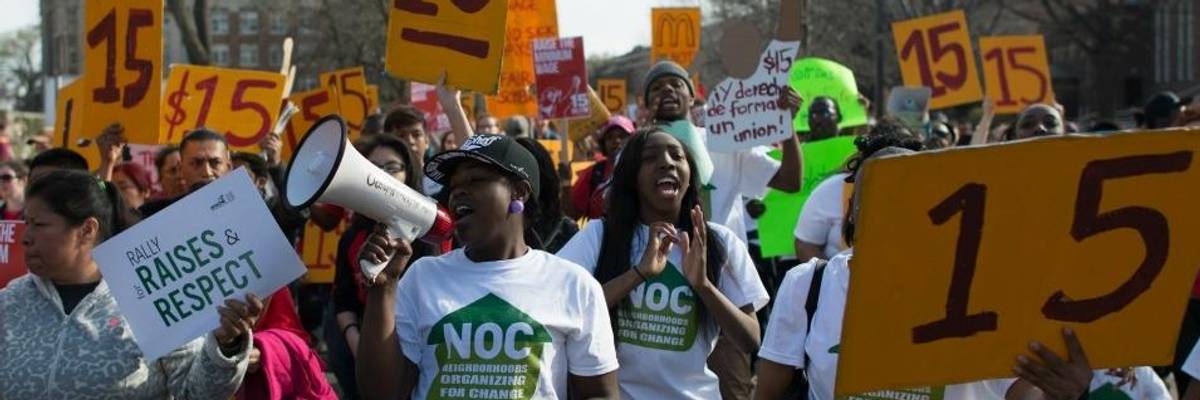
A minimum wage demonstration in 2015. (Photo: Fibonacci Blue/flickr/cc)
More than five million workers in states and cities across the country will see their incomes increase in 2019, thanks to the push for a higher minimum wage by groups including Fight for $15.
The federal minimum wage will remain at $7.25, where it has stood for a decade. But tireless advocacy by Fight for $15, which began its push in 2012 with 200 fast food workers going on strike to demand a living wage and the right to unionize, has pressured state legislators as well as voters to call for minimum wage hikes. As a result, twenty states and 21 cities will raise wages in the year ahead, with low-wage workers earning an estimated $5.4 billion more over the course of 2019.
"Happy 2019 to the millions of working Americans who are getting raises because of minimum wage boosts," tweeted Mary Kay Henry, international president of the Service Employees International Union (SEIU). "This wasn't given to anyone--it happened because we stuck together in the Fight for $15 and fought for a better life."
Progressive lawmakers including Sen. Bernie Sanders (I-Vt.) and Ro Khanna (D-Calif.) also applauded the minimum wage hikes and the advocacy of Fight for $15--while pledging to continue the fight for increases at the federal level.
States including Arizona, California, Colorado, Maine, Massachusetts, Missouri, New York, and Washington are raising their minimum wages, with plans to increase them to at least $12 per hour in the coming years. California will increase its minimum wage to $15 per hour by 2022 and Massachusetts will do the same by 2023.
Workers in some of the country's most expensive cities will also earn more starting January 1, with businesses in Seattle required to pay employees $16 per hour and many in New York City required to pay $15 per hour.
"The American people believe in the value of work--and that workers deserve to be valued. That's why there's such strong support for raising the minimum wage." --Christine Owens, NELPThe Fight for $15 has "motivated many [lawmakers] to accept that we need higher minimum wages than we currently have in much of the country," David Cooper, senior economic analyst at the Economic Policy Institute, told the Associated Press.
Voters in several states have also indicated that they've had enough of a federal minimum wage that is too low to pay the monthly rent on an average two-bedroom apartment in any state in the country. Minimum wage hikes in Arizona, Arkansas, Colorado, Maine, Missouri, and Washington were the result of ballot referendums.
"Minimum wage increases resonate strongly with so many Americans because people feel like they're working harder than ever but have little to show for it," Christine Owens, executive director of the National Employment Law Project (NELP), said in a statement. "The American people believe in the value of work--and that workers deserve to be valued. That's why there's such strong support for raising the minimum wage. People believe it's the right thing to do, and they understand it's one of the best ways to lift the incomes of working families who really need that money."
In 2018, Fight for $15 helped lead Amazon workers to a $15 minimum wage, and the movement's advocacy paved the way for Rep.-elect Alexandria Ocasio-Cortez (D-N.Y.) to announce a $15 wage for her interns.
The group also secured a $15 minimum wage for University of North Carolina healthcare employees, Cleveland Clinic in Ohio, and all workers in Shelby County, Tennessee.
"These wins prove that all of our organizing and hard work are paying off," the group wrote on its website. "That's the energy we need to take with us into next year. Our voices are being heard, and our movement is stronger than ever. We won't stop until every worker across the country gets the pay they deserve."
Dear Common Dreams reader, It’s been nearly 30 years since I co-founded Common Dreams with my late wife, Lina Newhouser. We had the radical notion that journalism should serve the public good, not corporate profits. It was clear to us from the outset what it would take to build such a project. No paid advertisements. No corporate sponsors. No millionaire publisher telling us what to think or do. Many people said we wouldn't last a year, but we proved those doubters wrong. Together with a tremendous team of journalists and dedicated staff, we built an independent media outlet free from the constraints of profits and corporate control. Our mission has always been simple: To inform. To inspire. To ignite change for the common good. Building Common Dreams was not easy. Our survival was never guaranteed. When you take on the most powerful forces—Wall Street greed, fossil fuel industry destruction, Big Tech lobbyists, and uber-rich oligarchs who have spent billions upon billions rigging the economy and democracy in their favor—the only bulwark you have is supporters who believe in your work. But here’s the urgent message from me today. It's never been this bad out there. And it's never been this hard to keep us going. At the very moment Common Dreams is most needed, the threats we face are intensifying. We need your support now more than ever. We don't accept corporate advertising and never will. We don't have a paywall because we don't think people should be blocked from critical news based on their ability to pay. Everything we do is funded by the donations of readers like you. When everyone does the little they can afford, we are strong. But if that support retreats or dries up, so do we. Will you donate now to make sure Common Dreams not only survives but thrives? —Craig Brown, Co-founder |
More than five million workers in states and cities across the country will see their incomes increase in 2019, thanks to the push for a higher minimum wage by groups including Fight for $15.
The federal minimum wage will remain at $7.25, where it has stood for a decade. But tireless advocacy by Fight for $15, which began its push in 2012 with 200 fast food workers going on strike to demand a living wage and the right to unionize, has pressured state legislators as well as voters to call for minimum wage hikes. As a result, twenty states and 21 cities will raise wages in the year ahead, with low-wage workers earning an estimated $5.4 billion more over the course of 2019.
"Happy 2019 to the millions of working Americans who are getting raises because of minimum wage boosts," tweeted Mary Kay Henry, international president of the Service Employees International Union (SEIU). "This wasn't given to anyone--it happened because we stuck together in the Fight for $15 and fought for a better life."
Progressive lawmakers including Sen. Bernie Sanders (I-Vt.) and Ro Khanna (D-Calif.) also applauded the minimum wage hikes and the advocacy of Fight for $15--while pledging to continue the fight for increases at the federal level.
States including Arizona, California, Colorado, Maine, Massachusetts, Missouri, New York, and Washington are raising their minimum wages, with plans to increase them to at least $12 per hour in the coming years. California will increase its minimum wage to $15 per hour by 2022 and Massachusetts will do the same by 2023.
Workers in some of the country's most expensive cities will also earn more starting January 1, with businesses in Seattle required to pay employees $16 per hour and many in New York City required to pay $15 per hour.
"The American people believe in the value of work--and that workers deserve to be valued. That's why there's such strong support for raising the minimum wage." --Christine Owens, NELPThe Fight for $15 has "motivated many [lawmakers] to accept that we need higher minimum wages than we currently have in much of the country," David Cooper, senior economic analyst at the Economic Policy Institute, told the Associated Press.
Voters in several states have also indicated that they've had enough of a federal minimum wage that is too low to pay the monthly rent on an average two-bedroom apartment in any state in the country. Minimum wage hikes in Arizona, Arkansas, Colorado, Maine, Missouri, and Washington were the result of ballot referendums.
"Minimum wage increases resonate strongly with so many Americans because people feel like they're working harder than ever but have little to show for it," Christine Owens, executive director of the National Employment Law Project (NELP), said in a statement. "The American people believe in the value of work--and that workers deserve to be valued. That's why there's such strong support for raising the minimum wage. People believe it's the right thing to do, and they understand it's one of the best ways to lift the incomes of working families who really need that money."
In 2018, Fight for $15 helped lead Amazon workers to a $15 minimum wage, and the movement's advocacy paved the way for Rep.-elect Alexandria Ocasio-Cortez (D-N.Y.) to announce a $15 wage for her interns.
The group also secured a $15 minimum wage for University of North Carolina healthcare employees, Cleveland Clinic in Ohio, and all workers in Shelby County, Tennessee.
"These wins prove that all of our organizing and hard work are paying off," the group wrote on its website. "That's the energy we need to take with us into next year. Our voices are being heard, and our movement is stronger than ever. We won't stop until every worker across the country gets the pay they deserve."
More than five million workers in states and cities across the country will see their incomes increase in 2019, thanks to the push for a higher minimum wage by groups including Fight for $15.
The federal minimum wage will remain at $7.25, where it has stood for a decade. But tireless advocacy by Fight for $15, which began its push in 2012 with 200 fast food workers going on strike to demand a living wage and the right to unionize, has pressured state legislators as well as voters to call for minimum wage hikes. As a result, twenty states and 21 cities will raise wages in the year ahead, with low-wage workers earning an estimated $5.4 billion more over the course of 2019.
"Happy 2019 to the millions of working Americans who are getting raises because of minimum wage boosts," tweeted Mary Kay Henry, international president of the Service Employees International Union (SEIU). "This wasn't given to anyone--it happened because we stuck together in the Fight for $15 and fought for a better life."
Progressive lawmakers including Sen. Bernie Sanders (I-Vt.) and Ro Khanna (D-Calif.) also applauded the minimum wage hikes and the advocacy of Fight for $15--while pledging to continue the fight for increases at the federal level.
States including Arizona, California, Colorado, Maine, Massachusetts, Missouri, New York, and Washington are raising their minimum wages, with plans to increase them to at least $12 per hour in the coming years. California will increase its minimum wage to $15 per hour by 2022 and Massachusetts will do the same by 2023.
Workers in some of the country's most expensive cities will also earn more starting January 1, with businesses in Seattle required to pay employees $16 per hour and many in New York City required to pay $15 per hour.
"The American people believe in the value of work--and that workers deserve to be valued. That's why there's such strong support for raising the minimum wage." --Christine Owens, NELPThe Fight for $15 has "motivated many [lawmakers] to accept that we need higher minimum wages than we currently have in much of the country," David Cooper, senior economic analyst at the Economic Policy Institute, told the Associated Press.
Voters in several states have also indicated that they've had enough of a federal minimum wage that is too low to pay the monthly rent on an average two-bedroom apartment in any state in the country. Minimum wage hikes in Arizona, Arkansas, Colorado, Maine, Missouri, and Washington were the result of ballot referendums.
"Minimum wage increases resonate strongly with so many Americans because people feel like they're working harder than ever but have little to show for it," Christine Owens, executive director of the National Employment Law Project (NELP), said in a statement. "The American people believe in the value of work--and that workers deserve to be valued. That's why there's such strong support for raising the minimum wage. People believe it's the right thing to do, and they understand it's one of the best ways to lift the incomes of working families who really need that money."
In 2018, Fight for $15 helped lead Amazon workers to a $15 minimum wage, and the movement's advocacy paved the way for Rep.-elect Alexandria Ocasio-Cortez (D-N.Y.) to announce a $15 wage for her interns.
The group also secured a $15 minimum wage for University of North Carolina healthcare employees, Cleveland Clinic in Ohio, and all workers in Shelby County, Tennessee.
"These wins prove that all of our organizing and hard work are paying off," the group wrote on its website. "That's the energy we need to take with us into next year. Our voices are being heard, and our movement is stronger than ever. We won't stop until every worker across the country gets the pay they deserve."