SUBSCRIBE TO OUR FREE NEWSLETTER
Daily news & progressive opinion—funded by the people, not the corporations—delivered straight to your inbox.
5
#000000
#FFFFFF
To donate by check, phone, or other method, see our More Ways to Give page.
Daily news & progressive opinion—funded by the people, not the corporations—delivered straight to your inbox.
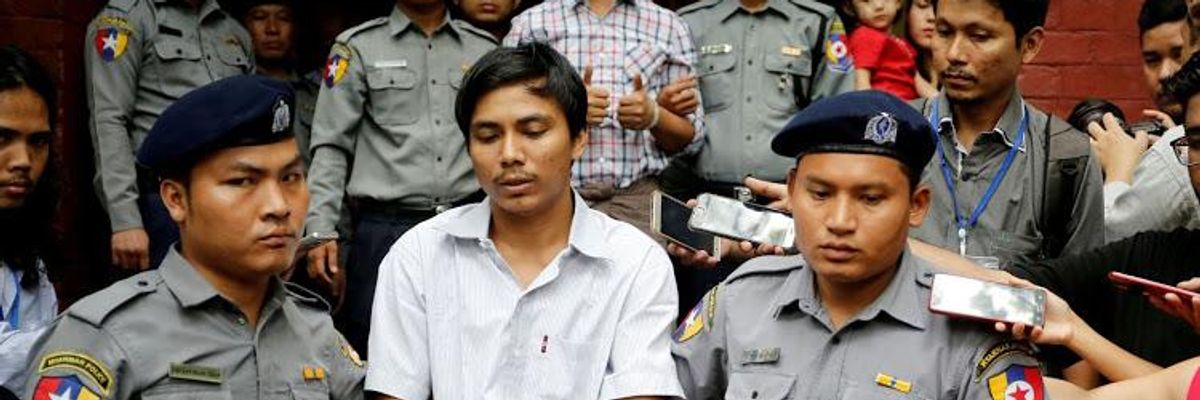
Detained Reuters journalist Kyaw Soe Oo and Wa Lone are escorted by police as they leave after a court hearing in Yangon, Myanmar, in this file photo taken on August 20 2018. (Photo: Reuters/Ann Wang)
For the third consecutive year, the Committee to Project Journalists (CPJ) has documented at least 251 cases of reporters across the globe being jailed for doing their jobs, with more than half imprisoned in Turkey, China, and Egypt after being accused of "anti-governmental activities."
"It looks like a trend now," report author Elana Beiser told Reuters about the near-record numbers. "It looks like the new normal."
"The past three years have recorded the highest number of jailed journalists since CPJ began keeping track, with consecutive records set in 2016 and 2017," the report explains. While the total figure dropped slightly this year, concerns over global crackdowns on press freedom remain high.
"The terrible global assault on journalists that has intensified in the past few years shows no sign of abating. It is unacceptable that 251 journalists are in jail around the world just for covering the news," CPJ executive director Joel Simon said in a statement. "The broader cost is being borne by all those who care about the flow of news and information. The tyrants who use imprisonment to impose censorship cannot be allowed to get away with it."
As the report details:
The majority of those imprisoned globally--70 percent--are facing anti-state charges such as belonging to or aiding groups deemed by authorities as terrorist organizations. The number imprisoned on charges of false news rose to 28 globally, compared with nine just two years ago. Egypt jailed the most journalists on false news charges with 19, followed by Cameroon with four, Rwanda with three, and one each in China and Morocco. The increase comes amid heightened global rhetoric about "fake news," of which U.S. President Donald Trump is the leading voice.
The higher number of prisoners in China--with 47 behind bars--reflects the latest wave of persecution of the Uighur ethnic minority in the Xinjiang region. At least 10 journalists in China were detained without charge, all of them in Xinjiang, where the United Nations has accused Beijing of mass surveillance and detention of up to a million people without trial.
It is worth noting that CPJ's overall figure accounts for the hundreds of journalists imprisoned for reporting around the world, but does not include those who are missing or have been killed.
The release of the report follows TIME magazine on Tuesday naming "the guardians and the war on truth," or journalists jailed and killed for their work, as its Person of the Year. One of the covers features Washington Post columnist Jamal Khashoggi, murdered by a Saudi hit team at the country's consulate in Istanbul. Saudi Arabia ranks fourth on the CPJ's new list, with 16 jailed journalists.
While Turkish President Recep Tayyip Erdogan and other officials have raised alarm about Khashoggi's killing, as Beiser pointed out on Twitter Thursday, Turkey is hardly a protector of press freedom. Erdogan's crackdown has "intensified" since the failed coup in 2016, and with at least 68 journalists imprisoned as of Dec. 1, Turkey is holding more reporters behind bars than any other country on Earth.
Meanwhile, in the United States, "where journalists encountered hostile rhetoric and fatal violence in 2018," the report notes that "although nine were arrested in the course of the year, according to the U.S. Press Freedom Tracker, of which CPJ is a partner," there were none behind bars as of Dec. 1.
However, in line with Trump's hardline immigration policies, it points to at least seven recent cases where U.S. Immigration and Customs Enforcement (ICE) has held foreign journalists seeking asylum due to threats at home "in prolonged detention."
Other key findings highlighted in the report include:
Dear Common Dreams reader, It’s been nearly 30 years since I co-founded Common Dreams with my late wife, Lina Newhouser. We had the radical notion that journalism should serve the public good, not corporate profits. It was clear to us from the outset what it would take to build such a project. No paid advertisements. No corporate sponsors. No millionaire publisher telling us what to think or do. Many people said we wouldn't last a year, but we proved those doubters wrong. Together with a tremendous team of journalists and dedicated staff, we built an independent media outlet free from the constraints of profits and corporate control. Our mission has always been simple: To inform. To inspire. To ignite change for the common good. Building Common Dreams was not easy. Our survival was never guaranteed. When you take on the most powerful forces—Wall Street greed, fossil fuel industry destruction, Big Tech lobbyists, and uber-rich oligarchs who have spent billions upon billions rigging the economy and democracy in their favor—the only bulwark you have is supporters who believe in your work. But here’s the urgent message from me today. It's never been this bad out there. And it's never been this hard to keep us going. At the very moment Common Dreams is most needed, the threats we face are intensifying. We need your support now more than ever. We don't accept corporate advertising and never will. We don't have a paywall because we don't think people should be blocked from critical news based on their ability to pay. Everything we do is funded by the donations of readers like you. When everyone does the little they can afford, we are strong. But if that support retreats or dries up, so do we. Will you donate now to make sure Common Dreams not only survives but thrives? —Craig Brown, Co-founder |
For the third consecutive year, the Committee to Project Journalists (CPJ) has documented at least 251 cases of reporters across the globe being jailed for doing their jobs, with more than half imprisoned in Turkey, China, and Egypt after being accused of "anti-governmental activities."
"It looks like a trend now," report author Elana Beiser told Reuters about the near-record numbers. "It looks like the new normal."
"The past three years have recorded the highest number of jailed journalists since CPJ began keeping track, with consecutive records set in 2016 and 2017," the report explains. While the total figure dropped slightly this year, concerns over global crackdowns on press freedom remain high.
"The terrible global assault on journalists that has intensified in the past few years shows no sign of abating. It is unacceptable that 251 journalists are in jail around the world just for covering the news," CPJ executive director Joel Simon said in a statement. "The broader cost is being borne by all those who care about the flow of news and information. The tyrants who use imprisonment to impose censorship cannot be allowed to get away with it."
As the report details:
The majority of those imprisoned globally--70 percent--are facing anti-state charges such as belonging to or aiding groups deemed by authorities as terrorist organizations. The number imprisoned on charges of false news rose to 28 globally, compared with nine just two years ago. Egypt jailed the most journalists on false news charges with 19, followed by Cameroon with four, Rwanda with three, and one each in China and Morocco. The increase comes amid heightened global rhetoric about "fake news," of which U.S. President Donald Trump is the leading voice.
The higher number of prisoners in China--with 47 behind bars--reflects the latest wave of persecution of the Uighur ethnic minority in the Xinjiang region. At least 10 journalists in China were detained without charge, all of them in Xinjiang, where the United Nations has accused Beijing of mass surveillance and detention of up to a million people without trial.
It is worth noting that CPJ's overall figure accounts for the hundreds of journalists imprisoned for reporting around the world, but does not include those who are missing or have been killed.
The release of the report follows TIME magazine on Tuesday naming "the guardians and the war on truth," or journalists jailed and killed for their work, as its Person of the Year. One of the covers features Washington Post columnist Jamal Khashoggi, murdered by a Saudi hit team at the country's consulate in Istanbul. Saudi Arabia ranks fourth on the CPJ's new list, with 16 jailed journalists.
While Turkish President Recep Tayyip Erdogan and other officials have raised alarm about Khashoggi's killing, as Beiser pointed out on Twitter Thursday, Turkey is hardly a protector of press freedom. Erdogan's crackdown has "intensified" since the failed coup in 2016, and with at least 68 journalists imprisoned as of Dec. 1, Turkey is holding more reporters behind bars than any other country on Earth.
Meanwhile, in the United States, "where journalists encountered hostile rhetoric and fatal violence in 2018," the report notes that "although nine were arrested in the course of the year, according to the U.S. Press Freedom Tracker, of which CPJ is a partner," there were none behind bars as of Dec. 1.
However, in line with Trump's hardline immigration policies, it points to at least seven recent cases where U.S. Immigration and Customs Enforcement (ICE) has held foreign journalists seeking asylum due to threats at home "in prolonged detention."
Other key findings highlighted in the report include:
For the third consecutive year, the Committee to Project Journalists (CPJ) has documented at least 251 cases of reporters across the globe being jailed for doing their jobs, with more than half imprisoned in Turkey, China, and Egypt after being accused of "anti-governmental activities."
"It looks like a trend now," report author Elana Beiser told Reuters about the near-record numbers. "It looks like the new normal."
"The past three years have recorded the highest number of jailed journalists since CPJ began keeping track, with consecutive records set in 2016 and 2017," the report explains. While the total figure dropped slightly this year, concerns over global crackdowns on press freedom remain high.
"The terrible global assault on journalists that has intensified in the past few years shows no sign of abating. It is unacceptable that 251 journalists are in jail around the world just for covering the news," CPJ executive director Joel Simon said in a statement. "The broader cost is being borne by all those who care about the flow of news and information. The tyrants who use imprisonment to impose censorship cannot be allowed to get away with it."
As the report details:
The majority of those imprisoned globally--70 percent--are facing anti-state charges such as belonging to or aiding groups deemed by authorities as terrorist organizations. The number imprisoned on charges of false news rose to 28 globally, compared with nine just two years ago. Egypt jailed the most journalists on false news charges with 19, followed by Cameroon with four, Rwanda with three, and one each in China and Morocco. The increase comes amid heightened global rhetoric about "fake news," of which U.S. President Donald Trump is the leading voice.
The higher number of prisoners in China--with 47 behind bars--reflects the latest wave of persecution of the Uighur ethnic minority in the Xinjiang region. At least 10 journalists in China were detained without charge, all of them in Xinjiang, where the United Nations has accused Beijing of mass surveillance and detention of up to a million people without trial.
It is worth noting that CPJ's overall figure accounts for the hundreds of journalists imprisoned for reporting around the world, but does not include those who are missing or have been killed.
The release of the report follows TIME magazine on Tuesday naming "the guardians and the war on truth," or journalists jailed and killed for their work, as its Person of the Year. One of the covers features Washington Post columnist Jamal Khashoggi, murdered by a Saudi hit team at the country's consulate in Istanbul. Saudi Arabia ranks fourth on the CPJ's new list, with 16 jailed journalists.
While Turkish President Recep Tayyip Erdogan and other officials have raised alarm about Khashoggi's killing, as Beiser pointed out on Twitter Thursday, Turkey is hardly a protector of press freedom. Erdogan's crackdown has "intensified" since the failed coup in 2016, and with at least 68 journalists imprisoned as of Dec. 1, Turkey is holding more reporters behind bars than any other country on Earth.
Meanwhile, in the United States, "where journalists encountered hostile rhetoric and fatal violence in 2018," the report notes that "although nine were arrested in the course of the year, according to the U.S. Press Freedom Tracker, of which CPJ is a partner," there were none behind bars as of Dec. 1.
However, in line with Trump's hardline immigration policies, it points to at least seven recent cases where U.S. Immigration and Customs Enforcement (ICE) has held foreign journalists seeking asylum due to threats at home "in prolonged detention."
Other key findings highlighted in the report include: