SUBSCRIBE TO OUR FREE NEWSLETTER
Daily news & progressive opinion—funded by the people, not the corporations—delivered straight to your inbox.
5
#000000
#FFFFFF
To donate by check, phone, or other method, see our More Ways to Give page.
Daily news & progressive opinion—funded by the people, not the corporations—delivered straight to your inbox.
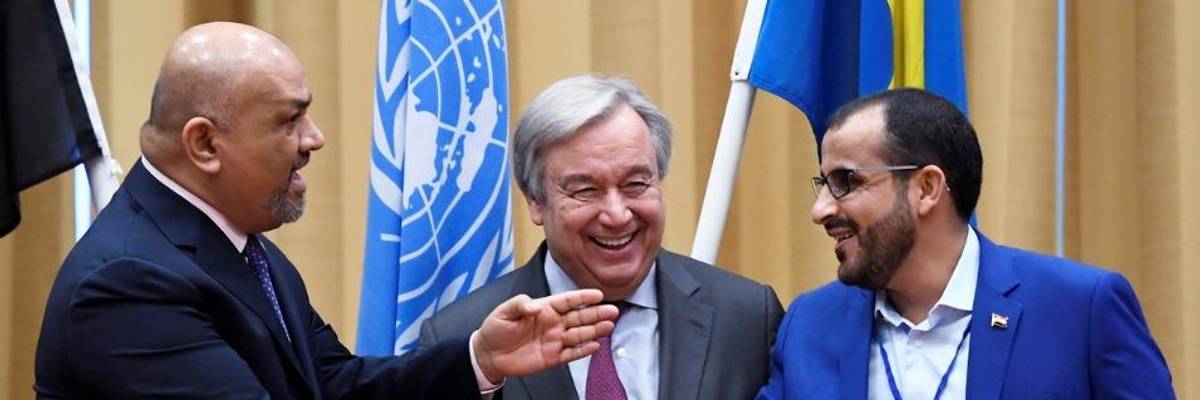
Government representative Khaled Hussein al-Yamani shakes hands with Houthi delegate Mohammed Abdulsalam, as U.N. Secretary General Antonio Guterres watches. (Photo: Pontus Lundahl/TT)
While progressive U.S. lawmakers' efforts to take meaningful action to end American involvement in the Saudi-led assault on Yemen were stymied this week, human rights groups expressed relief that progress was made across the Atlantic in United Nations-led peace talks in Sweden, with both sides of the conflict in Yemen agreeing to an immediate ceasefire in the port city of Hodeidah.
The city, which has been controlled by the Houthis since October 2014, has been the site of numerous bombings since the Saudi-led coalition began its offensive in June. The ceasefire will bring reprieve not only to the two million Yemenis who live in the city, but for two-thirds of the country's population, who rely on Hodeidah as the key entry point for food, medical supplies, and other aid. All troops from both sides of the conflict are now scheduled to withdraw from the city within 21 days, with further peace talks planned for late January.
The International Rescue Committee (IRC), whose humanitarian workers have been struggling to provide aid in the country, noted that the ceasefire "will have a tangible impact on the crisis in Yemen" and the 14 million Yemenis facing famine. As of November, according to Save the Children, an estimated 85,000 children in the country had starved to death.
"The IRC welcomes the news that Yemen's warring parties have agreed to a ceasefire in the critical port city of Hodeidah," said David Miliband, president of the group. "We, and the people of Yemen, are desperate for its implementation. It is the deeds, not the words of the parties to the conflict that will decide if Yemeni civilians get the relief they deserve--lives remain on the line."
The ceasefire deal was reached just hours before the U.S. Senate voted to approve a resolution to end U.S. military support for the Saudis, who have relied on U.S. weapons, intelligence, and fuel since its assault on Yemen began in 2015.
But with five House Democrats joining the majority of the GOP to pass a measure Tuesday barring Rep. Ro Khanna's (D-Calif.) resolution to end U.S. involvement, the Senate vote was rendered largely symbolic before it took place. House Democrats will not be able to force a vote on the issue until after the New Year.
Humanitarian groups stressed that the international community must take concrete action to help end the suffering of Yemeni civilians. Since the war began, an estimated 10,000 Yemenis have been killed in bombings, while tens of thousands more have died from cholera and diphtheria as epidemics have arisen due to heavily damaged infrastructure and port blockades.
"We call on the international community to strengthen the U.N.'s efforts to end gross violations of international law committed by all parties to the conflict and ensure justice and reparation for victims," said Lynn Maalouf of Amnesty International.
"It is critical that the international community does not lose focus in it efforts to end the war," said Miliband. "Allies of all warring parties, including the U.S., U.K., France, and Iran should continue to apply sustained diplomatic pressure to ensure these agreements are followed and to take meaningful action if violations occur."
The IRC also outlined the steps that must be taken at future Yemen talks, calling for a UN-supported ceasefire for the entire country, the opening of the airport in the capital city of Sana'a, and the payment of public employees' salaries, many of which have not been paid for more than a year amid the chaos.
"Finally, for Yemen to take the next vital steps towards peace, warring parties must be held accountable for commitments to return to the table in January to build on the progress made this week," said Miliband.
Dear Common Dreams reader, It’s been nearly 30 years since I co-founded Common Dreams with my late wife, Lina Newhouser. We had the radical notion that journalism should serve the public good, not corporate profits. It was clear to us from the outset what it would take to build such a project. No paid advertisements. No corporate sponsors. No millionaire publisher telling us what to think or do. Many people said we wouldn't last a year, but we proved those doubters wrong. Together with a tremendous team of journalists and dedicated staff, we built an independent media outlet free from the constraints of profits and corporate control. Our mission has always been simple: To inform. To inspire. To ignite change for the common good. Building Common Dreams was not easy. Our survival was never guaranteed. When you take on the most powerful forces—Wall Street greed, fossil fuel industry destruction, Big Tech lobbyists, and uber-rich oligarchs who have spent billions upon billions rigging the economy and democracy in their favor—the only bulwark you have is supporters who believe in your work. But here’s the urgent message from me today. It's never been this bad out there. And it's never been this hard to keep us going. At the very moment Common Dreams is most needed, the threats we face are intensifying. We need your support now more than ever. We don't accept corporate advertising and never will. We don't have a paywall because we don't think people should be blocked from critical news based on their ability to pay. Everything we do is funded by the donations of readers like you. When everyone does the little they can afford, we are strong. But if that support retreats or dries up, so do we. Will you donate now to make sure Common Dreams not only survives but thrives? —Craig Brown, Co-founder |
While progressive U.S. lawmakers' efforts to take meaningful action to end American involvement in the Saudi-led assault on Yemen were stymied this week, human rights groups expressed relief that progress was made across the Atlantic in United Nations-led peace talks in Sweden, with both sides of the conflict in Yemen agreeing to an immediate ceasefire in the port city of Hodeidah.
The city, which has been controlled by the Houthis since October 2014, has been the site of numerous bombings since the Saudi-led coalition began its offensive in June. The ceasefire will bring reprieve not only to the two million Yemenis who live in the city, but for two-thirds of the country's population, who rely on Hodeidah as the key entry point for food, medical supplies, and other aid. All troops from both sides of the conflict are now scheduled to withdraw from the city within 21 days, with further peace talks planned for late January.
The International Rescue Committee (IRC), whose humanitarian workers have been struggling to provide aid in the country, noted that the ceasefire "will have a tangible impact on the crisis in Yemen" and the 14 million Yemenis facing famine. As of November, according to Save the Children, an estimated 85,000 children in the country had starved to death.
"The IRC welcomes the news that Yemen's warring parties have agreed to a ceasefire in the critical port city of Hodeidah," said David Miliband, president of the group. "We, and the people of Yemen, are desperate for its implementation. It is the deeds, not the words of the parties to the conflict that will decide if Yemeni civilians get the relief they deserve--lives remain on the line."
The ceasefire deal was reached just hours before the U.S. Senate voted to approve a resolution to end U.S. military support for the Saudis, who have relied on U.S. weapons, intelligence, and fuel since its assault on Yemen began in 2015.
But with five House Democrats joining the majority of the GOP to pass a measure Tuesday barring Rep. Ro Khanna's (D-Calif.) resolution to end U.S. involvement, the Senate vote was rendered largely symbolic before it took place. House Democrats will not be able to force a vote on the issue until after the New Year.
Humanitarian groups stressed that the international community must take concrete action to help end the suffering of Yemeni civilians. Since the war began, an estimated 10,000 Yemenis have been killed in bombings, while tens of thousands more have died from cholera and diphtheria as epidemics have arisen due to heavily damaged infrastructure and port blockades.
"We call on the international community to strengthen the U.N.'s efforts to end gross violations of international law committed by all parties to the conflict and ensure justice and reparation for victims," said Lynn Maalouf of Amnesty International.
"It is critical that the international community does not lose focus in it efforts to end the war," said Miliband. "Allies of all warring parties, including the U.S., U.K., France, and Iran should continue to apply sustained diplomatic pressure to ensure these agreements are followed and to take meaningful action if violations occur."
The IRC also outlined the steps that must be taken at future Yemen talks, calling for a UN-supported ceasefire for the entire country, the opening of the airport in the capital city of Sana'a, and the payment of public employees' salaries, many of which have not been paid for more than a year amid the chaos.
"Finally, for Yemen to take the next vital steps towards peace, warring parties must be held accountable for commitments to return to the table in January to build on the progress made this week," said Miliband.
While progressive U.S. lawmakers' efforts to take meaningful action to end American involvement in the Saudi-led assault on Yemen were stymied this week, human rights groups expressed relief that progress was made across the Atlantic in United Nations-led peace talks in Sweden, with both sides of the conflict in Yemen agreeing to an immediate ceasefire in the port city of Hodeidah.
The city, which has been controlled by the Houthis since October 2014, has been the site of numerous bombings since the Saudi-led coalition began its offensive in June. The ceasefire will bring reprieve not only to the two million Yemenis who live in the city, but for two-thirds of the country's population, who rely on Hodeidah as the key entry point for food, medical supplies, and other aid. All troops from both sides of the conflict are now scheduled to withdraw from the city within 21 days, with further peace talks planned for late January.
The International Rescue Committee (IRC), whose humanitarian workers have been struggling to provide aid in the country, noted that the ceasefire "will have a tangible impact on the crisis in Yemen" and the 14 million Yemenis facing famine. As of November, according to Save the Children, an estimated 85,000 children in the country had starved to death.
"The IRC welcomes the news that Yemen's warring parties have agreed to a ceasefire in the critical port city of Hodeidah," said David Miliband, president of the group. "We, and the people of Yemen, are desperate for its implementation. It is the deeds, not the words of the parties to the conflict that will decide if Yemeni civilians get the relief they deserve--lives remain on the line."
The ceasefire deal was reached just hours before the U.S. Senate voted to approve a resolution to end U.S. military support for the Saudis, who have relied on U.S. weapons, intelligence, and fuel since its assault on Yemen began in 2015.
But with five House Democrats joining the majority of the GOP to pass a measure Tuesday barring Rep. Ro Khanna's (D-Calif.) resolution to end U.S. involvement, the Senate vote was rendered largely symbolic before it took place. House Democrats will not be able to force a vote on the issue until after the New Year.
Humanitarian groups stressed that the international community must take concrete action to help end the suffering of Yemeni civilians. Since the war began, an estimated 10,000 Yemenis have been killed in bombings, while tens of thousands more have died from cholera and diphtheria as epidemics have arisen due to heavily damaged infrastructure and port blockades.
"We call on the international community to strengthen the U.N.'s efforts to end gross violations of international law committed by all parties to the conflict and ensure justice and reparation for victims," said Lynn Maalouf of Amnesty International.
"It is critical that the international community does not lose focus in it efforts to end the war," said Miliband. "Allies of all warring parties, including the U.S., U.K., France, and Iran should continue to apply sustained diplomatic pressure to ensure these agreements are followed and to take meaningful action if violations occur."
The IRC also outlined the steps that must be taken at future Yemen talks, calling for a UN-supported ceasefire for the entire country, the opening of the airport in the capital city of Sana'a, and the payment of public employees' salaries, many of which have not been paid for more than a year amid the chaos.
"Finally, for Yemen to take the next vital steps towards peace, warring parties must be held accountable for commitments to return to the table in January to build on the progress made this week," said Miliband.