SUBSCRIBE TO OUR FREE NEWSLETTER
Daily news & progressive opinion—funded by the people, not the corporations—delivered straight to your inbox.
5
#000000
#FFFFFF
To donate by check, phone, or other method, see our More Ways to Give page.
Daily news & progressive opinion—funded by the people, not the corporations—delivered straight to your inbox.
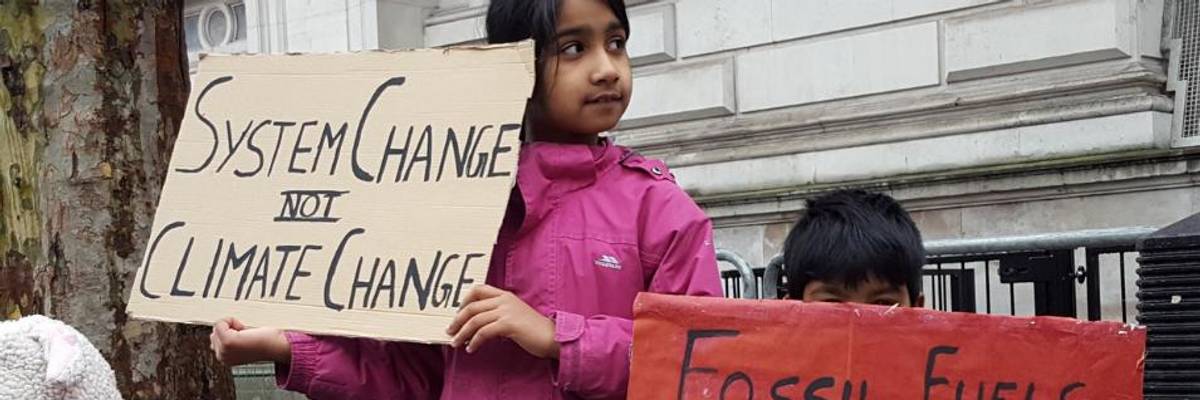
Inspired by the protests of 15-year-old Swedish activist Greta Thunberg, young activists organized strikes in London--and across the globe--on Friday to demand bold climate action. (Photo: Terry Matthews/Extinction Rebellion/Twitter)
Rich countries--and the United States in particular--aren't "paying their fair share" in terms of taking concrete actions to mitigate the global climate crisis, according to an independent review released at the COP24 talks in Poland, where world leaders are discussing how to meet the aims of the Paris agreement.
After Paris: Inequality, Fair Shares, and the Climate Emergency (pdf)--produced by an international coalition of social movements, environmental and development organizations,trade unions, and various other groups--declares that "equity is not a moral or academic nicety, but a practical necessity in meeting the Paris goals."
"The cost of climate transition must ultimately be paid by the people who have the money, this is true both within countries and between them, or billions will suffer."
--Rachel Kennerley, Friends of the Earth
Although the Paris agreement's primary objective--limiting global temperature rise within this century to 1.5degC above pre-industrial levels--"requires profound action in developing countries that cannot realistically, or fairly, be expected without meaningful levels of international support," the report concludes that wealthier countries aren't taking bold enough steps, which will have worldwide implications without a change in course.
These nations--including the United States, the only country on the planet that no longer supports the Paris accord--"must urgently and dramatically deepen their domestic mitigation efforts," the report charges. "If they are to contribute their fair shares to the common effort, they must also support additional actions outside their own borders."
And it's not just the richest nations that are failing. The report, which "draws attention not only to the inequality between countries, but also the inequality within countries, between the rich and the majority poor," also asserts that "if we are to achieve the critical outcome of limiting global temperature rise to 1.5degC, the wealthy (individuals and companies) in all nations must take the greatest action to both reduce their own emissions and to support the global transition."
The report is an indictment not only of the United States--which, under President Donald Trump, has rolled back climate regulations in favor of policies friendly to the fossil fuel industry--but also the European Union and the United Kingdom, which is working toward exiting the E.U. It comes as the latest projections show planet-warming emissions hitting record levels in 2018, largely thanks to the polluting practices of the U.S., E.U., China, and India.
The key takeaway from the analysis is something that's long been emphasized by climate campaigners. As Brandon Wu of ActionAid USA put it, "Unless there is a fair deal that accounts for the legacy of climate change caused by industrialized developed countries, we will never have a sustainable global strategy."
"We have to get some trust back into the process," Wu added, "and that starts with rich countries making much stronger commitments to fix the climate crisis that they, and their wealthiest elites, are largely responsible for creating."
Friends of the Earth climate campaigner Rachel Kennerley concurred.
"The cost of climate transition must ultimately be paid by the people who have the money, this is true both within countries and between them, or billions will suffer," she said. "We have one planet, we can act together now to save it, or be the generation that passively allowed species destruction on a truly terrifying scale."
Dear Common Dreams reader, It’s been nearly 30 years since I co-founded Common Dreams with my late wife, Lina Newhouser. We had the radical notion that journalism should serve the public good, not corporate profits. It was clear to us from the outset what it would take to build such a project. No paid advertisements. No corporate sponsors. No millionaire publisher telling us what to think or do. Many people said we wouldn't last a year, but we proved those doubters wrong. Together with a tremendous team of journalists and dedicated staff, we built an independent media outlet free from the constraints of profits and corporate control. Our mission has always been simple: To inform. To inspire. To ignite change for the common good. Building Common Dreams was not easy. Our survival was never guaranteed. When you take on the most powerful forces—Wall Street greed, fossil fuel industry destruction, Big Tech lobbyists, and uber-rich oligarchs who have spent billions upon billions rigging the economy and democracy in their favor—the only bulwark you have is supporters who believe in your work. But here’s the urgent message from me today. It's never been this bad out there. And it's never been this hard to keep us going. At the very moment Common Dreams is most needed, the threats we face are intensifying. We need your support now more than ever. We don't accept corporate advertising and never will. We don't have a paywall because we don't think people should be blocked from critical news based on their ability to pay. Everything we do is funded by the donations of readers like you. When everyone does the little they can afford, we are strong. But if that support retreats or dries up, so do we. Will you donate now to make sure Common Dreams not only survives but thrives? —Craig Brown, Co-founder |
Rich countries--and the United States in particular--aren't "paying their fair share" in terms of taking concrete actions to mitigate the global climate crisis, according to an independent review released at the COP24 talks in Poland, where world leaders are discussing how to meet the aims of the Paris agreement.
After Paris: Inequality, Fair Shares, and the Climate Emergency (pdf)--produced by an international coalition of social movements, environmental and development organizations,trade unions, and various other groups--declares that "equity is not a moral or academic nicety, but a practical necessity in meeting the Paris goals."
"The cost of climate transition must ultimately be paid by the people who have the money, this is true both within countries and between them, or billions will suffer."
--Rachel Kennerley, Friends of the Earth
Although the Paris agreement's primary objective--limiting global temperature rise within this century to 1.5degC above pre-industrial levels--"requires profound action in developing countries that cannot realistically, or fairly, be expected without meaningful levels of international support," the report concludes that wealthier countries aren't taking bold enough steps, which will have worldwide implications without a change in course.
These nations--including the United States, the only country on the planet that no longer supports the Paris accord--"must urgently and dramatically deepen their domestic mitigation efforts," the report charges. "If they are to contribute their fair shares to the common effort, they must also support additional actions outside their own borders."
And it's not just the richest nations that are failing. The report, which "draws attention not only to the inequality between countries, but also the inequality within countries, between the rich and the majority poor," also asserts that "if we are to achieve the critical outcome of limiting global temperature rise to 1.5degC, the wealthy (individuals and companies) in all nations must take the greatest action to both reduce their own emissions and to support the global transition."
The report is an indictment not only of the United States--which, under President Donald Trump, has rolled back climate regulations in favor of policies friendly to the fossil fuel industry--but also the European Union and the United Kingdom, which is working toward exiting the E.U. It comes as the latest projections show planet-warming emissions hitting record levels in 2018, largely thanks to the polluting practices of the U.S., E.U., China, and India.
The key takeaway from the analysis is something that's long been emphasized by climate campaigners. As Brandon Wu of ActionAid USA put it, "Unless there is a fair deal that accounts for the legacy of climate change caused by industrialized developed countries, we will never have a sustainable global strategy."
"We have to get some trust back into the process," Wu added, "and that starts with rich countries making much stronger commitments to fix the climate crisis that they, and their wealthiest elites, are largely responsible for creating."
Friends of the Earth climate campaigner Rachel Kennerley concurred.
"The cost of climate transition must ultimately be paid by the people who have the money, this is true both within countries and between them, or billions will suffer," she said. "We have one planet, we can act together now to save it, or be the generation that passively allowed species destruction on a truly terrifying scale."
Rich countries--and the United States in particular--aren't "paying their fair share" in terms of taking concrete actions to mitigate the global climate crisis, according to an independent review released at the COP24 talks in Poland, where world leaders are discussing how to meet the aims of the Paris agreement.
After Paris: Inequality, Fair Shares, and the Climate Emergency (pdf)--produced by an international coalition of social movements, environmental and development organizations,trade unions, and various other groups--declares that "equity is not a moral or academic nicety, but a practical necessity in meeting the Paris goals."
"The cost of climate transition must ultimately be paid by the people who have the money, this is true both within countries and between them, or billions will suffer."
--Rachel Kennerley, Friends of the Earth
Although the Paris agreement's primary objective--limiting global temperature rise within this century to 1.5degC above pre-industrial levels--"requires profound action in developing countries that cannot realistically, or fairly, be expected without meaningful levels of international support," the report concludes that wealthier countries aren't taking bold enough steps, which will have worldwide implications without a change in course.
These nations--including the United States, the only country on the planet that no longer supports the Paris accord--"must urgently and dramatically deepen their domestic mitigation efforts," the report charges. "If they are to contribute their fair shares to the common effort, they must also support additional actions outside their own borders."
And it's not just the richest nations that are failing. The report, which "draws attention not only to the inequality between countries, but also the inequality within countries, between the rich and the majority poor," also asserts that "if we are to achieve the critical outcome of limiting global temperature rise to 1.5degC, the wealthy (individuals and companies) in all nations must take the greatest action to both reduce their own emissions and to support the global transition."
The report is an indictment not only of the United States--which, under President Donald Trump, has rolled back climate regulations in favor of policies friendly to the fossil fuel industry--but also the European Union and the United Kingdom, which is working toward exiting the E.U. It comes as the latest projections show planet-warming emissions hitting record levels in 2018, largely thanks to the polluting practices of the U.S., E.U., China, and India.
The key takeaway from the analysis is something that's long been emphasized by climate campaigners. As Brandon Wu of ActionAid USA put it, "Unless there is a fair deal that accounts for the legacy of climate change caused by industrialized developed countries, we will never have a sustainable global strategy."
"We have to get some trust back into the process," Wu added, "and that starts with rich countries making much stronger commitments to fix the climate crisis that they, and their wealthiest elites, are largely responsible for creating."
Friends of the Earth climate campaigner Rachel Kennerley concurred.
"The cost of climate transition must ultimately be paid by the people who have the money, this is true both within countries and between them, or billions will suffer," she said. "We have one planet, we can act together now to save it, or be the generation that passively allowed species destruction on a truly terrifying scale."