SUBSCRIBE TO OUR FREE NEWSLETTER
Daily news & progressive opinion—funded by the people, not the corporations—delivered straight to your inbox.
5
#000000
#FFFFFF
To donate by check, phone, or other method, see our More Ways to Give page.
Daily news & progressive opinion—funded by the people, not the corporations—delivered straight to your inbox.
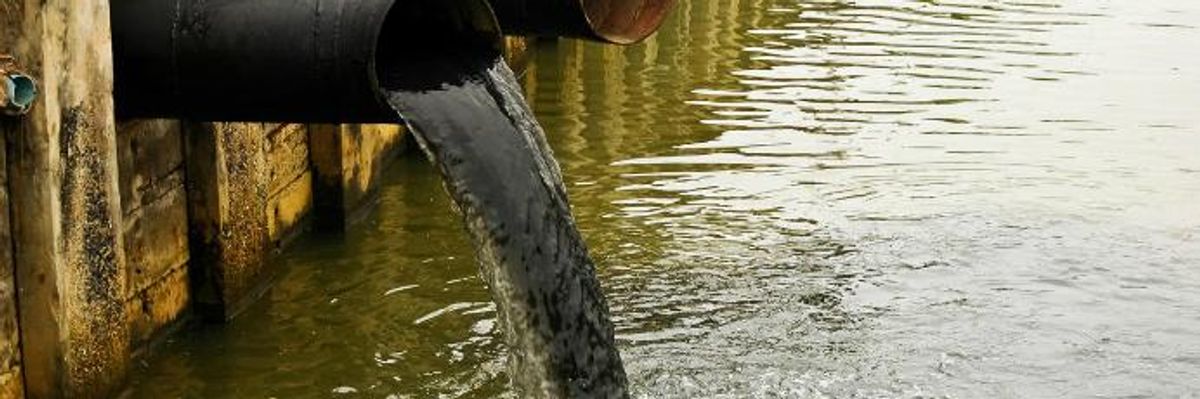
"As a result of the change, an estimated 60-90 percent of U.S. waterways could lose federal protections that currently shield them from pollution and development," The Intercept's Sharon Lerner reported on Friday. (Photo: wonderisland/Shutterstock)
In a move environmentalists are warning will seriously endanger drinking water and wildlife nationwide, President Donald Trump's Environmental Protection Agency (EPA) is reportedly gearing up to hand yet another gift to big polluters by drastically curtailing the number of waterways and wetlands protected under the Clean Water Act.
"The rollback will take us backward. And most people don't remember just how bad that was."
--Daniel Estrin, Waterkeeper Alliance
"As a result of the change, an estimated 60-90 percent of U.S. waterways could lose federal protections that currently shield them from pollution and development," The Intercept's Sharon Lerner reported on Friday, citing an analysis by Public Employees for Environmental Responsibility. "The new Trump administration rule imposes the most substantial restrictions on the Clean Water Act since its passage in 1972."
Brett Hartl, government affairs director at the Center for Biological Diversity, said if the new rule--which is expected to be unveiled on Tuesday--takes effect, corporations will be free to "dump as much crap into" rivers and streams as they want.
"For some parts of the country, it's a complete wiping away of the Clean Water Act," Hartl concluded.
The Obama-era Waters of the U.S. (WOTUS) rule, which the Trump administration has long been aiming to roll back, was designed to limit pollution in most of the nation's large bodies of water in an effort to protect drinking water from contamination.
The Trump EPA is attempting to reinterpret the WOTUS rule in a way that allows oil giants, real estate developers, and golf course owners to freely pollute rivers and streams. Critics have pointed out that Trump's businesses may stand to profit from any weakening of the WOTUS rule.
According to E&E News, which obtained a copy of EPA talking points, the Trump administration's rule "will erase federal protections from streams that flow only following rainfall, as well as wetlands not physically connected to larger waterways."
"The exact number of wetlands and waterways losing federal protections won't be known until the full, detailed proposal is released," E&E News reported on Thursday.
Daniel Estrin, general counsel and advocacy director at Waterkeeper Alliance, argued that the success of the Clean Water Act--while far from complete--has led many to forget how contaminated and visibly polluted the nation's water supply was before the law.
"The rollback will take us backward," Estrin warned of the EPA's proposed rule. "And most people don't remember just how bad that was."
Dear Common Dreams reader, It’s been nearly 30 years since I co-founded Common Dreams with my late wife, Lina Newhouser. We had the radical notion that journalism should serve the public good, not corporate profits. It was clear to us from the outset what it would take to build such a project. No paid advertisements. No corporate sponsors. No millionaire publisher telling us what to think or do. Many people said we wouldn't last a year, but we proved those doubters wrong. Together with a tremendous team of journalists and dedicated staff, we built an independent media outlet free from the constraints of profits and corporate control. Our mission has always been simple: To inform. To inspire. To ignite change for the common good. Building Common Dreams was not easy. Our survival was never guaranteed. When you take on the most powerful forces—Wall Street greed, fossil fuel industry destruction, Big Tech lobbyists, and uber-rich oligarchs who have spent billions upon billions rigging the economy and democracy in their favor—the only bulwark you have is supporters who believe in your work. But here’s the urgent message from me today. It's never been this bad out there. And it's never been this hard to keep us going. At the very moment Common Dreams is most needed, the threats we face are intensifying. We need your support now more than ever. We don't accept corporate advertising and never will. We don't have a paywall because we don't think people should be blocked from critical news based on their ability to pay. Everything we do is funded by the donations of readers like you. When everyone does the little they can afford, we are strong. But if that support retreats or dries up, so do we. Will you donate now to make sure Common Dreams not only survives but thrives? —Craig Brown, Co-founder |
In a move environmentalists are warning will seriously endanger drinking water and wildlife nationwide, President Donald Trump's Environmental Protection Agency (EPA) is reportedly gearing up to hand yet another gift to big polluters by drastically curtailing the number of waterways and wetlands protected under the Clean Water Act.
"The rollback will take us backward. And most people don't remember just how bad that was."
--Daniel Estrin, Waterkeeper Alliance
"As a result of the change, an estimated 60-90 percent of U.S. waterways could lose federal protections that currently shield them from pollution and development," The Intercept's Sharon Lerner reported on Friday, citing an analysis by Public Employees for Environmental Responsibility. "The new Trump administration rule imposes the most substantial restrictions on the Clean Water Act since its passage in 1972."
Brett Hartl, government affairs director at the Center for Biological Diversity, said if the new rule--which is expected to be unveiled on Tuesday--takes effect, corporations will be free to "dump as much crap into" rivers and streams as they want.
"For some parts of the country, it's a complete wiping away of the Clean Water Act," Hartl concluded.
The Obama-era Waters of the U.S. (WOTUS) rule, which the Trump administration has long been aiming to roll back, was designed to limit pollution in most of the nation's large bodies of water in an effort to protect drinking water from contamination.
The Trump EPA is attempting to reinterpret the WOTUS rule in a way that allows oil giants, real estate developers, and golf course owners to freely pollute rivers and streams. Critics have pointed out that Trump's businesses may stand to profit from any weakening of the WOTUS rule.
According to E&E News, which obtained a copy of EPA talking points, the Trump administration's rule "will erase federal protections from streams that flow only following rainfall, as well as wetlands not physically connected to larger waterways."
"The exact number of wetlands and waterways losing federal protections won't be known until the full, detailed proposal is released," E&E News reported on Thursday.
Daniel Estrin, general counsel and advocacy director at Waterkeeper Alliance, argued that the success of the Clean Water Act--while far from complete--has led many to forget how contaminated and visibly polluted the nation's water supply was before the law.
"The rollback will take us backward," Estrin warned of the EPA's proposed rule. "And most people don't remember just how bad that was."
In a move environmentalists are warning will seriously endanger drinking water and wildlife nationwide, President Donald Trump's Environmental Protection Agency (EPA) is reportedly gearing up to hand yet another gift to big polluters by drastically curtailing the number of waterways and wetlands protected under the Clean Water Act.
"The rollback will take us backward. And most people don't remember just how bad that was."
--Daniel Estrin, Waterkeeper Alliance
"As a result of the change, an estimated 60-90 percent of U.S. waterways could lose federal protections that currently shield them from pollution and development," The Intercept's Sharon Lerner reported on Friday, citing an analysis by Public Employees for Environmental Responsibility. "The new Trump administration rule imposes the most substantial restrictions on the Clean Water Act since its passage in 1972."
Brett Hartl, government affairs director at the Center for Biological Diversity, said if the new rule--which is expected to be unveiled on Tuesday--takes effect, corporations will be free to "dump as much crap into" rivers and streams as they want.
"For some parts of the country, it's a complete wiping away of the Clean Water Act," Hartl concluded.
The Obama-era Waters of the U.S. (WOTUS) rule, which the Trump administration has long been aiming to roll back, was designed to limit pollution in most of the nation's large bodies of water in an effort to protect drinking water from contamination.
The Trump EPA is attempting to reinterpret the WOTUS rule in a way that allows oil giants, real estate developers, and golf course owners to freely pollute rivers and streams. Critics have pointed out that Trump's businesses may stand to profit from any weakening of the WOTUS rule.
According to E&E News, which obtained a copy of EPA talking points, the Trump administration's rule "will erase federal protections from streams that flow only following rainfall, as well as wetlands not physically connected to larger waterways."
"The exact number of wetlands and waterways losing federal protections won't be known until the full, detailed proposal is released," E&E News reported on Thursday.
Daniel Estrin, general counsel and advocacy director at Waterkeeper Alliance, argued that the success of the Clean Water Act--while far from complete--has led many to forget how contaminated and visibly polluted the nation's water supply was before the law.
"The rollback will take us backward," Estrin warned of the EPA's proposed rule. "And most people don't remember just how bad that was."