SUBSCRIBE TO OUR FREE NEWSLETTER
Daily news & progressive opinion—funded by the people, not the corporations—delivered straight to your inbox.
5
#000000
#FFFFFF
To donate by check, phone, or other method, see our More Ways to Give page.
Daily news & progressive opinion—funded by the people, not the corporations—delivered straight to your inbox.
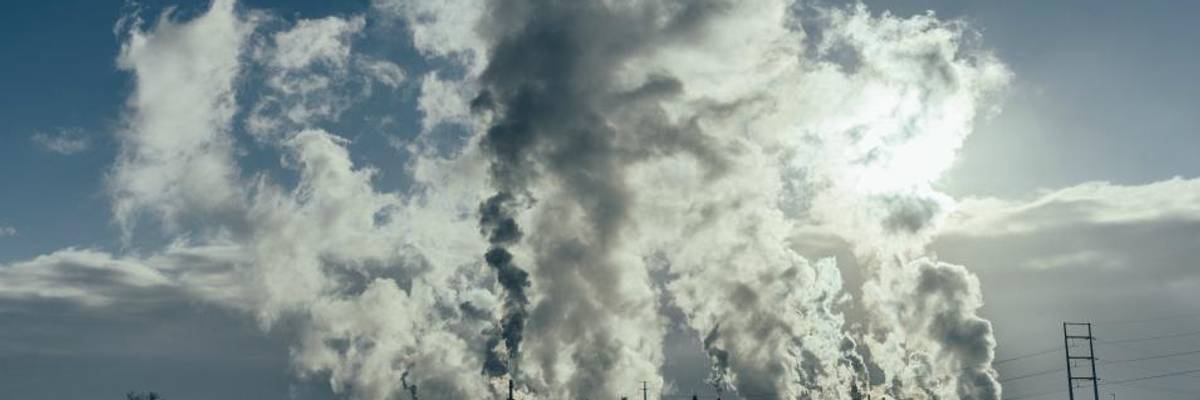
Atmospheric concentrations of planet-warming gases have hit record highs, according to a leading U.N. climate agency. (Photo: Tony Webster/Flickr/cc)
As communities most impacted by the climate crisis ramp up demands for urgent global action, atmospheric concentrations of the top three greenhouse gases driving global warming have hit record high levels, according to the World Meteorological Organization (WMO) out Thursday.
"Without rapid cuts in CO2 and other greenhouse gases, climate change will have increasingly destructive and irreversible impacts on life on Earth."
--Petteri Taalas, WMO secretary-general
Last year, as the latest WMO Greenhouse Gas Bulletin (pdf) details, average concentrations of carbon dioxide, methane, and nitrous oxide all rose--with CO2 hitting 405.5 parts per million (ppm), its highest level in a few million years.
The report also noted that there was a "resurgence of a potent greenhouse gas and ozone-depleting substance"--called trichlorofluoromethane, or CFC-11--likely tied to "increased emissions associated with production of CFC-11 in eastern Asia."
"The last time the Earth experienced a comparable concentration of CO2 was 3-5 million years ago, when the temperature was 2-3degC warmer and sea level was 10-20 meters higher than now," said Petteri Taalas, secretary-general of WMO, a climate-focused United Nations agency.
"The science is clear," he added. "Without rapid cuts in CO2 and other greenhouse gases, climate change will have increasingly destructive and irreversible impacts on life on Earth. The window of opportunity for action is almost closed."
The concentration of carbon dioxide has scientists especially worried, because it sticks around for so long. "CO2 remains in the atmosphere for hundreds of years and in the oceans for even longer," explained WMO deputy secretary-general Elena Manaenkova--and "there is currently no magic wand to remove all the excess CO2 from the atmosphere."
While scientists the world over are working on ways to curb emissions and address the planet-warming gases already in the atmosphere, the record-breaking figures have heightened their alarm. As a WMO statement pointed out, "there is no sign of a reversal in this trend, which is driving long-term climate change, sea level rise, ocean acidification, and more extreme weather."
The WMO findings come on the heels a recent report from the Intergovernmental Panel on Climate Change (IPCC) that emphasized the need for "rapid, far-reaching, and unprecedented" action to avert a human-caused climate catastrophe.
That report, which examined what the planet could look like if the global temperature rises to 1.5degC versus 2degC above pre-industrial levels, "shows that deep and rapid reductions of emissions of carbon dioxide and other greenhouse gases will be needed in all sectors of society and the economy," said IPCC chair Hoesung Lee.
"The WMO Greenhouse Gas Bulletin, showing a continuing rising trend in concentrations of greenhouse gases," he concluded, "underlines just how urgent these emissions reductions are."
Dear Common Dreams reader, It’s been nearly 30 years since I co-founded Common Dreams with my late wife, Lina Newhouser. We had the radical notion that journalism should serve the public good, not corporate profits. It was clear to us from the outset what it would take to build such a project. No paid advertisements. No corporate sponsors. No millionaire publisher telling us what to think or do. Many people said we wouldn't last a year, but we proved those doubters wrong. Together with a tremendous team of journalists and dedicated staff, we built an independent media outlet free from the constraints of profits and corporate control. Our mission has always been simple: To inform. To inspire. To ignite change for the common good. Building Common Dreams was not easy. Our survival was never guaranteed. When you take on the most powerful forces—Wall Street greed, fossil fuel industry destruction, Big Tech lobbyists, and uber-rich oligarchs who have spent billions upon billions rigging the economy and democracy in their favor—the only bulwark you have is supporters who believe in your work. But here’s the urgent message from me today. It's never been this bad out there. And it's never been this hard to keep us going. At the very moment Common Dreams is most needed, the threats we face are intensifying. We need your support now more than ever. We don't accept corporate advertising and never will. We don't have a paywall because we don't think people should be blocked from critical news based on their ability to pay. Everything we do is funded by the donations of readers like you. When everyone does the little they can afford, we are strong. But if that support retreats or dries up, so do we. Will you donate now to make sure Common Dreams not only survives but thrives? —Craig Brown, Co-founder |
As communities most impacted by the climate crisis ramp up demands for urgent global action, atmospheric concentrations of the top three greenhouse gases driving global warming have hit record high levels, according to the World Meteorological Organization (WMO) out Thursday.
"Without rapid cuts in CO2 and other greenhouse gases, climate change will have increasingly destructive and irreversible impacts on life on Earth."
--Petteri Taalas, WMO secretary-general
Last year, as the latest WMO Greenhouse Gas Bulletin (pdf) details, average concentrations of carbon dioxide, methane, and nitrous oxide all rose--with CO2 hitting 405.5 parts per million (ppm), its highest level in a few million years.
The report also noted that there was a "resurgence of a potent greenhouse gas and ozone-depleting substance"--called trichlorofluoromethane, or CFC-11--likely tied to "increased emissions associated with production of CFC-11 in eastern Asia."
"The last time the Earth experienced a comparable concentration of CO2 was 3-5 million years ago, when the temperature was 2-3degC warmer and sea level was 10-20 meters higher than now," said Petteri Taalas, secretary-general of WMO, a climate-focused United Nations agency.
"The science is clear," he added. "Without rapid cuts in CO2 and other greenhouse gases, climate change will have increasingly destructive and irreversible impacts on life on Earth. The window of opportunity for action is almost closed."
The concentration of carbon dioxide has scientists especially worried, because it sticks around for so long. "CO2 remains in the atmosphere for hundreds of years and in the oceans for even longer," explained WMO deputy secretary-general Elena Manaenkova--and "there is currently no magic wand to remove all the excess CO2 from the atmosphere."
While scientists the world over are working on ways to curb emissions and address the planet-warming gases already in the atmosphere, the record-breaking figures have heightened their alarm. As a WMO statement pointed out, "there is no sign of a reversal in this trend, which is driving long-term climate change, sea level rise, ocean acidification, and more extreme weather."
The WMO findings come on the heels a recent report from the Intergovernmental Panel on Climate Change (IPCC) that emphasized the need for "rapid, far-reaching, and unprecedented" action to avert a human-caused climate catastrophe.
That report, which examined what the planet could look like if the global temperature rises to 1.5degC versus 2degC above pre-industrial levels, "shows that deep and rapid reductions of emissions of carbon dioxide and other greenhouse gases will be needed in all sectors of society and the economy," said IPCC chair Hoesung Lee.
"The WMO Greenhouse Gas Bulletin, showing a continuing rising trend in concentrations of greenhouse gases," he concluded, "underlines just how urgent these emissions reductions are."
As communities most impacted by the climate crisis ramp up demands for urgent global action, atmospheric concentrations of the top three greenhouse gases driving global warming have hit record high levels, according to the World Meteorological Organization (WMO) out Thursday.
"Without rapid cuts in CO2 and other greenhouse gases, climate change will have increasingly destructive and irreversible impacts on life on Earth."
--Petteri Taalas, WMO secretary-general
Last year, as the latest WMO Greenhouse Gas Bulletin (pdf) details, average concentrations of carbon dioxide, methane, and nitrous oxide all rose--with CO2 hitting 405.5 parts per million (ppm), its highest level in a few million years.
The report also noted that there was a "resurgence of a potent greenhouse gas and ozone-depleting substance"--called trichlorofluoromethane, or CFC-11--likely tied to "increased emissions associated with production of CFC-11 in eastern Asia."
"The last time the Earth experienced a comparable concentration of CO2 was 3-5 million years ago, when the temperature was 2-3degC warmer and sea level was 10-20 meters higher than now," said Petteri Taalas, secretary-general of WMO, a climate-focused United Nations agency.
"The science is clear," he added. "Without rapid cuts in CO2 and other greenhouse gases, climate change will have increasingly destructive and irreversible impacts on life on Earth. The window of opportunity for action is almost closed."
The concentration of carbon dioxide has scientists especially worried, because it sticks around for so long. "CO2 remains in the atmosphere for hundreds of years and in the oceans for even longer," explained WMO deputy secretary-general Elena Manaenkova--and "there is currently no magic wand to remove all the excess CO2 from the atmosphere."
While scientists the world over are working on ways to curb emissions and address the planet-warming gases already in the atmosphere, the record-breaking figures have heightened their alarm. As a WMO statement pointed out, "there is no sign of a reversal in this trend, which is driving long-term climate change, sea level rise, ocean acidification, and more extreme weather."
The WMO findings come on the heels a recent report from the Intergovernmental Panel on Climate Change (IPCC) that emphasized the need for "rapid, far-reaching, and unprecedented" action to avert a human-caused climate catastrophe.
That report, which examined what the planet could look like if the global temperature rises to 1.5degC versus 2degC above pre-industrial levels, "shows that deep and rapid reductions of emissions of carbon dioxide and other greenhouse gases will be needed in all sectors of society and the economy," said IPCC chair Hoesung Lee.
"The WMO Greenhouse Gas Bulletin, showing a continuing rising trend in concentrations of greenhouse gases," he concluded, "underlines just how urgent these emissions reductions are."