SUBSCRIBE TO OUR FREE NEWSLETTER
Daily news & progressive opinion—funded by the people, not the corporations—delivered straight to your inbox.
5
#000000
#FFFFFF
To donate by check, phone, or other method, see our More Ways to Give page.
Daily news & progressive opinion—funded by the people, not the corporations—delivered straight to your inbox.
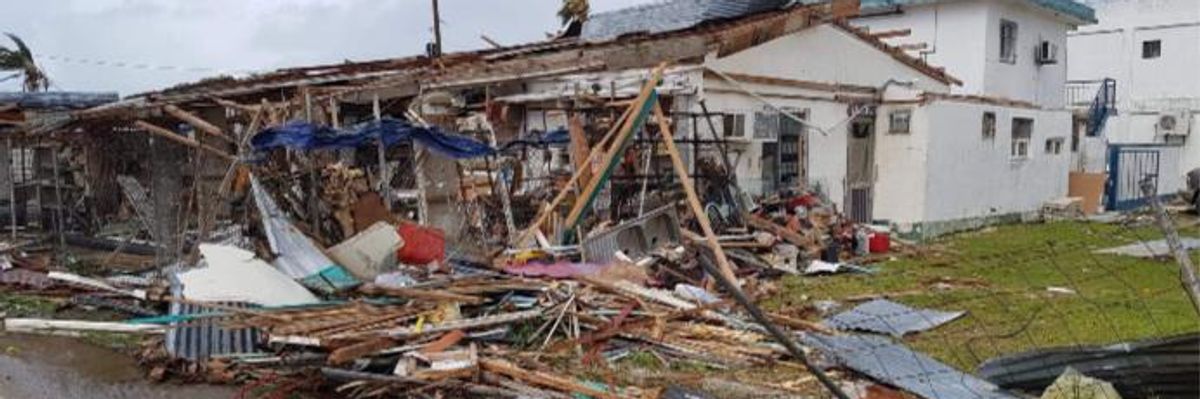
Super Typhoon Yutu, comparable to a Category 5 hurricane, has devastated the Northern Mariana Islands, a U.S. commonwealth. (Photo: Haidee Eugenio/Twitter)
As climate experts around the world warn how anthropogenic global warming will continue to make extreme weather worse, the "catastrophic" Super Typhoon Yutu has left the Northern Mariana Islands, a U.S. commonwealth in the Pacific Ocean, "mangled," as one local official described the devastation.
"There's a lot of damage and destruction. It's like a small war just passed through."
--Congressman Gregorio Kilili Camacho Sablan
The powerful storm struck overnight, with the eye of the storm passing over the island Tinian around 2 a.m. local time on Thursday, and brought with it 20-foot waves and 180mph winds--meaning the typhoon was comparable to a Category 5 hurricane. At least one person was killed.
"Tinian has been devastated by Typhoon Yutu," Mayor Joey P. San Nicolas told USA Today. "The homes, main roads have been destroyed. Our critical infrastructure has been compromised. We currently have no power and water. Our ports at this time are inaccessible and several points within the island are inaccessible."
San Nicolas added that the island's "power distribution system is completely destroyed."
"There's a lot of damage and destruction," said Gregorio Kilili Camacho Sablan, the commonwealth's non-voting delegate to the U.S. Congress. "It's like a small war just passed through."
Gov. Ralph Deleon Guerrero Torres has requested immediate humanitarian aid from the Federal Emergency Management Agency, or FEMA, in the form of "food, water, cots, toilet kits, tarps, and temporary shelter resources," according to a statement from the governor's office that Sablan posted to Facebook.
Democratic Rep. Barbara Lee of California, in a tweet, called on Congress to ensure that the agency provides adequate relief to the islands--especially given that FEMA, and the Trump administration more broadly, failed to do so after Hurricane Maria ravaged Puerto Rico last year.
Edwin K. Propst, a representative in the commonwealth's Legislature, spent a sleepless night at home with his family on Saipan, according to the New York Times. "Last night, it was like a freight train and a 747 were racing, and you're right in between them," he told the newspaper on Thursday.
After the typhoon passed, Propst visited "several constituents who lost it all... Their homes, their valuables, their prized possessions." He doesn't expect electricity to return to the territory for several months. "We really need help," he said. "Our island has been flattened. It's one of the worst typhoons we've seen in a very, very long time."
The super typhoon was the strongest storm to strike U.S. soil since 1935, and the fifth most powerful storm ever recorded, according to Weather Underground. Seven of the world's top 10 have occurred in just the past 12 years.
Beyond its devastating wind speeds, this storm is also notable because of the rate at which it became so powerful. As Vox explained:
Yutu very quickly intensified, transforming from a tropical storm to a massive dangerous typhoon in just two days. Atmospheric scientists suspect that in a warming world, rapid intensification of storms will become more common, fueled by increased sea temperatures.
Rapid intensification is very dangerous, because it can catch coastal communities off guard. Recall Hurricane Michael, which devastated Florida's panhandle, also rapidly intensified from a Category 2 to a Category 5 in a day. Hurricane Willa, which impacted Mexico this week, also rapidly intensified from 40 mph winds to 160 mph winds in just two days. (Overall, forecasting hurricane intensity is hard, and scientists don't perfectly understand the mechanisms that lead to rapid intensification.) These rapidly intensifying tropical cyclones may be a sign of the world to come.
After pummeling the Northern Mariana Islands, Yutu charged across the Pacific toward the Philippines, Japan, and Taiwan.
Dear Common Dreams reader, It’s been nearly 30 years since I co-founded Common Dreams with my late wife, Lina Newhouser. We had the radical notion that journalism should serve the public good, not corporate profits. It was clear to us from the outset what it would take to build such a project. No paid advertisements. No corporate sponsors. No millionaire publisher telling us what to think or do. Many people said we wouldn't last a year, but we proved those doubters wrong. Together with a tremendous team of journalists and dedicated staff, we built an independent media outlet free from the constraints of profits and corporate control. Our mission has always been simple: To inform. To inspire. To ignite change for the common good. Building Common Dreams was not easy. Our survival was never guaranteed. When you take on the most powerful forces—Wall Street greed, fossil fuel industry destruction, Big Tech lobbyists, and uber-rich oligarchs who have spent billions upon billions rigging the economy and democracy in their favor—the only bulwark you have is supporters who believe in your work. But here’s the urgent message from me today. It's never been this bad out there. And it's never been this hard to keep us going. At the very moment Common Dreams is most needed, the threats we face are intensifying. We need your support now more than ever. We don't accept corporate advertising and never will. We don't have a paywall because we don't think people should be blocked from critical news based on their ability to pay. Everything we do is funded by the donations of readers like you. When everyone does the little they can afford, we are strong. But if that support retreats or dries up, so do we. Will you donate now to make sure Common Dreams not only survives but thrives? —Craig Brown, Co-founder |
As climate experts around the world warn how anthropogenic global warming will continue to make extreme weather worse, the "catastrophic" Super Typhoon Yutu has left the Northern Mariana Islands, a U.S. commonwealth in the Pacific Ocean, "mangled," as one local official described the devastation.
"There's a lot of damage and destruction. It's like a small war just passed through."
--Congressman Gregorio Kilili Camacho Sablan
The powerful storm struck overnight, with the eye of the storm passing over the island Tinian around 2 a.m. local time on Thursday, and brought with it 20-foot waves and 180mph winds--meaning the typhoon was comparable to a Category 5 hurricane. At least one person was killed.
"Tinian has been devastated by Typhoon Yutu," Mayor Joey P. San Nicolas told USA Today. "The homes, main roads have been destroyed. Our critical infrastructure has been compromised. We currently have no power and water. Our ports at this time are inaccessible and several points within the island are inaccessible."
San Nicolas added that the island's "power distribution system is completely destroyed."
"There's a lot of damage and destruction," said Gregorio Kilili Camacho Sablan, the commonwealth's non-voting delegate to the U.S. Congress. "It's like a small war just passed through."
Gov. Ralph Deleon Guerrero Torres has requested immediate humanitarian aid from the Federal Emergency Management Agency, or FEMA, in the form of "food, water, cots, toilet kits, tarps, and temporary shelter resources," according to a statement from the governor's office that Sablan posted to Facebook.
Democratic Rep. Barbara Lee of California, in a tweet, called on Congress to ensure that the agency provides adequate relief to the islands--especially given that FEMA, and the Trump administration more broadly, failed to do so after Hurricane Maria ravaged Puerto Rico last year.
Edwin K. Propst, a representative in the commonwealth's Legislature, spent a sleepless night at home with his family on Saipan, according to the New York Times. "Last night, it was like a freight train and a 747 were racing, and you're right in between them," he told the newspaper on Thursday.
After the typhoon passed, Propst visited "several constituents who lost it all... Their homes, their valuables, their prized possessions." He doesn't expect electricity to return to the territory for several months. "We really need help," he said. "Our island has been flattened. It's one of the worst typhoons we've seen in a very, very long time."
The super typhoon was the strongest storm to strike U.S. soil since 1935, and the fifth most powerful storm ever recorded, according to Weather Underground. Seven of the world's top 10 have occurred in just the past 12 years.
Beyond its devastating wind speeds, this storm is also notable because of the rate at which it became so powerful. As Vox explained:
Yutu very quickly intensified, transforming from a tropical storm to a massive dangerous typhoon in just two days. Atmospheric scientists suspect that in a warming world, rapid intensification of storms will become more common, fueled by increased sea temperatures.
Rapid intensification is very dangerous, because it can catch coastal communities off guard. Recall Hurricane Michael, which devastated Florida's panhandle, also rapidly intensified from a Category 2 to a Category 5 in a day. Hurricane Willa, which impacted Mexico this week, also rapidly intensified from 40 mph winds to 160 mph winds in just two days. (Overall, forecasting hurricane intensity is hard, and scientists don't perfectly understand the mechanisms that lead to rapid intensification.) These rapidly intensifying tropical cyclones may be a sign of the world to come.
After pummeling the Northern Mariana Islands, Yutu charged across the Pacific toward the Philippines, Japan, and Taiwan.
As climate experts around the world warn how anthropogenic global warming will continue to make extreme weather worse, the "catastrophic" Super Typhoon Yutu has left the Northern Mariana Islands, a U.S. commonwealth in the Pacific Ocean, "mangled," as one local official described the devastation.
"There's a lot of damage and destruction. It's like a small war just passed through."
--Congressman Gregorio Kilili Camacho Sablan
The powerful storm struck overnight, with the eye of the storm passing over the island Tinian around 2 a.m. local time on Thursday, and brought with it 20-foot waves and 180mph winds--meaning the typhoon was comparable to a Category 5 hurricane. At least one person was killed.
"Tinian has been devastated by Typhoon Yutu," Mayor Joey P. San Nicolas told USA Today. "The homes, main roads have been destroyed. Our critical infrastructure has been compromised. We currently have no power and water. Our ports at this time are inaccessible and several points within the island are inaccessible."
San Nicolas added that the island's "power distribution system is completely destroyed."
"There's a lot of damage and destruction," said Gregorio Kilili Camacho Sablan, the commonwealth's non-voting delegate to the U.S. Congress. "It's like a small war just passed through."
Gov. Ralph Deleon Guerrero Torres has requested immediate humanitarian aid from the Federal Emergency Management Agency, or FEMA, in the form of "food, water, cots, toilet kits, tarps, and temporary shelter resources," according to a statement from the governor's office that Sablan posted to Facebook.
Democratic Rep. Barbara Lee of California, in a tweet, called on Congress to ensure that the agency provides adequate relief to the islands--especially given that FEMA, and the Trump administration more broadly, failed to do so after Hurricane Maria ravaged Puerto Rico last year.
Edwin K. Propst, a representative in the commonwealth's Legislature, spent a sleepless night at home with his family on Saipan, according to the New York Times. "Last night, it was like a freight train and a 747 were racing, and you're right in between them," he told the newspaper on Thursday.
After the typhoon passed, Propst visited "several constituents who lost it all... Their homes, their valuables, their prized possessions." He doesn't expect electricity to return to the territory for several months. "We really need help," he said. "Our island has been flattened. It's one of the worst typhoons we've seen in a very, very long time."
The super typhoon was the strongest storm to strike U.S. soil since 1935, and the fifth most powerful storm ever recorded, according to Weather Underground. Seven of the world's top 10 have occurred in just the past 12 years.
Beyond its devastating wind speeds, this storm is also notable because of the rate at which it became so powerful. As Vox explained:
Yutu very quickly intensified, transforming from a tropical storm to a massive dangerous typhoon in just two days. Atmospheric scientists suspect that in a warming world, rapid intensification of storms will become more common, fueled by increased sea temperatures.
Rapid intensification is very dangerous, because it can catch coastal communities off guard. Recall Hurricane Michael, which devastated Florida's panhandle, also rapidly intensified from a Category 2 to a Category 5 in a day. Hurricane Willa, which impacted Mexico this week, also rapidly intensified from 40 mph winds to 160 mph winds in just two days. (Overall, forecasting hurricane intensity is hard, and scientists don't perfectly understand the mechanisms that lead to rapid intensification.) These rapidly intensifying tropical cyclones may be a sign of the world to come.
After pummeling the Northern Mariana Islands, Yutu charged across the Pacific toward the Philippines, Japan, and Taiwan.