SUBSCRIBE TO OUR FREE NEWSLETTER
Daily news & progressive opinion—funded by the people, not the corporations—delivered straight to your inbox.
5
#000000
#FFFFFF
To donate by check, phone, or other method, see our More Ways to Give page.
Daily news & progressive opinion—funded by the people, not the corporations—delivered straight to your inbox.
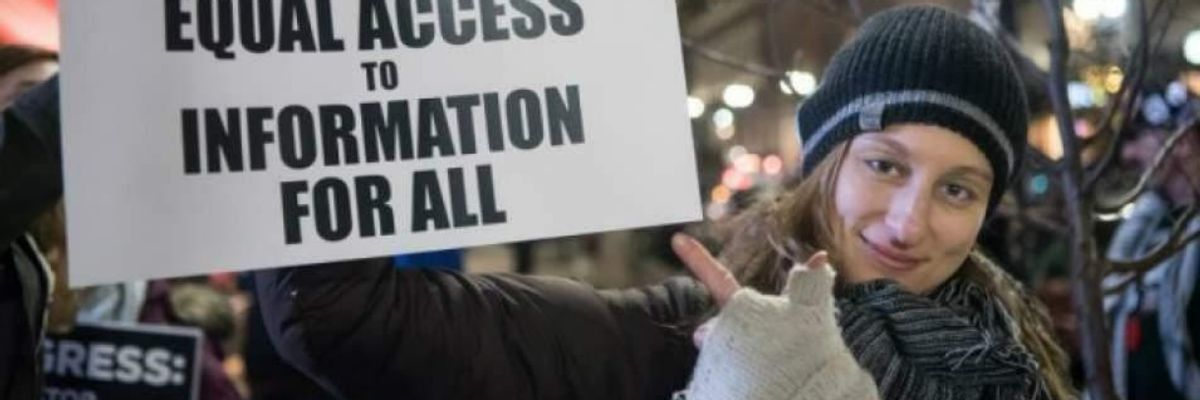
The Federal Communication Commission's December decision to roll back net neutrality rules provoked widespread protests. (Photo: Tim Carter/Flickr/cc)
New York law enforcement officials this week issued subpoenas to more than a dozen pro-telecom industry groups as part of an investigation into millions of allegedly fraudulent public comments submitted to the Federal Communications Commission's (FCC) website last year as the agency was preparing to repeal net neutrality protections.
"With the fog of fraud and spam lifted from the comment corpus, lawmakers and their staff, journalists, interested citizens, and policymakers can...better understand what Americans actually said about the repeal of net neutrality protection." --Ryan Singel, Stanford University
A vast majority of the 22 million comments are thought to have been fake, according to the office of New York Attorney General Barbara Underwood, who issued the subpoenas.
"The FCC's public comment process was corrupted by millions of fake comments," Ms. Underwood said in a statement Tuesday. "The law protects New Yorkers from deception and the misuse of their identities. My office will get to the bottom of what happened and hold accountable those responsible for using stolen identities to distort public opinion on net neutrality."
The groups accused of orchestrating a deluge of anti-net neutrality comments include Broadband for America, Century Strategies, and "conservative messaging firm" Media Bridge--which openly wrote in a press release that one of its clients had submitted nearly 800,000 comments to the FCC's website.
Open internet defenders Free Press and Fight for the Future have also been subpoenaed, according to the Wall Street Journal--but both support the attorney general's probe.
"We are responding to their requests and welcome this inquiry," Free Press spokesman Tim Karr told the Journal.
Millions of the comments submitted to the FCC's website followed a verbatim script expressing support for the telecom industry, or used temporary or duplicate email addresses, according to the New York Times.
In addition to the fraudulent comments that flooded the system, Underwood is investigating whether the group or groups responsible for the fake responses also committed mass identity theft, as millions of real Americans' names were assigned to the comments.
Stanford University conducted a study this month finding that only about 800,000 of the comments were unique--meaning not generated by a form or automated script--and out of those, 99.7 percent urged the FCC to uphold net neutrality protections.
"With the fog of fraud and spam lifted from the comment corpus, lawmakers and their staff, journalists, interested citizens, and policymakers can use these reports to better understand what Americans actually said about the repeal of net neutrality protections and why 800,000 Americans went further than just signing a petition for a redress of grievances by actually putting their concerns in their own words," wrote Stanford researcher Ryan Singel on Monday.
Net neutrality protections stop internet service providers like Verizon and Comcast from blocking or throttling certain online content and charging fees for internet companies to use "fast lanes"--enabling wealthy companies to ensure that they receive traffic while independent journalists, activists, and other groups are left struggling to find an audience.
Ahead of the FCC's 3-2 vote last year repealing net neutrality, 83 percent of Americans expressed support for the rules.
"When you sift through all the noise, fake comments, bots, and BS you always find the truth: no one wants their cable company to charge more fees and control what they see and do on the internet," Fight for the Future Deputy Director Evan Greer said Tuesday.
Dear Common Dreams reader, It’s been nearly 30 years since I co-founded Common Dreams with my late wife, Lina Newhouser. We had the radical notion that journalism should serve the public good, not corporate profits. It was clear to us from the outset what it would take to build such a project. No paid advertisements. No corporate sponsors. No millionaire publisher telling us what to think or do. Many people said we wouldn't last a year, but we proved those doubters wrong. Together with a tremendous team of journalists and dedicated staff, we built an independent media outlet free from the constraints of profits and corporate control. Our mission has always been simple: To inform. To inspire. To ignite change for the common good. Building Common Dreams was not easy. Our survival was never guaranteed. When you take on the most powerful forces—Wall Street greed, fossil fuel industry destruction, Big Tech lobbyists, and uber-rich oligarchs who have spent billions upon billions rigging the economy and democracy in their favor—the only bulwark you have is supporters who believe in your work. But here’s the urgent message from me today. It's never been this bad out there. And it's never been this hard to keep us going. At the very moment Common Dreams is most needed, the threats we face are intensifying. We need your support now more than ever. We don't accept corporate advertising and never will. We don't have a paywall because we don't think people should be blocked from critical news based on their ability to pay. Everything we do is funded by the donations of readers like you. When everyone does the little they can afford, we are strong. But if that support retreats or dries up, so do we. Will you donate now to make sure Common Dreams not only survives but thrives? —Craig Brown, Co-founder |
New York law enforcement officials this week issued subpoenas to more than a dozen pro-telecom industry groups as part of an investigation into millions of allegedly fraudulent public comments submitted to the Federal Communications Commission's (FCC) website last year as the agency was preparing to repeal net neutrality protections.
"With the fog of fraud and spam lifted from the comment corpus, lawmakers and their staff, journalists, interested citizens, and policymakers can...better understand what Americans actually said about the repeal of net neutrality protection." --Ryan Singel, Stanford University
A vast majority of the 22 million comments are thought to have been fake, according to the office of New York Attorney General Barbara Underwood, who issued the subpoenas.
"The FCC's public comment process was corrupted by millions of fake comments," Ms. Underwood said in a statement Tuesday. "The law protects New Yorkers from deception and the misuse of their identities. My office will get to the bottom of what happened and hold accountable those responsible for using stolen identities to distort public opinion on net neutrality."
The groups accused of orchestrating a deluge of anti-net neutrality comments include Broadband for America, Century Strategies, and "conservative messaging firm" Media Bridge--which openly wrote in a press release that one of its clients had submitted nearly 800,000 comments to the FCC's website.
Open internet defenders Free Press and Fight for the Future have also been subpoenaed, according to the Wall Street Journal--but both support the attorney general's probe.
"We are responding to their requests and welcome this inquiry," Free Press spokesman Tim Karr told the Journal.
Millions of the comments submitted to the FCC's website followed a verbatim script expressing support for the telecom industry, or used temporary or duplicate email addresses, according to the New York Times.
In addition to the fraudulent comments that flooded the system, Underwood is investigating whether the group or groups responsible for the fake responses also committed mass identity theft, as millions of real Americans' names were assigned to the comments.
Stanford University conducted a study this month finding that only about 800,000 of the comments were unique--meaning not generated by a form or automated script--and out of those, 99.7 percent urged the FCC to uphold net neutrality protections.
"With the fog of fraud and spam lifted from the comment corpus, lawmakers and their staff, journalists, interested citizens, and policymakers can use these reports to better understand what Americans actually said about the repeal of net neutrality protections and why 800,000 Americans went further than just signing a petition for a redress of grievances by actually putting their concerns in their own words," wrote Stanford researcher Ryan Singel on Monday.
Net neutrality protections stop internet service providers like Verizon and Comcast from blocking or throttling certain online content and charging fees for internet companies to use "fast lanes"--enabling wealthy companies to ensure that they receive traffic while independent journalists, activists, and other groups are left struggling to find an audience.
Ahead of the FCC's 3-2 vote last year repealing net neutrality, 83 percent of Americans expressed support for the rules.
"When you sift through all the noise, fake comments, bots, and BS you always find the truth: no one wants their cable company to charge more fees and control what they see and do on the internet," Fight for the Future Deputy Director Evan Greer said Tuesday.
New York law enforcement officials this week issued subpoenas to more than a dozen pro-telecom industry groups as part of an investigation into millions of allegedly fraudulent public comments submitted to the Federal Communications Commission's (FCC) website last year as the agency was preparing to repeal net neutrality protections.
"With the fog of fraud and spam lifted from the comment corpus, lawmakers and their staff, journalists, interested citizens, and policymakers can...better understand what Americans actually said about the repeal of net neutrality protection." --Ryan Singel, Stanford University
A vast majority of the 22 million comments are thought to have been fake, according to the office of New York Attorney General Barbara Underwood, who issued the subpoenas.
"The FCC's public comment process was corrupted by millions of fake comments," Ms. Underwood said in a statement Tuesday. "The law protects New Yorkers from deception and the misuse of their identities. My office will get to the bottom of what happened and hold accountable those responsible for using stolen identities to distort public opinion on net neutrality."
The groups accused of orchestrating a deluge of anti-net neutrality comments include Broadband for America, Century Strategies, and "conservative messaging firm" Media Bridge--which openly wrote in a press release that one of its clients had submitted nearly 800,000 comments to the FCC's website.
Open internet defenders Free Press and Fight for the Future have also been subpoenaed, according to the Wall Street Journal--but both support the attorney general's probe.
"We are responding to their requests and welcome this inquiry," Free Press spokesman Tim Karr told the Journal.
Millions of the comments submitted to the FCC's website followed a verbatim script expressing support for the telecom industry, or used temporary or duplicate email addresses, according to the New York Times.
In addition to the fraudulent comments that flooded the system, Underwood is investigating whether the group or groups responsible for the fake responses also committed mass identity theft, as millions of real Americans' names were assigned to the comments.
Stanford University conducted a study this month finding that only about 800,000 of the comments were unique--meaning not generated by a form or automated script--and out of those, 99.7 percent urged the FCC to uphold net neutrality protections.
"With the fog of fraud and spam lifted from the comment corpus, lawmakers and their staff, journalists, interested citizens, and policymakers can use these reports to better understand what Americans actually said about the repeal of net neutrality protections and why 800,000 Americans went further than just signing a petition for a redress of grievances by actually putting their concerns in their own words," wrote Stanford researcher Ryan Singel on Monday.
Net neutrality protections stop internet service providers like Verizon and Comcast from blocking or throttling certain online content and charging fees for internet companies to use "fast lanes"--enabling wealthy companies to ensure that they receive traffic while independent journalists, activists, and other groups are left struggling to find an audience.
Ahead of the FCC's 3-2 vote last year repealing net neutrality, 83 percent of Americans expressed support for the rules.
"When you sift through all the noise, fake comments, bots, and BS you always find the truth: no one wants their cable company to charge more fees and control what they see and do on the internet," Fight for the Future Deputy Director Evan Greer said Tuesday.