SUBSCRIBE TO OUR FREE NEWSLETTER
Daily news & progressive opinion—funded by the people, not the corporations—delivered straight to your inbox.
5
#000000
#FFFFFF
To donate by check, phone, or other method, see our More Ways to Give page.
Daily news & progressive opinion—funded by the people, not the corporations—delivered straight to your inbox.
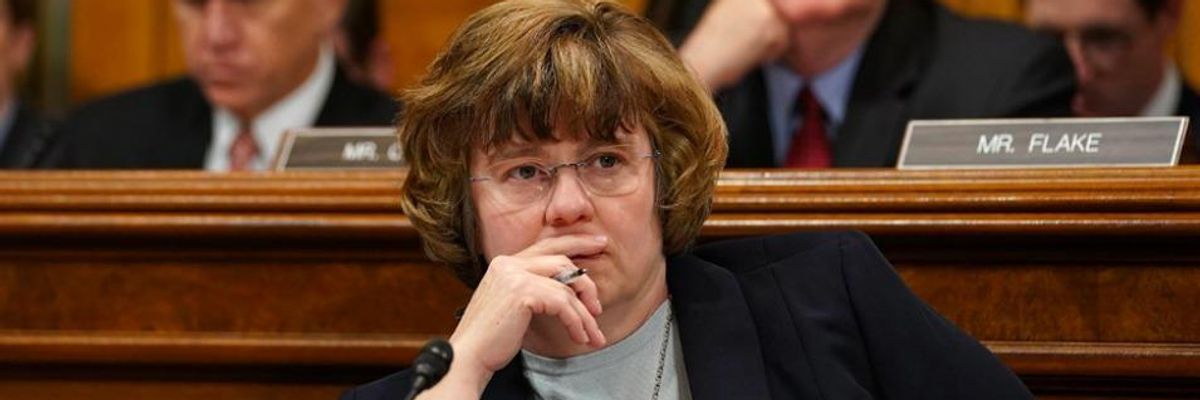
Maricope County sex crimes prosecutor Rachel Mitchell's memo on Dr. Christine Blasey Ford's allegations against Brett Kavanaugh came to a conclusion regarding whether she would advise a criminal prosecution against the judge--not whether he deserved a seat on the U.S. Supreme Court. (Photo: @NECN/Twitter)
A memo from Maricopa County sex crimes prosecutor Rachel Mitchell, who questioned Dr. Christine Blasey Ford during her testimony on allegations against U.S. Supreme Court nominee Brett Kavanaugh, revealed late Sunday that Mitchell would not advise a criminal prosecution for Kavanaugh--obscuring the reality of the consequences Kavanaugh currently faces if the FBI finds evidence that he has committed sexual assault or perjured himself in any way.
The memo claims a "reasonable prosecutor" would not pursue Ford's case, and includes five pages of Mitchell's observations about perceived holes in her story of the alleged sexual assault which took place in the early 1980s, when Kavanaugh and Ford were in high school.
But while Mitchell offered her thoughts on the believability of Ford's testimony, she included nothing about Kavanaugh's belligerent statement and refusal to answer direct questions from Senate Democrats during his appearance last Thursday--strongly suggesting that it was Ford, not Kavanaugh, who was on trial during the hearing.
The document's conclusion also flies in the face of what numerous political observers have pointed out in recent days--that the question of criminally prosecuting Kavanaugh is irrelevant, because a Senate hearing is not intended as a criminal trial. The purpose of Democrats in the Senate was not to build a case to bring charges against Kavanaugh, but only to help determine if he warrants a lifetime appointment on the Supreme Court.
The memo was released as an FBI probe into Ford's claims and those of Deborah Ramirez, who alleges Kavanaugh assaulted her in college, got underway. The Senate Judiciary Committee was forced to call for an investigation on Friday after it became clear that the Republicans did not yet have enough votes to bring Kavanaugh's nomination to the Senate floor for a vote. However, according to reports, the White House has severely limited the scope of the investigation.
Last week, Mitchell questioned Ford on her allegations, but her participation in the hearing was cut short when Republican senators began questioning Kavanaugh--and defending him against the claims.
Dear Common Dreams reader, It’s been nearly 30 years since I co-founded Common Dreams with my late wife, Lina Newhouser. We had the radical notion that journalism should serve the public good, not corporate profits. It was clear to us from the outset what it would take to build such a project. No paid advertisements. No corporate sponsors. No millionaire publisher telling us what to think or do. Many people said we wouldn't last a year, but we proved those doubters wrong. Together with a tremendous team of journalists and dedicated staff, we built an independent media outlet free from the constraints of profits and corporate control. Our mission has always been simple: To inform. To inspire. To ignite change for the common good. Building Common Dreams was not easy. Our survival was never guaranteed. When you take on the most powerful forces—Wall Street greed, fossil fuel industry destruction, Big Tech lobbyists, and uber-rich oligarchs who have spent billions upon billions rigging the economy and democracy in their favor—the only bulwark you have is supporters who believe in your work. But here’s the urgent message from me today. It's never been this bad out there. And it's never been this hard to keep us going. At the very moment Common Dreams is most needed, the threats we face are intensifying. We need your support now more than ever. We don't accept corporate advertising and never will. We don't have a paywall because we don't think people should be blocked from critical news based on their ability to pay. Everything we do is funded by the donations of readers like you. When everyone does the little they can afford, we are strong. But if that support retreats or dries up, so do we. Will you donate now to make sure Common Dreams not only survives but thrives? —Craig Brown, Co-founder |
A memo from Maricopa County sex crimes prosecutor Rachel Mitchell, who questioned Dr. Christine Blasey Ford during her testimony on allegations against U.S. Supreme Court nominee Brett Kavanaugh, revealed late Sunday that Mitchell would not advise a criminal prosecution for Kavanaugh--obscuring the reality of the consequences Kavanaugh currently faces if the FBI finds evidence that he has committed sexual assault or perjured himself in any way.
The memo claims a "reasonable prosecutor" would not pursue Ford's case, and includes five pages of Mitchell's observations about perceived holes in her story of the alleged sexual assault which took place in the early 1980s, when Kavanaugh and Ford were in high school.
But while Mitchell offered her thoughts on the believability of Ford's testimony, she included nothing about Kavanaugh's belligerent statement and refusal to answer direct questions from Senate Democrats during his appearance last Thursday--strongly suggesting that it was Ford, not Kavanaugh, who was on trial during the hearing.
The document's conclusion also flies in the face of what numerous political observers have pointed out in recent days--that the question of criminally prosecuting Kavanaugh is irrelevant, because a Senate hearing is not intended as a criminal trial. The purpose of Democrats in the Senate was not to build a case to bring charges against Kavanaugh, but only to help determine if he warrants a lifetime appointment on the Supreme Court.
The memo was released as an FBI probe into Ford's claims and those of Deborah Ramirez, who alleges Kavanaugh assaulted her in college, got underway. The Senate Judiciary Committee was forced to call for an investigation on Friday after it became clear that the Republicans did not yet have enough votes to bring Kavanaugh's nomination to the Senate floor for a vote. However, according to reports, the White House has severely limited the scope of the investigation.
Last week, Mitchell questioned Ford on her allegations, but her participation in the hearing was cut short when Republican senators began questioning Kavanaugh--and defending him against the claims.
A memo from Maricopa County sex crimes prosecutor Rachel Mitchell, who questioned Dr. Christine Blasey Ford during her testimony on allegations against U.S. Supreme Court nominee Brett Kavanaugh, revealed late Sunday that Mitchell would not advise a criminal prosecution for Kavanaugh--obscuring the reality of the consequences Kavanaugh currently faces if the FBI finds evidence that he has committed sexual assault or perjured himself in any way.
The memo claims a "reasonable prosecutor" would not pursue Ford's case, and includes five pages of Mitchell's observations about perceived holes in her story of the alleged sexual assault which took place in the early 1980s, when Kavanaugh and Ford were in high school.
But while Mitchell offered her thoughts on the believability of Ford's testimony, she included nothing about Kavanaugh's belligerent statement and refusal to answer direct questions from Senate Democrats during his appearance last Thursday--strongly suggesting that it was Ford, not Kavanaugh, who was on trial during the hearing.
The document's conclusion also flies in the face of what numerous political observers have pointed out in recent days--that the question of criminally prosecuting Kavanaugh is irrelevant, because a Senate hearing is not intended as a criminal trial. The purpose of Democrats in the Senate was not to build a case to bring charges against Kavanaugh, but only to help determine if he warrants a lifetime appointment on the Supreme Court.
The memo was released as an FBI probe into Ford's claims and those of Deborah Ramirez, who alleges Kavanaugh assaulted her in college, got underway. The Senate Judiciary Committee was forced to call for an investigation on Friday after it became clear that the Republicans did not yet have enough votes to bring Kavanaugh's nomination to the Senate floor for a vote. However, according to reports, the White House has severely limited the scope of the investigation.
Last week, Mitchell questioned Ford on her allegations, but her participation in the hearing was cut short when Republican senators began questioning Kavanaugh--and defending him against the claims.