SUBSCRIBE TO OUR FREE NEWSLETTER
Daily news & progressive opinion—funded by the people, not the corporations—delivered straight to your inbox.
5
#000000
#FFFFFF
To donate by check, phone, or other method, see our More Ways to Give page.
Daily news & progressive opinion—funded by the people, not the corporations—delivered straight to your inbox.
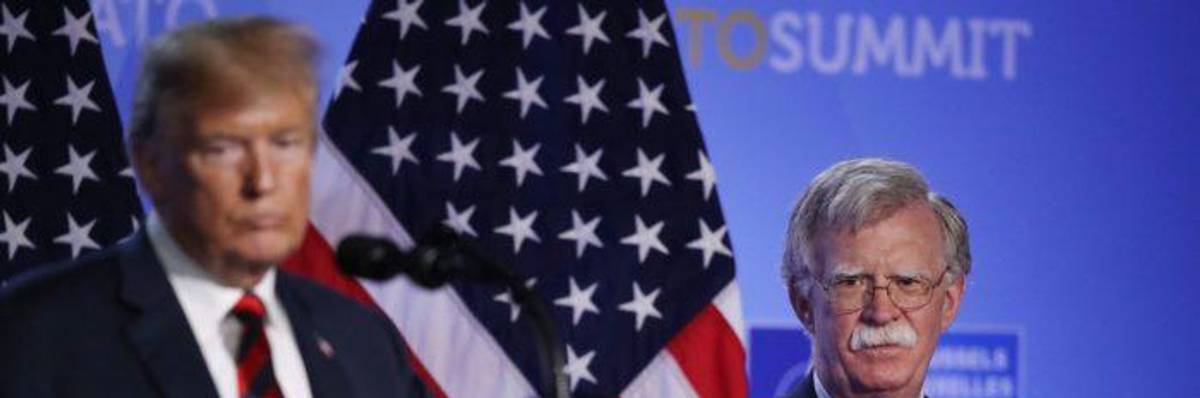
President Trump, flanked by National Security Advisor John Bolton, at the NATO Summit on July 12, 2018, in Brussels, Belgium. (Photo: Sean Gallup via Getty Images)
United Nations officials reported on Thursday that Iran is still complying with the 2015 nuclear deal it entered into with the Obama administration, three months after President Donald Trump announced he was withdrawing from the agreement.
Trump's decision was among many in the past 19 months which have alienated the U.S. from the international community--and observers including National Iranian American Council (NIAC) founder Trita Parsi noted that Iran now seems intent on continuing that estrangement--allowing the Trump administration to become a global "pariah."
Repeating the conclusion it came to a number of times between 2015 and this past May when Trump withdrew from the deal, the International Atomic Energy Agency (IAEA) said Iran is continuing to honor the terms of the agreement, limiting the amount of uranium it enriches and stores, according to Reuters.
Trump's decision to back out of the agreement was made despite protests from the other nations who were party to the deal; against the advice of the United Nations and the wishes of 56 percent of the American public.
Meanwhile, just as Iran's strict adherence did not stop Trump from abandoning the deal, it also did not stop the president from imposing harsh sanctions, which have begun to take hold in Iran.
"Sanctions hurt ordinary people on the streets and do not inflict pain at all whatsoever on the government. How is withholding chemotherapy from my 80-year-old grandmother helpful to anyone's objective?" --Meisam, Iranian physicianIn addition to the high unemployment rates resulting from decades of sanctions -- with a 13 percent overall jobless rate and about a third of Iranians between the ages of 15 and 29 out of work--the public is feeling the effects of medicine shortages and the sharp devaluation of the country's currency.
"Sanctions hurt ordinary people on the streets and do not inflict pain at all whatsoever on the government," a physician named Meisam, whose family has struggled to obtain cancer treatment for his grandmother in recent weeks, told the Independent. "How is withholding chemotherapy from my 80-year-old grandmother helpful to anyone's objective?"
Trump gleefully took note of the sanctions' impact earlier this month, tweeting that the country's economy "is going very bad, and fast!" and suggesting Iranians' suffering could bring officials to the negotiating table--a possibility that was dismissed Thursday by Supreme Leader Ayatollah Ali Khamenei.
The continued punishment of Iranian civilians will only serve to anger ordinary citizens and officials who have previously taken part in hard-fought negotiations, as well as bolstering political hardliners in Tehran, NIAC president Jamal Abdi warned.
"The grievous harm sanctions cause the Iranian people cannot be overstated: As the economy and unemployment levels make daily life unbearable for millions of Iranians, families are choked off from life-saving medicines and starved of critical infrastructure," Abdi told the Independent. "These sanctions will threaten Iran's compliance with the nuclear accord, while also undercutting hopes for Iranian moderation, harming the Iranian middle class, and empowering Iranian hardliners and extremists."
Dear Common Dreams reader, It’s been nearly 30 years since I co-founded Common Dreams with my late wife, Lina Newhouser. We had the radical notion that journalism should serve the public good, not corporate profits. It was clear to us from the outset what it would take to build such a project. No paid advertisements. No corporate sponsors. No millionaire publisher telling us what to think or do. Many people said we wouldn't last a year, but we proved those doubters wrong. Together with a tremendous team of journalists and dedicated staff, we built an independent media outlet free from the constraints of profits and corporate control. Our mission has always been simple: To inform. To inspire. To ignite change for the common good. Building Common Dreams was not easy. Our survival was never guaranteed. When you take on the most powerful forces—Wall Street greed, fossil fuel industry destruction, Big Tech lobbyists, and uber-rich oligarchs who have spent billions upon billions rigging the economy and democracy in their favor—the only bulwark you have is supporters who believe in your work. But here’s the urgent message from me today. It's never been this bad out there. And it's never been this hard to keep us going. At the very moment Common Dreams is most needed, the threats we face are intensifying. We need your support now more than ever. We don't accept corporate advertising and never will. We don't have a paywall because we don't think people should be blocked from critical news based on their ability to pay. Everything we do is funded by the donations of readers like you. When everyone does the little they can afford, we are strong. But if that support retreats or dries up, so do we. Will you donate now to make sure Common Dreams not only survives but thrives? —Craig Brown, Co-founder |
United Nations officials reported on Thursday that Iran is still complying with the 2015 nuclear deal it entered into with the Obama administration, three months after President Donald Trump announced he was withdrawing from the agreement.
Trump's decision was among many in the past 19 months which have alienated the U.S. from the international community--and observers including National Iranian American Council (NIAC) founder Trita Parsi noted that Iran now seems intent on continuing that estrangement--allowing the Trump administration to become a global "pariah."
Repeating the conclusion it came to a number of times between 2015 and this past May when Trump withdrew from the deal, the International Atomic Energy Agency (IAEA) said Iran is continuing to honor the terms of the agreement, limiting the amount of uranium it enriches and stores, according to Reuters.
Trump's decision to back out of the agreement was made despite protests from the other nations who were party to the deal; against the advice of the United Nations and the wishes of 56 percent of the American public.
Meanwhile, just as Iran's strict adherence did not stop Trump from abandoning the deal, it also did not stop the president from imposing harsh sanctions, which have begun to take hold in Iran.
"Sanctions hurt ordinary people on the streets and do not inflict pain at all whatsoever on the government. How is withholding chemotherapy from my 80-year-old grandmother helpful to anyone's objective?" --Meisam, Iranian physicianIn addition to the high unemployment rates resulting from decades of sanctions -- with a 13 percent overall jobless rate and about a third of Iranians between the ages of 15 and 29 out of work--the public is feeling the effects of medicine shortages and the sharp devaluation of the country's currency.
"Sanctions hurt ordinary people on the streets and do not inflict pain at all whatsoever on the government," a physician named Meisam, whose family has struggled to obtain cancer treatment for his grandmother in recent weeks, told the Independent. "How is withholding chemotherapy from my 80-year-old grandmother helpful to anyone's objective?"
Trump gleefully took note of the sanctions' impact earlier this month, tweeting that the country's economy "is going very bad, and fast!" and suggesting Iranians' suffering could bring officials to the negotiating table--a possibility that was dismissed Thursday by Supreme Leader Ayatollah Ali Khamenei.
The continued punishment of Iranian civilians will only serve to anger ordinary citizens and officials who have previously taken part in hard-fought negotiations, as well as bolstering political hardliners in Tehran, NIAC president Jamal Abdi warned.
"The grievous harm sanctions cause the Iranian people cannot be overstated: As the economy and unemployment levels make daily life unbearable for millions of Iranians, families are choked off from life-saving medicines and starved of critical infrastructure," Abdi told the Independent. "These sanctions will threaten Iran's compliance with the nuclear accord, while also undercutting hopes for Iranian moderation, harming the Iranian middle class, and empowering Iranian hardliners and extremists."
United Nations officials reported on Thursday that Iran is still complying with the 2015 nuclear deal it entered into with the Obama administration, three months after President Donald Trump announced he was withdrawing from the agreement.
Trump's decision was among many in the past 19 months which have alienated the U.S. from the international community--and observers including National Iranian American Council (NIAC) founder Trita Parsi noted that Iran now seems intent on continuing that estrangement--allowing the Trump administration to become a global "pariah."
Repeating the conclusion it came to a number of times between 2015 and this past May when Trump withdrew from the deal, the International Atomic Energy Agency (IAEA) said Iran is continuing to honor the terms of the agreement, limiting the amount of uranium it enriches and stores, according to Reuters.
Trump's decision to back out of the agreement was made despite protests from the other nations who were party to the deal; against the advice of the United Nations and the wishes of 56 percent of the American public.
Meanwhile, just as Iran's strict adherence did not stop Trump from abandoning the deal, it also did not stop the president from imposing harsh sanctions, which have begun to take hold in Iran.
"Sanctions hurt ordinary people on the streets and do not inflict pain at all whatsoever on the government. How is withholding chemotherapy from my 80-year-old grandmother helpful to anyone's objective?" --Meisam, Iranian physicianIn addition to the high unemployment rates resulting from decades of sanctions -- with a 13 percent overall jobless rate and about a third of Iranians between the ages of 15 and 29 out of work--the public is feeling the effects of medicine shortages and the sharp devaluation of the country's currency.
"Sanctions hurt ordinary people on the streets and do not inflict pain at all whatsoever on the government," a physician named Meisam, whose family has struggled to obtain cancer treatment for his grandmother in recent weeks, told the Independent. "How is withholding chemotherapy from my 80-year-old grandmother helpful to anyone's objective?"
Trump gleefully took note of the sanctions' impact earlier this month, tweeting that the country's economy "is going very bad, and fast!" and suggesting Iranians' suffering could bring officials to the negotiating table--a possibility that was dismissed Thursday by Supreme Leader Ayatollah Ali Khamenei.
The continued punishment of Iranian civilians will only serve to anger ordinary citizens and officials who have previously taken part in hard-fought negotiations, as well as bolstering political hardliners in Tehran, NIAC president Jamal Abdi warned.
"The grievous harm sanctions cause the Iranian people cannot be overstated: As the economy and unemployment levels make daily life unbearable for millions of Iranians, families are choked off from life-saving medicines and starved of critical infrastructure," Abdi told the Independent. "These sanctions will threaten Iran's compliance with the nuclear accord, while also undercutting hopes for Iranian moderation, harming the Iranian middle class, and empowering Iranian hardliners and extremists."