SUBSCRIBE TO OUR FREE NEWSLETTER
Daily news & progressive opinion—funded by the people, not the corporations—delivered straight to your inbox.
5
#000000
#FFFFFF
To donate by check, phone, or other method, see our More Ways to Give page.
Daily news & progressive opinion—funded by the people, not the corporations—delivered straight to your inbox.
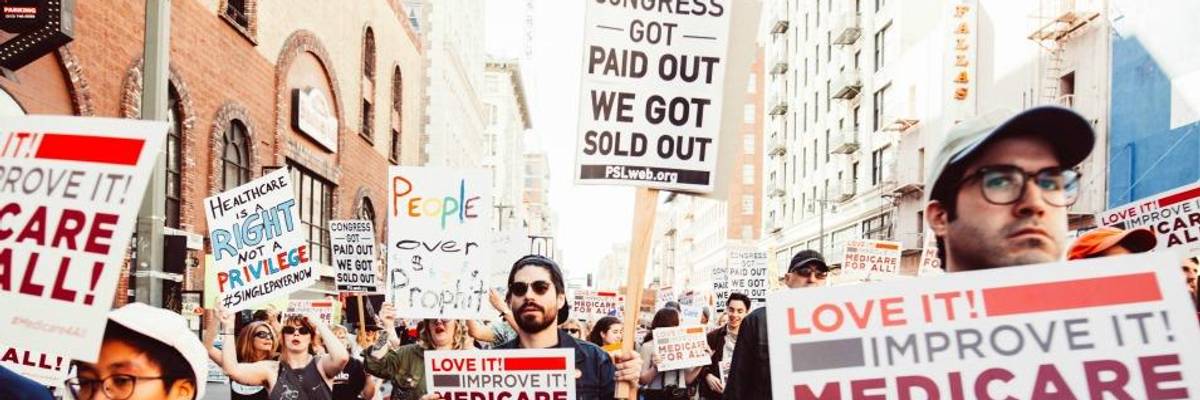
Recent polling by the Kaiser Family Foundation has shown that a majority of Americans support a Medicare for All healthcare program. (Photo: Molly Adams/Flickr/cc)
Just as many Democratic lawmakers have signed on in the past year as co-sponsors of Sen. Bernie Sanders (I-Vt.) Medicare for All bill, healthcare corporations are banding together to fight the swelling wave of support for a single-payer healthcare system.
Health insurance and drug companies have formed a coalition aimed at "building on the strength of employer-provided health coverage," according to the groups--a transparent attempt to defeat the momentum building among Medicare for All advocates, using attack ads and research biased against a single-payer system.
The coalition, called the Partnership for America's Health Care Future and including the industry groups America's Health Insurance Plans (AHIP), the Pharmaceutical Research and Manufacturers of America (PhRMA), the American Medical Association, and the Federation of American Hospitals, is being taken not as a significant threat to Sanders' plan and a similar proposal in the House, but as evidence that the country is closer than ever to implementing single-payer healthcare.
Industry giants' apparent anxiety over the end of for-profit health insurance is "clear evidence that we are making progress," Adam Gaffney of Physicians for a National Health Program told The Hill.
Sanders himself told the outlet that it did not surprise him "that the insurance companies and drug companies will spend an enormous sum of money in lobbying, campaign contributions, and television ads to defeat Medicare for all, but they are on the wrong side of history."
Public support for Medicare for All has been rapidly rising since Congress passed the Affordable Care Act in 2010. This past March, polling by the Kaiser Family Foundation showed that 59 percent of Americans support a national health plan paid for by the government. Less than a year earlier, in June 2017, the same poll found that just 53 percent had been in favor of Medicare for All.
Despite mounting evidence to contrary, the Partnership for America's Health Care Future will be devoted to convincing the public that, as a spokesperson told The Hill, "Most Americans support commonsense, pragmatic solutions that don't interrupt the coverage they rely upon for themselves and their families."
The "pragmatic solutions" that families allegedly want to continue relying on will reportedly involve premiums that are expected to go up as much as 91 percent in some parts of the country this fall. Sanders has maintained that his Medicare for All proposal would save the average American household at least $3,800 per year.
Nearly two-thirds of House Democrats have also signed on as co-sponsors of a single-payer healthcare bill--a number that could go up if the party regains a House majority by flipping 23 seats in November.
"Whether they like it or not," Sanders said of health insurance and pharmaceutical giants, "we will succeed in guaranteeing healthcare for all because this is an idea whose time has come."
This country and this world are at a monumental crossroads. US voters have an opportunity to beat back the forces of fascism and confront the billionaires who are rigging the economy, our media system, and our democracy, making it increasingly impossible for ordinary people to get by. We’re not just talking about the election. We’re talking about what must be done once these fascist elements are vanquished from power. We need a bolder set of solutions than what either major party has so far been willing to offer and a working-class movement ready to fight like hell for it. Trump didn't emerge from nowhere. The conditions that fueled MAGA authoritarianism were created by decades of radical neoliberal economic policies and a corrupt political system dominated by corporate interests. They slashed taxes on the super-rich, promising that the benefits would trickle down. They said giveaways to the corporate titans would make life more affordable for the rest of us. It was all bullshit. And when a bitter, betrayed populace searches for someone to blame, right-wing demagogues have little trouble finding scapegoats. People know when they're being lied to, but you won't hear any of this from the corporate media. Only independent journalism—powered and funded by people who believe in building a better world—can deliver truly trustworthy daily news. If you share our vision, please contribute whatever you can to sustain our work. |
Just as many Democratic lawmakers have signed on in the past year as co-sponsors of Sen. Bernie Sanders (I-Vt.) Medicare for All bill, healthcare corporations are banding together to fight the swelling wave of support for a single-payer healthcare system.
Health insurance and drug companies have formed a coalition aimed at "building on the strength of employer-provided health coverage," according to the groups--a transparent attempt to defeat the momentum building among Medicare for All advocates, using attack ads and research biased against a single-payer system.
The coalition, called the Partnership for America's Health Care Future and including the industry groups America's Health Insurance Plans (AHIP), the Pharmaceutical Research and Manufacturers of America (PhRMA), the American Medical Association, and the Federation of American Hospitals, is being taken not as a significant threat to Sanders' plan and a similar proposal in the House, but as evidence that the country is closer than ever to implementing single-payer healthcare.
Industry giants' apparent anxiety over the end of for-profit health insurance is "clear evidence that we are making progress," Adam Gaffney of Physicians for a National Health Program told The Hill.
Sanders himself told the outlet that it did not surprise him "that the insurance companies and drug companies will spend an enormous sum of money in lobbying, campaign contributions, and television ads to defeat Medicare for all, but they are on the wrong side of history."
Public support for Medicare for All has been rapidly rising since Congress passed the Affordable Care Act in 2010. This past March, polling by the Kaiser Family Foundation showed that 59 percent of Americans support a national health plan paid for by the government. Less than a year earlier, in June 2017, the same poll found that just 53 percent had been in favor of Medicare for All.
Despite mounting evidence to contrary, the Partnership for America's Health Care Future will be devoted to convincing the public that, as a spokesperson told The Hill, "Most Americans support commonsense, pragmatic solutions that don't interrupt the coverage they rely upon for themselves and their families."
The "pragmatic solutions" that families allegedly want to continue relying on will reportedly involve premiums that are expected to go up as much as 91 percent in some parts of the country this fall. Sanders has maintained that his Medicare for All proposal would save the average American household at least $3,800 per year.
Nearly two-thirds of House Democrats have also signed on as co-sponsors of a single-payer healthcare bill--a number that could go up if the party regains a House majority by flipping 23 seats in November.
"Whether they like it or not," Sanders said of health insurance and pharmaceutical giants, "we will succeed in guaranteeing healthcare for all because this is an idea whose time has come."