SUBSCRIBE TO OUR FREE NEWSLETTER
Daily news & progressive opinion—funded by the people, not the corporations—delivered straight to your inbox.
5
#000000
#FFFFFF
To donate by check, phone, or other method, see our More Ways to Give page.
Daily news & progressive opinion—funded by the people, not the corporations—delivered straight to your inbox.
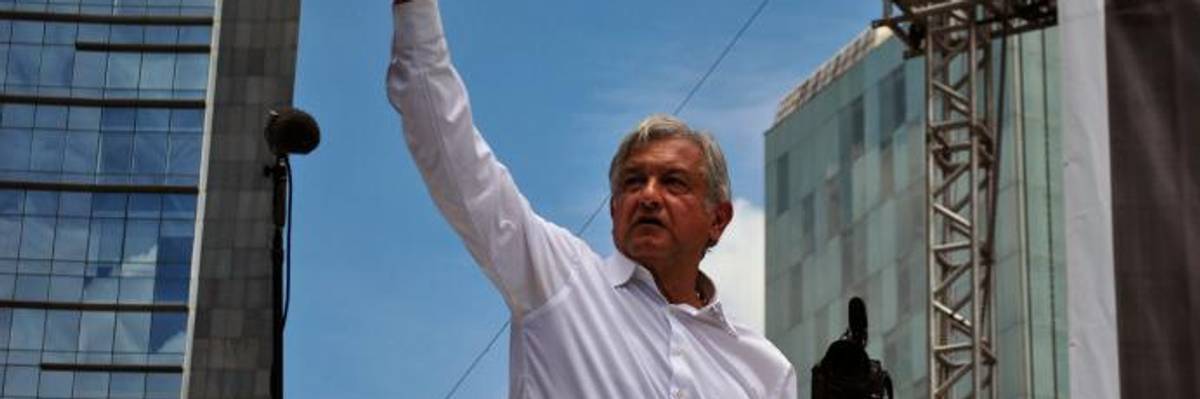
Mexican President-elect Andres Manuel Lopez Obrador, or AMLO, attended a rally in 2013. (Photo: ProtoplasmaKid/Wikimedia/cc)
Mexico's President-elect Andres Manuel Lopez Obrador, or AMLO, whose victory last month left many hopeful for the nation's next chapter, elicited praise from environmentalists for promising Wednesday to outlaw hydraulic fracturing, a controversial method of extracting natural gas that's often called fracking.
"This is the climate leadership we need," declared 350.org.
The "plan to ban fracking in Mexico represents the latest common-sense decision by a world leader to prohibit this inherently toxic, polluting practice," Food & Water Watch executive director Wenonah Hauter told DeSmog.
"[The] plan to ban fracking in Mexico represents the latest common-sense decision by a world leader to prohibit this inherently toxic, polluting practice."
--Wenonah Hauter, Food & Water Watch"President-elect Obrador is moving in the right direction on many issues, including energy and the environment," Hauter added. "He can move even farther by pledging to transition Mexico to a fully clean, renewable energy future, thereby setting a remarkable example for its neighbors to the north."
Lopez Obrador, who will take office Dec. 1, made the fracking announcement at a news conference on Wednesday. "We will no longer use that method to extract petroleum," he said, according to The Associated Press.
He also railed against the 2013 privatization of oil and gas reserves that had long been controlled by the state-owned Federal Electricity Commission (CFE), declaring, "The neoliberal governments deliberately closed the CFE plants in order to buy electricity from foreign companies at very high prices... All of that will be corrected."
While Hauter called on AMLO to usher in a new era of clean energy, as the Washington Post reported Wednesday, "In recent days, Lopez Obrador has said he would invest $9.4 billion in the state-owned sector, including two new oil refineries and the renovation of six existing ones."
Thomas Tunstall, research director for the University of Texas at San Antonio's Institute of Economic Development, pointed out to DeSmog that Mexico "has substantial untapped conventional oil and gas reserves." He also posited that the nation will continue constructing natural gas pipelines because they "are much less expensive that the alternative of shipping it in via LNG tankers."
Amid celebrations of AMLO's vow to ban fracking, Dr. Sandra Steingraber, a New York-based biologist and anti-fracking activist, noted the president-elect's oil plans and urged him to listen to Mexico's anti-pipeline activists who are "risking life and freedom" in their fight against dirty energy:
Dear Common Dreams reader, It’s been nearly 30 years since I co-founded Common Dreams with my late wife, Lina Newhouser. We had the radical notion that journalism should serve the public good, not corporate profits. It was clear to us from the outset what it would take to build such a project. No paid advertisements. No corporate sponsors. No millionaire publisher telling us what to think or do. Many people said we wouldn't last a year, but we proved those doubters wrong. Together with a tremendous team of journalists and dedicated staff, we built an independent media outlet free from the constraints of profits and corporate control. Our mission has always been simple: To inform. To inspire. To ignite change for the common good. Building Common Dreams was not easy. Our survival was never guaranteed. When you take on the most powerful forces—Wall Street greed, fossil fuel industry destruction, Big Tech lobbyists, and uber-rich oligarchs who have spent billions upon billions rigging the economy and democracy in their favor—the only bulwark you have is supporters who believe in your work. But here’s the urgent message from me today. It's never been this bad out there. And it's never been this hard to keep us going. At the very moment Common Dreams is most needed, the threats we face are intensifying. We need your support now more than ever. We don't accept corporate advertising and never will. We don't have a paywall because we don't think people should be blocked from critical news based on their ability to pay. Everything we do is funded by the donations of readers like you. When everyone does the little they can afford, we are strong. But if that support retreats or dries up, so do we. Will you donate now to make sure Common Dreams not only survives but thrives? —Craig Brown, Co-founder |
Mexico's President-elect Andres Manuel Lopez Obrador, or AMLO, whose victory last month left many hopeful for the nation's next chapter, elicited praise from environmentalists for promising Wednesday to outlaw hydraulic fracturing, a controversial method of extracting natural gas that's often called fracking.
"This is the climate leadership we need," declared 350.org.
The "plan to ban fracking in Mexico represents the latest common-sense decision by a world leader to prohibit this inherently toxic, polluting practice," Food & Water Watch executive director Wenonah Hauter told DeSmog.
"[The] plan to ban fracking in Mexico represents the latest common-sense decision by a world leader to prohibit this inherently toxic, polluting practice."
--Wenonah Hauter, Food & Water Watch"President-elect Obrador is moving in the right direction on many issues, including energy and the environment," Hauter added. "He can move even farther by pledging to transition Mexico to a fully clean, renewable energy future, thereby setting a remarkable example for its neighbors to the north."
Lopez Obrador, who will take office Dec. 1, made the fracking announcement at a news conference on Wednesday. "We will no longer use that method to extract petroleum," he said, according to The Associated Press.
He also railed against the 2013 privatization of oil and gas reserves that had long been controlled by the state-owned Federal Electricity Commission (CFE), declaring, "The neoliberal governments deliberately closed the CFE plants in order to buy electricity from foreign companies at very high prices... All of that will be corrected."
While Hauter called on AMLO to usher in a new era of clean energy, as the Washington Post reported Wednesday, "In recent days, Lopez Obrador has said he would invest $9.4 billion in the state-owned sector, including two new oil refineries and the renovation of six existing ones."
Thomas Tunstall, research director for the University of Texas at San Antonio's Institute of Economic Development, pointed out to DeSmog that Mexico "has substantial untapped conventional oil and gas reserves." He also posited that the nation will continue constructing natural gas pipelines because they "are much less expensive that the alternative of shipping it in via LNG tankers."
Amid celebrations of AMLO's vow to ban fracking, Dr. Sandra Steingraber, a New York-based biologist and anti-fracking activist, noted the president-elect's oil plans and urged him to listen to Mexico's anti-pipeline activists who are "risking life and freedom" in their fight against dirty energy:
Mexico's President-elect Andres Manuel Lopez Obrador, or AMLO, whose victory last month left many hopeful for the nation's next chapter, elicited praise from environmentalists for promising Wednesday to outlaw hydraulic fracturing, a controversial method of extracting natural gas that's often called fracking.
"This is the climate leadership we need," declared 350.org.
The "plan to ban fracking in Mexico represents the latest common-sense decision by a world leader to prohibit this inherently toxic, polluting practice," Food & Water Watch executive director Wenonah Hauter told DeSmog.
"[The] plan to ban fracking in Mexico represents the latest common-sense decision by a world leader to prohibit this inherently toxic, polluting practice."
--Wenonah Hauter, Food & Water Watch"President-elect Obrador is moving in the right direction on many issues, including energy and the environment," Hauter added. "He can move even farther by pledging to transition Mexico to a fully clean, renewable energy future, thereby setting a remarkable example for its neighbors to the north."
Lopez Obrador, who will take office Dec. 1, made the fracking announcement at a news conference on Wednesday. "We will no longer use that method to extract petroleum," he said, according to The Associated Press.
He also railed against the 2013 privatization of oil and gas reserves that had long been controlled by the state-owned Federal Electricity Commission (CFE), declaring, "The neoliberal governments deliberately closed the CFE plants in order to buy electricity from foreign companies at very high prices... All of that will be corrected."
While Hauter called on AMLO to usher in a new era of clean energy, as the Washington Post reported Wednesday, "In recent days, Lopez Obrador has said he would invest $9.4 billion in the state-owned sector, including two new oil refineries and the renovation of six existing ones."
Thomas Tunstall, research director for the University of Texas at San Antonio's Institute of Economic Development, pointed out to DeSmog that Mexico "has substantial untapped conventional oil and gas reserves." He also posited that the nation will continue constructing natural gas pipelines because they "are much less expensive that the alternative of shipping it in via LNG tankers."
Amid celebrations of AMLO's vow to ban fracking, Dr. Sandra Steingraber, a New York-based biologist and anti-fracking activist, noted the president-elect's oil plans and urged him to listen to Mexico's anti-pipeline activists who are "risking life and freedom" in their fight against dirty energy: