SUBSCRIBE TO OUR FREE NEWSLETTER
Daily news & progressive opinion—funded by the people, not the corporations—delivered straight to your inbox.
5
#000000
#FFFFFF
To donate by check, phone, or other method, see our More Ways to Give page.
Daily news & progressive opinion—funded by the people, not the corporations—delivered straight to your inbox.
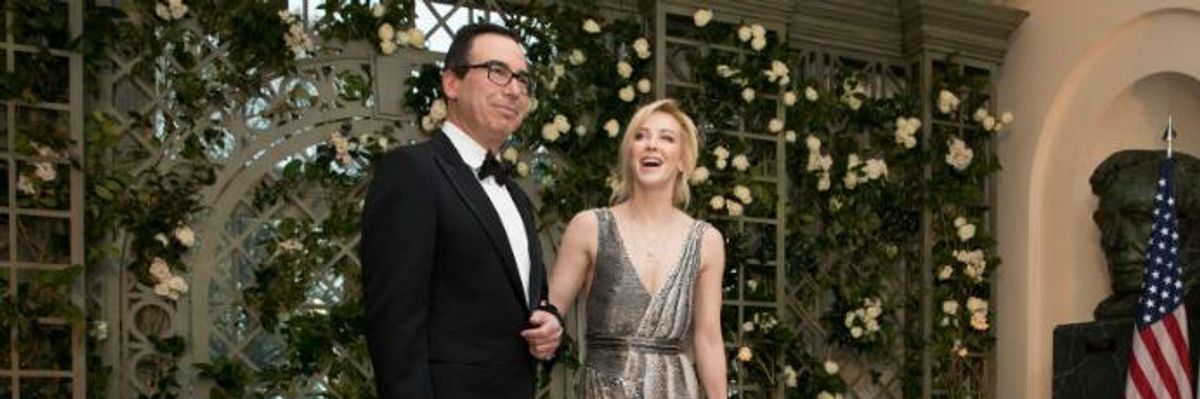
Treasury Secretary Steven Mnuchin and his wife Louise Linton arrive at the White House for a state dinner April 24, 2018 in Washington, D.C. (Photo: Aaron P. Bernstein/Getty Images)
No longer bothering to pretend that its tax policy amounts to anything more than dumping as much money as possible into the pockets of ultra-wealthy CEOs and investors, the Trump administration is considering a plan to leapfrog Congress and unilaterally hand the richest Americans another $100 billion in tax cuts.
" Donald Trump wants to go around Congress and hand $100 billion to his rich buddies on top of the $1.5 trillion he gave away to billionaires and big corporations last year. D.C. works great if you're rich and powerful."
--Sen. Elizabeth Warren
As the New York Times reports, Treasury Secretary and wannabe Bond villain Steve Mnuchin is studying whether his department has the authority to change "the definition of 'cost' for calculating capital gains, allowing taxpayers to adjust the initial value of an asset, such as a home or a share of stock, for inflation when it sells."
Almost two-thirds of the benefits of such a change would go to the top 0.1 percent, the Times notes.
How will the White House pay for such a windfall to the wealthy? This question is always raised to squash proposals that benefit the poor and working class, but--as The Debt Collective notes on Twitter--it "never applies to billion dollar transfers to the one percent."
While lauded by Republican members of Congress and prominent right-wing anti-tax crusader Grover Norquist, the Trump administration's legally questionable plot was quickly denounced by progressive lawmakers and advocacy groups as yet another "disgusting" attempt by Trump to do "everything he can to enrich the wealthy while stacking the deck against the middle class."
Ted Genoways, editor-at-large of Pacific Standard, likened the White House's plan to reward the richest Americans by executive fiat to "that part of every bank heist movie, where the robbers realize they've triggered the alarms and the cops are on the way, and so they just start stuffing the bags with as much money as they can carry."
Trump's latest plan to reward the wealthy comes as Republicans are fast at work on their "tax cuts 2.0," which will double down on the $1.5 trillion gift to the rich Trump signed into law last year.
While, as predicted, the tax cuts have been a major boon for CEOs and major corporations--which have used a huge portion of their savings to buy back their own stock--workers have seen virtually no gains from the tax bill. In fact, even as the economy continues to grow at a steady clip, wages are actually declining--which means that all of the new growth is going straight to the top.
Dear Common Dreams reader, It’s been nearly 30 years since I co-founded Common Dreams with my late wife, Lina Newhouser. We had the radical notion that journalism should serve the public good, not corporate profits. It was clear to us from the outset what it would take to build such a project. No paid advertisements. No corporate sponsors. No millionaire publisher telling us what to think or do. Many people said we wouldn't last a year, but we proved those doubters wrong. Together with a tremendous team of journalists and dedicated staff, we built an independent media outlet free from the constraints of profits and corporate control. Our mission has always been simple: To inform. To inspire. To ignite change for the common good. Building Common Dreams was not easy. Our survival was never guaranteed. When you take on the most powerful forces—Wall Street greed, fossil fuel industry destruction, Big Tech lobbyists, and uber-rich oligarchs who have spent billions upon billions rigging the economy and democracy in their favor—the only bulwark you have is supporters who believe in your work. But here’s the urgent message from me today. It's never been this bad out there. And it's never been this hard to keep us going. At the very moment Common Dreams is most needed, the threats we face are intensifying. We need your support now more than ever. We don't accept corporate advertising and never will. We don't have a paywall because we don't think people should be blocked from critical news based on their ability to pay. Everything we do is funded by the donations of readers like you. When everyone does the little they can afford, we are strong. But if that support retreats or dries up, so do we. Will you donate now to make sure Common Dreams not only survives but thrives? —Craig Brown, Co-founder |
No longer bothering to pretend that its tax policy amounts to anything more than dumping as much money as possible into the pockets of ultra-wealthy CEOs and investors, the Trump administration is considering a plan to leapfrog Congress and unilaterally hand the richest Americans another $100 billion in tax cuts.
" Donald Trump wants to go around Congress and hand $100 billion to his rich buddies on top of the $1.5 trillion he gave away to billionaires and big corporations last year. D.C. works great if you're rich and powerful."
--Sen. Elizabeth Warren
As the New York Times reports, Treasury Secretary and wannabe Bond villain Steve Mnuchin is studying whether his department has the authority to change "the definition of 'cost' for calculating capital gains, allowing taxpayers to adjust the initial value of an asset, such as a home or a share of stock, for inflation when it sells."
Almost two-thirds of the benefits of such a change would go to the top 0.1 percent, the Times notes.
How will the White House pay for such a windfall to the wealthy? This question is always raised to squash proposals that benefit the poor and working class, but--as The Debt Collective notes on Twitter--it "never applies to billion dollar transfers to the one percent."
While lauded by Republican members of Congress and prominent right-wing anti-tax crusader Grover Norquist, the Trump administration's legally questionable plot was quickly denounced by progressive lawmakers and advocacy groups as yet another "disgusting" attempt by Trump to do "everything he can to enrich the wealthy while stacking the deck against the middle class."
Ted Genoways, editor-at-large of Pacific Standard, likened the White House's plan to reward the richest Americans by executive fiat to "that part of every bank heist movie, where the robbers realize they've triggered the alarms and the cops are on the way, and so they just start stuffing the bags with as much money as they can carry."
Trump's latest plan to reward the wealthy comes as Republicans are fast at work on their "tax cuts 2.0," which will double down on the $1.5 trillion gift to the rich Trump signed into law last year.
While, as predicted, the tax cuts have been a major boon for CEOs and major corporations--which have used a huge portion of their savings to buy back their own stock--workers have seen virtually no gains from the tax bill. In fact, even as the economy continues to grow at a steady clip, wages are actually declining--which means that all of the new growth is going straight to the top.
No longer bothering to pretend that its tax policy amounts to anything more than dumping as much money as possible into the pockets of ultra-wealthy CEOs and investors, the Trump administration is considering a plan to leapfrog Congress and unilaterally hand the richest Americans another $100 billion in tax cuts.
" Donald Trump wants to go around Congress and hand $100 billion to his rich buddies on top of the $1.5 trillion he gave away to billionaires and big corporations last year. D.C. works great if you're rich and powerful."
--Sen. Elizabeth Warren
As the New York Times reports, Treasury Secretary and wannabe Bond villain Steve Mnuchin is studying whether his department has the authority to change "the definition of 'cost' for calculating capital gains, allowing taxpayers to adjust the initial value of an asset, such as a home or a share of stock, for inflation when it sells."
Almost two-thirds of the benefits of such a change would go to the top 0.1 percent, the Times notes.
How will the White House pay for such a windfall to the wealthy? This question is always raised to squash proposals that benefit the poor and working class, but--as The Debt Collective notes on Twitter--it "never applies to billion dollar transfers to the one percent."
While lauded by Republican members of Congress and prominent right-wing anti-tax crusader Grover Norquist, the Trump administration's legally questionable plot was quickly denounced by progressive lawmakers and advocacy groups as yet another "disgusting" attempt by Trump to do "everything he can to enrich the wealthy while stacking the deck against the middle class."
Ted Genoways, editor-at-large of Pacific Standard, likened the White House's plan to reward the richest Americans by executive fiat to "that part of every bank heist movie, where the robbers realize they've triggered the alarms and the cops are on the way, and so they just start stuffing the bags with as much money as they can carry."
Trump's latest plan to reward the wealthy comes as Republicans are fast at work on their "tax cuts 2.0," which will double down on the $1.5 trillion gift to the rich Trump signed into law last year.
While, as predicted, the tax cuts have been a major boon for CEOs and major corporations--which have used a huge portion of their savings to buy back their own stock--workers have seen virtually no gains from the tax bill. In fact, even as the economy continues to grow at a steady clip, wages are actually declining--which means that all of the new growth is going straight to the top.