SUBSCRIBE TO OUR FREE NEWSLETTER
Daily news & progressive opinion—funded by the people, not the corporations—delivered straight to your inbox.
5
#000000
#FFFFFF
To donate by check, phone, or other method, see our More Ways to Give page.
Daily news & progressive opinion—funded by the people, not the corporations—delivered straight to your inbox.
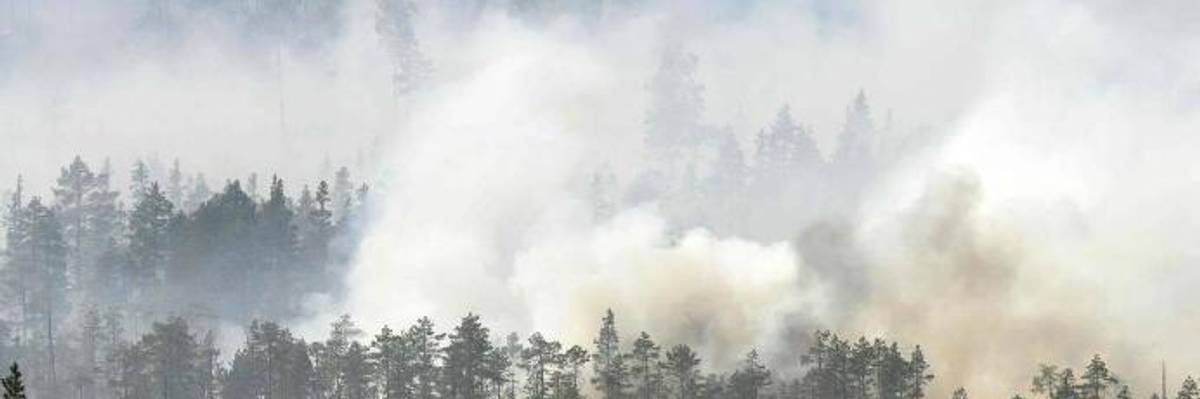
Firefighters battle a wildfire in Sweden. (Photo: @jyllandsposten/Twitter)
With wildfires raging the world over, a new preliminary analysis conducted by the World Weather Attribution (WWA) and reported by the Guardian found that the global climate crisis notably increased the likeliness of last year's Hurricane Harvey and "Lucifer" heat wave, as well as the current heat wave sweeping across Northern Europe and fueling fires in the Arctic Circle.
"This is something that society can and should prepare for. But equally there is no doubt that we can and should constrain the increasing likelihood of all kinds of extreme weather events by restricting greenhouse gas emissions as sharply as possible."
--Friederike Otto, University of Oxford
"We found that for the weather station in the far north, in the Arctic Circle, the current heat wave is just extraordinary--unprecedented in the historical record," said Geert Jan van Oldenborgh of the Royal Netherlands Meteorological Institute and WWA.
The researchers found that climate change made the heat wave in Northern Europe more than twice as likely, Hurricane Harvey three times more likely, and the Lucifer heat wave 10 times more likely.
"By comparing extreme weather with historical measurements and with computer models of a climate unaltered by carbon emissions, researchers can find how much global warming is increasing the risk of dangerous weather," the Guardian explained. This analysis differs from a full study that would require "many climate models to be run on high-powered computers, which takes months."
Summarizing their conclusion, Friederike Otto of the University of Oxford and WWA told the newspaper, "The logic that climate change will do this is inescapable--the world is becoming warmer, and so heat waves like this are becoming more common."
While "most heat wave studies have been done on large scale averages, so European-wide temperatures," Otto noted that "in this study, we have looked at individual locations, where people live, to represent the heat wave people are actually experiencing."
The heat wave that has fueled more than 50 fires in Sweden in recent weeks has also caused excessive heat throughout the U.K. and Europe--including in Greece, where a fire killed dozens earlier this week.
Pointing to recent comments from British politicians who are demanding concrete action to prevent such events from becoming the "new normal" and endangering thousands or even millions of lives, 350.org echoed their call and highlighted worldwide rallies planned for Sept. 8 to demand a future free of fossil fuels.
"What was once regarded as unusually warm weather will become commonplace, and in some cases, it already has," Otto concluded. "So this is something that society can and should prepare for. But equally there is no doubt that we can and should constrain the increasing likelihood of all kinds of extreme weather events by restricting greenhouse gas emissions as sharply as possible."
Dear Common Dreams reader, It’s been nearly 30 years since I co-founded Common Dreams with my late wife, Lina Newhouser. We had the radical notion that journalism should serve the public good, not corporate profits. It was clear to us from the outset what it would take to build such a project. No paid advertisements. No corporate sponsors. No millionaire publisher telling us what to think or do. Many people said we wouldn't last a year, but we proved those doubters wrong. Together with a tremendous team of journalists and dedicated staff, we built an independent media outlet free from the constraints of profits and corporate control. Our mission has always been simple: To inform. To inspire. To ignite change for the common good. Building Common Dreams was not easy. Our survival was never guaranteed. When you take on the most powerful forces—Wall Street greed, fossil fuel industry destruction, Big Tech lobbyists, and uber-rich oligarchs who have spent billions upon billions rigging the economy and democracy in their favor—the only bulwark you have is supporters who believe in your work. But here’s the urgent message from me today. It's never been this bad out there. And it's never been this hard to keep us going. At the very moment Common Dreams is most needed, the threats we face are intensifying. We need your support now more than ever. We don't accept corporate advertising and never will. We don't have a paywall because we don't think people should be blocked from critical news based on their ability to pay. Everything we do is funded by the donations of readers like you. When everyone does the little they can afford, we are strong. But if that support retreats or dries up, so do we. Will you donate now to make sure Common Dreams not only survives but thrives? —Craig Brown, Co-founder |
With wildfires raging the world over, a new preliminary analysis conducted by the World Weather Attribution (WWA) and reported by the Guardian found that the global climate crisis notably increased the likeliness of last year's Hurricane Harvey and "Lucifer" heat wave, as well as the current heat wave sweeping across Northern Europe and fueling fires in the Arctic Circle.
"This is something that society can and should prepare for. But equally there is no doubt that we can and should constrain the increasing likelihood of all kinds of extreme weather events by restricting greenhouse gas emissions as sharply as possible."
--Friederike Otto, University of Oxford
"We found that for the weather station in the far north, in the Arctic Circle, the current heat wave is just extraordinary--unprecedented in the historical record," said Geert Jan van Oldenborgh of the Royal Netherlands Meteorological Institute and WWA.
The researchers found that climate change made the heat wave in Northern Europe more than twice as likely, Hurricane Harvey three times more likely, and the Lucifer heat wave 10 times more likely.
"By comparing extreme weather with historical measurements and with computer models of a climate unaltered by carbon emissions, researchers can find how much global warming is increasing the risk of dangerous weather," the Guardian explained. This analysis differs from a full study that would require "many climate models to be run on high-powered computers, which takes months."
Summarizing their conclusion, Friederike Otto of the University of Oxford and WWA told the newspaper, "The logic that climate change will do this is inescapable--the world is becoming warmer, and so heat waves like this are becoming more common."
While "most heat wave studies have been done on large scale averages, so European-wide temperatures," Otto noted that "in this study, we have looked at individual locations, where people live, to represent the heat wave people are actually experiencing."
The heat wave that has fueled more than 50 fires in Sweden in recent weeks has also caused excessive heat throughout the U.K. and Europe--including in Greece, where a fire killed dozens earlier this week.
Pointing to recent comments from British politicians who are demanding concrete action to prevent such events from becoming the "new normal" and endangering thousands or even millions of lives, 350.org echoed their call and highlighted worldwide rallies planned for Sept. 8 to demand a future free of fossil fuels.
"What was once regarded as unusually warm weather will become commonplace, and in some cases, it already has," Otto concluded. "So this is something that society can and should prepare for. But equally there is no doubt that we can and should constrain the increasing likelihood of all kinds of extreme weather events by restricting greenhouse gas emissions as sharply as possible."
With wildfires raging the world over, a new preliminary analysis conducted by the World Weather Attribution (WWA) and reported by the Guardian found that the global climate crisis notably increased the likeliness of last year's Hurricane Harvey and "Lucifer" heat wave, as well as the current heat wave sweeping across Northern Europe and fueling fires in the Arctic Circle.
"This is something that society can and should prepare for. But equally there is no doubt that we can and should constrain the increasing likelihood of all kinds of extreme weather events by restricting greenhouse gas emissions as sharply as possible."
--Friederike Otto, University of Oxford
"We found that for the weather station in the far north, in the Arctic Circle, the current heat wave is just extraordinary--unprecedented in the historical record," said Geert Jan van Oldenborgh of the Royal Netherlands Meteorological Institute and WWA.
The researchers found that climate change made the heat wave in Northern Europe more than twice as likely, Hurricane Harvey three times more likely, and the Lucifer heat wave 10 times more likely.
"By comparing extreme weather with historical measurements and with computer models of a climate unaltered by carbon emissions, researchers can find how much global warming is increasing the risk of dangerous weather," the Guardian explained. This analysis differs from a full study that would require "many climate models to be run on high-powered computers, which takes months."
Summarizing their conclusion, Friederike Otto of the University of Oxford and WWA told the newspaper, "The logic that climate change will do this is inescapable--the world is becoming warmer, and so heat waves like this are becoming more common."
While "most heat wave studies have been done on large scale averages, so European-wide temperatures," Otto noted that "in this study, we have looked at individual locations, where people live, to represent the heat wave people are actually experiencing."
The heat wave that has fueled more than 50 fires in Sweden in recent weeks has also caused excessive heat throughout the U.K. and Europe--including in Greece, where a fire killed dozens earlier this week.
Pointing to recent comments from British politicians who are demanding concrete action to prevent such events from becoming the "new normal" and endangering thousands or even millions of lives, 350.org echoed their call and highlighted worldwide rallies planned for Sept. 8 to demand a future free of fossil fuels.
"What was once regarded as unusually warm weather will become commonplace, and in some cases, it already has," Otto concluded. "So this is something that society can and should prepare for. But equally there is no doubt that we can and should constrain the increasing likelihood of all kinds of extreme weather events by restricting greenhouse gas emissions as sharply as possible."