SUBSCRIBE TO OUR FREE NEWSLETTER
Daily news & progressive opinion—funded by the people, not the corporations—delivered straight to your inbox.
5
#000000
#FFFFFF
To donate by check, phone, or other method, see our More Ways to Give page.
Daily news & progressive opinion—funded by the people, not the corporations—delivered straight to your inbox.
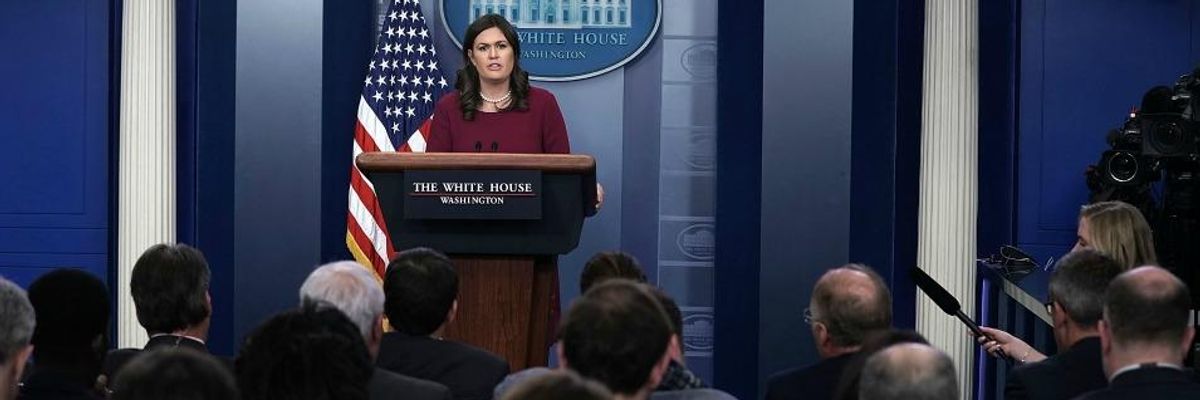
Strained relations between President Donald Trump's White House and the news media reached a low point on Wednesday when a CNN reporter was banned from a press conference after asking the president questions about his former attorney, Michael Cohen, and Russian President Vladimir Putin. (Photo: Alex Wong/Getty Images)
On the heels of President Donald Trump's Orwellian remark advising supporters that what they read in the news "is not what's happening," the White House released its own statement claiming that it supports a free press--directly after banning a reporter from a news conference.
After CNN correspondent Kaitlan Collins, according to the Trump administration's version of events, "shouted questions and refused to leave despite repeatedly being asked to do so" at an Oval Office press meeting, White House Press Secretary Sarah Huckabee Sanders and Deputy Chief of Staff for Communications Bill Shine told Collins she would not be welcome at a later press conference in the Rose Garden.
"To be clear, we support a free press and ask that everyone be respectful of the president and guests at the White House," the communications officials concluded.
Journalists and free press advocates responded to the obvious disconnect in the White House's statement.
"I was blocked from attending an open press event at the White House because the White House did not like the questions I posed to President Trump earlier in the day during an event in the Oval Office with the president of the European Commission," Collins told her network.
After the two leaders made statements at the Oval Office event, Collins explained, "I and several other reporters started asking President Trump questions. This is a normal occurrence and it [was] also our only chance to ask President Trump questions that day."
"To address the thing about how Collins 'refused' to leave the session upon request: Such a 'refusal' could well be attributed to just about any pool representative who has filed into an Oval Office meeting," wrote media critic Erik Wemple at the Washington Post. "That's because Trump's long-suffering press wranglers start shouting 'time to go' at the very moment that the formalities conclude--and then Trump proceeds to drag things out by taking a question here, a question there. Reporters have pretty much learned to tune out the cries of the wranglers in hopes of securing answers to their shouted questions."
Collins' questions to the president addressed two of this week's major news stories--Trump's White House invitation to Russian President Vladimir Putin and a tape that his former lawyer, Michael Cohen, released in which the president was heard apparently arranging a payment to a former model who has claimed she had an affair with him.
"Did Michael Cohen betray you, Mr. President?" Collins asked. "Mr. President, are you worried about what Michael Cohen is going to say to prosecutors?...Why has Vladimir Putin not accepted your invitation, Mr. President?"
"Just because the White House is uncomfortable with a question regarding the news of the day doesn't mean the question isn't relevant and shouldn't be asked," said CNN in a statement. "This decision to bar a member of the press is retaliatory in nature and not indicative of an open and free press. We demand better."
Dear Common Dreams reader, It’s been nearly 30 years since I co-founded Common Dreams with my late wife, Lina Newhouser. We had the radical notion that journalism should serve the public good, not corporate profits. It was clear to us from the outset what it would take to build such a project. No paid advertisements. No corporate sponsors. No millionaire publisher telling us what to think or do. Many people said we wouldn't last a year, but we proved those doubters wrong. Together with a tremendous team of journalists and dedicated staff, we built an independent media outlet free from the constraints of profits and corporate control. Our mission has always been simple: To inform. To inspire. To ignite change for the common good. Building Common Dreams was not easy. Our survival was never guaranteed. When you take on the most powerful forces—Wall Street greed, fossil fuel industry destruction, Big Tech lobbyists, and uber-rich oligarchs who have spent billions upon billions rigging the economy and democracy in their favor—the only bulwark you have is supporters who believe in your work. But here’s the urgent message from me today. It's never been this bad out there. And it's never been this hard to keep us going. At the very moment Common Dreams is most needed, the threats we face are intensifying. We need your support now more than ever. We don't accept corporate advertising and never will. We don't have a paywall because we don't think people should be blocked from critical news based on their ability to pay. Everything we do is funded by the donations of readers like you. When everyone does the little they can afford, we are strong. But if that support retreats or dries up, so do we. Will you donate now to make sure Common Dreams not only survives but thrives? —Craig Brown, Co-founder |
On the heels of President Donald Trump's Orwellian remark advising supporters that what they read in the news "is not what's happening," the White House released its own statement claiming that it supports a free press--directly after banning a reporter from a news conference.
After CNN correspondent Kaitlan Collins, according to the Trump administration's version of events, "shouted questions and refused to leave despite repeatedly being asked to do so" at an Oval Office press meeting, White House Press Secretary Sarah Huckabee Sanders and Deputy Chief of Staff for Communications Bill Shine told Collins she would not be welcome at a later press conference in the Rose Garden.
"To be clear, we support a free press and ask that everyone be respectful of the president and guests at the White House," the communications officials concluded.
Journalists and free press advocates responded to the obvious disconnect in the White House's statement.
"I was blocked from attending an open press event at the White House because the White House did not like the questions I posed to President Trump earlier in the day during an event in the Oval Office with the president of the European Commission," Collins told her network.
After the two leaders made statements at the Oval Office event, Collins explained, "I and several other reporters started asking President Trump questions. This is a normal occurrence and it [was] also our only chance to ask President Trump questions that day."
"To address the thing about how Collins 'refused' to leave the session upon request: Such a 'refusal' could well be attributed to just about any pool representative who has filed into an Oval Office meeting," wrote media critic Erik Wemple at the Washington Post. "That's because Trump's long-suffering press wranglers start shouting 'time to go' at the very moment that the formalities conclude--and then Trump proceeds to drag things out by taking a question here, a question there. Reporters have pretty much learned to tune out the cries of the wranglers in hopes of securing answers to their shouted questions."
Collins' questions to the president addressed two of this week's major news stories--Trump's White House invitation to Russian President Vladimir Putin and a tape that his former lawyer, Michael Cohen, released in which the president was heard apparently arranging a payment to a former model who has claimed she had an affair with him.
"Did Michael Cohen betray you, Mr. President?" Collins asked. "Mr. President, are you worried about what Michael Cohen is going to say to prosecutors?...Why has Vladimir Putin not accepted your invitation, Mr. President?"
"Just because the White House is uncomfortable with a question regarding the news of the day doesn't mean the question isn't relevant and shouldn't be asked," said CNN in a statement. "This decision to bar a member of the press is retaliatory in nature and not indicative of an open and free press. We demand better."
On the heels of President Donald Trump's Orwellian remark advising supporters that what they read in the news "is not what's happening," the White House released its own statement claiming that it supports a free press--directly after banning a reporter from a news conference.
After CNN correspondent Kaitlan Collins, according to the Trump administration's version of events, "shouted questions and refused to leave despite repeatedly being asked to do so" at an Oval Office press meeting, White House Press Secretary Sarah Huckabee Sanders and Deputy Chief of Staff for Communications Bill Shine told Collins she would not be welcome at a later press conference in the Rose Garden.
"To be clear, we support a free press and ask that everyone be respectful of the president and guests at the White House," the communications officials concluded.
Journalists and free press advocates responded to the obvious disconnect in the White House's statement.
"I was blocked from attending an open press event at the White House because the White House did not like the questions I posed to President Trump earlier in the day during an event in the Oval Office with the president of the European Commission," Collins told her network.
After the two leaders made statements at the Oval Office event, Collins explained, "I and several other reporters started asking President Trump questions. This is a normal occurrence and it [was] also our only chance to ask President Trump questions that day."
"To address the thing about how Collins 'refused' to leave the session upon request: Such a 'refusal' could well be attributed to just about any pool representative who has filed into an Oval Office meeting," wrote media critic Erik Wemple at the Washington Post. "That's because Trump's long-suffering press wranglers start shouting 'time to go' at the very moment that the formalities conclude--and then Trump proceeds to drag things out by taking a question here, a question there. Reporters have pretty much learned to tune out the cries of the wranglers in hopes of securing answers to their shouted questions."
Collins' questions to the president addressed two of this week's major news stories--Trump's White House invitation to Russian President Vladimir Putin and a tape that his former lawyer, Michael Cohen, released in which the president was heard apparently arranging a payment to a former model who has claimed she had an affair with him.
"Did Michael Cohen betray you, Mr. President?" Collins asked. "Mr. President, are you worried about what Michael Cohen is going to say to prosecutors?...Why has Vladimir Putin not accepted your invitation, Mr. President?"
"Just because the White House is uncomfortable with a question regarding the news of the day doesn't mean the question isn't relevant and shouldn't be asked," said CNN in a statement. "This decision to bar a member of the press is retaliatory in nature and not indicative of an open and free press. We demand better."