SUBSCRIBE TO OUR FREE NEWSLETTER
Daily news & progressive opinion—funded by the people, not the corporations—delivered straight to your inbox.
5
#000000
#FFFFFF
To donate by check, phone, or other method, see our More Ways to Give page.
Daily news & progressive opinion—funded by the people, not the corporations—delivered straight to your inbox.
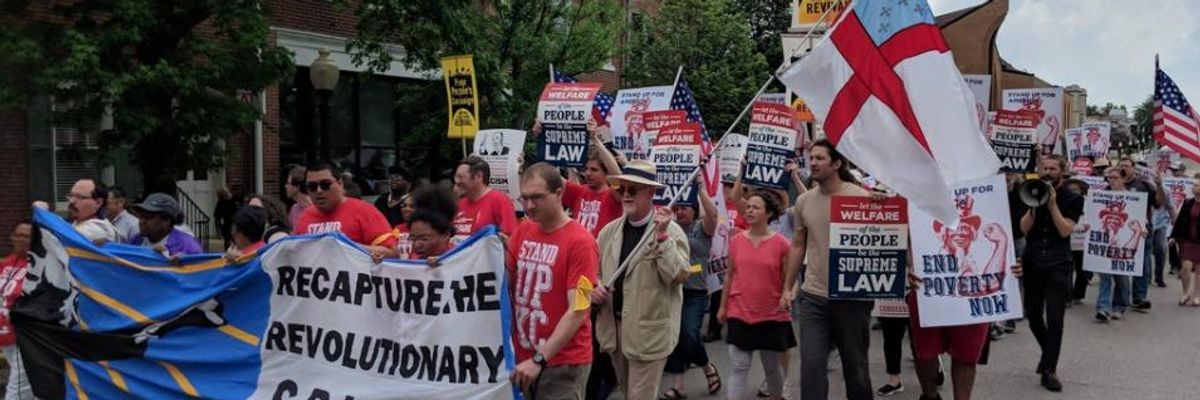
Protesters in Jefferson City, Missouri were just some of the participants in the nationwide launch of the Poor People's Campaign on Monday. (Photo: @standup_kc/Twitter)
Aiming to continue the work that Rev. Dr. Martin Luther King, Jr. was doing when he was assassinated 50 years ago, a new Poor People's Campaign officially launched on Monday with advocates for economic justice rallying in Washington, D.C. and more than 30 state capitols nationwide.
The campaign, with an emphasis on voter mobilization and civil disobedience, will include 40 days of demonstrations culminating in a massive protest on June 23 in Washington, D.C. The movement calls for wage laws that are "commensurate for the 21st century economy," a repeal to the tax plan the Republican Party pushed through Congress last year, universal healthcare, and the expansion of public housing as well as guaranteed "fair and decent housing."
Led by the Rev. William Barber, organizer of North Carolina's Moral Mondays protests, the Poor People's Campaign will focus on weekly themes under the larger issue of poverty and economic inequality, including women and children in poverty, voting rights, healthcare, and housing.
"We cannot continue to have a democracy that engages in the kind of policy violence that we see happening every day," Barber told Amy Goodman of Democracy Now! on Monday. "All over this country we continue to see what is not often seen or talked about in our politics, in our political debates, or even in the media...250,000 people are dying every year from poverty and low wealth."
King's Poor People's Campaign aimed to petition the government to pass an Economic Bill of Rights, guaranteeing Americans an annual wage and full employment, allocating $30 billion to combat poverty, and establishment of low-cost housing for the poor.
Today, Barber and the Institute for Policy Studies estimate that 140 million Americans are living in poverty--about 100 million more than the census estimates.
The new Poor People's Campaign demands far-reaching policy changes that aim to alleviate the economic burdens placed on poverty-stricken Americans.
The movement follows a widespread national focus on the labor movement, as teachers across the country have staged walkouts to protest chronically low wages and underfunded schools, and Sen. Bernie Sanders's (I-Vt.) introduction of a bill to strengthen the nation's unions.
On Democracy Now!, Barber stressed that the prevalence of poverty in the U.S.--one of the world's wealthiest countries--and the abandonment of American workers indicates a profound moral failing of the government.
"It is time for a moral confrontation, a non-violent moral confrontation," Barber said. "It is immoral to have 37 million people without healthcare, it is immoral not to pay living wages when we know we can do it...Our first goal is to break through the moral narrative to where we're talking about it. We're not even talking about these issues in the country."
The 40 days of protests will be the launch of a "multi-year campaign," Barber added.
On social media, participants in cities across the country shared images and videos of the Poor People's Campaign's launch.
Washington, D.C.
Massachusetts
Florida
Dear Common Dreams reader, It’s been nearly 30 years since I co-founded Common Dreams with my late wife, Lina Newhouser. We had the radical notion that journalism should serve the public good, not corporate profits. It was clear to us from the outset what it would take to build such a project. No paid advertisements. No corporate sponsors. No millionaire publisher telling us what to think or do. Many people said we wouldn't last a year, but we proved those doubters wrong. Together with a tremendous team of journalists and dedicated staff, we built an independent media outlet free from the constraints of profits and corporate control. Our mission has always been simple: To inform. To inspire. To ignite change for the common good. Building Common Dreams was not easy. Our survival was never guaranteed. When you take on the most powerful forces—Wall Street greed, fossil fuel industry destruction, Big Tech lobbyists, and uber-rich oligarchs who have spent billions upon billions rigging the economy and democracy in their favor—the only bulwark you have is supporters who believe in your work. But here’s the urgent message from me today. It's never been this bad out there. And it's never been this hard to keep us going. At the very moment Common Dreams is most needed, the threats we face are intensifying. We need your support now more than ever. We don't accept corporate advertising and never will. We don't have a paywall because we don't think people should be blocked from critical news based on their ability to pay. Everything we do is funded by the donations of readers like you. When everyone does the little they can afford, we are strong. But if that support retreats or dries up, so do we. Will you donate now to make sure Common Dreams not only survives but thrives? —Craig Brown, Co-founder |
Aiming to continue the work that Rev. Dr. Martin Luther King, Jr. was doing when he was assassinated 50 years ago, a new Poor People's Campaign officially launched on Monday with advocates for economic justice rallying in Washington, D.C. and more than 30 state capitols nationwide.
The campaign, with an emphasis on voter mobilization and civil disobedience, will include 40 days of demonstrations culminating in a massive protest on June 23 in Washington, D.C. The movement calls for wage laws that are "commensurate for the 21st century economy," a repeal to the tax plan the Republican Party pushed through Congress last year, universal healthcare, and the expansion of public housing as well as guaranteed "fair and decent housing."
Led by the Rev. William Barber, organizer of North Carolina's Moral Mondays protests, the Poor People's Campaign will focus on weekly themes under the larger issue of poverty and economic inequality, including women and children in poverty, voting rights, healthcare, and housing.
"We cannot continue to have a democracy that engages in the kind of policy violence that we see happening every day," Barber told Amy Goodman of Democracy Now! on Monday. "All over this country we continue to see what is not often seen or talked about in our politics, in our political debates, or even in the media...250,000 people are dying every year from poverty and low wealth."
King's Poor People's Campaign aimed to petition the government to pass an Economic Bill of Rights, guaranteeing Americans an annual wage and full employment, allocating $30 billion to combat poverty, and establishment of low-cost housing for the poor.
Today, Barber and the Institute for Policy Studies estimate that 140 million Americans are living in poverty--about 100 million more than the census estimates.
The new Poor People's Campaign demands far-reaching policy changes that aim to alleviate the economic burdens placed on poverty-stricken Americans.
The movement follows a widespread national focus on the labor movement, as teachers across the country have staged walkouts to protest chronically low wages and underfunded schools, and Sen. Bernie Sanders's (I-Vt.) introduction of a bill to strengthen the nation's unions.
On Democracy Now!, Barber stressed that the prevalence of poverty in the U.S.--one of the world's wealthiest countries--and the abandonment of American workers indicates a profound moral failing of the government.
"It is time for a moral confrontation, a non-violent moral confrontation," Barber said. "It is immoral to have 37 million people without healthcare, it is immoral not to pay living wages when we know we can do it...Our first goal is to break through the moral narrative to where we're talking about it. We're not even talking about these issues in the country."
The 40 days of protests will be the launch of a "multi-year campaign," Barber added.
On social media, participants in cities across the country shared images and videos of the Poor People's Campaign's launch.
Washington, D.C.
Massachusetts
Florida
Aiming to continue the work that Rev. Dr. Martin Luther King, Jr. was doing when he was assassinated 50 years ago, a new Poor People's Campaign officially launched on Monday with advocates for economic justice rallying in Washington, D.C. and more than 30 state capitols nationwide.
The campaign, with an emphasis on voter mobilization and civil disobedience, will include 40 days of demonstrations culminating in a massive protest on June 23 in Washington, D.C. The movement calls for wage laws that are "commensurate for the 21st century economy," a repeal to the tax plan the Republican Party pushed through Congress last year, universal healthcare, and the expansion of public housing as well as guaranteed "fair and decent housing."
Led by the Rev. William Barber, organizer of North Carolina's Moral Mondays protests, the Poor People's Campaign will focus on weekly themes under the larger issue of poverty and economic inequality, including women and children in poverty, voting rights, healthcare, and housing.
"We cannot continue to have a democracy that engages in the kind of policy violence that we see happening every day," Barber told Amy Goodman of Democracy Now! on Monday. "All over this country we continue to see what is not often seen or talked about in our politics, in our political debates, or even in the media...250,000 people are dying every year from poverty and low wealth."
King's Poor People's Campaign aimed to petition the government to pass an Economic Bill of Rights, guaranteeing Americans an annual wage and full employment, allocating $30 billion to combat poverty, and establishment of low-cost housing for the poor.
Today, Barber and the Institute for Policy Studies estimate that 140 million Americans are living in poverty--about 100 million more than the census estimates.
The new Poor People's Campaign demands far-reaching policy changes that aim to alleviate the economic burdens placed on poverty-stricken Americans.
The movement follows a widespread national focus on the labor movement, as teachers across the country have staged walkouts to protest chronically low wages and underfunded schools, and Sen. Bernie Sanders's (I-Vt.) introduction of a bill to strengthen the nation's unions.
On Democracy Now!, Barber stressed that the prevalence of poverty in the U.S.--one of the world's wealthiest countries--and the abandonment of American workers indicates a profound moral failing of the government.
"It is time for a moral confrontation, a non-violent moral confrontation," Barber said. "It is immoral to have 37 million people without healthcare, it is immoral not to pay living wages when we know we can do it...Our first goal is to break through the moral narrative to where we're talking about it. We're not even talking about these issues in the country."
The 40 days of protests will be the launch of a "multi-year campaign," Barber added.
On social media, participants in cities across the country shared images and videos of the Poor People's Campaign's launch.
Washington, D.C.
Massachusetts
Florida