SUBSCRIBE TO OUR FREE NEWSLETTER
Daily news & progressive opinion—funded by the people, not the corporations—delivered straight to your inbox.
5
#000000
#FFFFFF
To donate by check, phone, or other method, see our More Ways to Give page.
Daily news & progressive opinion—funded by the people, not the corporations—delivered straight to your inbox.
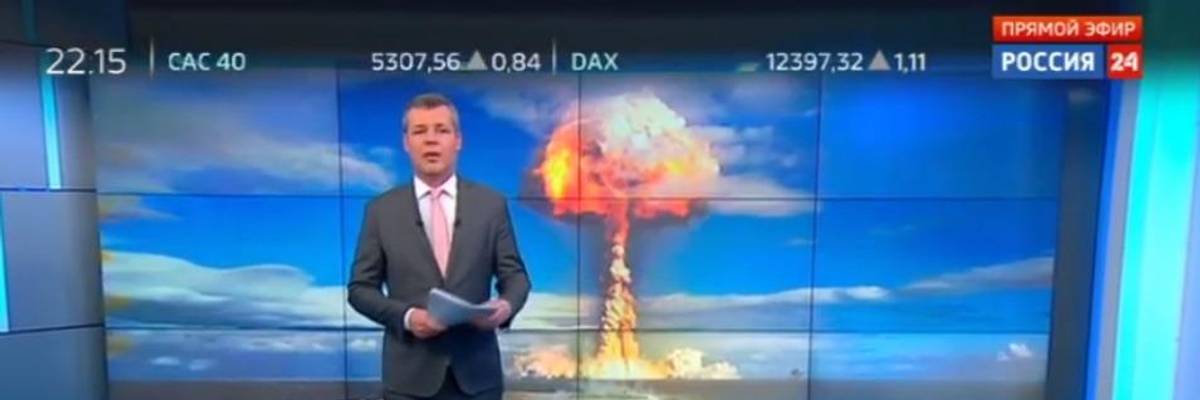
A Russian newscast prepared citizens for the possibility of war with the U.S.--and suggested that American citizens should be more concerned about impending war than Russians. (Photo: Vesti 24/Screenshot)
As President Donald Trump sent mixed messages about his plans for possible military action in Syria this week, Russian state media advised citizens to take his warnings from earlier this week to heart, and prepare for war with the U.S.
On the country's state-owned media channel, a news anchor on Wednesday explained to viewers how to prepare for a potential war by stocking a bomb shelter--while images of nuclear explosions were shown behind him.
As Newsweek reports:
Warning that the potential conflict between the two superpowers would be "catastrophic," an anchor for Russia's Vesti 24 showed off shelves of food, recommending that people buy salt, oatmeal, and other products that can last a long time on the shelves if they plan to hide in a bunker. Powdered milk lasts five years, while sugar and rice can last up to eight years, the newscaster explained before showing videos of pasta cooking in a bomb shelter.
The newscast showed shelf-stable foods that could last five to eight years--including powdered milk, rice, and sugar--and advised Russians to buy gas masks and huge supplies of water.
The anchor took on a mocking tone at times, saying that Americans have far more to fear than Russians.
"The real panic isn't here but across the ocean," said the reporter, adding that the instructions to stock bunkers were for "people who succumb to panic and decide to spend all their savings."
Watch:
Trump warned he was considering military action against Syrian President Bashar al-Assad this week, after he accused Assad--who Russia has defended in the country's civil war over the last seven years--of attacking the town of Douma with poison gas last weekend.
A navy destroyer armed with Tomahawk missiles embarked from Cyrus on Monday, leading to fears that Trump would impulsively launch an attack on the war-torn country--while anti-war advocates urged Trump to allow the U.N. to investigate the chemical attack before taking action.
In response to Trump's threats, Russia quickly said it wouldshoot down any U.S. missiles and possibly target U.S. launch sites as well, leading international affairs and military experts to warn that the U.S. would stand little chance of defeating Russia's defenses--and that an escalation could ultimately lead to a nuclear exchange.
"There is a major war scare here in Moscow. Russia is expecting a U.S. strike in Syria. The Russian chief of military Valery Gerasimov promised a response against U.S. platforms launching missiles," Ariel Cohen, a senior fellow at the Atlantic Council, told Newsweek. "The U.S. needs to keep in mind not only the adversarial position of Russia, which of course is the case, but the Russian nuclear potential...An escalation in Syria that affects Russia may lead to a military conflict with Russia, which has an escalation trajectory towards a nuclear war."
Meanwhile, Murtaza Mohammad Hussain at the Intercept argued that while Trump's threats could carry the danger of war, the majority of those who will suffer in a conflict between the U.S. and Russia are likely neither American nor Russian--but Middle Eastern.
Dear Common Dreams reader, It’s been nearly 30 years since I co-founded Common Dreams with my late wife, Lina Newhouser. We had the radical notion that journalism should serve the public good, not corporate profits. It was clear to us from the outset what it would take to build such a project. No paid advertisements. No corporate sponsors. No millionaire publisher telling us what to think or do. Many people said we wouldn't last a year, but we proved those doubters wrong. Together with a tremendous team of journalists and dedicated staff, we built an independent media outlet free from the constraints of profits and corporate control. Our mission has always been simple: To inform. To inspire. To ignite change for the common good. Building Common Dreams was not easy. Our survival was never guaranteed. When you take on the most powerful forces—Wall Street greed, fossil fuel industry destruction, Big Tech lobbyists, and uber-rich oligarchs who have spent billions upon billions rigging the economy and democracy in their favor—the only bulwark you have is supporters who believe in your work. But here’s the urgent message from me today. It's never been this bad out there. And it's never been this hard to keep us going. At the very moment Common Dreams is most needed, the threats we face are intensifying. We need your support now more than ever. We don't accept corporate advertising and never will. We don't have a paywall because we don't think people should be blocked from critical news based on their ability to pay. Everything we do is funded by the donations of readers like you. When everyone does the little they can afford, we are strong. But if that support retreats or dries up, so do we. Will you donate now to make sure Common Dreams not only survives but thrives? —Craig Brown, Co-founder |
As President Donald Trump sent mixed messages about his plans for possible military action in Syria this week, Russian state media advised citizens to take his warnings from earlier this week to heart, and prepare for war with the U.S.
On the country's state-owned media channel, a news anchor on Wednesday explained to viewers how to prepare for a potential war by stocking a bomb shelter--while images of nuclear explosions were shown behind him.
As Newsweek reports:
Warning that the potential conflict between the two superpowers would be "catastrophic," an anchor for Russia's Vesti 24 showed off shelves of food, recommending that people buy salt, oatmeal, and other products that can last a long time on the shelves if they plan to hide in a bunker. Powdered milk lasts five years, while sugar and rice can last up to eight years, the newscaster explained before showing videos of pasta cooking in a bomb shelter.
The newscast showed shelf-stable foods that could last five to eight years--including powdered milk, rice, and sugar--and advised Russians to buy gas masks and huge supplies of water.
The anchor took on a mocking tone at times, saying that Americans have far more to fear than Russians.
"The real panic isn't here but across the ocean," said the reporter, adding that the instructions to stock bunkers were for "people who succumb to panic and decide to spend all their savings."
Watch:
Trump warned he was considering military action against Syrian President Bashar al-Assad this week, after he accused Assad--who Russia has defended in the country's civil war over the last seven years--of attacking the town of Douma with poison gas last weekend.
A navy destroyer armed with Tomahawk missiles embarked from Cyrus on Monday, leading to fears that Trump would impulsively launch an attack on the war-torn country--while anti-war advocates urged Trump to allow the U.N. to investigate the chemical attack before taking action.
In response to Trump's threats, Russia quickly said it wouldshoot down any U.S. missiles and possibly target U.S. launch sites as well, leading international affairs and military experts to warn that the U.S. would stand little chance of defeating Russia's defenses--and that an escalation could ultimately lead to a nuclear exchange.
"There is a major war scare here in Moscow. Russia is expecting a U.S. strike in Syria. The Russian chief of military Valery Gerasimov promised a response against U.S. platforms launching missiles," Ariel Cohen, a senior fellow at the Atlantic Council, told Newsweek. "The U.S. needs to keep in mind not only the adversarial position of Russia, which of course is the case, but the Russian nuclear potential...An escalation in Syria that affects Russia may lead to a military conflict with Russia, which has an escalation trajectory towards a nuclear war."
Meanwhile, Murtaza Mohammad Hussain at the Intercept argued that while Trump's threats could carry the danger of war, the majority of those who will suffer in a conflict between the U.S. and Russia are likely neither American nor Russian--but Middle Eastern.
As President Donald Trump sent mixed messages about his plans for possible military action in Syria this week, Russian state media advised citizens to take his warnings from earlier this week to heart, and prepare for war with the U.S.
On the country's state-owned media channel, a news anchor on Wednesday explained to viewers how to prepare for a potential war by stocking a bomb shelter--while images of nuclear explosions were shown behind him.
As Newsweek reports:
Warning that the potential conflict between the two superpowers would be "catastrophic," an anchor for Russia's Vesti 24 showed off shelves of food, recommending that people buy salt, oatmeal, and other products that can last a long time on the shelves if they plan to hide in a bunker. Powdered milk lasts five years, while sugar and rice can last up to eight years, the newscaster explained before showing videos of pasta cooking in a bomb shelter.
The newscast showed shelf-stable foods that could last five to eight years--including powdered milk, rice, and sugar--and advised Russians to buy gas masks and huge supplies of water.
The anchor took on a mocking tone at times, saying that Americans have far more to fear than Russians.
"The real panic isn't here but across the ocean," said the reporter, adding that the instructions to stock bunkers were for "people who succumb to panic and decide to spend all their savings."
Watch:
Trump warned he was considering military action against Syrian President Bashar al-Assad this week, after he accused Assad--who Russia has defended in the country's civil war over the last seven years--of attacking the town of Douma with poison gas last weekend.
A navy destroyer armed with Tomahawk missiles embarked from Cyrus on Monday, leading to fears that Trump would impulsively launch an attack on the war-torn country--while anti-war advocates urged Trump to allow the U.N. to investigate the chemical attack before taking action.
In response to Trump's threats, Russia quickly said it wouldshoot down any U.S. missiles and possibly target U.S. launch sites as well, leading international affairs and military experts to warn that the U.S. would stand little chance of defeating Russia's defenses--and that an escalation could ultimately lead to a nuclear exchange.
"There is a major war scare here in Moscow. Russia is expecting a U.S. strike in Syria. The Russian chief of military Valery Gerasimov promised a response against U.S. platforms launching missiles," Ariel Cohen, a senior fellow at the Atlantic Council, told Newsweek. "The U.S. needs to keep in mind not only the adversarial position of Russia, which of course is the case, but the Russian nuclear potential...An escalation in Syria that affects Russia may lead to a military conflict with Russia, which has an escalation trajectory towards a nuclear war."
Meanwhile, Murtaza Mohammad Hussain at the Intercept argued that while Trump's threats could carry the danger of war, the majority of those who will suffer in a conflict between the U.S. and Russia are likely neither American nor Russian--but Middle Eastern.