SUBSCRIBE TO OUR FREE NEWSLETTER
Daily news & progressive opinion—funded by the people, not the corporations—delivered straight to your inbox.
5
#000000
#FFFFFF
To donate by check, phone, or other method, see our More Ways to Give page.
Daily news & progressive opinion—funded by the people, not the corporations—delivered straight to your inbox.
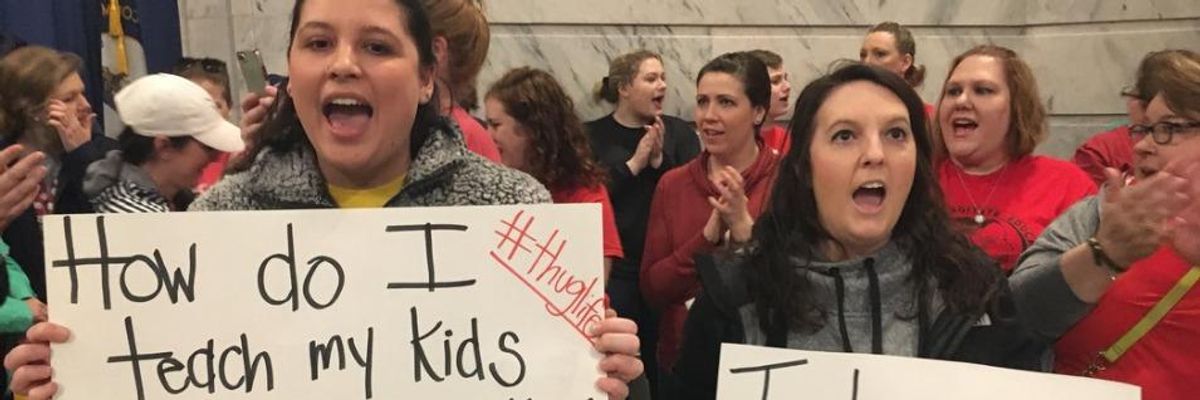
Teachers in Kentucky protested at the state Capitol Friday after lawmakers passed a bill that educators fear will weaken their pensions. (Photo: @mandy_mclaren/Twitter)
Teachers across Kentucky on Friday became the latest educators to walk out of their classrooms, denouncing a bill that passed in the state Senate on Thursday which proposes reduced pension benefits for state employees.
The strike, which closed schools in more than 20 counties, is the latest in a recent wave of impassioned protests that have been staged by teachers in red states, where lawmakers have placed little importance on funding schools and retaining qualified teachers in recent decades--instead wooing corporations with tax cuts.
In Kentucky, educators and supporters have adopted the hashtag #120strong to encourage teachers in all 120 counties to join the fight to keep state workers' pensions funded.
The bill that passed Thursday would limit the number of sick days teachers can put towards retirement; establish a plan in which new hires contribute a certain amount to their pensions, leading to fears of steep cuts to retirement plans; and would allow lawmakers to make other changes to pensions in the future.
Hundreds of teachers descended on the state Capitol, chanting "Vote them out!" and unfurling a banner that read, "Kentucky Deserves Better," and promised to return Monday to continue the protest.
The protests follow a nine-day strike in West Virginia earlier this month, as every public school was closed while teachers demanded a permanent funding solution for their state-run health insurance program, after facing rising premiums and some of the lowest teaching salaries in the nation.
In Oklahoma, schools are expected to be closed on Monday as teachers stage a walkout. After weeks of protests and mobilization by educators, the state legislature finally passed a bill this week giving teachers a $6,000 raise and raising taxes on oil and gas development--but teachers have warned the bill is insufficient and the strike will go on to protest the state's poor education funding.
And in Arizona, teachers are threatening to strike unless lawmakers fund 20 percent raises for their workforce and pledge to end tax cuts until education spending is brought up to par with the national average.
According to Jeff Bryant of Campaign for America's Future, the recent activism in education is a phenomenon that Democrats should pay attention to as the midterm elections approach.
Bryant pointed to a number of recent down-ballot elections in Illinois in which progressive candidates were victorious after making strong support for public schools a key campaign issue. Vying for a state House seat, Delia Ramirez pledged to "protect our public-school system from corporate interests which attack teachers and students to destabilize public neighborhood schools and profit from privatizing education."
Such promises are likely swaying voters because education is a major concern for them, Bryant notes. A recent Pew Research Center poll found that 72 percent of Americans ranked education as a top political priority--ahead of the economy and healthcare.
"Grassroots progressive Democrats are telling the party's establishment how it can lead and win on education issues," wrote Bryant. "What's not clear is if the party's pundit and policy apparatus is willing to listen."
Dear Common Dreams reader, It’s been nearly 30 years since I co-founded Common Dreams with my late wife, Lina Newhouser. We had the radical notion that journalism should serve the public good, not corporate profits. It was clear to us from the outset what it would take to build such a project. No paid advertisements. No corporate sponsors. No millionaire publisher telling us what to think or do. Many people said we wouldn't last a year, but we proved those doubters wrong. Together with a tremendous team of journalists and dedicated staff, we built an independent media outlet free from the constraints of profits and corporate control. Our mission has always been simple: To inform. To inspire. To ignite change for the common good. Building Common Dreams was not easy. Our survival was never guaranteed. When you take on the most powerful forces—Wall Street greed, fossil fuel industry destruction, Big Tech lobbyists, and uber-rich oligarchs who have spent billions upon billions rigging the economy and democracy in their favor—the only bulwark you have is supporters who believe in your work. But here’s the urgent message from me today. It's never been this bad out there. And it's never been this hard to keep us going. At the very moment Common Dreams is most needed, the threats we face are intensifying. We need your support now more than ever. We don't accept corporate advertising and never will. We don't have a paywall because we don't think people should be blocked from critical news based on their ability to pay. Everything we do is funded by the donations of readers like you. When everyone does the little they can afford, we are strong. But if that support retreats or dries up, so do we. Will you donate now to make sure Common Dreams not only survives but thrives? —Craig Brown, Co-founder |
Teachers across Kentucky on Friday became the latest educators to walk out of their classrooms, denouncing a bill that passed in the state Senate on Thursday which proposes reduced pension benefits for state employees.
The strike, which closed schools in more than 20 counties, is the latest in a recent wave of impassioned protests that have been staged by teachers in red states, where lawmakers have placed little importance on funding schools and retaining qualified teachers in recent decades--instead wooing corporations with tax cuts.
In Kentucky, educators and supporters have adopted the hashtag #120strong to encourage teachers in all 120 counties to join the fight to keep state workers' pensions funded.
The bill that passed Thursday would limit the number of sick days teachers can put towards retirement; establish a plan in which new hires contribute a certain amount to their pensions, leading to fears of steep cuts to retirement plans; and would allow lawmakers to make other changes to pensions in the future.
Hundreds of teachers descended on the state Capitol, chanting "Vote them out!" and unfurling a banner that read, "Kentucky Deserves Better," and promised to return Monday to continue the protest.
The protests follow a nine-day strike in West Virginia earlier this month, as every public school was closed while teachers demanded a permanent funding solution for their state-run health insurance program, after facing rising premiums and some of the lowest teaching salaries in the nation.
In Oklahoma, schools are expected to be closed on Monday as teachers stage a walkout. After weeks of protests and mobilization by educators, the state legislature finally passed a bill this week giving teachers a $6,000 raise and raising taxes on oil and gas development--but teachers have warned the bill is insufficient and the strike will go on to protest the state's poor education funding.
And in Arizona, teachers are threatening to strike unless lawmakers fund 20 percent raises for their workforce and pledge to end tax cuts until education spending is brought up to par with the national average.
According to Jeff Bryant of Campaign for America's Future, the recent activism in education is a phenomenon that Democrats should pay attention to as the midterm elections approach.
Bryant pointed to a number of recent down-ballot elections in Illinois in which progressive candidates were victorious after making strong support for public schools a key campaign issue. Vying for a state House seat, Delia Ramirez pledged to "protect our public-school system from corporate interests which attack teachers and students to destabilize public neighborhood schools and profit from privatizing education."
Such promises are likely swaying voters because education is a major concern for them, Bryant notes. A recent Pew Research Center poll found that 72 percent of Americans ranked education as a top political priority--ahead of the economy and healthcare.
"Grassroots progressive Democrats are telling the party's establishment how it can lead and win on education issues," wrote Bryant. "What's not clear is if the party's pundit and policy apparatus is willing to listen."
Teachers across Kentucky on Friday became the latest educators to walk out of their classrooms, denouncing a bill that passed in the state Senate on Thursday which proposes reduced pension benefits for state employees.
The strike, which closed schools in more than 20 counties, is the latest in a recent wave of impassioned protests that have been staged by teachers in red states, where lawmakers have placed little importance on funding schools and retaining qualified teachers in recent decades--instead wooing corporations with tax cuts.
In Kentucky, educators and supporters have adopted the hashtag #120strong to encourage teachers in all 120 counties to join the fight to keep state workers' pensions funded.
The bill that passed Thursday would limit the number of sick days teachers can put towards retirement; establish a plan in which new hires contribute a certain amount to their pensions, leading to fears of steep cuts to retirement plans; and would allow lawmakers to make other changes to pensions in the future.
Hundreds of teachers descended on the state Capitol, chanting "Vote them out!" and unfurling a banner that read, "Kentucky Deserves Better," and promised to return Monday to continue the protest.
The protests follow a nine-day strike in West Virginia earlier this month, as every public school was closed while teachers demanded a permanent funding solution for their state-run health insurance program, after facing rising premiums and some of the lowest teaching salaries in the nation.
In Oklahoma, schools are expected to be closed on Monday as teachers stage a walkout. After weeks of protests and mobilization by educators, the state legislature finally passed a bill this week giving teachers a $6,000 raise and raising taxes on oil and gas development--but teachers have warned the bill is insufficient and the strike will go on to protest the state's poor education funding.
And in Arizona, teachers are threatening to strike unless lawmakers fund 20 percent raises for their workforce and pledge to end tax cuts until education spending is brought up to par with the national average.
According to Jeff Bryant of Campaign for America's Future, the recent activism in education is a phenomenon that Democrats should pay attention to as the midterm elections approach.
Bryant pointed to a number of recent down-ballot elections in Illinois in which progressive candidates were victorious after making strong support for public schools a key campaign issue. Vying for a state House seat, Delia Ramirez pledged to "protect our public-school system from corporate interests which attack teachers and students to destabilize public neighborhood schools and profit from privatizing education."
Such promises are likely swaying voters because education is a major concern for them, Bryant notes. A recent Pew Research Center poll found that 72 percent of Americans ranked education as a top political priority--ahead of the economy and healthcare.
"Grassroots progressive Democrats are telling the party's establishment how it can lead and win on education issues," wrote Bryant. "What's not clear is if the party's pundit and policy apparatus is willing to listen."