SUBSCRIBE TO OUR FREE NEWSLETTER
Daily news & progressive opinion—funded by the people, not the corporations—delivered straight to your inbox.
5
#000000
#FFFFFF
To donate by check, phone, or other method, see our More Ways to Give page.
Daily news & progressive opinion—funded by the people, not the corporations—delivered straight to your inbox.
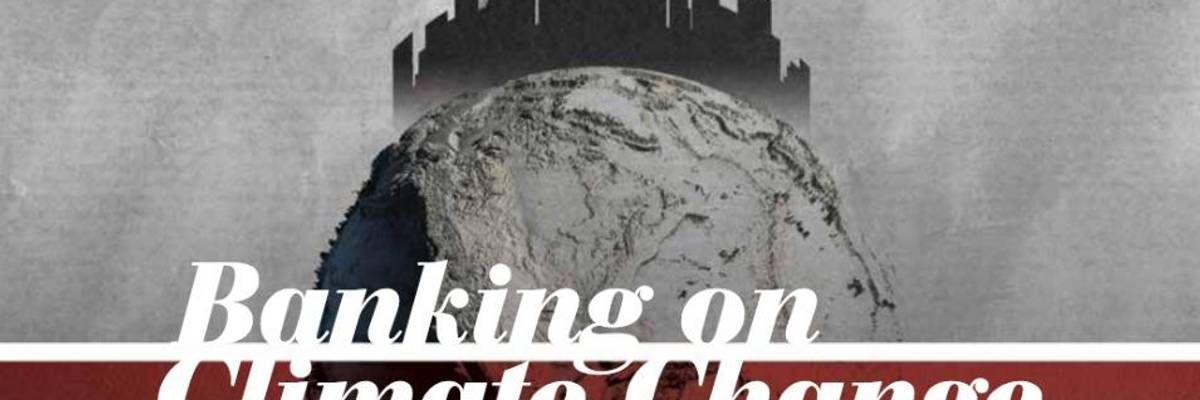
A new report by green groups including Oil Change International and Sierra Club show that major banks poured $115 billion into dirty energy last year--up 11 percent from 2016. (Image: "Banking on Climate Change")
Going backward in the era of Trump--and despite international efforts to curb the climate crisis by reducing carbon emissions and reliance on fossil fuels--a new study out Wednesday details how major banks invested heavily in the world's dirtiest energy sectors in 2017, pouring $115 billion into tar sands, offshore oil drilling, and coal mining projects.
"Every single dollar that these banks provide for the expansion of the fossil fuel industry is a dollar going to increase the climate crisis," said Stephen Kretzmann of Oil Change International, one of the groups behind the study (pdf).
The findings of the report--entitled "Banking on Climate Change"--were described by author and activist Naomi Klein as "terrifying."
This is a terrifying report and the Alberta tar sands are at the dead centre of it: "'Extreme' fossil fuel investments have surged under Donald Trump, report reveals." https://t.co/iCrut7OJHy #StopKM
-- Naomi Klein (@NaomiAKlein) March 28, 2018
Until they end their funding of dirty energy, Kretzmann added, "these banks will be complicit in our climate catastrophe, plain and simple."
Institutions including JP Morgan Chase, TD Bank, and Bank of America increased their funding of dirty energy by 11 percent from 2016 to 2017, flouting the Paris Climate Agreement.
The tar sands sector, known as the dirtiest source of energy on the planet, received major support from banks last year, with financing going up by 111 percent to $98 billion. JP Morgan Chase quadrupled its funding of the industry, a year after researchers found tar sands operations were a major cause of pollution.
Environmental campaigners also denounced banks for their support of industries that have caused destruction to communities by building pipelines with no regard for citizens' homes and human rights. Dirty energy projects funded by financial institutions in 2017 included the Line 3 Tar Sands pipeline proposed by Enbridge, which TD Bank, Citibank, Royal Bank of Canada, and MUFBGall invest in; and new coal plants expected to be build across Southeast Asia, bankrolled by Mizuho, MUFG, and SMFG.
"These banks fund the projects that are killing the planet, destroying indigenous sacred sites, and violating the human rights of citizens." --Tara Houska, Honor the Earth
"These banks fund the projects that are killing the planet, destroying indigenous sacred sites, and violating the human rights of citizens," said Tara Houska of Honor the Earth. "The financial industry is on notice--the human rights policies banks claim are in place must be enforced. Stop funding fossil fuels and move into a green economy."
"It is not surprising that we see the world's largest sovereign wealth fund managers no longer prepared to take the increasing risk associated with oil and gas assets, which do not have a long-term future," said Paul Fisher of the Cambridge Institute for Sustainability Leadership, when Norway made its announcement.
Dear Common Dreams reader, It’s been nearly 30 years since I co-founded Common Dreams with my late wife, Lina Newhouser. We had the radical notion that journalism should serve the public good, not corporate profits. It was clear to us from the outset what it would take to build such a project. No paid advertisements. No corporate sponsors. No millionaire publisher telling us what to think or do. Many people said we wouldn't last a year, but we proved those doubters wrong. Together with a tremendous team of journalists and dedicated staff, we built an independent media outlet free from the constraints of profits and corporate control. Our mission has always been simple: To inform. To inspire. To ignite change for the common good. Building Common Dreams was not easy. Our survival was never guaranteed. When you take on the most powerful forces—Wall Street greed, fossil fuel industry destruction, Big Tech lobbyists, and uber-rich oligarchs who have spent billions upon billions rigging the economy and democracy in their favor—the only bulwark you have is supporters who believe in your work. But here’s the urgent message from me today. It's never been this bad out there. And it's never been this hard to keep us going. At the very moment Common Dreams is most needed, the threats we face are intensifying. We need your support now more than ever. We don't accept corporate advertising and never will. We don't have a paywall because we don't think people should be blocked from critical news based on their ability to pay. Everything we do is funded by the donations of readers like you. When everyone does the little they can afford, we are strong. But if that support retreats or dries up, so do we. Will you donate now to make sure Common Dreams not only survives but thrives? —Craig Brown, Co-founder |
Going backward in the era of Trump--and despite international efforts to curb the climate crisis by reducing carbon emissions and reliance on fossil fuels--a new study out Wednesday details how major banks invested heavily in the world's dirtiest energy sectors in 2017, pouring $115 billion into tar sands, offshore oil drilling, and coal mining projects.
"Every single dollar that these banks provide for the expansion of the fossil fuel industry is a dollar going to increase the climate crisis," said Stephen Kretzmann of Oil Change International, one of the groups behind the study (pdf).
The findings of the report--entitled "Banking on Climate Change"--were described by author and activist Naomi Klein as "terrifying."
This is a terrifying report and the Alberta tar sands are at the dead centre of it: "'Extreme' fossil fuel investments have surged under Donald Trump, report reveals." https://t.co/iCrut7OJHy #StopKM
-- Naomi Klein (@NaomiAKlein) March 28, 2018
Until they end their funding of dirty energy, Kretzmann added, "these banks will be complicit in our climate catastrophe, plain and simple."
Institutions including JP Morgan Chase, TD Bank, and Bank of America increased their funding of dirty energy by 11 percent from 2016 to 2017, flouting the Paris Climate Agreement.
The tar sands sector, known as the dirtiest source of energy on the planet, received major support from banks last year, with financing going up by 111 percent to $98 billion. JP Morgan Chase quadrupled its funding of the industry, a year after researchers found tar sands operations were a major cause of pollution.
Environmental campaigners also denounced banks for their support of industries that have caused destruction to communities by building pipelines with no regard for citizens' homes and human rights. Dirty energy projects funded by financial institutions in 2017 included the Line 3 Tar Sands pipeline proposed by Enbridge, which TD Bank, Citibank, Royal Bank of Canada, and MUFBGall invest in; and new coal plants expected to be build across Southeast Asia, bankrolled by Mizuho, MUFG, and SMFG.
"These banks fund the projects that are killing the planet, destroying indigenous sacred sites, and violating the human rights of citizens." --Tara Houska, Honor the Earth
"These banks fund the projects that are killing the planet, destroying indigenous sacred sites, and violating the human rights of citizens," said Tara Houska of Honor the Earth. "The financial industry is on notice--the human rights policies banks claim are in place must be enforced. Stop funding fossil fuels and move into a green economy."
"It is not surprising that we see the world's largest sovereign wealth fund managers no longer prepared to take the increasing risk associated with oil and gas assets, which do not have a long-term future," said Paul Fisher of the Cambridge Institute for Sustainability Leadership, when Norway made its announcement.
Going backward in the era of Trump--and despite international efforts to curb the climate crisis by reducing carbon emissions and reliance on fossil fuels--a new study out Wednesday details how major banks invested heavily in the world's dirtiest energy sectors in 2017, pouring $115 billion into tar sands, offshore oil drilling, and coal mining projects.
"Every single dollar that these banks provide for the expansion of the fossil fuel industry is a dollar going to increase the climate crisis," said Stephen Kretzmann of Oil Change International, one of the groups behind the study (pdf).
The findings of the report--entitled "Banking on Climate Change"--were described by author and activist Naomi Klein as "terrifying."
This is a terrifying report and the Alberta tar sands are at the dead centre of it: "'Extreme' fossil fuel investments have surged under Donald Trump, report reveals." https://t.co/iCrut7OJHy #StopKM
-- Naomi Klein (@NaomiAKlein) March 28, 2018
Until they end their funding of dirty energy, Kretzmann added, "these banks will be complicit in our climate catastrophe, plain and simple."
Institutions including JP Morgan Chase, TD Bank, and Bank of America increased their funding of dirty energy by 11 percent from 2016 to 2017, flouting the Paris Climate Agreement.
The tar sands sector, known as the dirtiest source of energy on the planet, received major support from banks last year, with financing going up by 111 percent to $98 billion. JP Morgan Chase quadrupled its funding of the industry, a year after researchers found tar sands operations were a major cause of pollution.
Environmental campaigners also denounced banks for their support of industries that have caused destruction to communities by building pipelines with no regard for citizens' homes and human rights. Dirty energy projects funded by financial institutions in 2017 included the Line 3 Tar Sands pipeline proposed by Enbridge, which TD Bank, Citibank, Royal Bank of Canada, and MUFBGall invest in; and new coal plants expected to be build across Southeast Asia, bankrolled by Mizuho, MUFG, and SMFG.
"These banks fund the projects that are killing the planet, destroying indigenous sacred sites, and violating the human rights of citizens." --Tara Houska, Honor the Earth
"These banks fund the projects that are killing the planet, destroying indigenous sacred sites, and violating the human rights of citizens," said Tara Houska of Honor the Earth. "The financial industry is on notice--the human rights policies banks claim are in place must be enforced. Stop funding fossil fuels and move into a green economy."
"It is not surprising that we see the world's largest sovereign wealth fund managers no longer prepared to take the increasing risk associated with oil and gas assets, which do not have a long-term future," said Paul Fisher of the Cambridge Institute for Sustainability Leadership, when Norway made its announcement.