SUBSCRIBE TO OUR FREE NEWSLETTER
Daily news & progressive opinion—funded by the people, not the corporations—delivered straight to your inbox.
5
#000000
#FFFFFF
To donate by check, phone, or other method, see our More Ways to Give page.
Daily news & progressive opinion—funded by the people, not the corporations—delivered straight to your inbox.
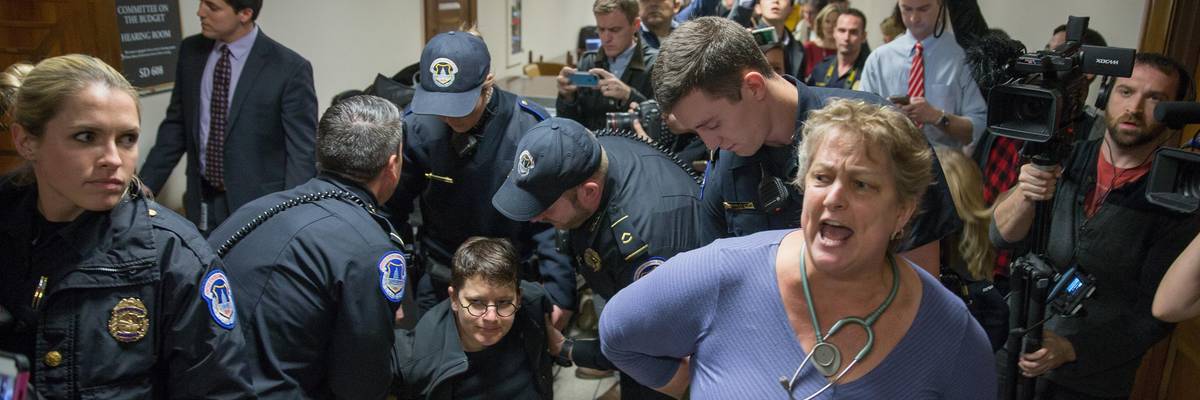
Demonstrators were arrested Tueday after interrupting the Senate Budget Committee as it debated the Republican tax bill, which includes a repeal of the ACA's individual mandate, potentially eliminating health coverage for 13 milion Americans. (Photo: Tasos Katopodis/Getty Images)
As the Senate Budget Committee debated the Republican tax bill on Tuesday before passing the proposal in a 12-11 vote, about a dozen people were arrested after disrupting the meeting to demand that senators reject the bill.
The demonstrators chanted, "Kill the bill, don't kill us," repeating the refrain that was commonly heard in protests against the Republicans' plan to repeal the Affordable Care Act (ACA) over the summer.
Earlier this month, the Senate Finance Committee added a repeal of the ACA's individual mandate to the bill, which the Congressional Budget Office estimated would leave 13 million Americans without health insurance. The revelation resulted in a huge push to defeat the bill by groups like Indivisible and other members of the Trump resistance, in recent weeks.
At the Dirksen Senate Office Building on Tuesday, the Capitol police arrested about a dozen protesters as the committee voted along part lines to advance the bill.
In addition to the impact the bill would have on health coverage, analyses by groups including the Tax Policy Center, the Joint Committee on Taxation, the Center for Budget and Policy Priorities, and Americans for Tax Fairness have all found that while middle class households may see tax cuts initially under the Republican plan, by 2027 most of the benefits of the proposal would be going to the wealthiest Americans.
Republicans including President Donald Trump have also insisted that average American families would benefit from the repeal of the estate tax under the plan--though the tax only applies to transfers or inheritances of wealth over $5.5 million, and actually only affects about 5,000 American families.
With the Senate Budget Committee vote cleared, the Senate is expected to vote on the bill as early as Thursday. Two Republicans, Sens. Ron Johnson (R-Wisc.) and Steve Daines (R-Mont.), have said they oppose the bill, while nine others have expressed concerns.
"We do have a few members who have concerns and were trying to address them.," said Majority Leader Mitch McConnell in a news conference. "We know we can't go forward until we have 50 people satisfied and that's what we're trying to get to."
The president was confident that the GOP would be able to rally enough support, describing his lunchtime meeting with the party as a "love fest" in a press conference, and adding that he and Republicans in Congress have a shared desire to get the bill passed.
Meanwhile, following its Day of Action on Monday, Indivisible urged progressives to target Sens. Susan Collins (R-Maine) and Bob Corker (R-Tenn.), both of whom indicated on Tuesday that some of their concerns regarding property tax deductions and deficit increases were being met in discussions, and that they were leaning towards supporting the legislation.
Sens. Jeff Flake (R-Ariz.), Marco Rubio (R-Fla.), Mike Lee (R-Utah), and John McCain were also identified as Republicans who could vote against their party's bill with enough pressure from constituents.
MoveOn.org, Indivisible, and Organizing for America held events Tuesday at Senators' offices and planned more demonstrations ahead of the expected Senate vote.
Dear Common Dreams reader, It’s been nearly 30 years since I co-founded Common Dreams with my late wife, Lina Newhouser. We had the radical notion that journalism should serve the public good, not corporate profits. It was clear to us from the outset what it would take to build such a project. No paid advertisements. No corporate sponsors. No millionaire publisher telling us what to think or do. Many people said we wouldn't last a year, but we proved those doubters wrong. Together with a tremendous team of journalists and dedicated staff, we built an independent media outlet free from the constraints of profits and corporate control. Our mission has always been simple: To inform. To inspire. To ignite change for the common good. Building Common Dreams was not easy. Our survival was never guaranteed. When you take on the most powerful forces—Wall Street greed, fossil fuel industry destruction, Big Tech lobbyists, and uber-rich oligarchs who have spent billions upon billions rigging the economy and democracy in their favor—the only bulwark you have is supporters who believe in your work. But here’s the urgent message from me today. It's never been this bad out there. And it's never been this hard to keep us going. At the very moment Common Dreams is most needed, the threats we face are intensifying. We need your support now more than ever. We don't accept corporate advertising and never will. We don't have a paywall because we don't think people should be blocked from critical news based on their ability to pay. Everything we do is funded by the donations of readers like you. When everyone does the little they can afford, we are strong. But if that support retreats or dries up, so do we. Will you donate now to make sure Common Dreams not only survives but thrives? —Craig Brown, Co-founder |
As the Senate Budget Committee debated the Republican tax bill on Tuesday before passing the proposal in a 12-11 vote, about a dozen people were arrested after disrupting the meeting to demand that senators reject the bill.
The demonstrators chanted, "Kill the bill, don't kill us," repeating the refrain that was commonly heard in protests against the Republicans' plan to repeal the Affordable Care Act (ACA) over the summer.
Earlier this month, the Senate Finance Committee added a repeal of the ACA's individual mandate to the bill, which the Congressional Budget Office estimated would leave 13 million Americans without health insurance. The revelation resulted in a huge push to defeat the bill by groups like Indivisible and other members of the Trump resistance, in recent weeks.
At the Dirksen Senate Office Building on Tuesday, the Capitol police arrested about a dozen protesters as the committee voted along part lines to advance the bill.
In addition to the impact the bill would have on health coverage, analyses by groups including the Tax Policy Center, the Joint Committee on Taxation, the Center for Budget and Policy Priorities, and Americans for Tax Fairness have all found that while middle class households may see tax cuts initially under the Republican plan, by 2027 most of the benefits of the proposal would be going to the wealthiest Americans.
Republicans including President Donald Trump have also insisted that average American families would benefit from the repeal of the estate tax under the plan--though the tax only applies to transfers or inheritances of wealth over $5.5 million, and actually only affects about 5,000 American families.
With the Senate Budget Committee vote cleared, the Senate is expected to vote on the bill as early as Thursday. Two Republicans, Sens. Ron Johnson (R-Wisc.) and Steve Daines (R-Mont.), have said they oppose the bill, while nine others have expressed concerns.
"We do have a few members who have concerns and were trying to address them.," said Majority Leader Mitch McConnell in a news conference. "We know we can't go forward until we have 50 people satisfied and that's what we're trying to get to."
The president was confident that the GOP would be able to rally enough support, describing his lunchtime meeting with the party as a "love fest" in a press conference, and adding that he and Republicans in Congress have a shared desire to get the bill passed.
Meanwhile, following its Day of Action on Monday, Indivisible urged progressives to target Sens. Susan Collins (R-Maine) and Bob Corker (R-Tenn.), both of whom indicated on Tuesday that some of their concerns regarding property tax deductions and deficit increases were being met in discussions, and that they were leaning towards supporting the legislation.
Sens. Jeff Flake (R-Ariz.), Marco Rubio (R-Fla.), Mike Lee (R-Utah), and John McCain were also identified as Republicans who could vote against their party's bill with enough pressure from constituents.
MoveOn.org, Indivisible, and Organizing for America held events Tuesday at Senators' offices and planned more demonstrations ahead of the expected Senate vote.
As the Senate Budget Committee debated the Republican tax bill on Tuesday before passing the proposal in a 12-11 vote, about a dozen people were arrested after disrupting the meeting to demand that senators reject the bill.
The demonstrators chanted, "Kill the bill, don't kill us," repeating the refrain that was commonly heard in protests against the Republicans' plan to repeal the Affordable Care Act (ACA) over the summer.
Earlier this month, the Senate Finance Committee added a repeal of the ACA's individual mandate to the bill, which the Congressional Budget Office estimated would leave 13 million Americans without health insurance. The revelation resulted in a huge push to defeat the bill by groups like Indivisible and other members of the Trump resistance, in recent weeks.
At the Dirksen Senate Office Building on Tuesday, the Capitol police arrested about a dozen protesters as the committee voted along part lines to advance the bill.
In addition to the impact the bill would have on health coverage, analyses by groups including the Tax Policy Center, the Joint Committee on Taxation, the Center for Budget and Policy Priorities, and Americans for Tax Fairness have all found that while middle class households may see tax cuts initially under the Republican plan, by 2027 most of the benefits of the proposal would be going to the wealthiest Americans.
Republicans including President Donald Trump have also insisted that average American families would benefit from the repeal of the estate tax under the plan--though the tax only applies to transfers or inheritances of wealth over $5.5 million, and actually only affects about 5,000 American families.
With the Senate Budget Committee vote cleared, the Senate is expected to vote on the bill as early as Thursday. Two Republicans, Sens. Ron Johnson (R-Wisc.) and Steve Daines (R-Mont.), have said they oppose the bill, while nine others have expressed concerns.
"We do have a few members who have concerns and were trying to address them.," said Majority Leader Mitch McConnell in a news conference. "We know we can't go forward until we have 50 people satisfied and that's what we're trying to get to."
The president was confident that the GOP would be able to rally enough support, describing his lunchtime meeting with the party as a "love fest" in a press conference, and adding that he and Republicans in Congress have a shared desire to get the bill passed.
Meanwhile, following its Day of Action on Monday, Indivisible urged progressives to target Sens. Susan Collins (R-Maine) and Bob Corker (R-Tenn.), both of whom indicated on Tuesday that some of their concerns regarding property tax deductions and deficit increases were being met in discussions, and that they were leaning towards supporting the legislation.
Sens. Jeff Flake (R-Ariz.), Marco Rubio (R-Fla.), Mike Lee (R-Utah), and John McCain were also identified as Republicans who could vote against their party's bill with enough pressure from constituents.
MoveOn.org, Indivisible, and Organizing for America held events Tuesday at Senators' offices and planned more demonstrations ahead of the expected Senate vote.