SUBSCRIBE TO OUR FREE NEWSLETTER
Daily news & progressive opinion—funded by the people, not the corporations—delivered straight to your inbox.
5
#000000
#FFFFFF
To donate by check, phone, or other method, see our More Ways to Give page.
Daily news & progressive opinion—funded by the people, not the corporations—delivered straight to your inbox.
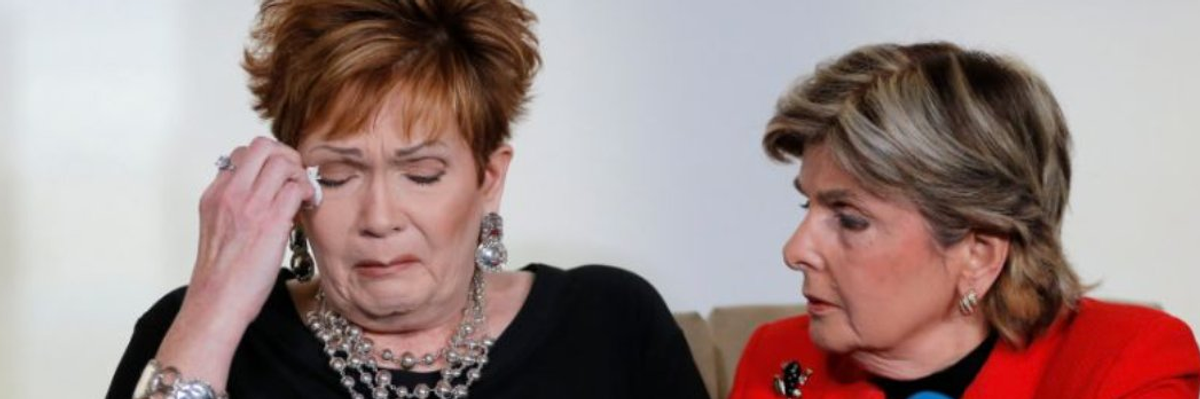
Beverly Young Nelson held a press conference on Monday, alleging that Alabama Senate candidate assaulted her when she was 16 years old. (Photo: RVAWonk/Twitter)
A second woman has come forward to accuse Alabama Senate candidate Roy Moore of sexually abusing her when she was a teenager, less than a week after the Washington Post published a report alleging similar abuses.
Beverly Young Nelson held a press conference on Monday to share her story, alleging that Moore had attempted to rape her in 1975. Nelson was 16 at the time and Moore was 28.
Nelson's press conference followed the release of poll results Monday showing that Moore--despite last week's bombshell allegations--continued to hold a lead over Democratic opponent Doug Jones. The survey was taken by Emerson College last Thursday through Saturday, just after the Post released its thoroughly-researched report alleging that Moore had sexually abused a 14-year-old girl when he was 32 and Alabama's assistant district attorney.
The Post report also included allegations that Moore had pursued romantic relationships with girls ranging in age from 16 to 18 when he was an adult. The age of consent in Alabama was and still is 16.
On Monday, Senate Majority Leader Mitch McConnell called on Moore to step aside in the race, saying "I believe the women" who accused Moore of pursuing relationships with them when they were teenagers and he was an adult in his 30s. Sen. Susan Collins (R-Maine) also urged Moore to leave the race, after previously saying he should step aside only if the allegations were found to be true.
Contrasting with the calls from Washington, D.C. on Monday, however, were the voices of evangelical Christian leaders. More than 50 pastors signed a letter pledging their support of Moore, accusing "the Washington establishment" of waging an "all-out war on his campaign."
The pastors praised Moore's resolve in fighting "the culture wars"--suggesting that the question of whether it's acceptable to sexually abuse teenagers is a topic up for debate between Alabama residents and the rest of the country--and urged voters to join them in supporting him.
About 86 percent of adults in Alabama are Christians and nearly half of those are evangelical Protestants. On Sunday, 37 percent of evangelicals in the state reported that they were more likely to vote for Moore following last week's allegations, according to a JMC Analytics poll.
Last year, President Donald Trump won 80 percent of evangelical voters' support in the general election, a month after an audio recording was released in which Trump bragged about sexually assaulting women.
Dear Common Dreams reader, It’s been nearly 30 years since I co-founded Common Dreams with my late wife, Lina Newhouser. We had the radical notion that journalism should serve the public good, not corporate profits. It was clear to us from the outset what it would take to build such a project. No paid advertisements. No corporate sponsors. No millionaire publisher telling us what to think or do. Many people said we wouldn't last a year, but we proved those doubters wrong. Together with a tremendous team of journalists and dedicated staff, we built an independent media outlet free from the constraints of profits and corporate control. Our mission has always been simple: To inform. To inspire. To ignite change for the common good. Building Common Dreams was not easy. Our survival was never guaranteed. When you take on the most powerful forces—Wall Street greed, fossil fuel industry destruction, Big Tech lobbyists, and uber-rich oligarchs who have spent billions upon billions rigging the economy and democracy in their favor—the only bulwark you have is supporters who believe in your work. But here’s the urgent message from me today. It's never been this bad out there. And it's never been this hard to keep us going. At the very moment Common Dreams is most needed, the threats we face are intensifying. We need your support now more than ever. We don't accept corporate advertising and never will. We don't have a paywall because we don't think people should be blocked from critical news based on their ability to pay. Everything we do is funded by the donations of readers like you. When everyone does the little they can afford, we are strong. But if that support retreats or dries up, so do we. Will you donate now to make sure Common Dreams not only survives but thrives? —Craig Brown, Co-founder |
A second woman has come forward to accuse Alabama Senate candidate Roy Moore of sexually abusing her when she was a teenager, less than a week after the Washington Post published a report alleging similar abuses.
Beverly Young Nelson held a press conference on Monday to share her story, alleging that Moore had attempted to rape her in 1975. Nelson was 16 at the time and Moore was 28.
Nelson's press conference followed the release of poll results Monday showing that Moore--despite last week's bombshell allegations--continued to hold a lead over Democratic opponent Doug Jones. The survey was taken by Emerson College last Thursday through Saturday, just after the Post released its thoroughly-researched report alleging that Moore had sexually abused a 14-year-old girl when he was 32 and Alabama's assistant district attorney.
The Post report also included allegations that Moore had pursued romantic relationships with girls ranging in age from 16 to 18 when he was an adult. The age of consent in Alabama was and still is 16.
On Monday, Senate Majority Leader Mitch McConnell called on Moore to step aside in the race, saying "I believe the women" who accused Moore of pursuing relationships with them when they were teenagers and he was an adult in his 30s. Sen. Susan Collins (R-Maine) also urged Moore to leave the race, after previously saying he should step aside only if the allegations were found to be true.
Contrasting with the calls from Washington, D.C. on Monday, however, were the voices of evangelical Christian leaders. More than 50 pastors signed a letter pledging their support of Moore, accusing "the Washington establishment" of waging an "all-out war on his campaign."
The pastors praised Moore's resolve in fighting "the culture wars"--suggesting that the question of whether it's acceptable to sexually abuse teenagers is a topic up for debate between Alabama residents and the rest of the country--and urged voters to join them in supporting him.
About 86 percent of adults in Alabama are Christians and nearly half of those are evangelical Protestants. On Sunday, 37 percent of evangelicals in the state reported that they were more likely to vote for Moore following last week's allegations, according to a JMC Analytics poll.
Last year, President Donald Trump won 80 percent of evangelical voters' support in the general election, a month after an audio recording was released in which Trump bragged about sexually assaulting women.
A second woman has come forward to accuse Alabama Senate candidate Roy Moore of sexually abusing her when she was a teenager, less than a week after the Washington Post published a report alleging similar abuses.
Beverly Young Nelson held a press conference on Monday to share her story, alleging that Moore had attempted to rape her in 1975. Nelson was 16 at the time and Moore was 28.
Nelson's press conference followed the release of poll results Monday showing that Moore--despite last week's bombshell allegations--continued to hold a lead over Democratic opponent Doug Jones. The survey was taken by Emerson College last Thursday through Saturday, just after the Post released its thoroughly-researched report alleging that Moore had sexually abused a 14-year-old girl when he was 32 and Alabama's assistant district attorney.
The Post report also included allegations that Moore had pursued romantic relationships with girls ranging in age from 16 to 18 when he was an adult. The age of consent in Alabama was and still is 16.
On Monday, Senate Majority Leader Mitch McConnell called on Moore to step aside in the race, saying "I believe the women" who accused Moore of pursuing relationships with them when they were teenagers and he was an adult in his 30s. Sen. Susan Collins (R-Maine) also urged Moore to leave the race, after previously saying he should step aside only if the allegations were found to be true.
Contrasting with the calls from Washington, D.C. on Monday, however, were the voices of evangelical Christian leaders. More than 50 pastors signed a letter pledging their support of Moore, accusing "the Washington establishment" of waging an "all-out war on his campaign."
The pastors praised Moore's resolve in fighting "the culture wars"--suggesting that the question of whether it's acceptable to sexually abuse teenagers is a topic up for debate between Alabama residents and the rest of the country--and urged voters to join them in supporting him.
About 86 percent of adults in Alabama are Christians and nearly half of those are evangelical Protestants. On Sunday, 37 percent of evangelicals in the state reported that they were more likely to vote for Moore following last week's allegations, according to a JMC Analytics poll.
Last year, President Donald Trump won 80 percent of evangelical voters' support in the general election, a month after an audio recording was released in which Trump bragged about sexually assaulting women.