SUBSCRIBE TO OUR FREE NEWSLETTER
Daily news & progressive opinion—funded by the people, not the corporations—delivered straight to your inbox.
5
#000000
#FFFFFF
To donate by check, phone, or other method, see our More Ways to Give page.
Daily news & progressive opinion—funded by the people, not the corporations—delivered straight to your inbox.
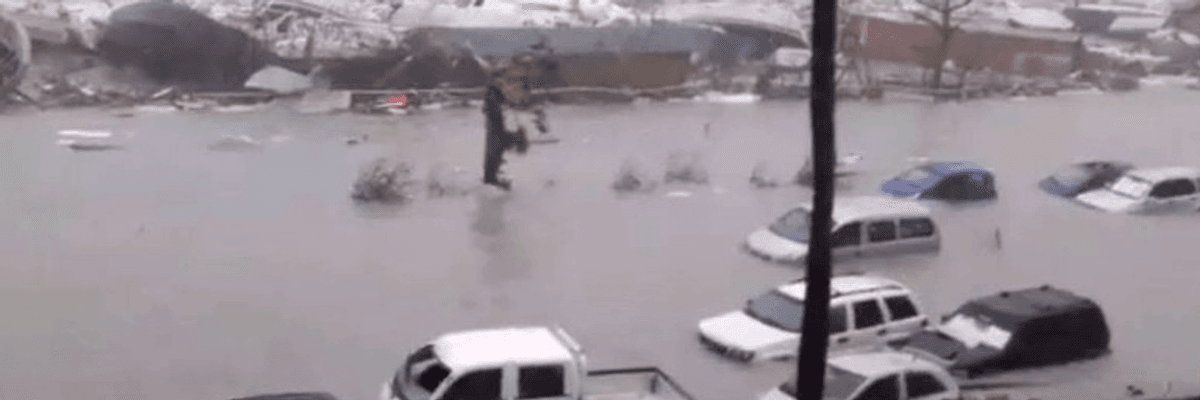
Parts of the Caribbean island of St. Martin were left flooded Wednesday after Hurricane Irma hit. (Image: Screenshot/CNN)
Some of the small Caribbean islands that are expected to suffer the most damage from Hurricane Irma have had some of the loudest voices in recent months regarding the effects of climate change--and the harm being done by leaders including President Donald Trump, who withdrew the United States from the Paris climate accord in June.
Images of the storm's destruction on St. Martin, Anguilla, and Barbuda on Wednesday confirmed many Caribbean leaders' concerns:
Last week at a meeting about infrastructure aid, the prime minister of St. Lucia, which lies to the south of Irma's path and has offered to serve as an evacuation point for its neighboring islands, implored developed nations to help the Caribbean to combat the effects of climate change.
Prime Minister Allen Chastanet said Small Island Developing States (SIDS) stand to sustain some of the most severe damage from climate change if larger, wealthier nations don't accept climate scientists' consensus that human activity contributes to global warming, and work to reverse the impact of greenhouse gases.
"I am going to keep pounding on the table and letting my voice be heard explaining that the SIDS cannot wait," said Chastanet. He mentioned the catastrophic damage brought in 2016 by Hurricane Matthew, a Category 5 storm that left Haiti with its worst humanitarian crisis since the earthquake that struck the country in 2010.
"There is no greater example of that than what took place in Haiti," he said. "Did we not know that Haiti was in a hurricane belt? Did we not know that there was clearly a trend of increasing storms?"
When Trump announced that he would stop implementing the Paris accord, declaring it "a bad deal" for Americans, the U.S. ended its contributions to the U.N. Green Climate Fund, which helps developing countries to reduce their greenhouse gas emissions and adapt to climate change. The decision was met with shock by leaders in the Caribbean, where islands are especially at risk for the rising sea levels and intense hurricanes brought by global warming.
"Climate change is a real problem and it requires all of us to leave a sustainable planet to the next generation," said Governor Ricardo Rossello of Puerto Rico, where officials issued flash flood warnings in preparation for Irma on Wednesday afternoon. "We call upon all local governments across the nation to continue to pass rules and regulations that protect our climate. As most of the world moves forward, our nation cannot sit idle and lag behind."
The Caribbean Hotel and Tourism Association, a coalition of businesses that contribute to one of the region's major economic sectors, spoke out against Trump's decision as well. "The Caribbean is one of the world's most vulnerable regions to the escalating effects of climate change," said the group. "The socio-economic consequences from rising sea levels and temperatures, increasingly violent storms and severe droughts, oil spills, mismanagement of waste, and coral bleaching are having mounting consequences, and left unchecked threaten the very viability of the region's economies and societies, and the health and welfare of Caribbean people."
While hurricanes are naturally occurring weather events, climate change has contributed to the severity of recent hurricanes and tropical storms, as noted by the tourism group. "Unfortunately, the physicality is very clear," said climate scientist Anders Levermann of the Potsdam Institute for Climate Impact Research in a statement to Bloomberg. "Hurricanes get their destructive energy from the warmth of the ocean, and the region's water temperatures are super elevated."
While the Caribbean nations in Irma's path have sounded alarms about climate change, Republican Gov. Rick Scott of Florida, which Irma is also expected to hit, has been skeptical of the link between human activity and global warming. In 2010 Scott said, "I've not been convinced that there's any man-made climate change," and this year he backed Trump's withdrawal from the Paris accord.
Dear Common Dreams reader, It’s been nearly 30 years since I co-founded Common Dreams with my late wife, Lina Newhouser. We had the radical notion that journalism should serve the public good, not corporate profits. It was clear to us from the outset what it would take to build such a project. No paid advertisements. No corporate sponsors. No millionaire publisher telling us what to think or do. Many people said we wouldn't last a year, but we proved those doubters wrong. Together with a tremendous team of journalists and dedicated staff, we built an independent media outlet free from the constraints of profits and corporate control. Our mission has always been simple: To inform. To inspire. To ignite change for the common good. Building Common Dreams was not easy. Our survival was never guaranteed. When you take on the most powerful forces—Wall Street greed, fossil fuel industry destruction, Big Tech lobbyists, and uber-rich oligarchs who have spent billions upon billions rigging the economy and democracy in their favor—the only bulwark you have is supporters who believe in your work. But here’s the urgent message from me today. It's never been this bad out there. And it's never been this hard to keep us going. At the very moment Common Dreams is most needed, the threats we face are intensifying. We need your support now more than ever. We don't accept corporate advertising and never will. We don't have a paywall because we don't think people should be blocked from critical news based on their ability to pay. Everything we do is funded by the donations of readers like you. When everyone does the little they can afford, we are strong. But if that support retreats or dries up, so do we. Will you donate now to make sure Common Dreams not only survives but thrives? —Craig Brown, Co-founder |
Some of the small Caribbean islands that are expected to suffer the most damage from Hurricane Irma have had some of the loudest voices in recent months regarding the effects of climate change--and the harm being done by leaders including President Donald Trump, who withdrew the United States from the Paris climate accord in June.
Images of the storm's destruction on St. Martin, Anguilla, and Barbuda on Wednesday confirmed many Caribbean leaders' concerns:
Last week at a meeting about infrastructure aid, the prime minister of St. Lucia, which lies to the south of Irma's path and has offered to serve as an evacuation point for its neighboring islands, implored developed nations to help the Caribbean to combat the effects of climate change.
Prime Minister Allen Chastanet said Small Island Developing States (SIDS) stand to sustain some of the most severe damage from climate change if larger, wealthier nations don't accept climate scientists' consensus that human activity contributes to global warming, and work to reverse the impact of greenhouse gases.
"I am going to keep pounding on the table and letting my voice be heard explaining that the SIDS cannot wait," said Chastanet. He mentioned the catastrophic damage brought in 2016 by Hurricane Matthew, a Category 5 storm that left Haiti with its worst humanitarian crisis since the earthquake that struck the country in 2010.
"There is no greater example of that than what took place in Haiti," he said. "Did we not know that Haiti was in a hurricane belt? Did we not know that there was clearly a trend of increasing storms?"
When Trump announced that he would stop implementing the Paris accord, declaring it "a bad deal" for Americans, the U.S. ended its contributions to the U.N. Green Climate Fund, which helps developing countries to reduce their greenhouse gas emissions and adapt to climate change. The decision was met with shock by leaders in the Caribbean, where islands are especially at risk for the rising sea levels and intense hurricanes brought by global warming.
"Climate change is a real problem and it requires all of us to leave a sustainable planet to the next generation," said Governor Ricardo Rossello of Puerto Rico, where officials issued flash flood warnings in preparation for Irma on Wednesday afternoon. "We call upon all local governments across the nation to continue to pass rules and regulations that protect our climate. As most of the world moves forward, our nation cannot sit idle and lag behind."
The Caribbean Hotel and Tourism Association, a coalition of businesses that contribute to one of the region's major economic sectors, spoke out against Trump's decision as well. "The Caribbean is one of the world's most vulnerable regions to the escalating effects of climate change," said the group. "The socio-economic consequences from rising sea levels and temperatures, increasingly violent storms and severe droughts, oil spills, mismanagement of waste, and coral bleaching are having mounting consequences, and left unchecked threaten the very viability of the region's economies and societies, and the health and welfare of Caribbean people."
While hurricanes are naturally occurring weather events, climate change has contributed to the severity of recent hurricanes and tropical storms, as noted by the tourism group. "Unfortunately, the physicality is very clear," said climate scientist Anders Levermann of the Potsdam Institute for Climate Impact Research in a statement to Bloomberg. "Hurricanes get their destructive energy from the warmth of the ocean, and the region's water temperatures are super elevated."
While the Caribbean nations in Irma's path have sounded alarms about climate change, Republican Gov. Rick Scott of Florida, which Irma is also expected to hit, has been skeptical of the link between human activity and global warming. In 2010 Scott said, "I've not been convinced that there's any man-made climate change," and this year he backed Trump's withdrawal from the Paris accord.
Some of the small Caribbean islands that are expected to suffer the most damage from Hurricane Irma have had some of the loudest voices in recent months regarding the effects of climate change--and the harm being done by leaders including President Donald Trump, who withdrew the United States from the Paris climate accord in June.
Images of the storm's destruction on St. Martin, Anguilla, and Barbuda on Wednesday confirmed many Caribbean leaders' concerns:
Last week at a meeting about infrastructure aid, the prime minister of St. Lucia, which lies to the south of Irma's path and has offered to serve as an evacuation point for its neighboring islands, implored developed nations to help the Caribbean to combat the effects of climate change.
Prime Minister Allen Chastanet said Small Island Developing States (SIDS) stand to sustain some of the most severe damage from climate change if larger, wealthier nations don't accept climate scientists' consensus that human activity contributes to global warming, and work to reverse the impact of greenhouse gases.
"I am going to keep pounding on the table and letting my voice be heard explaining that the SIDS cannot wait," said Chastanet. He mentioned the catastrophic damage brought in 2016 by Hurricane Matthew, a Category 5 storm that left Haiti with its worst humanitarian crisis since the earthquake that struck the country in 2010.
"There is no greater example of that than what took place in Haiti," he said. "Did we not know that Haiti was in a hurricane belt? Did we not know that there was clearly a trend of increasing storms?"
When Trump announced that he would stop implementing the Paris accord, declaring it "a bad deal" for Americans, the U.S. ended its contributions to the U.N. Green Climate Fund, which helps developing countries to reduce their greenhouse gas emissions and adapt to climate change. The decision was met with shock by leaders in the Caribbean, where islands are especially at risk for the rising sea levels and intense hurricanes brought by global warming.
"Climate change is a real problem and it requires all of us to leave a sustainable planet to the next generation," said Governor Ricardo Rossello of Puerto Rico, where officials issued flash flood warnings in preparation for Irma on Wednesday afternoon. "We call upon all local governments across the nation to continue to pass rules and regulations that protect our climate. As most of the world moves forward, our nation cannot sit idle and lag behind."
The Caribbean Hotel and Tourism Association, a coalition of businesses that contribute to one of the region's major economic sectors, spoke out against Trump's decision as well. "The Caribbean is one of the world's most vulnerable regions to the escalating effects of climate change," said the group. "The socio-economic consequences from rising sea levels and temperatures, increasingly violent storms and severe droughts, oil spills, mismanagement of waste, and coral bleaching are having mounting consequences, and left unchecked threaten the very viability of the region's economies and societies, and the health and welfare of Caribbean people."
While hurricanes are naturally occurring weather events, climate change has contributed to the severity of recent hurricanes and tropical storms, as noted by the tourism group. "Unfortunately, the physicality is very clear," said climate scientist Anders Levermann of the Potsdam Institute for Climate Impact Research in a statement to Bloomberg. "Hurricanes get their destructive energy from the warmth of the ocean, and the region's water temperatures are super elevated."
While the Caribbean nations in Irma's path have sounded alarms about climate change, Republican Gov. Rick Scott of Florida, which Irma is also expected to hit, has been skeptical of the link between human activity and global warming. In 2010 Scott said, "I've not been convinced that there's any man-made climate change," and this year he backed Trump's withdrawal from the Paris accord.