SUBSCRIBE TO OUR FREE NEWSLETTER
Daily news & progressive opinion—funded by the people, not the corporations—delivered straight to your inbox.
5
#000000
#FFFFFF
To donate by check, phone, or other method, see our More Ways to Give page.
Daily news & progressive opinion—funded by the people, not the corporations—delivered straight to your inbox.
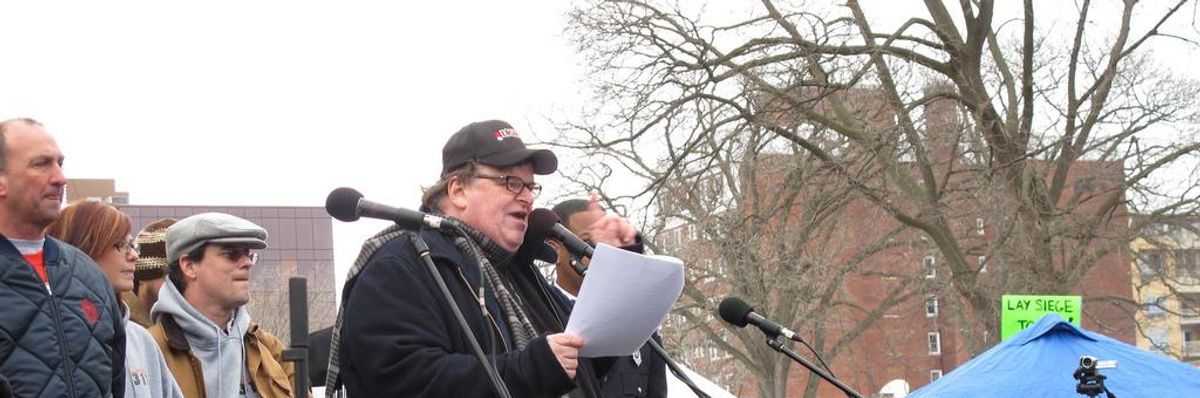
Michael Moore predicted a Trump win in 2016, and is warning that despite low approval ratings, the president could win a second term in 2020. (Photo: Bill Littman/Flickr/cc)
Activist and filmmaker Michael Moore is cautioning against complacency during President Donald Trump's first term--warning progressives that the president's historically low approval ratings don't necessarily point to a Trump defeat in 2020.
In an interview with Fast Company on Monday, Moore said he predicts Trump will win a second term if he runs for reelection. "I should say re-appointed, because we will have an even larger population that will vote against him in 2020," he noted. "But he will win those electoral states as it stands now."
Moore predicted that Trump would win in 2016, despite poll results that weren't much more favorable toward him than his current approval ratings are. Last September, a Washington Post poll found that 62 percent of Americans didn't think he was qualified to be president. A month earlier, an NBC poll found that 64 percent did not find Trump to be trustworthy, to have the temperament to serve as president, to share their values, or to care about people like them. Yet Trump's unexpected electoral victories in crucial states including Pennsylvania, Michigan, and Wisconsin won him the White House.
In those states, Trump now has approval ratings between 33 and 36 percent, as NBC political correspondent Steve Kornacki noted last week--similar to how he polled there during the campaign.
"Is this just another version of what we saw last year when his negative rating among Republicans looked alarmingly high through Election Day--when they snapped back and voted for him at a nearly 90 percent clip?" Kornacki wrote.
To avoid another Trump win, Moore is pushing for the adoption of the National Popular Vote interstate compact, an agreement made between states that would award every state's electoral votes to the winner of the popular vote. The proposal has been approved in 10 states and Washington, D.C., but is far from winning the support it needs to be enacted. With that in mind, the filmmaker also says the Democratic Party must mobilize to offer Americans a clear vision of how it and its nominees will work to improve their lives, and a real alternative to the Republican agenda.
"Eight million Obama voters voted for Trump. We just need to convince a few of them--hold out our hand and bring them back. Can we do that? I think we can do that," he said. "We do have to do some work to bring in people who would be sympathetic, and maybe they were justifiably upset, angry, and hurt and whatever, and we get that. But now they've seen how dangerous it is to have [Trump] as president of the United States. So I think we can bring enough people back."
In recent months Sens. Elizabeth Warren (D-Mass.) and Bernie Sanders (I-Vt.) have worked on this front, imploring Democrats to embrace progressive policies like single-payer healthcare as platform issues. Sen. Kirsten Gillibrand (D-N.Y.) became the latest Democrat to publicly support the idea when she said in June, "We should have Medicare for all in this country."
But far more Democrats will need to come out in favor of the idea in order for the party to reflect Americans' views on healthcare: in a Pew Research poll in June, 60 percent said the federal government should provide healthcare to its citizens, while 33 percent said they specifically supported a single-payer system--up five percentage points from January and 12 points from 2014.
In a new video on Monday, former Labor Secretary Robert Reich also argued that Democrats could defeat Trump if they rally around a bold, progressive agenda.
Watch:
Dear Common Dreams reader, It’s been nearly 30 years since I co-founded Common Dreams with my late wife, Lina Newhouser. We had the radical notion that journalism should serve the public good, not corporate profits. It was clear to us from the outset what it would take to build such a project. No paid advertisements. No corporate sponsors. No millionaire publisher telling us what to think or do. Many people said we wouldn't last a year, but we proved those doubters wrong. Together with a tremendous team of journalists and dedicated staff, we built an independent media outlet free from the constraints of profits and corporate control. Our mission has always been simple: To inform. To inspire. To ignite change for the common good. Building Common Dreams was not easy. Our survival was never guaranteed. When you take on the most powerful forces—Wall Street greed, fossil fuel industry destruction, Big Tech lobbyists, and uber-rich oligarchs who have spent billions upon billions rigging the economy and democracy in their favor—the only bulwark you have is supporters who believe in your work. But here’s the urgent message from me today. It's never been this bad out there. And it's never been this hard to keep us going. At the very moment Common Dreams is most needed, the threats we face are intensifying. We need your support now more than ever. We don't accept corporate advertising and never will. We don't have a paywall because we don't think people should be blocked from critical news based on their ability to pay. Everything we do is funded by the donations of readers like you. When everyone does the little they can afford, we are strong. But if that support retreats or dries up, so do we. Will you donate now to make sure Common Dreams not only survives but thrives? —Craig Brown, Co-founder |
Activist and filmmaker Michael Moore is cautioning against complacency during President Donald Trump's first term--warning progressives that the president's historically low approval ratings don't necessarily point to a Trump defeat in 2020.
In an interview with Fast Company on Monday, Moore said he predicts Trump will win a second term if he runs for reelection. "I should say re-appointed, because we will have an even larger population that will vote against him in 2020," he noted. "But he will win those electoral states as it stands now."
Moore predicted that Trump would win in 2016, despite poll results that weren't much more favorable toward him than his current approval ratings are. Last September, a Washington Post poll found that 62 percent of Americans didn't think he was qualified to be president. A month earlier, an NBC poll found that 64 percent did not find Trump to be trustworthy, to have the temperament to serve as president, to share their values, or to care about people like them. Yet Trump's unexpected electoral victories in crucial states including Pennsylvania, Michigan, and Wisconsin won him the White House.
In those states, Trump now has approval ratings between 33 and 36 percent, as NBC political correspondent Steve Kornacki noted last week--similar to how he polled there during the campaign.
"Is this just another version of what we saw last year when his negative rating among Republicans looked alarmingly high through Election Day--when they snapped back and voted for him at a nearly 90 percent clip?" Kornacki wrote.
To avoid another Trump win, Moore is pushing for the adoption of the National Popular Vote interstate compact, an agreement made between states that would award every state's electoral votes to the winner of the popular vote. The proposal has been approved in 10 states and Washington, D.C., but is far from winning the support it needs to be enacted. With that in mind, the filmmaker also says the Democratic Party must mobilize to offer Americans a clear vision of how it and its nominees will work to improve their lives, and a real alternative to the Republican agenda.
"Eight million Obama voters voted for Trump. We just need to convince a few of them--hold out our hand and bring them back. Can we do that? I think we can do that," he said. "We do have to do some work to bring in people who would be sympathetic, and maybe they were justifiably upset, angry, and hurt and whatever, and we get that. But now they've seen how dangerous it is to have [Trump] as president of the United States. So I think we can bring enough people back."
In recent months Sens. Elizabeth Warren (D-Mass.) and Bernie Sanders (I-Vt.) have worked on this front, imploring Democrats to embrace progressive policies like single-payer healthcare as platform issues. Sen. Kirsten Gillibrand (D-N.Y.) became the latest Democrat to publicly support the idea when she said in June, "We should have Medicare for all in this country."
But far more Democrats will need to come out in favor of the idea in order for the party to reflect Americans' views on healthcare: in a Pew Research poll in June, 60 percent said the federal government should provide healthcare to its citizens, while 33 percent said they specifically supported a single-payer system--up five percentage points from January and 12 points from 2014.
In a new video on Monday, former Labor Secretary Robert Reich also argued that Democrats could defeat Trump if they rally around a bold, progressive agenda.
Watch:
Activist and filmmaker Michael Moore is cautioning against complacency during President Donald Trump's first term--warning progressives that the president's historically low approval ratings don't necessarily point to a Trump defeat in 2020.
In an interview with Fast Company on Monday, Moore said he predicts Trump will win a second term if he runs for reelection. "I should say re-appointed, because we will have an even larger population that will vote against him in 2020," he noted. "But he will win those electoral states as it stands now."
Moore predicted that Trump would win in 2016, despite poll results that weren't much more favorable toward him than his current approval ratings are. Last September, a Washington Post poll found that 62 percent of Americans didn't think he was qualified to be president. A month earlier, an NBC poll found that 64 percent did not find Trump to be trustworthy, to have the temperament to serve as president, to share their values, or to care about people like them. Yet Trump's unexpected electoral victories in crucial states including Pennsylvania, Michigan, and Wisconsin won him the White House.
In those states, Trump now has approval ratings between 33 and 36 percent, as NBC political correspondent Steve Kornacki noted last week--similar to how he polled there during the campaign.
"Is this just another version of what we saw last year when his negative rating among Republicans looked alarmingly high through Election Day--when they snapped back and voted for him at a nearly 90 percent clip?" Kornacki wrote.
To avoid another Trump win, Moore is pushing for the adoption of the National Popular Vote interstate compact, an agreement made between states that would award every state's electoral votes to the winner of the popular vote. The proposal has been approved in 10 states and Washington, D.C., but is far from winning the support it needs to be enacted. With that in mind, the filmmaker also says the Democratic Party must mobilize to offer Americans a clear vision of how it and its nominees will work to improve their lives, and a real alternative to the Republican agenda.
"Eight million Obama voters voted for Trump. We just need to convince a few of them--hold out our hand and bring them back. Can we do that? I think we can do that," he said. "We do have to do some work to bring in people who would be sympathetic, and maybe they were justifiably upset, angry, and hurt and whatever, and we get that. But now they've seen how dangerous it is to have [Trump] as president of the United States. So I think we can bring enough people back."
In recent months Sens. Elizabeth Warren (D-Mass.) and Bernie Sanders (I-Vt.) have worked on this front, imploring Democrats to embrace progressive policies like single-payer healthcare as platform issues. Sen. Kirsten Gillibrand (D-N.Y.) became the latest Democrat to publicly support the idea when she said in June, "We should have Medicare for all in this country."
But far more Democrats will need to come out in favor of the idea in order for the party to reflect Americans' views on healthcare: in a Pew Research poll in June, 60 percent said the federal government should provide healthcare to its citizens, while 33 percent said they specifically supported a single-payer system--up five percentage points from January and 12 points from 2014.
In a new video on Monday, former Labor Secretary Robert Reich also argued that Democrats could defeat Trump if they rally around a bold, progressive agenda.
Watch: