SUBSCRIBE TO OUR FREE NEWSLETTER
Daily news & progressive opinion—funded by the people, not the corporations—delivered straight to your inbox.
5
#000000
#FFFFFF
To donate by check, phone, or other method, see our More Ways to Give page.
Daily news & progressive opinion—funded by the people, not the corporations—delivered straight to your inbox.
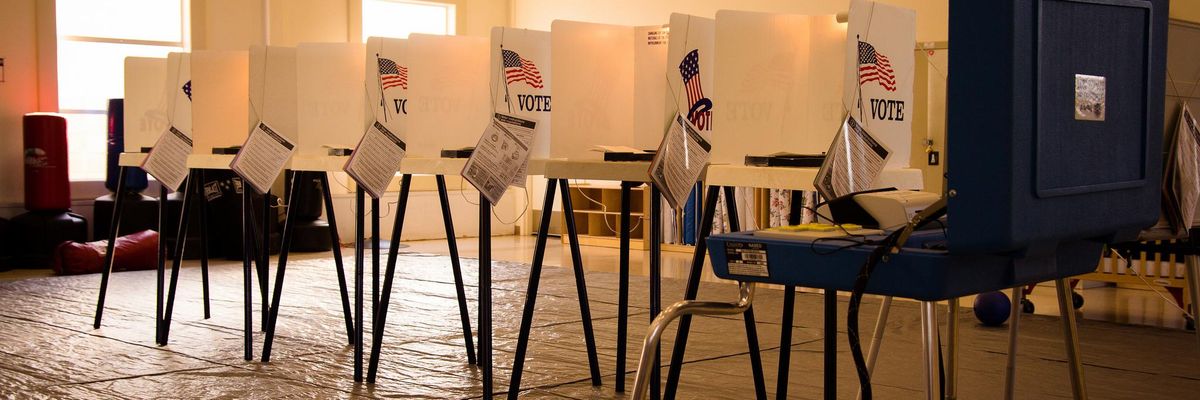
President Donald Trump appears to have successfully convinced his supporters that millions of illegal votes were cast in the 2016 election. (Photo: Stephen Velasco/Flickr/cc)
Identifying it as part of the "slippery slope to dictatorship," critics are pointing to a new poll as evidence that Trump's base would likely support him even if he were to propose postponing the 2020 elections.
Sixty-eight percent of voters polled by two researchers believed the president's repeated claims that widespread "voter fraud" cost him the popular vote in the 2016 election, and 52 percent said they would support postponing the 2020 election in order to make sure only "legal" citizens cast ballots. Fifty-six percent answered that they would support the measure if Trump and Congress approved of it.
"At a minimum, [the survey results] show that a substantial number of Republicans are amenable to violations of democratic norms that are more flagrant than what is typically propose."--Ariel Malka and Yphtach Lelkes, Washington Post
While the researchers who conducted the study, Ariel Malka of Yeshiva University and Yphtach Lelkes of University of Pennsylvania, noted in the Washington Post that respondents were answering a hypothetical question and their opinions could change if a delayed election were actually proposed, they stressed the disturbing nature of the survey's results:
At a minimum, they show that a substantial number of Republicans are amenable to violations of democratic norms that are more flagrant than what is typically proposed (or studied). And although the ensuing chaos could turn more Republicans against this kind of proposal, it is also conceivable that a high-stakes and polarized debate would do the exact opposite. Postponing the 2020 presidential election is not something that Trump or anyone in his administration has even hinted at, but for many in his constituency floating such an idea may not be a step too far.
The poll shocked many, with journalists and Trump critics noting that while Trump's supporters may be in the minority, their unwavering support of a president who has repeatedly challenged democratic norms is alarming--and the opinions expressed in the survey stoke fears that the Trump administration has set the U.S. down the path to authoritarianism.
This is how it starts folks. If you think what happened in Russia Turkey Iran etc can't happen here time to wake up! https://t.co/8yf5cXufB9
-- Reza Aslan (@rezaaslan) August 10, 2017
Others noted that the Republican leadership's failure to effectively challenge Trump in the first six months of his term begs the question of whether it would push back against the president and his base, should a delayed election be suggested.
Dear Common Dreams reader, It’s been nearly 30 years since I co-founded Common Dreams with my late wife, Lina Newhouser. We had the radical notion that journalism should serve the public good, not corporate profits. It was clear to us from the outset what it would take to build such a project. No paid advertisements. No corporate sponsors. No millionaire publisher telling us what to think or do. Many people said we wouldn't last a year, but we proved those doubters wrong. Together with a tremendous team of journalists and dedicated staff, we built an independent media outlet free from the constraints of profits and corporate control. Our mission has always been simple: To inform. To inspire. To ignite change for the common good. Building Common Dreams was not easy. Our survival was never guaranteed. When you take on the most powerful forces—Wall Street greed, fossil fuel industry destruction, Big Tech lobbyists, and uber-rich oligarchs who have spent billions upon billions rigging the economy and democracy in their favor—the only bulwark you have is supporters who believe in your work. But here’s the urgent message from me today. It's never been this bad out there. And it's never been this hard to keep us going. At the very moment Common Dreams is most needed, the threats we face are intensifying. We need your support now more than ever. We don't accept corporate advertising and never will. We don't have a paywall because we don't think people should be blocked from critical news based on their ability to pay. Everything we do is funded by the donations of readers like you. When everyone does the little they can afford, we are strong. But if that support retreats or dries up, so do we. Will you donate now to make sure Common Dreams not only survives but thrives? —Craig Brown, Co-founder |
Identifying it as part of the "slippery slope to dictatorship," critics are pointing to a new poll as evidence that Trump's base would likely support him even if he were to propose postponing the 2020 elections.
Sixty-eight percent of voters polled by two researchers believed the president's repeated claims that widespread "voter fraud" cost him the popular vote in the 2016 election, and 52 percent said they would support postponing the 2020 election in order to make sure only "legal" citizens cast ballots. Fifty-six percent answered that they would support the measure if Trump and Congress approved of it.
"At a minimum, [the survey results] show that a substantial number of Republicans are amenable to violations of democratic norms that are more flagrant than what is typically propose."--Ariel Malka and Yphtach Lelkes, Washington Post
While the researchers who conducted the study, Ariel Malka of Yeshiva University and Yphtach Lelkes of University of Pennsylvania, noted in the Washington Post that respondents were answering a hypothetical question and their opinions could change if a delayed election were actually proposed, they stressed the disturbing nature of the survey's results:
At a minimum, they show that a substantial number of Republicans are amenable to violations of democratic norms that are more flagrant than what is typically proposed (or studied). And although the ensuing chaos could turn more Republicans against this kind of proposal, it is also conceivable that a high-stakes and polarized debate would do the exact opposite. Postponing the 2020 presidential election is not something that Trump or anyone in his administration has even hinted at, but for many in his constituency floating such an idea may not be a step too far.
The poll shocked many, with journalists and Trump critics noting that while Trump's supporters may be in the minority, their unwavering support of a president who has repeatedly challenged democratic norms is alarming--and the opinions expressed in the survey stoke fears that the Trump administration has set the U.S. down the path to authoritarianism.
This is how it starts folks. If you think what happened in Russia Turkey Iran etc can't happen here time to wake up! https://t.co/8yf5cXufB9
-- Reza Aslan (@rezaaslan) August 10, 2017
Others noted that the Republican leadership's failure to effectively challenge Trump in the first six months of his term begs the question of whether it would push back against the president and his base, should a delayed election be suggested.
Identifying it as part of the "slippery slope to dictatorship," critics are pointing to a new poll as evidence that Trump's base would likely support him even if he were to propose postponing the 2020 elections.
Sixty-eight percent of voters polled by two researchers believed the president's repeated claims that widespread "voter fraud" cost him the popular vote in the 2016 election, and 52 percent said they would support postponing the 2020 election in order to make sure only "legal" citizens cast ballots. Fifty-six percent answered that they would support the measure if Trump and Congress approved of it.
"At a minimum, [the survey results] show that a substantial number of Republicans are amenable to violations of democratic norms that are more flagrant than what is typically propose."--Ariel Malka and Yphtach Lelkes, Washington Post
While the researchers who conducted the study, Ariel Malka of Yeshiva University and Yphtach Lelkes of University of Pennsylvania, noted in the Washington Post that respondents were answering a hypothetical question and their opinions could change if a delayed election were actually proposed, they stressed the disturbing nature of the survey's results:
At a minimum, they show that a substantial number of Republicans are amenable to violations of democratic norms that are more flagrant than what is typically proposed (or studied). And although the ensuing chaos could turn more Republicans against this kind of proposal, it is also conceivable that a high-stakes and polarized debate would do the exact opposite. Postponing the 2020 presidential election is not something that Trump or anyone in his administration has even hinted at, but for many in his constituency floating such an idea may not be a step too far.
The poll shocked many, with journalists and Trump critics noting that while Trump's supporters may be in the minority, their unwavering support of a president who has repeatedly challenged democratic norms is alarming--and the opinions expressed in the survey stoke fears that the Trump administration has set the U.S. down the path to authoritarianism.
This is how it starts folks. If you think what happened in Russia Turkey Iran etc can't happen here time to wake up! https://t.co/8yf5cXufB9
-- Reza Aslan (@rezaaslan) August 10, 2017
Others noted that the Republican leadership's failure to effectively challenge Trump in the first six months of his term begs the question of whether it would push back against the president and his base, should a delayed election be suggested.