

SUBSCRIBE TO OUR FREE NEWSLETTER
Daily news & progressive opinion—funded by the people, not the corporations—delivered straight to your inbox.
5
#000000
#FFFFFF
To donate by check, phone, or other method, see our More Ways to Give page.

As a group of 13 Republican senators--all of them both white and male--continue to craft in secret their version of a major healthcare overhaul bill, a new analysis shows these lawmakers have received approximately double the amount of campaign contributions from the health insurance and pharmaceutical industries than their Senate colleagues who have been so far excluded from the process.
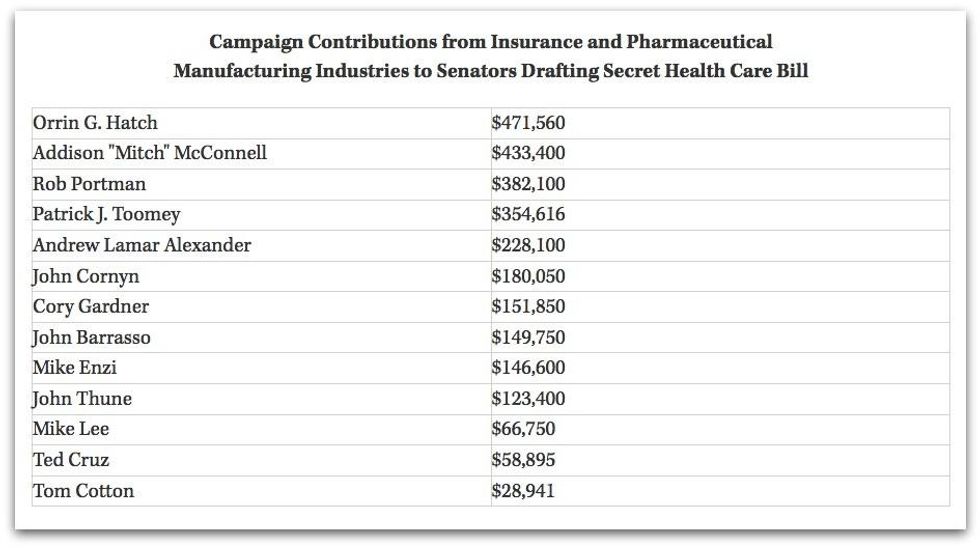
According to Maplight, a watchdog that tracks campaign spending, those chosen by Majority Leader Mitch McConnell (R-Ky.) to draft the Senate's version of Trumpcare legislation have collected, on average, $214,000 from companies that will be directly affected by major changes to the nation's healthcare system. That compares to an average of just $115,000 bestowed upon members not participating in the closed-door negotiations. Four of the 13 have received more than $300,000 from the insurance and pharmaceutical industries between November 2010 and November 2016, the timeframe covered by the analysis. Both McConnell and Sen. Orin Hatch of Utah have received well over $400,000 during that time period.
Here's the breakdown:
While it was reported that the Senate group would release as a draft their bill on Thursday, the secretive process--in addition to trickles of information about what the bill may contain--has been the source of public outrage and protest.
As Maplight notes, "The lack of transparency and public information about the bill makes it impossible to analyze the impact on the insurance and pharmaceutical industries, but indications from stock prices earlier this year showed investors were betting GOP legislation would be a boon for pharmaceutical companies and health insurers."
As a group of 13 Republican senators--all of them both white and male--continue to craft in secret their version of a major healthcare overhaul bill, a new analysis shows these lawmakers have received approximately double the amount of campaign contributions from the health insurance and pharmaceutical industries than their Senate colleagues who have been so far excluded from the process.
According to Maplight, a watchdog that tracks campaign spending, those chosen by Majority Leader Mitch McConnell (R-Ky.) to draft the Senate's version of Trumpcare legislation have collected, on average, $214,000 from companies that will be directly affected by major changes to the nation's healthcare system. That compares to an average of just $115,000 bestowed upon members not participating in the closed-door negotiations. Four of the 13 have received more than $300,000 from the insurance and pharmaceutical industries between November 2010 and November 2016, the timeframe covered by the analysis. Both McConnell and Sen. Orin Hatch of Utah have received well over $400,000 during that time period.
Here's the breakdown:
While it was reported that the Senate group would release as a draft their bill on Thursday, the secretive process--in addition to trickles of information about what the bill may contain--has been the source of public outrage and protest.
As Maplight notes, "The lack of transparency and public information about the bill makes it impossible to analyze the impact on the insurance and pharmaceutical industries, but indications from stock prices earlier this year showed investors were betting GOP legislation would be a boon for pharmaceutical companies and health insurers."
As a group of 13 Republican senators--all of them both white and male--continue to craft in secret their version of a major healthcare overhaul bill, a new analysis shows these lawmakers have received approximately double the amount of campaign contributions from the health insurance and pharmaceutical industries than their Senate colleagues who have been so far excluded from the process.
According to Maplight, a watchdog that tracks campaign spending, those chosen by Majority Leader Mitch McConnell (R-Ky.) to draft the Senate's version of Trumpcare legislation have collected, on average, $214,000 from companies that will be directly affected by major changes to the nation's healthcare system. That compares to an average of just $115,000 bestowed upon members not participating in the closed-door negotiations. Four of the 13 have received more than $300,000 from the insurance and pharmaceutical industries between November 2010 and November 2016, the timeframe covered by the analysis. Both McConnell and Sen. Orin Hatch of Utah have received well over $400,000 during that time period.
Here's the breakdown:
While it was reported that the Senate group would release as a draft their bill on Thursday, the secretive process--in addition to trickles of information about what the bill may contain--has been the source of public outrage and protest.
As Maplight notes, "The lack of transparency and public information about the bill makes it impossible to analyze the impact on the insurance and pharmaceutical industries, but indications from stock prices earlier this year showed investors were betting GOP legislation would be a boon for pharmaceutical companies and health insurers."

