SUBSCRIBE TO OUR FREE NEWSLETTER
Daily news & progressive opinion—funded by the people, not the corporations—delivered straight to your inbox.
5
#000000
#FFFFFF
To donate by check, phone, or other method, see our More Ways to Give page.
With leaders of civil society, governments, and business interests in Lima, Peru this week discussing what an international agreement to address climate change will ultimately entail, a growing focus has turned to how much longer the fossil fuel industry can avoid what scientists and financial experts say is now a fundamental truth: if the planet is to be saved from cataclysmic global warming, an enormous proportion of untapped coal, oil, and gas reserves will need to remain in the ground.
Speaking from the Conference of the Parties (COP20) summit on Tuesday, Christiana Figueres, who heads the United Nation Framework Convention on Climate Change (UNFCCC), said evidence is clearly mounting "that investment in fossil fuel is actually a high risk" and "getting more and more risky" with each passing day.
As the business pages of Bloomberg reflected on Tuesday, "With representatives from more than 190 countries gathered to discuss climate rules in Lima, the argument that burning all the world's known oil, gas and coal reserves would overwhelm the atmosphere is moving beyond the realm of environmental activists." According to Bloomberg the idea is increasingly hitting the mainstream, with large international investor groups and top banks studying the issue seriously:
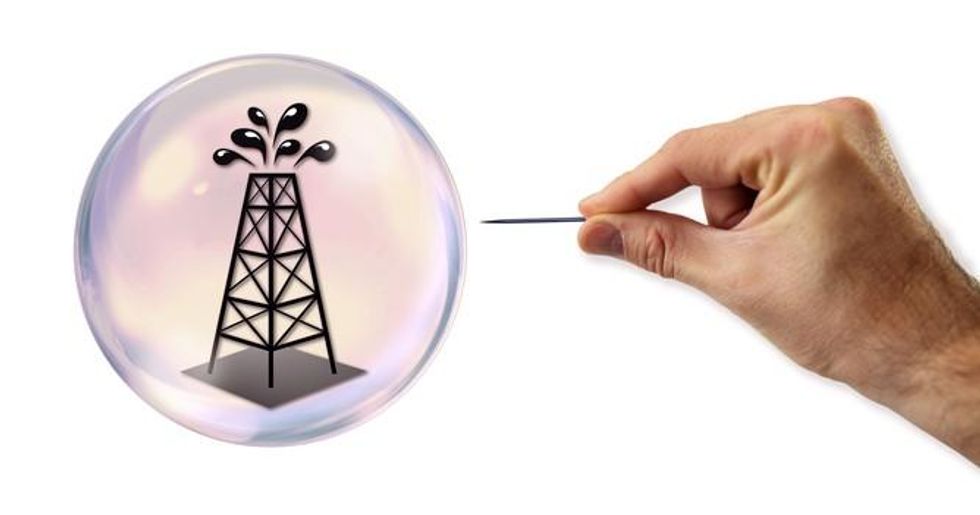
The concept gaining traction from Wall Street to the City of London is simple. Limits on emissions of carbon dioxide will be necessary to hold temperature increases to 2 degrees Celsius, the maximum climate scientists say is advisable. Without technologies to capture the waste gases from combusting fossil fuels, a majority of known oil, gas and coal deposits would have to stay underground. Once that point is reached, they become stranded.
To explore the idea of leaving those reserves in the ground--which economists call "stranded assets"--Bloomberg spoke with several experts on the subject, including former president Al Gore, who compared the global economy's reliance on fossil fuel extraction as "absurd" a financial situation as the one preceding the 2008 collapse of the U.S. housing market which unleashed a global domino effect of economic misery.
"Investors who haven't yet come to grips with the stranding problem are like the classic scene in the Road Runner cartoons where the coyote runs off the edge of the cliff, and his legs keep moving for quite a long time before gravity takes hold," Gore said. "There are investors out there whose legs are moving in mid-air."
Though advocates of climate justice, progressive-minded (as well as clear-eyed) economists, and other experts have long concluded that the combined math and science of climate change compels humanity to end its century-long addiction to fossil fuels, the elite investor class and world leaders have been much slower to admit the Earth has limits to the amount of carbon and other greenhouse gases it can absorb.
Ahead of the talks, U.S. Climate Envoy Todd Stern made news by openly acknowledging that it was "obvious" that a proportion of what the coal, oil, and gas companies count as financial assets cannot possibly be dug out of the ground and burned if the world hopes to meet global targets. The solution, Stern said, will ultimately be one that leaves "a lot of fossil fuel assets in the ground."
With or without the endorsement of powerful governments and prominent business voices, however, the global grassroots movement for fossil fuel divestment has vowed to push ahead with its clear message that business-as-usual is no longer an option and that individuals, governments, universities, churches, and institutions of all stripes now have a moral--as well as fiduciary--responsibility to pull their money out of dirty energy industries and re-invest them in the clean energy transition that the crisis of climate change demands.
As John Quiggin, a professor of economics at the University of Queensland, wrote this week in a widely-read piece about the issue, "Leaving aside the ethics of divestment and pursuing a purely rational economic analysis, the cold hard numbers of putting money into fossil fuels don't look good."
Despite the increasingly diverse chorus of those who acknowledge the carbon reality, Bloomberg's report highlights the reluctance of the key holdouts: the highly-profitable fossil fuel giants themselves.
BP this year said in its sustainability report that the concept of unburnable carbon "overstates the potential financial impact" on the value of oil explorers. Shell said rising demand will preserve the value of its assets.
Exxon told activist investors in March that it's "confident" none of its reserves are in danger of becoming stranded. Chevron Chief Executive Officer John Watson, in a Sept. 30 interview, addressed the issue confidently.
"We're going to be in the fossil fuels business for a long time," he said.
With leaders of civil society, governments, and business interests in Lima, Peru this week discussing what an international agreement to address climate change will ultimately entail, a growing focus has turned to how much longer the fossil fuel industry can avoid what scientists and financial experts say is now a fundamental truth: if the planet is to be saved from cataclysmic global warming, an enormous proportion of untapped coal, oil, and gas reserves will need to remain in the ground.
Speaking from the Conference of the Parties (COP20) summit on Tuesday, Christiana Figueres, who heads the United Nation Framework Convention on Climate Change (UNFCCC), said evidence is clearly mounting "that investment in fossil fuel is actually a high risk" and "getting more and more risky" with each passing day.
As the business pages of Bloomberg reflected on Tuesday, "With representatives from more than 190 countries gathered to discuss climate rules in Lima, the argument that burning all the world's known oil, gas and coal reserves would overwhelm the atmosphere is moving beyond the realm of environmental activists." According to Bloomberg the idea is increasingly hitting the mainstream, with large international investor groups and top banks studying the issue seriously:
The concept gaining traction from Wall Street to the City of London is simple. Limits on emissions of carbon dioxide will be necessary to hold temperature increases to 2 degrees Celsius, the maximum climate scientists say is advisable. Without technologies to capture the waste gases from combusting fossil fuels, a majority of known oil, gas and coal deposits would have to stay underground. Once that point is reached, they become stranded.
To explore the idea of leaving those reserves in the ground--which economists call "stranded assets"--Bloomberg spoke with several experts on the subject, including former president Al Gore, who compared the global economy's reliance on fossil fuel extraction as "absurd" a financial situation as the one preceding the 2008 collapse of the U.S. housing market which unleashed a global domino effect of economic misery.
"Investors who haven't yet come to grips with the stranding problem are like the classic scene in the Road Runner cartoons where the coyote runs off the edge of the cliff, and his legs keep moving for quite a long time before gravity takes hold," Gore said. "There are investors out there whose legs are moving in mid-air."
Though advocates of climate justice, progressive-minded (as well as clear-eyed) economists, and other experts have long concluded that the combined math and science of climate change compels humanity to end its century-long addiction to fossil fuels, the elite investor class and world leaders have been much slower to admit the Earth has limits to the amount of carbon and other greenhouse gases it can absorb.
Ahead of the talks, U.S. Climate Envoy Todd Stern made news by openly acknowledging that it was "obvious" that a proportion of what the coal, oil, and gas companies count as financial assets cannot possibly be dug out of the ground and burned if the world hopes to meet global targets. The solution, Stern said, will ultimately be one that leaves "a lot of fossil fuel assets in the ground."
With or without the endorsement of powerful governments and prominent business voices, however, the global grassroots movement for fossil fuel divestment has vowed to push ahead with its clear message that business-as-usual is no longer an option and that individuals, governments, universities, churches, and institutions of all stripes now have a moral--as well as fiduciary--responsibility to pull their money out of dirty energy industries and re-invest them in the clean energy transition that the crisis of climate change demands.
As John Quiggin, a professor of economics at the University of Queensland, wrote this week in a widely-read piece about the issue, "Leaving aside the ethics of divestment and pursuing a purely rational economic analysis, the cold hard numbers of putting money into fossil fuels don't look good."
Despite the increasingly diverse chorus of those who acknowledge the carbon reality, Bloomberg's report highlights the reluctance of the key holdouts: the highly-profitable fossil fuel giants themselves.
BP this year said in its sustainability report that the concept of unburnable carbon "overstates the potential financial impact" on the value of oil explorers. Shell said rising demand will preserve the value of its assets.
Exxon told activist investors in March that it's "confident" none of its reserves are in danger of becoming stranded. Chevron Chief Executive Officer John Watson, in a Sept. 30 interview, addressed the issue confidently.
"We're going to be in the fossil fuels business for a long time," he said.
With leaders of civil society, governments, and business interests in Lima, Peru this week discussing what an international agreement to address climate change will ultimately entail, a growing focus has turned to how much longer the fossil fuel industry can avoid what scientists and financial experts say is now a fundamental truth: if the planet is to be saved from cataclysmic global warming, an enormous proportion of untapped coal, oil, and gas reserves will need to remain in the ground.
Speaking from the Conference of the Parties (COP20) summit on Tuesday, Christiana Figueres, who heads the United Nation Framework Convention on Climate Change (UNFCCC), said evidence is clearly mounting "that investment in fossil fuel is actually a high risk" and "getting more and more risky" with each passing day.
As the business pages of Bloomberg reflected on Tuesday, "With representatives from more than 190 countries gathered to discuss climate rules in Lima, the argument that burning all the world's known oil, gas and coal reserves would overwhelm the atmosphere is moving beyond the realm of environmental activists." According to Bloomberg the idea is increasingly hitting the mainstream, with large international investor groups and top banks studying the issue seriously:
The concept gaining traction from Wall Street to the City of London is simple. Limits on emissions of carbon dioxide will be necessary to hold temperature increases to 2 degrees Celsius, the maximum climate scientists say is advisable. Without technologies to capture the waste gases from combusting fossil fuels, a majority of known oil, gas and coal deposits would have to stay underground. Once that point is reached, they become stranded.
To explore the idea of leaving those reserves in the ground--which economists call "stranded assets"--Bloomberg spoke with several experts on the subject, including former president Al Gore, who compared the global economy's reliance on fossil fuel extraction as "absurd" a financial situation as the one preceding the 2008 collapse of the U.S. housing market which unleashed a global domino effect of economic misery.
"Investors who haven't yet come to grips with the stranding problem are like the classic scene in the Road Runner cartoons where the coyote runs off the edge of the cliff, and his legs keep moving for quite a long time before gravity takes hold," Gore said. "There are investors out there whose legs are moving in mid-air."
Though advocates of climate justice, progressive-minded (as well as clear-eyed) economists, and other experts have long concluded that the combined math and science of climate change compels humanity to end its century-long addiction to fossil fuels, the elite investor class and world leaders have been much slower to admit the Earth has limits to the amount of carbon and other greenhouse gases it can absorb.
Ahead of the talks, U.S. Climate Envoy Todd Stern made news by openly acknowledging that it was "obvious" that a proportion of what the coal, oil, and gas companies count as financial assets cannot possibly be dug out of the ground and burned if the world hopes to meet global targets. The solution, Stern said, will ultimately be one that leaves "a lot of fossil fuel assets in the ground."
With or without the endorsement of powerful governments and prominent business voices, however, the global grassroots movement for fossil fuel divestment has vowed to push ahead with its clear message that business-as-usual is no longer an option and that individuals, governments, universities, churches, and institutions of all stripes now have a moral--as well as fiduciary--responsibility to pull their money out of dirty energy industries and re-invest them in the clean energy transition that the crisis of climate change demands.
As John Quiggin, a professor of economics at the University of Queensland, wrote this week in a widely-read piece about the issue, "Leaving aside the ethics of divestment and pursuing a purely rational economic analysis, the cold hard numbers of putting money into fossil fuels don't look good."
Despite the increasingly diverse chorus of those who acknowledge the carbon reality, Bloomberg's report highlights the reluctance of the key holdouts: the highly-profitable fossil fuel giants themselves.
BP this year said in its sustainability report that the concept of unburnable carbon "overstates the potential financial impact" on the value of oil explorers. Shell said rising demand will preserve the value of its assets.
Exxon told activist investors in March that it's "confident" none of its reserves are in danger of becoming stranded. Chevron Chief Executive Officer John Watson, in a Sept. 30 interview, addressed the issue confidently.
"We're going to be in the fossil fuels business for a long time," he said.