

SUBSCRIBE TO OUR FREE NEWSLETTER
Daily news & progressive opinion—funded by the people, not the corporations—delivered straight to your inbox.
5
#000000
#FFFFFF
To donate by check, phone, or other method, see our More Ways to Give page.
Daily news & progressive opinion—funded by the people, not the corporations—delivered straight to your inbox.
The Intergovernmental Panel on Climate Change (IPCC) tonight is going to release an important report to help inform global efforts to limit climate change. The special report details the impacts of a global average temperature increase of 1.5degC relative to 2degC above pre-industrial levels, and pathways to limit temperature increase to that level. Governments of the world have come together this week in Incheon, South Korea to negotiate and agree on the report's Summary for Policymakers, which is based on the underlying science in the final IPCC report. The summary is expected to be released on Monday morning in South Korea (late on Sunday night here on the US east coast).
Here are seven things you should know about the IPCC 1.5degC report and why it matters.
The IPCC special report on 1.5degC comes at the request of countries - a request that was made at the time the Paris Agreement was reached, which "Invites the Intergovernmental Panel on Climate Change to provide a special report in 2018 on the impacts of global warming of 1.5 degC above pre-industrial levels and related global greenhouse gas emission pathways" (Excerpt taken from the decision text accompanying the 2015 Paris Agreement). The timing of this report is critical because it is meant to help inform and motivate more ambitious emissions reduction commitments from countries. In Paris, nations also agreed to "convene a facilitative dialogue among Parties in 2018 to take stock of the collective efforts of Parties in relation to progress towards the long-term goal" of the Paris Agreement and "to inform the preparation of nationally determined contributions." There was an explicit recognition at the time that existing country commitments were inadequate to meet the Paris Agreement goals, and the hope was that countries would ratchet up ambition in light of the latest science detailed in the IPCC report. (UCS Climate Scientist Rachel Licker explains more about the report in her recent blogpost.)
The IPCC does not do new science, but it does synthesize and interpret the existing body of scientific literature using a consensus-based approach. By its very nature, this means that the scientific report is likely to adopt a fairly conservative approach to characterizing the risks of climate impacts. This is likely to be especially true about new, emerging risks that are only now being understood by scientists, such as some of the runaway risks or feedback loops related to the loss of land-based ice sheets or thawing permafrost. Unfortunately, some may use this as an excuse to downplay the potential for extreme risks. A sober reading of the recent science shows that unfortunately we have seen uncertainties about serious risks break the wrong way again and again. In addition, the Summary for Policymakers is a politically-negotiated text. It is meant to reflect the underlying science but there is some room for governments to make decisions about what to emphasize and what to downplay. The eyes of the global scientific community will be on this summary to make sure that it doesn't water down or misinterpret the science.
The report will compare impacts of warming at 1.5degC with 2degC. This is the first time that the science on 1.5degC is being assembled in this manner so that in itself makes the report unprecedented. One growing cause for concern is that some major impacts are being experienced already even before the 1.5degC threshold has been crossed, as this past year of intense typhoons and hurricanes, wildfires, heatwaves and floods has shown. That means we can no longer rely on the notion of a "safe" temperature guardrail.
Unsurprisingly, the report is likely to be equivocal about the feasibility of limiting the global average temperature increase to 1.5degC. That's because any ambitious effort to limit temperature increases is a combination of scientific, technological, political, social and economic parameters. This is not just an accounting exercise about carbon budgets and emissions; it comes down to crucial choices we make right now as a global community. What's clear is that we have no time to waste in making deep cuts in global heat-trapping emissions, and unfortunately there is a very significant probability that we are likely to exceed 1.5degC given our failure to enact ambitious policies thus far. Regardless of whether or not this specific temperature target is achieved, there's no doubt that limiting temperature increases to as low as possible is as critical and urgent as ever. Every fraction of a degree we can avoid is important to limit worsening climate impacts.
The pathways to reach 1.5degC or other low temperature targets all involve a massive scale up of low-carbon energy technologies and energy efficiency. Numerous studies show that to achieve ambitious temperature targets, we have to get to net zero emissions no later than by mid-century, a fact that is likely to be echoed in the IPCC report. That means we have to not only cut emissions but must also invest in scaling up so-called "negative emissions" options. These options span a range including: afforestation and reforestation; enhanced land management practices; direct air capture; and bioenergy with carbon capture and storage (BECCS).
The Paris Agreement enshrines the long-term temperature goals in the context of sustainable development and poverty eradication, an important detail that is often lost in the public discourse (see Article 2). As the science underlying the IPCC report makes clear, worsening climate impacts will disproportionately affect low-income and otherwise disadvantaged communities around the world. Many of these impacts--including threats to food security and water availability, rising extreme heat, extreme precipitation and other extreme events and disasters, and loss of land--will make it even harder for people to meet their daily needs and climb out of poverty. These impacts could significantly set back investments that countries are making to improve the well-being of their people. At the same time, pollution from our dependence on fossil fuels also disproportionately affects low-income communities and communities of color. A transition away from fossil fuels to cleaner, more sustainable energy sources would bring significant near-term public health benefits to these communities.
The IPCC is not a policy-prescriptive body and this report is specifically intended to be policy-prescriptive. But responsible governments of the world can and should make some obvious connections with policy. (See below for more on policy implications). One big takeaway from the report is very likely to be that the world is currently not on an emissions trajectory aligned with the long-term goals of the Paris Agreement, and so countries must do more to ratchet up the ambition of policies to drive down heat-trapping emissions. At the same time, some pretty sobering climate impacts are already being experienced globally, and these are likely to worsen. We'll also need policies to help people cope with the growing harms from climate change.
With the release of the report, governments of the world will have the information they asked for in 2015 in Paris. It's a fresh reminder, if one was needed, that current emissions reduction pledges are not enough to meet the long-term goals of the Paris Agreement. Indeed, they are not enough for any appropriately ambitious temperature target, given what we know about dangerous climate impacts already unfolding even at lower temperature thresholds. The policy implications of the report are obvious: we need to implement a suite of policies to sharply limit carbon emissions and build climate resilience, and we must do all this is in a way that prioritizes equitable outcomes particularly for the world's poor and marginalized communities.
Numerous studies show potential pathways to make deep cuts in heat-trapping emissions. Many countries, including the United States (under the Obama administration), have outlined long-term strategies to lower their emissions. It's now time to act.
We already have many of the solutions we need to limit emissions--such as ramping up cost-effective, low-carbon energy sources (like wind and solar energy) and energy efficiency and investing in carbon-friendly forest management and land use practices. We'll need to invest in technologies, processes and infrastructure to advance the (low-carbon) electrification of as many energy uses as possible, including in the transportation and industrial sectors. We also have to invest in research, development and deployment of a portfolio of the next generation of solutions--which could include advanced battery storage, zero-carbon fuels and transit options, carbon capture and sequestration, safe advanced nuclear reactors, more distributed electricity generation, and changes in diet, land use and land use management choices, to name just a few options--with the understanding that there are risks that some of these investments may not come to fruition in time or may have serious side-effects. Finally, we have to find ways to increase energy access for the millions of people in the world who still don't have access to modern energy services. An ambitious suite of solutions must be quickly scaled up globally, else we risk locking in 3.4degC or worse.
The need to invest in "negative emissions" options also raises difficult technological, socioeconomic environmental and ethical challenges. Which options will be possible to scale up in the time-frame needed, what kinds of costs and trade-offs they will involve, how should those trade-offs be weighed, and how much can these options really contribute to global efforts to limit climate change are still open questions. But there's no doubt we'll have to grapple with the realities of needing negative emissions technologies, including through inclusive scientific and stakeholder processes to properly evaluate them and appropriate policies to advance research into and the development and implementation of chosen technologies.
The costs of a rapid transition away from fossil fuels may be significant in the near term, although surely less than the ultimate costs of an unlivable planet. That's why richer nations must provide the climate finance needed by the least developed countries to make this transition swiftly. There are some who suggest a false choice between sustainable development and climate action, arguing that less developed nations need to expand fossil fuel use and carbon emissions in order to lift people out of poverty. This is a sure path to runaway emissions and dangerous climate impacts--the burden of which will fall disproportionately on developing nations. The only way out of this trap is for nations of the world to come together and make equity considerations central to how we solve the climate crisis. Yes, all people have a right to a decent standard of living, and access to energy is critical for achieving that goal. Will rich nations step up to ensure swift access to low-carbon energy globally? This is as vital a question as any about technology pathways.
Many of the world's people, today and in the future, are going to experience significant climate impacts--including worsening drought, water scarcity, flooding, heat waves and wildfires--even if we succeed in reducing emissions. The harms and loss of life, especially to those communities that are most exposed and have the least resources to cope, could potentially be immense. Policymakers also need to be thinking of the worst-case scenarios for impacts like sea level rise to help communities prepare well ahead of time, as well as factor climate projections into plans for long-lived investments in critical infrastructure. Richer nations, that have benefited from a lion's share of the carbon budget consumed to date, have a responsibility to help developing countries cope with these worsening impacts, including by providing funding for resilience measures and real pathways for people to move out of harm's way.
As the next annual meeting of the UNFCCC draws close, to be held Dec 3-14 in Katowice, Poland, governments must now grapple with the next steps in implementing the Paris Agreement, as my colleague Alden Meyer describes in his blog. In the context of this IPCC report, they must detail how they intend to create a process for increasing emissions reduction pledges from countries and increasing the levels of climate finance for developing nations over the next two years and beyond--all with a view to limiting the harmful effects of climate change.
By 2020 at the latest, the global community must agree on an enhanced action plan and more ambitious, firm, national commitments for achieving the goals of the Paris Agreement, if we are to have any chance of coming close to them.
The choices we must make now are daunting. We are in a world of trade-offs. Some of the solutions we may need to rely on won't be cheap. And they may come with adverse environmental or socioeconomic consequences or unknown risks that will have to be weighed relative to climate risks. We no longer have the luxury of pure win-win choices.
How we make these choices is also important. We need to be clear-eyed about risks and trade-offs. We need to engage a diverse set of stakeholders from the global community in making key decisions. And we cannot afford to delay action any longer.
Here in the United States, it is a time of deep concern with the Trump administration rolling back every national climate policy, stepping away from the Paris Agreement, and working on every front to undermine international cooperation. It's going to be up to states, cities, tribal communities, faith leaders, labor and environmental justice leaders, youth groups--ordinary Americans from all walks of life--to pick up the baton and do our part to contribute to global efforts to limit climate change.
Whether or not we are able to limit temperature increases to 1.5degC, the task ahead is crystal clear: cut emissions as much as possible and invest in resilience to projected climate impacts everywhere in the world. The eternal question remains: will policymakers step up and do what's needed to make this a reality in a time-frame commensurate with the urgency of the climate crisis?
Our children and grandchildren's futures depend on the choices we make today.
With leaders of civil society, governments, and business interests in Lima, Peru this week discussing what an international agreement to address climate change will ultimately entail, a growing focus has turned to how much longer the fossil fuel industry can avoid what scientists and financial experts say is now a fundamental truth: if the planet is to be saved from cataclysmic global warming, an enormous proportion of untapped coal, oil, and gas reserves will need to remain in the ground.
Speaking from the Conference of the Parties (COP20) summit on Tuesday, Christiana Figueres, who heads the United Nation Framework Convention on Climate Change (UNFCCC), said evidence is clearly mounting "that investment in fossil fuel is actually a high risk" and "getting more and more risky" with each passing day.
As the business pages of Bloomberg reflected on Tuesday, "With representatives from more than 190 countries gathered to discuss climate rules in Lima, the argument that burning all the world's known oil, gas and coal reserves would overwhelm the atmosphere is moving beyond the realm of environmental activists." According to Bloomberg the idea is increasingly hitting the mainstream, with large international investor groups and top banks studying the issue seriously:
The concept gaining traction from Wall Street to the City of London is simple. Limits on emissions of carbon dioxide will be necessary to hold temperature increases to 2 degrees Celsius, the maximum climate scientists say is advisable. Without technologies to capture the waste gases from combusting fossil fuels, a majority of known oil, gas and coal deposits would have to stay underground. Once that point is reached, they become stranded.
To explore the idea of leaving those reserves in the ground--which economists call "stranded assets"--Bloomberg spoke with several experts on the subject, including former president Al Gore, who compared the global economy's reliance on fossil fuel extraction as "absurd" a financial situation as the one preceding the 2008 collapse of the U.S. housing market which unleashed a global domino effect of economic misery.
"Investors who haven't yet come to grips with the stranding problem are like the classic scene in the Road Runner cartoons where the coyote runs off the edge of the cliff, and his legs keep moving for quite a long time before gravity takes hold," Gore said. "There are investors out there whose legs are moving in mid-air."
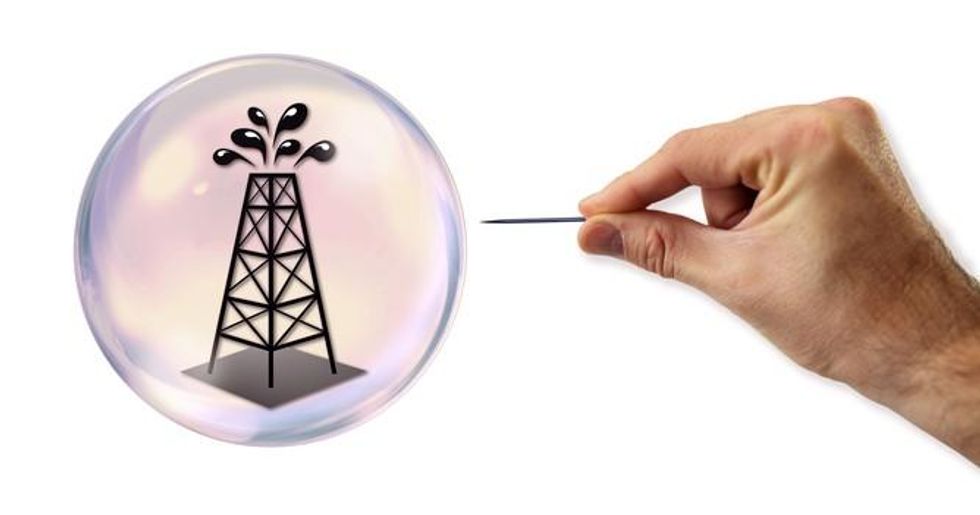
Though advocates of climate justice, progressive-minded (as well as clear-eyed) economists, and other experts have long concluded that the combined math and science of climate change compels humanity to end its century-long addiction to fossil fuels, the elite investor class and world leaders have been much slower to admit the Earth has limits to the amount of carbon and other greenhouse gases it can absorb.
Ahead of the talks, U.S. Climate Envoy Todd Stern made news by openly acknowledging that it was "obvious" that a proportion of what the coal, oil, and gas companies count as financial assets cannot possibly be dug out of the ground and burned if the world hopes to meet global targets. The solution, Stern said, will ultimately be one that leaves "a lot of fossil fuel assets in the ground."
With or without the endorsement of powerful governments and prominent business voices, however, the global grassroots movement for fossil fuel divestment has vowed to push ahead with its clear message that business-as-usual is no longer an option and that individuals, governments, universities, churches, and institutions of all stripes now have a moral--as well as fiduciary--responsibility to pull their money out of dirty energy industries and re-invest them in the clean energy transition that the crisis of climate change demands.
As John Quiggin, a professor of economics at the University of Queensland, wrote this week in a widely-read piece about the issue, "Leaving aside the ethics of divestment and pursuing a purely rational economic analysis, the cold hard numbers of putting money into fossil fuels don't look good."
Despite the increasingly diverse chorus of those who acknowledge the carbon reality, Bloomberg's report highlights the reluctance of the key holdouts: the highly-profitable fossil fuel giants themselves.
BP this year said in its sustainability report that the concept of unburnable carbon "overstates the potential financial impact" on the value of oil explorers. Shell said rising demand will preserve the value of its assets.
Exxon told activist investors in March that it's "confident" none of its reserves are in danger of becoming stranded. Chevron Chief Executive Officer John Watson, in a Sept. 30 interview, addressed the issue confidently.
"We're going to be in the fossil fuels business for a long time," he said.
MEXICO CITY - Although it is one of the victims of global warming, water will not be given a place of importance at the COP20 climate change conference to be held Dec. 1-12 in Lima, Peru.
Climate change already threatens water supplies for agriculture due to the reduction in the availability of fresh water, which is expected to be aggravated over the next decades. It also causes drought, torrential rainfall, flooding and a rise in the sea level, which together affect the global water situation.
"Water is a priority in adaptation," Lina Dabbagh, an activist with the Climate Action Network International (CAN-I), told Tierramerica. "In Latin America it's an extremely serious matter. But the idea is not to associate it with the international climate change negotiations, because the issue has its space in other forums."
Dabbagh, who will attend the 20th Conference of the Parties (COP20) to the United Nations Framework Convention on Climate Change (UNFCCC), was referring to the inclusion of water in discussions of the Sustainable Development Goals - which will build upon the Millennium Development Goals for the post-2015 development agenda - and the U.N. inter-agency coordination mechanism for all freshwater and sanitation related issues, U.N. Water.
The schedule for the conference only includes four panels that refer to water: "Water holds the key for mitigation, adaptation and for building resilience: towards a climate deal", "Africa & Caribbean South-South knowledge exchange on Water Security & Climate Resilient Development", "A new Security Agenda: safeguarding water, food, energy and health security in a changing climate", and "Mountains and water - from understanding to action".
Water is also mentioned, in passing, in the preparatory documents drawn up by civil society, whose parallel meeting, the People's Forum, will take place Dec. 8-11 in the Peruvian capital.
The synthesis report of Grupo Peru COP 20, an umbrella that groups a wide variety of social organisations, does not refer to water, although the group does mention it in its position on adaptation to climate change, which along with mitigation and loss and damage are the three pillars of the talks in Lima.
The organisations are demanding guaranteed access to water and food security in a context of climate change through concrete actions based on financing, capacity-building, technology transfer, energy efficiency and knowledge management.
For its part, the People's Summit agenda has eight main themes including global warming and climate change, energy and low-carbon development, and sustainable territorial governance.
This last point covers the preservation of ecosystems, sustainable management of nature and harmonious coexistence with people, as well as protection and administration of water.
"Water insecurity is a threat," said Alberto Palombo, secretary of the executive committee of the Inter-American Water Resources Network (IWRN).
"That's why we have to talk about intelligent integrated management of water resources. The existing problem isn't one of physical scarcity but of adequate management. Availability is affected by climate change," the representative of IWRN, which groups governments, social organisations, companies and academics, told Tierramerica.
Latin America has 30 percent of the world's water resources, but that doesn't mean it is free of problems, such as unequal distribution of water.
According to the IWRN, three of the region's biggest watersheds account for less than 10 percent of the available water, due to overuse: the Valley of Mexico, where the capital is located; the South Pacific, which includes Peru, Ecuador, Chile and Argentina; and the Rio de la Plata, including Argentina and Uruguay.
U.N. Water reports that Mexico has 3,822 cubic metres per year of water available per person, while it has consumed 17 percent of its freshwater reserves, which makes it one of the most critical cases in Latin America.
The rest of the region is doing much better, the U.N. agency says. The figures for Guatemala are 8,480 and 2.6 percent; Brazil 43,528 and 0.86 percent; and Argentina 21,325 and 4.3 percent, respectively.
Chile and Peru have abundant water, with 52,854 and 63,159 cubic metres per year per person, respectively. They also have relatively low proportions of freshwater exhaustion: just under four percent in Chile and under one percent in Peru.
The World Health Organisation estimates that 20 litres per capita per day should be assured to cover basic needs.
But parts of Argentina, Brazil, Chile, Colombia, Cuba, Ecuador, Mexico, Peru and Venezuela suffer from unsustainable water use and are exposed to water stress.
The report "Water and climate change adaptation in the Americas" by the Regional Policy Dialog (RPD) on Water and Climate Change Adaptation in the Americas says a growing number of people in the region live in areas with medium to high pressure on water resources.
That includes people who have less than 1,000 cubic metres per capita of water, who will total between 34 and 93 million by 2020 and between 101 and 200 million by 2050.
"Water suffers some of the major impacts of climate change. That is why we want to link the climate agenda with that of human rights," because they overlap, said Dabbagh.
The activist complained that "people have very little information, no one tells them what's going on, local efforts and local solutions are needed."
In March, the states parties to the UNFCCC are to present their national mitigation plans, which should take into account water treatment.
"We need to guarantee resources for prevention and adaptation, apply innovative financial mechanisms, improve management mechanisms, build green infrastructure, and restore and preserve watersheds," Palombo suggested.
If the current trends in recovery and consumption aren't turned around, Mexico City will no longer be able to guarantee water supplies by 2031, Bogota will reach that point in 2033, Santiago in 2043 and Rio de Janeiro in 2050, according to IWRN estimates.
Activists say it will be necessary to wait for another major conference for water to be granted the importance it has in climate change and sustainable development.
That will be the seventh World Water Forum, which under the theme "Water for our future" will bring together governments, companies, non-governmental organisations and academics in the South Korean cities of Daegu and Gyeongbuk Apr. 12-15, 2015.
This story was originally published by Latin American newspapers that are part of the Tierramerica network.
LIMA, PERU - In November, the world's top climate scientists issued their latest warning that the climate crisis is rapidly worsening on a number of fronts, and that we must stop our climate-polluting way of producing energy if we are to stand a chance of avoiding the worst impacts of climate change.
Science says that the risk of runaway climate change draws ever closer. Indeed, we are already witnessing the consequences of climate change: more frequent floods, storms, droughts and rising seas are already causing devastation. Around the world people and communities are paying the cost of our governments' continued inaction with their livelihoods and lives and this trend is likely to increase significantly in the future.
Good Energy, Bad Energy
The fact is - our current energy system - the way we produce, distribute and consume energy - is unsustainable, unjust and harming communities, workers, the environment and the climate. Emissions from energy are a key driver of climate change and the system is failing to provide for the basic energy needs of billions of people in the global South.
"We are calling on people to join the global movement for climate justice, which is gaining power and integrating actions at local, national and UN level."
The world's main sources of energy like oil, gas and coal are devastating communities, their land, their air and their water. And so are other energy sources like nuclear power, industrial agrofuels and biomass, mega-dams and waste-to-energy incineration. None of these destructive energy sources have a role in our energy future.
There are real solutions to the climate crisis. They include stopping fossil fuels, building sustainable, community-based energy systems, steep reductions in carbon emissions, transforming our food systems, and stopping deforestation.
Surely, a climate-safe, sustainable energy system which meets the basic energy needs of everyone and respects the rights and different ways of life of communities around the world is possible: An energy system where energy production and use support a safe and clean environment, and healthy, thriving local economies that provide safe, decent and secure jobs and livelihoods. Such an energy system would be based on democracy and respect for human rights.
To make this happen we urgently need to invest in locally-appropriate, climate-safe, affordable and low impact energy for all, and reduce energy dependence so that people don't need much energy to meet their basic needs and live a good life.
We also need to end new destructive energy projects and phase out existing destructive energy sources and we need to tackle the trade and investment rules that prioritise corporations' needs over those of people and the environment.
So the goals are set, and it is time to act immediately towards a transition period in which the rights of affected communities and workers are respected and their needs provided for during the transition.
Climate Politics at Odds with Climate Science
So how are our governments tackling the issue? In the 20 years of the UN negotiations on climate change, we haven't stopped climate change, nor even slowed it down. Proposals on the table, negotiated by our governments, now are mostly empty false solutions, including expanded carbon markets, and a risky method called REDD (Reducing Emissions from Deforestation and forest Degradation), which will not prevent climate change, and will impact and endanger poor and indigenous communities while earning money for big corporations.
Our governments' inaction is obvious: they have failed to create a strong and equitable climate agreement at the UN for 20 years and their baby steps in Lima do not take us in the right direction. The reason is that, unfortunately, the UN climate negotiations are massively compromised because the corporate polluters who fund and create dirty energy are in the negotiating halls and have our governments in their pockets.
"If we want any concrete agreement that would ensure the stopping of climate change for the benefit of all, we must stop the corporate takeover of UN climate negotiations by those corporate polluters."
Major corporations and polluters are lobbying to undermine the chances of achieving climate justice via the UNFCCC. Much of this influence is exerted in the member states before governments come to the climate negotiations, but the negotiations are also attended by hundreds of lobbyists from the corporate sector trying to ensure that any agreement promotes the interests of big business before people's interests and climate justice. If we want any concrete agreement that would ensure the stopping of climate change for the benefit of all, we must stop the corporate takeover of UN climate negotiations by those corporate polluters.
There is also an issue of historic responsibility. The world's richest, developed countries are responsible for the majority of historical carbon emissions, while hosting only 15% of the world's population. They emitted the biggest share of the greenhouse gases present in the atmosphere today, way more than their fair share. They must urgently make the deepest emission cuts and provide the most money if countries are to fairly share the responsibility of preventing catastrophic climate change.
Of course, tackling climate change and avoiding catastrophic climate change necessitates action by all countries. But the responsibility of countries to take action must reflect their historical responsibility for creating the problem and their capacity to act. While the emissions of industrializing countries like China, India, South Africa and Brazil are rapidly increasing, these nations made a much smaller contribution to the climate problem overall than the rich developed countries, and their per capita emissions are still much lower.
Industrialised countries' governments are neglecting their responsibility to prevent climate catastrophe and their positions at global climate talks are increasingly driven by the narrow economic and financial interests of wealthy elites and multinational corporations. These interests, tied to the economic sectors responsible for pollution or profiting from false solutions to the climate crisis like carbon trading and fossil fuels, are the key forces behind global inaction.
This year in Lima there are big plans to expand carbon markets. Friends of the Earth International argues that carbon markets are a false solution to climate change that let rich countries off the hook and do not address the climate crisis. Expanding carbon markets will make climate change worse and cause further harm to people around the world while bringing huge profits to polluters. The UN climate talks are supposed to be making progress on implementing the agreement that world governments made in 1992 to stop man-made and dangerous climate change. The agreement recognises that rich countries have done the most to cause the problem of climate change and should take the lead in solving it, as well as provide funds to poorer countries as repayment of their climate debt.
But developed countries' governments have done very little to deliver on these commitments and time is running out. What's more, rich countries continue to further diminish their responsibilities to tackle climate change and dismantle the whole framework for binding reductions of greenhouse gases, without which we have no chance of avoiding catastrophic climate change.
What needs to happen in the climate talks?
Within the UN, rich developed countries must meet their historical responsibility by committing to urgent and deep emissions cuts in line with science and justice and without false solutions such as carbon trading, offsetting and other loopholes.
"Unfortunately, if the UN climate negotiations continue in the same manner, any deal on the table at the UN climate negotiations in Paris next year will fall far short of what is required by science and climate justice."
They must also repay their climate debt to poorer countries in the developing world so that they too can tackle climate change. This means transferring adequate public finance and technology to developing countries so that they too can build low-carbon and truly sustainable economies, adapt to climate change and receive compensation for irreparable loss and damage. This will help ensure a safe climate, more secure livelihoods, more jobs, and clean affordable energy for all.
For now, the UN talks are still heading in the wrong direction, with weak non-binding pledges and insufficient finance from developed countries, and huge reliance on false solutions like carbon trading and REDD. Unfortunately, if the UN climate negotiations continue in the same manner, any deal on the table at the UN climate negotiations in Paris next year will fall far short of what is required by science and climate justice. To achieve a binding and justice-based agreement based on the cuts needed, as science tells us, our governments must listen to those impacted by climate change, not to corporations, which, by definition aim at more profits, not a safer climate.
Movement Building and Climate Justice
Preventing the climate crisis and the potential collapse of life-supporting ecosystems on a global level, requires long-term thinking, brave leaders and a mass movement. We have to challenge the corporate influence over our governments and exert real democratic control over the energy transition so that the needs and interests of people and the planet take priority over private profit. And at the heart of this movement we need climate justice - action on climate change that is radical, that challenges the system that has led to the climate catastrophe, and that fights for fair solutions that will benefit all people, not just the few.
It is already happening. In September we saw massive mobilizations around the world, with hundreds of thousands of people marching and actions across every continent, including 400,000 people on the streets of New York. And at the latest UN talks in Lima, we see people from all walks of life - indigenous people, social movements, youth, farmers, women's movements - from across Peru, Latin America, and around the world joining together in the People's Summit to collectively articulate the peoples' demands and the peoples' solutions to climate change.
But we need to grow much bigger and much stronger. We are calling on people to join the global movement for climate justice, which is gaining power and integrating actions at local, national and UN level. The solution to the climate crisis is achievable and it is in our hands.
It's one of the oldest tricks in politics: Talk down expectations to the point that you can meet them.
And it played out again in Berlin as 21 countries--including the United States--pledged nearly $9.5 billion to the Green Climate Fund, a UN body tasked with helping developing countries cope with climate change and transition to clean energy systems.
The total--which will cover a four-year period before new pledges are made--included $3 billion from the United States, $1.5 billion from Japan, and around $1 billion each from the United Kingdom, France, and Germany.
That's a big step in the right direction. But put into context, $9.5 billion quickly sounds less impressive.
Floods, droughts, sea level rises, heat waves, and other forms of extreme weather are likely to cost developing countries hundreds of billions of dollars every year. And it will take hundreds of billions more to ensure that they industrialize more cleanly than their counterparts did in North America, Europe, Japan, and Australia.
Developed countries should foot a large part of that bill, since they bear the greatest responsibility for causing climate change.
The Politics of Responsibility
Determining who pays for what is an integral part of achieving an international climate deal. And so far, pledges from rich countries have tracked far behind previous requests and recommendations.
Back in 2009, developed countries signed the Copenhagen Accord, which committed them to move $100 billion per year by 2020 to developing countries. A year later, the UN climate conference in Cancun called for the Green Climate Fund to be set up to channel a "significant share" of the money developing countries need to adapt to climate change.
Earlier this year, the G77--which is actually a grouping of 133 developing countries--called for $15 billion to be put into the Green Climate Fund. UN climate chief Christiana Figueres set the bar lower at $10 billion. The failure to even reach that figure is likely to put strain on negotiations for a new multilateral climate agreement that is expected to be reached in December 2015.
But it's not just the headline figure that's important. Plenty of devils are likely to be lurking in the details.
Delivering on the U.S. pledge requires budgetary approval from a hostile Congress, although a payment schedule stretching over much of the next decade could make that more politically feasible than it initially sounds.
More concerning are the conditions attached to the U.S. pledge, which include a threat that some of the money could be redirected to other funds--likely those run by the World Bank--if "the pace of progress" at the Green Climate Fund is inadequate. Given that the United States is advocating rules on how the fund makes decisions that would tip the balance of power in favor of contributor countries, the threat is far from innocuous.
France will provide a significant proportion of its share as loans rather than grants, while the small print of the UK contribution is likely to reveal that part of its money comes as a "capital contribution," which can only be paid out as loans.
Those restrictions could limit the scope of activities that the fund can finance, since much of the vital support and infrastructure needed to support community resilience in the face of climate change is too unprofitable to support loan repayments.
Future of the Fund
Looming over these issues is the larger, unresolved question of what the fund will actually finance. Some donor countries--including the United States--are pushing for a fund that would support transnational corporations and their supply chains, helping them turn profits from investments in developing countries.
Despite its green mandate, the Green Climate Fund may also support an array of "dirty energy" projects--including power generation from fossil fuels, nuclear power, and destructive mega-dam projects. That's the subject of an ongoing dispute on the fund's 24-member board and a persistent complaint from a range of civil society organizations.
That battle is not yet lost.
Despite its shortcomings, the Green Climate Fund has great potential to support a global transition to renewable energy, sustainable public transport systems, and energy efficiency. And with its goal of spending 50 percent of its funds on "adaptation" activities, it could also serve as a vital lifeline for communities already facing the impacts of climate change.
An important milestone was passed with the billions pledged to the Green Climate Fund. But achieving a cleaner, more resilient world will take billions more--along with a commitment to invest the money in projects that mitigate climate change rather than cause it.
President Barack Obama's pledge of up to $3 billion to a fund to help developing countries cope with climate change was met on Friday with caution by analysts and campaigners, who said the commitment falls well short of meeting the nation's true obligation to pay reparations to those bearing the brunt of the crisis.
"The U.S. has a historical, ecological, and climate debt, and a moral responsibility to pay for the mitigation and adaptation of the climate crisis," Tom Goldtooth, Executive Director of Indigenous Environmental Network and Coordinating Committee member of Grassroots Global Justice Alliance, told Common Dreams. "The U.S. continues to throw peanuts towards poor countries of the Global South."
According to statements made by anonymous White House officials, as reported by the Guardian, Obama will pledge between $2.5 and $3 billion over the next four years to the United Nations Green Climate Fund, which was created under the UN Framework Convention on Climate Change to direct funds from wealthy countries to developing ones to help them slash emissions and adapt and to global warming.
"$3 billion falls magnitudes below what is actually needed by developing countries to confront a climate crisis that is not of their making."
--Karen Orenstein, Friends of the Earth
"While a step in the right direction, the pledge falls far short of what is actually needed by developing countries to address climate change," declared Friends of the Earth in a statement released Friday.
Obama is likely to make the formal announcement at the upcoming Group of 20 (G20) summit in Brisbane, Australia this weekend. "We're doing this because it is in our national interest to build resilience in developing countries to climate change," said one administration official. The revelation comes shortly before a November 20 meeting to take place in Berlin, Germany, aimed at raising money for the Green Climate Fund.
The White House said the money is conditional on pledges from other nations, and the full $3 billion will only be paid if the fund raises $10 billion, the Guardian reports. It is not yet clear where the funding will come from, and whether Obama will need congressional approval. Obama's commitment is not much higher than the $2 billion George W. Bush pledged in 2008 towards a World Bank Climate Investment fund.
The question of who will pay for the ongoing human impacts of climate change has been at the center of global efforts to stem and address the crisis. While most of the emissions driving global warming come from wealthy nations, numerous studies show that poor nations across the world--which are also the nations who have contributed least to creating the crisis--face the greatest impact.
Social movements and countries from the Global South have argued that rich countries owe a "climate debt"--to be paid in the form of reparations. "Years ago at the COP16 in Cancun, developing countries and social movements had evaluated that the debt amounts of developed countries is an equivalent of $100 billion annually," said Goldtooth. "The U.S. holds responsibility for a major portion of that amount."
While the International Monetary Fund and World Bank have both acknowledged that the global south is hit hardest by the crisis, neither institution has formally backed reparations or other mandated payments by wealthy nations. They have, however, played a role in pulling impacted countries deeper into debt. Front-lines nations, including Bangladesh, are forced to take out World Bank loans to deal with the ongoing impacts of climate change, including deadly cyclones, floods, and droughts. In turn, the accumulated interest payments on those loans are driving these governments further into debt.
" U.S. military spending topped $575 billion last year alone. While it's welcome, a White House pledge of $3 billion over four years to climate security is a drop in the bucket by comparison."
--Janet Redman, Institute for Policy StudiesMeanwhile, powerful countries are subsidizing the largest drivers of climate change, including fossil fuel development and industrial agriculture. A report released this week by the Overseas Development Institute and Oil Change International found that G20 countries are collectively spending $88 billion a year in public funds to finance the fossil fuel industry's discovery of new gas, coal, and oil sources.
Janet Redman, climate policy director at the Institute for Policy Studies, pointed out Friday that Obama's pledge is miniscule compared to U.S. military funding: "U.S. military spending topped $575 billion last year alone. While it's welcome, a White House pledge of $3 billion over four years to climate security is a drop in the bucket by comparison."
"The impacts of climate change--extreme storms, water scarcity, food shortages--are no longer threats," Redman added. "For vulnerable communities around the world they are a reality."
1) It is historic. John Kerry was right to use the phrase in his New York Times oped announcing the deal: for the first time a developing nation has agreed to eventually limit its emissions, which has become a necessity for advancing international climate negotiations.
2) It isn't binding in any way. In effect President Obama is writing an IOU to be cashed by future presidents and Congresses (and Xi is doing the same for future Politburos). If they take the actions to meet the targets, then it's meaningful, but for now it's a paper promise. And since physics is uninterested in spin, all the hard work lies ahead.
3) It is proof, if any more was needed, that renewable energy is ready to go. The Chinese say they'll be using clean sources to get 20 percent of their energy by 2030 -- which is not just possible, it should be easy. Which they know because they've revolutionized the production of solar energy, driving down the cost of panels by 90 percent or more in the last decade.
4) It is not remotely enough to keep us out of climate trouble. We've increased the temperature less than a degree and that's been enough to melt enormous quantities of ice, not to mention set the weather on berserk. So this plan to let the increase more than double is folly -- though it is good to see that the two sides have at least agreed not to undermine that two degrees target, the one tiny achievement of the Copenhagen conference fiasco.
5) It is a good way to put pressure on other nations. I've just come back from India, which has worked hard to avoid any targets of any sort. But the lesson from this pact is, actual world leaders at least need to demonstrate they're talking about climate; it makes the lead-up to the global negotiations in Paris next year more interesting.
6) It isn't a way for Obama to get off the hook on things like the Keystone pipeline. If he's serious about meeting these kinds of targets, then we need serious steps; the surest sign this is a talking point, not a serious commitment, would be to approve new pipelines or authorize new drilling. If you pledge sobriety and then buy a keg of beer, people are going to wonder.
7) It is a good reminder that fossil fuel investors should continue their flight to safety -- the burgeoning divestment movement has been arguing not just on moral grounds, but also making the point that the future will inevitably lead to a downsloping curve for the old energies. This is another warning -- for anyone who looks more than a few quarters out, the writing is on the wall.
8) It's not, in any way, a stretch goal. These numbers are easy -- if you were really being cynical, you could say they're trying to put a floor under the retreat from carbon, to manage a retreat from fossil fuels instead of really putting carbon on the run. The Germans, for instance, will be moving in on 60 percent of their energy from clean sources by the mid-2020s, when we'll still be cutting carbon emissions by small increments.
9) It is -- and this is the real key -- a reminder that movements work. President Obama first endorsed the 80 percent by 2050 goal he enshrined in this pact when he was running for president in 2007, a week after 1,400 demonstrations around the nation demanded that goal. This comes seven weeks after by far the largest global climate demonstrations in history, and amidst ongoing unrest in China about the filthy air in its cities.
10) It isn't, in other words, a reason to slack off a bit in the ongoing fight for a livable climate, a fight our civilizations are in great danger of losing. If we want this to be a start, and not a finish, we've got to build even bigger and more powerful movements that push the successors of these gentlemen to meet what science demands. Today's an achievement for everyone who's held a banner, signed a petition, and gone to jail -- and a call for many more to join us going forward!
After months of secret negotiations, a surprise joint announcement by U.S. President Barack Obama and Chinese President Xi Jingping revealed the world's two largest contributors to global warming have made a non-binding agreement to reduce their greenhouse gas emissions over the next fifteen years and stated their hope that such pledges will spur other nations to follow suit ahead of next year's international climate talks in Paris.
According to a statement on the deal from the White House, the U.S. "intends" to reduce its emissions by 26 to 28 percent "below its 2005 level in 2025" and "to make best efforts" to meet the higher target. Meanwhile, "China intends to achieve the peaking of CO2 emissions around 2030 and to make best efforts to peak early and intends to increase the share of non-fossil fuels in primary energy consumption to around 20 percent by 2030."
Though termed a "historic agreement" by President Obama and a "game changer" by others who noted the importance of the two economic giants putting forward these commitments, other green campaigners warned against giving the non-binding and amorphous agreement more credit than it deserves.
"The US and China reaffirming their commitment to limiting global warming to 2degC should send shockwaves through the financial markets, because the only way to meet that target is by leaving 80% of fossil fuel reserves underground." --May Boeve, 350.org
"The cuts pledged by President Obama are nowhere near what the US needs to cut if it was serious about preventing runaway climate change. These US voluntary pledges are not legally binding and are not based on science or equity," said Sara Shaw, the climate justice and energy coordinator for Friends of the Earth International.
As Ben Adler points out at Grist:
You might notice a lot of wiggle room in that language. [...] The White House release refers to these goals as statements of "intent." They don't promise or even "agree" to hit these targets, they merely "intend" to.
That may sound a little weak, but it's necessary. Remember, foreign treaties require approval from a two-thirds supermajority of the U.S. Senate before they can be ratified. There's no way Senate Republicans would vote for an emission-reduction treaty. But by merely jointly announcing with China their intentions, the Obama administration avoids signing an actual treaty. So the Senate can't formally stop this agreement.
At the press conference in Beijing where the agreement was announced, Obama said, "As the world's largest economies and greatest emitters of greenhouse gases we have special responsibility to lead the global effort against climate change. I am proud we can announce a historic agreement. I commend President Xi, his team and the Chinese government for their making to slow, peak and then reverse China's carbon emissions."
"Both sides have yet to reach the goal of a truly game-changing climate relationship. There is a clear expectation of more ambition from these two economies whose emissions trajectories define the global response to climate change. Today's announcements should only be the floor and not the ceiling of enhanced actions." --Nic Clyde, Greenpeace Australia-Pacific
For his part, Xi Jinping added that China and the U.S. want to "make sure international climate change negotiations will reach agreement as scheduled at the Paris conference in 2015 and agreed to deepen practical co-operation on clean energy, environmental protection and other areas."
Despite the positive development of mutual cooperation between the two countries that have stubbornly refused to make such emission reduction pledges in the past, climate campaigners reminded the public that when it comes to the science of global warming and climate change the devil continues to be in the details.
Dipti Bhatnagar, also of Friends of the Earth International, said that though the announcment may be "spun as a landmark" development by some, the reality is that "the US pledges are just a drop in the ocean. These figures are very far from being the sea of change we urgently need from the US government."
The better news, said Bhatnagar, is that China is taking the "fight against climate change ever more seriously and intends to peak its emissions in next 15 years. We urge China and all nations to urgently switch from emissions-causing dirty energy to community-based renewable energy."
Nic Clyde, the senior climate and energy campaigner for Greenpeace Australia-Pacific, said that the U.S. and China have not yet reached "the goal of a truly game-changing climate relationship."
"Today's climate announcement by the US and China may be spun as a landmark, but in reality the US pledges are just a drop in the ocean." --Dipti Bhatnagar, Friends of the Earth International
He added, "There is a clear expectation of more ambition from these two economies whose emissions trajectories define the global response to climate change. Today's announcements should only be the floor and not the ceiling of enhanced actions."
In response to the announcement, Greenpeace USA senior legislative Representative Kyle Ash said:
Although some climate denying politicians and fossil fuel executives will continue to howl at any effort to reduce carbon pollution, this joint announcement of increased ambition from the two largest carbon polluters shows that their efforts to derail progress are increasingly irrelevant to global efforts to address climate change. Despite efforts of climate denier politicians like Senators McConnell and Inhofe to protect the fossil fuel industry at any cost, broad majorities of Americans support climate action and clean, renewable energy.
This early and joint announcement from the US and China is welcome, and should increase the chances of a strong climate treaty next year. However, President Obama's 2025 emissions reduction targets are not strong enough, and the Greenpeace Energy [R]evolution scenario shows that we can reduce carbon pollution 40% below 2005 levels by 2025, while simultaneously generating more employment and a stronger economy.
According to professor of history Juan Cole, who runs the influential Informed Comment blog, "It is a sad commentary that this agreement is actually an improvement on previous goals of the two countries. And it is better to have an agreement with firm dates and targets than to have the two carbon monsters take turns hiding behind each other at climate talks. But this agreement isn't a commitment to reduce carbon emissions on a timescale appropriate to the magnitude of the crisis. It mostly kicks the ball down the road."
In reaction to the announcement, executive director of 350.org May Boeve said the U.S-China pledges could be welcomed, but only if the public understands the real implications of agreeing to meet the 2degC target. In a statement, she said:
It's no coincidence that after the biggest climate mobilization in history, world leaders are stepping up their ambition on climate action. This announcement is a sign that President Obama is taking his climate legacy seriously and is willing to stand up to big polluters. But the real proof will be in the pudding. There's no way approving the Keystone XL pipeline and additional fossil fuel development is compatible with this pathway. President Obama needs to build on this announcement and continue to take on climate deniers in the oil industry and Congress to ensure a clean future.
Today's announcement also strengthens the case for fossil fuel divestment. The US and China reaffirming their commitment to limiting global warming to 2degC should send shockwaves through the financial markets, because the only way to meet that target is by leaving 80% of fossil fuel reserves underground. The industry's business plan is simply incompatible with the pathways laid out today. It's time to get out of fossil fuels and invest in climate solutions.
As the climate action group TckTckTck points out:
According to the latest report from the Intergovernmental Panel on Climate Change - the most comprehensive climate change report ever produced, carbon emissions need to drop to zero by 2100."
And many NGOs say that the world has to phase out fossil fuels and phase in 100% renewables by the middle of the century, to keep the global warming under 2degC.
The latest United Nations report on the threat of global warming - by far the most serious warning ever of possible environmental disaster - faces a string of serious hurdles to overcome during the next 13 months if the world's nations are to sign a new, binding climate pact at the end of 2015.
The latest United Nations report on the threat of global warming - by far the most serious warning ever of possible environmental disaster - faces a string of serious hurdles to overcome during the next 13 months if the world's nations are to sign a new, binding climate pact at the end of 2015.
The Intergovernmental Panel on Climate Change's (IPCC) hard-nosed report, released in Copenhagen on Sunday, describes in detail the disaster ahead unless humankind can perform a near miracle by reversing carbon emissions by 2020 and then phase out emissions entirely by the end of this century.
The document was finalized following a week of sometimes acrimonious discussion between scientists and officials from countries such as the United States and Canada with large fossil fuel reserves which were only slightly successful in having some of the report's tough language removed.
The report was prepared to provide up-to-date information for governments attempting to deliver a new global treaty on climate change during a final UN Climate Summit scheduled for Paris in December 2015.
The IPCC offers hope for the future of the planet by saying that if the right solutions are put into place there can be continued economic and human development.
However, considering the severity of the report And its political implications, it is questionable how much progress can be made because of a number of difficulties that must be overcome.
To begin with, the UN lacks the power to force governments to follow any particular course of action. While UN Secretary-General Ban Ki-moon sounds like he is in charge of a solid campaign for change, he's really a concerned cheerleader. Moreover, Sunday's report includes only vague suggestions concerning actions that should be taken to slow global warming. It says that:
Most of the world's electricity should be produced from low-carbon sources by 2050;
Renewables will have to grow from the current 30 per cent share to 80 per cent of the power sector by 2050;
Fossil fuel power generation without carbon capture and storage (CCS) technology would need to be phased out almost entirely by 2011. However, the world has only one CCS plant in operation as the technology has not proven to be reliable; and
Perhaps in keeping with the desperate situation facing the UN, it meekly offers that behavioural changes, such as eating less meat, can have a role in cutting emissions.
One on-going political issue concerns to what extent wealthy countries, which are responsible for much of the climate destruction to this point, are willing to assist less developed nations in covering the costs of mitigating the damage caused by climate change.
An important step was taken last week when the UN finalized the formation of the Green Climate Fund (GCF), which is receiving pledges of funds that will be used to launch climate projects in developing countries. The target set at the 2009 Copenhagen Summit was to raise $100-billion by 2020. However, pledges have been slow to come in so the UN now hopes governments and the private sector will commit $15-billion as starter capital.
The UN is keeping a close eye on somewhat acrimonious discussions underway between the United States and China over reducing the burning of coal, which is the world's dirtiest polluter. If the two super-powers cannot reach an agreement, some countries may be reluctant to sign onto a binding deal next year.
Another issue concerning the U.S. is whether President Obama, who no doubt would like to boost his legacy with a global climate agreement, will have the power to sign an agreement in Paris. In September, members of the Senate, many of whom receive large donations from carbon-producing corporations, refused to sign the U.S. onto a special declaration. It called for the establishment of a global price on carbon that would penalize industries for excessive carbon emissions.
President Obama almost certainly will need the backing of the Senate if he is to sign the U.S. on to a full agreement next year.
Lurking in the background are powerful corporations that would lose trillions of dollars and be forced to re-think their future if the drastic measures called for by the IPCC are implemented.
The Corporate Europe Observatory (CEO), which monitors corporate power in Europe, claims that "dirty energy corporations" will try to hijack the next round of UN climate negotiations, scheduled for Peru next month. "Some of the most polluting corporations and their lobby groups are trying to prevent governments from endorsing effective climate action and instead promoting false solutions like dirty coal and carbon markets," says the group.
In fact, corporate participation in the climate discussions is coordinated by the UN Global Compact , a powerful business lobby that looks out for the interests of corporations across a number of UN program areas. Many of the corporations come from the energy sector.
Despite the obstacles ahead, a group of leading non-governmental organizations optimistically issued a report in September outlining what they believe needs to come out of the Paris Summit.
The NGO report says that, among other things, a new agreement needs to include: a clear signal to businesses to steer investment toward low-carbon outcomes; ambitious action before and after 2020; a strong legal framework with clear rules for compliance; a central role for equity among countries; considerable public finance for adaptation; and a framework for action on deforestation and land use.
The next round of discussions will be held in Lima, Peru from December 1 to 12.