SUBSCRIBE TO OUR FREE NEWSLETTER
Daily news & progressive opinion—funded by the people, not the corporations—delivered straight to your inbox.
5
#000000
#FFFFFF
To donate by check, phone, or other method, see our More Ways to Give page.
Daily news & progressive opinion—funded by the people, not the corporations—delivered straight to your inbox.
Going in to the recent elections in the Netherlands, the mainstream story seemed lifted from William Butler Yeats poem, The Second Coming: "Things fall apart; the center cannot hold -- The best lack all conviction, while the worst are full of passionate intensity."
The right was on the march, the left at war with itself, the traditional parties adrift, and the barbarians were hammering at the gates of the European Union.
It's a grand image, rather like Game of Thrones. But the reality is considerably more complex.
There is, of course, some truth in the apocalyptic imagery: right-wing parties in the Netherlands, France, and Germany have grown. There are indeed some sharp divisions among left parties. And many Europeans are pretty unhappy with those that have inflicted them with austerity policies that have tanked living standards for all but a sliver of the elite.
But there are other narratives at work in Europe these days besides an HBO mega series about blood, war, and treachery.
A Shot Across the Status Quo in the Netherlands
The recent election in the Netherlands is a case in point. After holding a lead over all the other parties, Geert Wilders' right-wing, racist Party for Freedom faltered. In the end, his Islamophobes didn't break the gates, though they did pick up five seats.
Overall it was a victory for the center, but it was also a warning for those who advocate "staying the course" politics -- and, most pointedly, the consequences of abandoning principles for power.
The Left Greens did quite well by taking on Wilders' anti-Islam agenda and challenging Prime Minister Mark Rutte's center-right Popular Party for Freedom and Democracy on the economic front. In one national debate, Jesse Klaver, the GreenLeft's dynamic leader, argued that janitors should be paid more and bankers less. The election, he said, is not about "Islam and Muslims," but about "housing, income, and health care." The voters clearly bought it.
Rutte's coalition partner, the center-left Labor Party, was crushed, losing 29 seats. For the past four years, the Dutch Labor Party has gone along with Rutte's program of raising the retirement age and cutting back social spending, and voters punished them for shelving their progressive politics for a seat at the table.
Rutte's party also lost eight seats, which probably went to centrist parties like Democrats66, suggesting that Rutte's "business as usual" isn't what voters want either (though it's still the number one party in the 150-seat parliament).
There were some lessons from the Dutch elections, though not the simplistic one that the "populist" barbarians lost to the "reasonable" center.
What it mainly demonstrated is that voters are unhappy with the current situation, they are looking for answers, and parties on the left and center left should think carefully about joining governments that think it "reasonable" to impoverish their own people.
France on the Brink
Next up in the election docket is France, where polls show Marine Le Pen's neo-Nazi National Front leading the pack in a five-way race with traditional right-wing candidate Francois Fillon, centrist and former Socialist Party member Emmanuel Macron, Socialist Party candidate Benoit Hamon, and leftist Jean-Luc Melenchon.
The first round, scheduled for April 23, will eliminate all but the two top vote getters. A final round will be held May 7.
With Melenchon and Hamon running at 11.5 percent and 13.5 percent respectively, thus splitting the left vote, the race appears to be between Fillon, Macron, and Le Pen, with the latter polling slightly ahead of Macron and considerably better than Fillon.
If you're attracted to the apocalypse analogy, France is probably your ticket.
Le Pen is running a campaign aimed against anyone who doesn't look like Charlemagne or Joan of Arc, but her strong anti-EU positions play well with young people, in small towns, and among rural inhabitants. All three groups have been left behind by neoliberal EU policies that have resulted in de-industrialization and growing economic inequality. Polls indicate she commands 39 percent of 18-to-24 year olds, compared with 21 percent for Macron and 21 percent for Fillon.
Fillon has been wounded by the revelation that he's been using public funds to pay family members some $850,000 for work they never did. But even before the scandal, his social conservatism played poorly with the young, and workers are alienated by his economic strategy that harkens back to that of British Prime Minister Margret Thatcher, whom he greatly admires. His programs sound much like Donald Trump's: Cut jobless benefits and social services, lay off public workers, and give tax cuts to the wealthy.
Macron, an ex-Rothschild banker and former minister of economics under Hollande, is running neck and neck with Le Pen under the slogan "En Marche" ("On Our Way"), compelling critics on the left to ask "to what?" His platform is a mix of fiscal discipline and mild economic stimulation. At 39, he's young, telegenic, and a good speaker. But his policies are vague, and it's not clear there's a there there.
Most polls indicate a Le Pen vs. Macron runoff, with Macron coming out on top, but that may be dangerous thinking. Macron's support is soft. Only about 50 percent of those who say they intend to vote for him are "certain" of their vote. In comparison, 80 percent of Le Pen's voters are "certain" they will vote for her.
There are, as well, some disturbing polling indications for the second round. According to the IFOP poll, some 38 percent of Fillon's supporters say they'll jump to Le Pen -- that's 2 million voters -- along with 7 percent of Hamon voters and 11 percent of Melenchon backers.
What may be the most disturbing number, however, is that 45 percent of Melenchon voters say they won't vote at all if Macron is the anti-Le Pen candidate in the second round. Some 26 percent of Fillon's voters and 21 percent of Hamon's voters would similarly abstain.
Le Pen will need at least 15 million votes to win, and the Front has never won more than 6 million nationally. But if turnout is low, Le Pen's strongly motivated voters could put her into the Elysee Palace. In this way, France most resembles Britain prior to the Brexit vote.
If that comes to pass, Le Pen will push for a national referendum on the EU. There's no guarantee the French will vote to stay in the Union. And if they leave, that will be the huge trade organization's death knell. The EU can get along without Britain, but it could not survive a Frexit.
Surprising Strength on the German Left
Germany will hold national elections on September 24, but the story there is very different than the one playing out in France.
The German government is currently a grand coalition between Chancellor Angela Merkel's conservative Christian Democrats and the center-left Social Democrats. The alliance has been a disaster for the Social Democrats, which at one point saw its poll numbers slip below 20 percent.
But German politics has suddenly shifted. On Merkel's left, the Social Democrats changed leaders and have broken with industrial policies that have driven down the wages of German workers in order to make the country an export juggernaut. On the chancellor's right, the racist, neo-Nazi Alternative for Germany has drained Christian Democrat voters to support a ban on immigration and a withdrawal from the EU, although the Alternative is dropping in the polls.
The game changer has been the sudden popularity of former EU president Martin Schulz, the new leader of the Social Democrats. The party is now neck and neck with Merkel's bloc, and some polls show Schulz actually defeating Merkel. In terms of personal popularity, Schulz is now running 16 points ahead of Merkel. While the chancellor's Christian Democrat alliance tops the polls at 34 percent, the Social Democrats are polling at 32 percent and climbing.
Schulz has made considerable headway critiquing declining living standards. Germany has large numbers of poorly paid workers, and almost 20 percent of workers age 25-to-34 are on insecure, short-term contracts. Unemployment benefits have also been cut back, even though Germany's economy is the most robust in Europe and the country has a $310 billion surplus.
In any case, the days when Merkel could pull down 40 percent of the vote are gone. Even if her coalition comes in number one, it may not have enough seats to govern, even if its traditional allies, the Free Democrats, make it back into the Bundestag.
That creates the possibility of the first so-called "red-red-green" national government of the Social Democrats, the left-wing Die Linke Party, and the Green Party. Die Linke and the Greens are both polling at around 8 percent. Such an alliance currently runs several major cities, including Berlin. It would not be an entirely comfortable united front: The Social Democrats and the Greens are pro-EU, while Die Linke is highly critical of the organization.
But there is a model out there that gives hope.
Portugal is currently run by a three-party center-left to left alliance. Those parties also disagree on things like the EU, the debt, and NATO membership, but for the time being they've decided that stimulating the economy and easing the burden of almost a decade of austerity trumps the disagreements.
An Italian Wild Card
And then there are the Italians.
While Italy hasn't scheduled elections, the defeat of a constitutional referendum supported by Democratic Party leader and then-Prime Minister Matteo Renzi last December almost guarantees a vote sometime in the next six months.
Italy has one of the more dysfunctional economies in the EU, with one of the Union's highest debt ratios and several major banks in deep trouble. It's the EU's third largest economy, but growth is anemic and unemployment stubbornly high, particularly among the young.
Renzi's center-left Democratic Party still tops the polls, but only just, and it's fallen nearly 15 points in two years. Nipping at its heels is the somewhat bizarre Five Star Party run by comedian Beppe Grillo, whose politics are, well, odd.
Five Star is strongly opposed to the EU, and allies itself with several right-wing parties in the European Parliament. It applauded the election of Donald Trump. On the other hand, it has a platform with many progressive planks, including economic stimulation, increased social services, a guaranteed income for poor Italians, and government transparency. It is also critical of NATO.
Five Star has recently taken a few poll hits, because the party's mayor of Rome has done a poor job keeping the big, sprawling city running -- in truth, even the ancient Romans found it a daunting task -- and is caught up in a financial scandal. Some Democratic Party leaders are also being investigated for corruption.
The only other major parties in the mix are former Prime Minister Silvio Berlusconi's center-right Forza Italia, which is polling around 13 percent, and the racist, xenophobic Northern League at 11.5 percent.
The latter, which is based the northern Po Valley, made a recent effort to broaden its base by taking its campaign to Naples in southern Italy. The result was a riot, with protestors tossing rocks, bottles, and Molotov cocktails at Northern League leader Matteo Salvini.
There are informal talks going on about uniting the two right-wing parties. Berlusconi has worked with the Northern League in the past.
There are also a gaggle of smaller parties in the parliament, ranging from the Left Ecology/Greens to the Brothers of Italy, none registering over 5 percent. But since whoever comes out on top will need to form a coalition, even small parties will likely punch above their weight.
If Five Star does come in first and patches together a government, it will press for a referendum on the EU, and there is no guarantee that Italians -- battered by the austerity policies of the big trade group -- won't decide to bail like the British did. An Italexit would probably be a fatal blow to the EU.
Europe's Choice
Predicting election outcomes is tricky these days, the Brexit and the election of Donald Trump being cases in point.
The most volatile of the upcoming ballots are in France and Italy. Germany's will certainly be important, but even if Merkel survives, the center-right will be much diminished and the left stronger. And that will have EU-wide implications.
The European left is divided, but not all divisions are unhealthy, and a robust debate is not a bad thing.
None of the problems Europe faces are simple. Is the EU salvageable? What are the alternatives to austerity? How do you tackle growing inequality and the marginalization of whole sections of society? How do you avoid the debt trap facing many countries, blocked by the EU's economic strictures from pursuing any strategy other than more austerity?
In a recent interview, Yanis Varoufakis, the former Greek finance minister and one of the founders of the left organization DiEM25, proposed a "New Deal" for Europe, where in "All Europeans should enjoy in their home country the right to a job paying a living wage, decent housing, high-quality health care and education, and a clean environment."
The New Deal has five goals that Varoufakis argues can be accomplished under the EU's current rules and without centering more power in Brussels at the expense of democracy and sovereignty. These would include "large-scale" investment in green technology, guaranteed employment with a living wage, an EU-wide anti-poverty fund, a universal basic income, and anti-eviction protections for the vulnerable.
None of those goals will be easy to achieve, but neither can Europe continue on its current path. The right-wing "populists" may lose an election, but they aren't going away.
Almost 40 years ago, British Prime Minister Margaret Thatcher launched her conservative assault on trade union rights, health care, education, and social services with the slogan, "There is no alternative." The world is still harvesting the bitter fruits of those years and the tides of hatred and anger they unleashed. It is what put Trump into the Oval Office and Le Pen within smelling distance of the French presidency.
But there is an alternative, and it starts with the simple idea of the greatest good to the greatest number.
The main message of 2016 was that we are entering a period of economic and political upheaval comparable to the industrial revolution of 1780-1850, and nothing expressed that message more clearly than Donald Trump's appointment of Andrew Puzder as Secretary of Labor. Even though it's clear that neither man understands the message.
The main message of 2016 was that we are entering a period of economic and political upheaval comparable to the industrial revolution of 1780-1850, and nothing expressed that message more clearly than Donald Trump's appointment of Andrew Puzder as Secretary of Labor. Even though it's clear that neither man understands the message.
Puzder bears a large part of the responsibility for fulfilling Trump's election promise to "bring back" America's lost industrial jobs: seven million in the past 35 years. That's what created the Rust Belt and the popular anger that put Trump in power. But Puzder is a fast-food magnate who got rich by shrinking his costs, and he has never met a computer he didn't like.
"They're always polite, they always upsell, they never take a vacation, they never show up late, there's never a slip-and-fall, or an age-, sex-, or race-discrimination case," he rhapsodised. They also never take lunch or toilet breaks, they'll work 24 hours a day, and they don't have to be paid. So out with the workers and in with the robots.
It was not evil foreigners who "stole" most of those seven million American jobs, and will probably eliminate up to 50 million more in the next 20 years. It's the 'intelligent machines' that did most of the damage, starting with simple assembly-line robots and ATMs. ("Every Automated Teller Machine contains the ghosts of three bank tellers.")
But the automation keeps moving up the skill sets. The first self-driving cars are now on the road in the United States. That's another four million jobs down the drain, starting with taxi drivers and long-distance truckers. In recent years eight American manufacturing jobs have been lost to automation for every one lost to "globalization", and it will only get worse.
A 2013 study concluded that 47 percent of existing jobs in the United States are vulnerable to automation in the next 20 years, and the numbers are as bad or worse for the other developed countries. This is what is really driving the "populist revolution" that caused two of the world's oldest democracies to make bizarre, self-harming political choices in the past year. First Brexit, then Trump.
Leaving the European Union will hurt Britain's economy badly, and putting a man like Donald Trump in the US presidency is a serious mistake. Yet half the voters in each country were so angry that they didn't care about the likely negative consequences of their vote.
There is more to come. Beppe Grillo's populist Five-Star Movement may win the next election in Italy. Marine Le Pen's National Front (no longer openly anti-Semitic, but still basically neo-fascist) could win the French presidential election next spring. The Netherlands and Germany may see hard-right, anti-immigrant parties in governing coalitions after their forthcoming elections.
Some people fear that we are seeing a re-run of the 1930s. Economic growth has slowed since the crash of 2008, and unemployment is much higher than it looks. The official US unemployment figure is only 5 percent, but almost one-third of American men between the ages of 25 and 54 are "economically inactive". So angry populist leaders are popping up again all across the developed world.
The 'Dirty Thirties' ended in the Second World War, and there are obvious parallels today. The European Union is fraying at the edges, and Donald Trump has talked about curtailing US support for NATO. He has also threatened to slap huge tariffs on Chinese exports to the US, and it's probably a bad idea to push China too hard when it is already in grave economic trouble.
But this is not the 1930s. There are no ranting dictators promising revenge for lost wars, and government benefits mean that unemployment is no longer a catastrophe for most people in Western countries. The old white working class (and some of the middle class) are angry because jobs are disappearing and because immigration is changing the ethnic balance in their countries, but they are not angry enough to want a war.
Trump's election means that we are in for a wild ride in the next four years, but he will ultimately disappoint his supporters because he is barking up the wrong tree. He cannot bring back the jobs that were lost, because most of them were not lost to his favourite culprits: free trade and uncontrolled immigration.
Even if Trump understood this, he could not admit it in public, because there is nothing he can do about it. He might ban immigrants coming in to "steal American jobs", and he can tear up free-trade deals to his heart's content, but his own cabinet contains people who have built their careers on eliminating jobs through automation.
This is change on the scale of the (first) industrial revolution, and you can't fight it. But then, you really don't need to. American industry has shed seven million jobs since 1979, but the value of US factory production has more than doubled (in constant dollars). It is only jobs that are being destroyed, not wealth.
It is not a disaster for a rich society to reach a point where the same goods are being produced and the same services are being provided, but most people no longer have to work 40 or 50 hours a week (in jobs that most of them hate). Or rather, it's not a disaster UNLESS HAVING NO WORK MEANS HAVING NO MONEY OR SELF-RESPECT.
The main political task for the next generation (post-Trump) in the developed countries will be to ensure that those without work have an income they can live on, and don't lose their self-respect. Other ways will doubtless be suggested, but one way of achieving this that is already getting attention is a Universal Basic Income (UBI).
The UBI would provide everybody with enough to live on. Since everybody got it, there would be no stigma involved in living on it. And 53 percent of today's jobs will still be there in 2033, so those who really wanted to work could top up their UBI with earned income. There would still be millionaires.
The first national referendum on UBI was held in Switzerland last June. It was a radical new idea, so of course it was overwhelmingly rejected. But this idea will not go away, and there will be more like it. The rich countries can stay rich and stable if they understand the nature of the task - but the developing countries may face a grim future.
No UBI for them -- they are not rich enough, not even China. But automation is eating into their newly gained industrial jobs too. A recent Citibank report estimated that 77 percent of Chinese jobs are at risk from automation, and in India there is talk of "premature deindustrialisation" (i.e. industrial jobs in India may be peaking right now, and will then go into decline).
That would not just mean continuing poverty for many, but huge political turmoil - populist revolutions and super-Trumps. The future (including the near future) will be quite interesting.
While far-right populist forces in Italy and beyond are claiming Sunday's referendum outcome and Prime Minister Matteo Renzi's subsequent resignation as a victory, others say that while the losers are clear, the winners of the vote on constitutional reform are far less obvious.
The plebescite asked Italians to vote on a package of changes to the country's constitution, which would have afforded more power to Renzi and future prime ministers. A broad coalition of opponents included anti-establishment and right-wing parties--leading some to wonder if the vote "could ultimately lead to Italy's exit from the E.U."
But "Italy's no vote does not fit quite so neatly into the narrative of a populist revolt against globalization and elites," wrote Luigi Scazzieri of the Center for European Reform on Monday, responding to those who declared the vote in line with those for Brexit in the U.K. and Donald Trump in the U.S..
"Themes such as globalization and immigration did not feature as strongly in the debate," Scazzieri explained. "Instead, after Renzi stated that he would resign if the constitutional reforms were rejected, the debate was focused on his own record as prime minister. And while of course populists voted no, many of the other no voters did so against the substance of the reforms, arguing that they were anti-democratic and would have altered constitutional checks and balances. Unlike Britain and the U.S., where elites were homogeneously in favor of remaining in the E.U. and opposed to Trump, in the Italian case, the political establishment and the experts were split in two."
And while the vote will almost certainly result in political and financial upheaval, the outcome "looks less like a rejection of Europe and the political establishment, and more like a serious miscalculation on the part of Renzi," journalist Noah Barkin argued at Reuters, citing polls that "show that a solid majority of Italian voters are in favor of both the E.U. and the euro."
Indeed, New Statesman correspondent Stephen Bush pointed out, "a vote that was supported by Silvio Berlusconi, two of the three major parties, as well as Mario Monti, the technocrat appointed effectively on the demands of Italy's creditors, and the Economist [cannot] be accurately described as a revolt against 'the establishment' if that term is to have any meaningful use whatsoever."
Bush pushed back further online:
Still, compared with the heartening liberal victory in Austria's presidential election, the outcome in Italy has clearly emboldened the far right as well as the populist Five Star Movement, whose leader Beppe Grillo has been compared to Trump.
The Five Star Movement and the anti-immigration Northern League (Lega Nord)--which both campaigned vigorously against the referendum--are now calling for snap elections in the wake of the vote, "suggesting both believe the large margin of victory in the 'no' camp would translate into big wins in a national election," the Guardian's Stephanie Kirchgaessner reported from Rome.
However, she continued, "it is clear that many Italians who voted 'no' would not necessarily support either party in a general election. Indeed, some were indifferent to Renzi's fate but believed the rise of populism made proposed changes to the constitution especially dangerous."
As Scazzieri wrote Monday:
A takeover by the populist Five Star Movement is unlikely either now or in the next election. The movement may run out of steam, as it increasingly becomes embroiled in political mishaps arising from its administration of Rome and Turin. Crucially, planned electoral reforms are likely to lead to a form of proportional representation that will make it difficult for any single party to form a government. The continuation of coalition governments will exclude the Five Star Movement, which refuses to take part in them.
And any new Italian government is likely to behave in the same way as Renzi's government did towards its European allies, seeking to bend fiscal rules in its favour and to press for a more expansive fiscal policy. It will also continue to demand solidarity from the E.U. with its efforts to deal with migrants and to rebuild the areas affected by recent earthquakes.
"Italy is unlikely to be the domino that leads to more instability in Europe," he concluded.
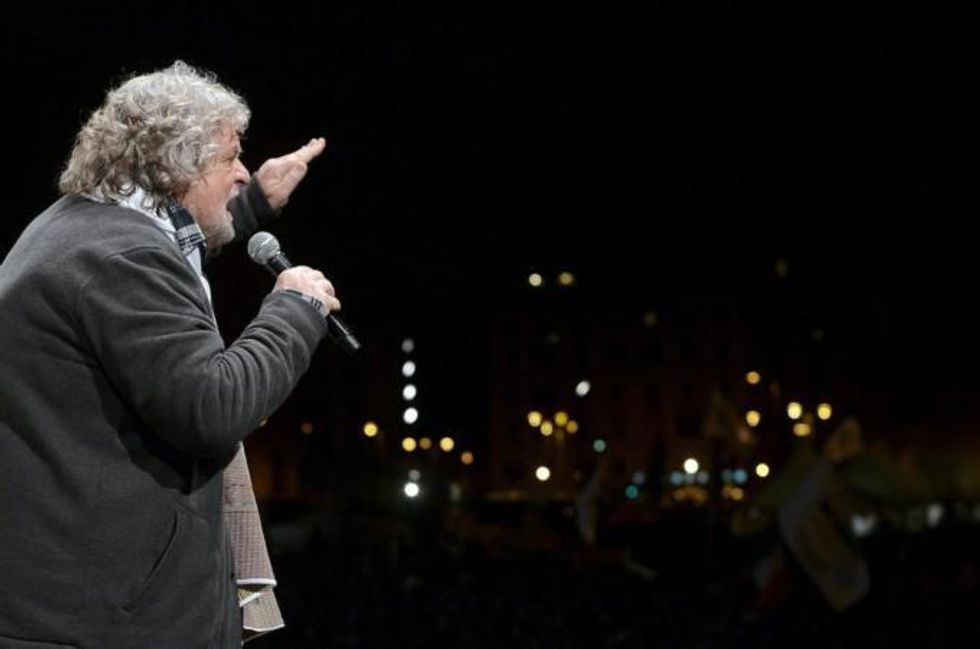
"Today saying No is the most beautiful and glorious form of politics....Whoever doesn't understand that can go screw themselves." It could have been Donald Trump before the US election two weeks ago, or Boris Johnson during the Brext campaign in Britain last June, but it was actually Beppe Grillo, founder and leader of Italy's populist Five Star Movement.
"Today saying No is the most beautiful and glorious form of politics....Whoever doesn't understand that can go screw themselves." It could have been Donald Trump before the US election two weeks ago, or Boris Johnson during the Brext campaign in Britain last June, but it was actually Beppe Grillo, founder and leader of Italy's populist Five Star Movement.
Grillo unhesitatingly compares his movement to "Trumpismo" in the United States, and the Five Star Movement (M5S) is currently running neck-and-neck with Prime Minister Matteo Renzi's Democratic Party in the opinion polls. Moreover, if Renzi loses the referendum on changing the Italian constitution that takes place this Sunday, there may be an election in Italy quite soon.
Matteo Renzi wanted to replace the elected Senate with a smaller appointed body and make other changes to streamline the process of passing laws in Italy. He got his proposal through both houses of parliament last April - but with such a slim majority that the results had to be confirmed by a referendum. At the time Renzi was confident that he would win it easily.
But that was before the Brexit vote in the United Kingdom and the irresistible rise of Donald Trump in the United States put wind in the sails of the Five Star Movement. Now the M5S's "Io Dico No" (I Say No) campaign is drawing huge crowds as it tours Italian cities, and the final opinion polls before the vote on 4 December gave the "No" a five-point lead in the referendum.
"Italian cities don't look as devastated as the U.S. Rust Belt, but the same processes that brought Donald Trump to the presidency have been at work in Italy."As the polls began to turn against his constitutional reforms, Renzi warned that he would resign if the vote went against them. But all that did was to turn it into a referendum on his own popularity, which is turning out to be considerably less than he imagined. And if M5S comes to power, it is pledged to hold another referendum - this time on pulling Italy out of the euro "single currency".
At the moment a large majority of Italians still want to keep the euro, but that could change. Italian cities don't look as devastated as the U.S. Rust Belt, but the same processes that brought Donald Trump to the presidency have been at work in Italy. Average family income is still less that it was before the 2008 crash, and unemployment among the young is close to 40 percent.
An estimated quarter of Italian industry has closed down in the past decade, and the country is staggering under the burden of a public debt that amounts to 132 percent of GDP. If uncertainty about the euro crashes Italy's economy (the third-largest economy in the Eurozone), then all 19 countries that use the euro, some 340 million people, are in deep trouble.
And the Italian economy could go belly up, because Italian banks are now as vulnerable as American banks were before 2008. They are stuffed with "non-performing loans" that have not been written off, but stay on the banks' books at around 45-50 percent of their original value. But they are really only worth about 20 percent of the original price.
"A lot of Italians are so angry that they just want to punish 'the elites.'"If Italian banks marked these loans down to their true market value, it would wipe out their capital and they would all go bankrupt overnight. It is an accident waiting to happen - and a "No" victory in the referendum could be that accident, because it might open the Five Star Movement's road to power.
In theory, it's a long road from a "No" in Sunday's constitutional referendum to an M5S government and a referendum on the euro. If Renzi resigns, and if no other combination of parties in parliament can form a government (probably not), there would be an election. But then M5S would have to win a majority, which is a long way from its current 30 percent support.
"[T]he entire 60-year-old project of European unity could crumble by the end of next year."In practice, it might be quite a short road. A lot of Italians are so angry that they just want to punish "the elites." If both M5S and the right-wing Lega Nord (which also wants to quit the euro) did well in the election, they might be able to form a coalition government, and then the fat would be in the fire.
Technically, only the single currency would be at risk, but in the current febrile atmosphere in Western politics, with support for populist parties surging everywhere, things can change very rapidly.
It is no longer inconceivable that the National Front, which wants to leave not just the euro but the European Union, could win the French presidential election in April. With Britain on its way out, a French government that wants to follow suit, and an Italian government that at least wants to leave the euro, the entire 60-year-old project of European unity could crumble by the end of next year.
That's a lot of ifs, and the likelihood of such a calamity is still very small. But we do live in interesting times.
Longtime critic of the Eurozone's destructive commitment to austerity, Italian comedian-turned-political activist Beppe Grillo has launched what one news outlet called a "full-throated attack" on the single currency, saying his country should throw off that "anti-democratic straitjacket" by nationalizing its banks and taking a stronger stance against the demands of elite financial interests.
Grillo, who the Guardian says "transformed Italian politics when he launched his anti-establishment Five Star Movement in 2009," called for Italy to exit the Euro in order to guard against the threat of bankruptcy and German-imposed austerity.
In comments written at his blog, Grillo criticized Greek Prime Minister Alexis Tsipras while comparing Germany's conduct during recent bailout negotiations to "explicit Nazism." He said that in the wake of the Greek crisis, Italy should be prepared to use its whopping debt as a weapon against foreign creditors.
The Guardian explains:
Grillo said Italy had to use its enormous EUR2tn (PS1.4bn) debt as leverage against Germany, implying that the potential global damage of an Italian default would stop Germany from "interfering" with Italy's "legitimate right" to convert its debt into another currency.
"It would be difficult to defend the interests of the Greek people worse than Tsipras did," Grillo wrote. "His refusal to exit the euro was his death sentence. He was convinced that he could break the marriage between the euro and austerity, but ended up delivering his country into Germany's hands, like a vassal."
In a separate interview this week with the Financial Times, Grillo said of the so-called Troika: "They don't care if they have to put tens of millions of people into hunger to balance an account, it's collateral damage. We've entrusted our lives to people who know nothing about life."
Responding to Grillo's comments, Open Europe's Vincenzo Scarpetta told the Guardian and Portuguese business daily Jornal de Negocios: "The Greek deal and negotiations have helped [Italy's anti-euro parties] make the case that it is impossible to reform the euro from the inside."
In his blog post, Grillo also took a broad swipe at the U.S. trade agenda, suggesting the Transatlantic Trade and Investment Partnership (TTIP) "would turn Europe into a subject of the U.S. in the same way Europe had become a subject of Germany," according to the Guardian.
As the Financial Times reports, the Five Star Movement "has been rising steadily in the polls since March" and currently enjoys the support of nearly 25 percent of Italian voters.
Everyone has something sweeping to say about last week's European elections. And, indeed, from a glance, it's easy to make pronouncements about the state of politics on the continent. Most emphasize mass abstention, the rise of far-right eurosceptic parties that oppose the EU, the crisis of social democracy, even some gains by the radical left.
A careful look at the data, however, invites more caution. The most important questions to be raised are whether these elections univocally show an increasing disaffection of citizens towards the project of the European Union and whether the European political establishment is facing a deep and general crisis.
My answer on both counts is no: the electoral results show a growing discontent caused by the five year-long poisonous combination of austerity and crisis, but this is not sufficient to speak of a deep political instability and even less of a legitimacy crisis. Moreover, except for the rise of eurosceptic parties, it is difficult to identify a strong common trend. The results seem to largely be the outcome of diverse political dynamics in each country.
To understand the elections, we should do something rare among the chattering classes: start with the data. For example, the rate of electoral participation and its trend in the last decades contrast claims that mass abstention is proof of the EU's increasing loss of political legitimacy. Despite predictions of a collapse due to the increasing disaffection of European citizens towards the European Union and its institutions, voter participation has been significantly higher than expected (43%).
In fact, the last elections have been the first ones since 1979 in which the trend of declining voter participation has reached a halt. This has been due in particular to the rate of voter participation in some of the largest countries. Massive abstention at these elections can hardly be proof of a growing loss of EU legitimacy -- not only because voting rates are steady, but also because this halt to the trend of declining voter participation cannot be explained only through the strong presence and affirmation of eurosceptic electoral lists.
While it is true that among some countries with the largest eurosceptic forces there is an increase in electoral participation -- for example, in France (+2.9%), UK (+1.5%), Greece (+5.6%), and Lithuania (+23.9%) -- this is not the case for Italy (-7.7%), Denmark (-3.1%), or Hungary (-7.4%). In the case of Germany, the increase could even be connected to a growth of a consensus in favor of the European Union and satisfied with the domestic economic situation. Moreover, from 2007 to 2014, the fall in the level of support for the euro has been relatively modest: from 69% to 66%.
It would, therefore, be more prudent to speak of a plurality of factors that have impacted voters' behavior in various countries. We can identify at least three of them: the rise of eurosceptic forces, mostly on the far-right; the presence of radical left organizations that have managed to express a strong opposition to austerity policies, a factor that has been decisive in countries such as Spain and Greece; and finally, an increase in trust towards governing parties that have taken a critical stance towards an excessively rigid interpretation of the fiscal compact and have advocated for a new season of taxes cuts and public spending.
These three factors hold different sway depending on the situation in each country.
A similar variety of situations characterizes the electoral results. Take the EU's five biggest countries: the severe defeat of the Tories in UK and of the Socialist Party in France, both soundly beaten by the two rising right-wing eurosceptic parties, UKIP and Front National (FN), has drawn much of the public attention. But this has obscured the fact that in Germany and Italy, the two countries led by a Grand Coalition government, the electoral results seem, on the contrary, to indicate a renewed trust for the governing parties.
Despite significant growth in voter participation, Angela Merkel's Christian Democratic Union (CDU) managed to maintain a stable position, winning 30% of vote. But the party that took advantage of the larger electoral participation, winning 2.5 million votes more than in 2009, is the Social Democratic Party (SPD), which got 27.3%.
In Italy, the Democratic Party (PD) was the protagonist of an astonishing recovery. Only a few months ago it was shaken by a deep leadership crisis, which then led to the rise of Matteo Renzi first as leader of the party and then as new prime minister. And just a year ago Italian voters seemed to be losing any trust in governing and traditional parties and in the political system as a whole, and the rise of the Five Star Movement, the new anti-establishment, populist and post-ideological formation guided by former comedian Beppe Grillo seemed irresistible.
On the contrary, on Sunday both Berlusconi and the Five Stars Movement were soundly beaten: the PD gained three million more votes than in 2009 and 2.5 million more votes than in the national election of 2013, reaching an impressive 41%.
Finally, in Spain the governing conservative People's Party (PP) got only 26% of votes (against 42.1% in 2009) and the Socialist Party (PSOE) got only 23% (against 38.8% in 2009). Contrary to UK and France, however, the opposition to the austerity policies implemented by the EU and the Spanish government has favored not right-wing eurosceptic parties, but rather left-wing coalitions: United Left (IU), which won 9.9% of votes (compared to 3.7% of 2009) and Podemos.
The latter is one of the biggest and most encouraging surprises of these elections: Podemos is a new embryonic political organization, based on grassroots participation and inspired by the indignados movement, that managed to win an astonishing 7.96%.
If we look at the aggregate results, the claim that these elections show the European social democracy's further loss of support seems to be ungrounded. Of course, one may contend that the social-democratic label does not apply anymore to parties such as the Italian Democrats, and one might question what we mean by "European social democracy" today. And granted, in France and Greece the center-left has collapsed.
However, on a European level the real loser of the elections are center-right parties: the European People's Party (EPP) fell from 35.8% to 28.4% of the seats, while the Socialists and Democrats (S&D) had their share hold steady: 25.4% (it was 25.6% in 2009).
If there is a common trend in these elections, it is the rise of forces that are strongly critical of the European Union. "Eurosceptic", however, is a wide and ambiguous umbrella category covering political forces as diverse as the Five Star Movement in Italy (21.1%) and the neo-Nazi Golden Dawn in Greece (9.4%). Nationalist, xenophobic and Islamophobic far-right parties litter the European landscape. Beyond just Golden Dawn, there's Jobbik in Hungary (14.7%), the Swedish Democrats (9.7%), the Party for Freedom in the Netherlands (13.2%), Freedom Party in Austria (19.5%), Vlaams Belang in Belgium (4.2%), Northern League in Italy (6.1%), Finns Party in Finland (12.9%).
This definition, however, does not so easily apply to other right-wing and reactionary formations such as UKIP in the United Kingdom (27%), the newly formed Alternative for Germany (7%), the libertarian Party of Free Citizens in the Czech Republic (5.2%), or the populist People's Party in Denmark (26.6%).
In the last period, Marine Le Pen has carried on a significant restyling of the Front National. Without entirely breaking with the fascist inheritance of her party, she has consistently pursued its partial institutional normalization and focused the electoral campaign on a combination of Islamophobic and anti-immigrant policies, economic protectionism, and opposition to austerity and to the loss of French national sovereignty.
This blend managed to convince a large part of working class and young voters, but as a matter of fact only one in five FN voters declared that they opposed the EU. Being the major winner of these elections, in the days after the vote Marine Le Pen launched the idea of regrouping the eurosceptics of the European Parliament under the FN leadership. However, UKIP, Finns Party, the Danish People's Party, and Alternative for Germany have declined the invitation, judging a regroupment with the FN out of question, while the FN itself refuses any official association with the neo-Nazi Jobbik and Golden Dawn parties.
Finally, on the Left, the GUE/NGL (European United Left/Nordic Green Left) won 5.6% of the seats, 1% more than in 2009. The most promising and positive results are certainly those of Greece, where Syriza won the ballot with 26.6%, creating the conditions for a call for anticipated national elections in the fall, and in Spain, with the rise of IU and Podemos. Another interesting novelty is the affirmation of the Swedish feminist and anti-racist organization (Feminist Initiative) created in 2005, which won 5.3% of the votes.
Less reassuring are the outcomes in France and Germany. The French Front de Gauche (FG) paid for the choices and behavior of the Communist Party (PCF). At the local elections of some months ago, the PCF decided to privilege its alliance with the Socialist Party over its involvement in the FG, causing a major crisis within the left-wing coalition. The ambiguous association of the PCF with the Socialists hurt the FG, in an election characterized by a vote of protest addressed mainly against the inept Socialist administration of Francois Hollande.
While the FN stormed among working-class voters, the FG did not manage to attract disappointed socialist voters, getting only 6.3% of the vote. In Germany, Die Linke did not manage to grow in comparison with the 2009 elections, winning basically the same score: 7.4%. Finally, the anticapitalist left in France, Greece, and Portugal got disappointing results: Nouveau Parti anticapitaliste and Antarsya are under one percent and the Portuguese Bloco de Esquerda got only 4.6%, dropping a full 6% compared to their 2009 total.
What does this data all mean?
While it is certainly true that this vote expressed a clear discontent about the deterioration of conditions of life caused by the combination of crisis and austerity policies across Europe, the political translation of this discontent varies according to the different national situations. As I suggested earlier, we can identify three different political translations of this discontent: rising support to far-right or populist anti-Euro parties; rise of left-wing opposition to austerity policies; and renewed trust in governing or establishment political parties that have expressed the intention of interpreting the fiscal compact in a looser and more flexible way.
It would be a mistake to think that the main outcome of these elections is simply a vertical crisis of governing and pro-Euro parties, and it would be an even greater mistake to think that the most important match in the next months will be the one played between the formations of the radical left, on the one hand, and those of the far-right, on the other. While this scenario may partially apply to some countries, such as France, it does not apply so easily to the European situation in general.
Germany and Italy's electoral results should be taken seriously. The Italian Democratic Party, which has now thirty-one seats in the European Parliament (only three less than the German CDU), will most likely play a major role in the coming months, due to the collapse of the French Socialist Party. Moreover, starting from July, Italy will have the Presidency of the Council of the European Union for six months.
The success of the Democratic Party is due to a combination of various factors, some of which are peculiar to the Italian political landscape. One of the factors, however, is particularly relevant for the European scenario: Matteo Renzi, the new leader of the party and prime minister, has taken a critical stance towards a rigid application of the fiscal compact. As Perry Anderson noticed in a recent article on "The Italian Disaster":
[H]is opening package of social measures combines legislation making it so easy for newworkers to be fired that even the Economist has raised its eyebrows, with a handout of EUR1,000 tax cuts to the least well-paid, unabashedly presented as a plum for the polls.
Italian voters proved to be sensitive to the idea of bending EU rules, partially redistributing income, while at the same time not questioning the EU neoliberal paradigm, including a further de-regularization of the labor market.
Could this become the European Commission's response to the threat of a legitimacy and anti-European crisis? And is there a space for an increase of public spending and a policy of partial expansive reforms? This is likely to become the open question of the coming months.
In the meantime, on Monday, one day after the election, the President of the European Central Bank (ECB), Mario Draghi, declared that the electoral results are worrying and that the moment has arrived to give concrete answers to the European citizens. He will likely release further press statements in the coming days, and on June 5 the ECB might announce not only the cutting of interest rates, but also a bond-buying program, with no conditionality attached, to supposedly avoid deflation, overcome credit constraints, and support economic growth.
Finally, the second likely scenario will be a further drift of democracy into technocratic soft despotism. The European Parliament has already quite limited decisional powers relative to the European Commission and the European Council. The current presence of 143 eurosceptic representatives and 42 members of the GUE in the Parliament will likely push the governing parties to a further displacement of decisional power to the Commission and the ECB, particularly in a situation as complex as that of the next months, which include the negotiations on the TTIP (Trade Transatlantic Investment Partnership) between US and EU.
A significant event in the coming months will be the summit of the European heads of states on youth employment, which will take place on July 11 in Turin, Italy. This may become an important occasion for a discussion among governments on a new course of European policies: a greater flexibility in the application of the fiscal compact and in public spending combined with a further erosion of social and labor rights.
A network of Italian and German political and social organizations is already organizing a day of protest against the summit. This might be the first opportunity for the Left to forcefully oppose this new course.
Finally, Podemos's surprising electoral success in Spain should be taken as an important lesson for the European Left. We will have to confront a complex situation combining rise of nationalist and populist parties, a possible reformulation of European economic policies capable of institutional stabilization, and a further drift to new forms of technocratic authoritarianism.
The combination of social conflict and radical democracy should not only be a key goal of the Left, but also the "way of life" for all radical formations. As Perry Anderson wrote, "Europe is ill." And we're the only ones who can cure the disease.
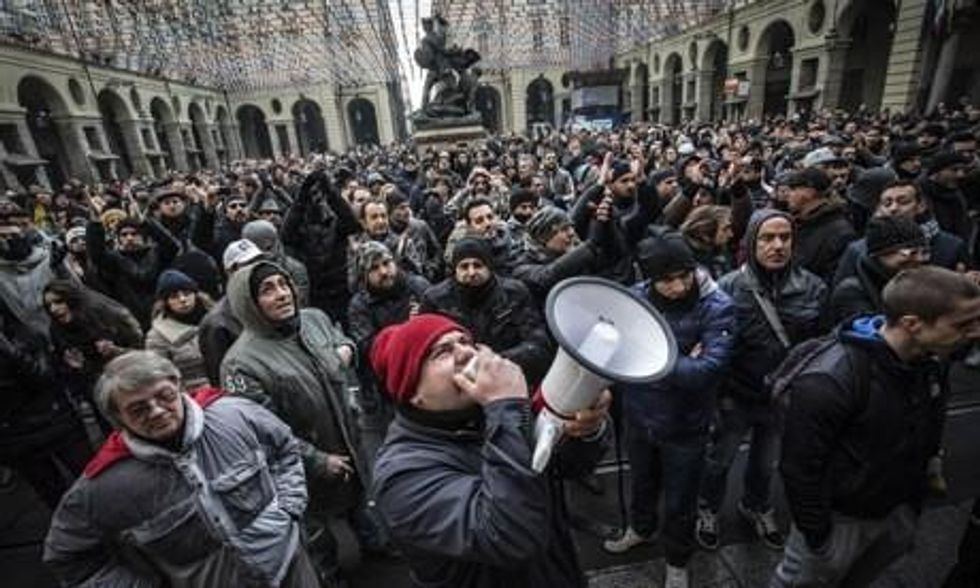
"Activists wearing Italian flag masks and white nooses around their necks rallied outside the European Commission's office in Rome and took down a European flag outside before being chased off by police," AFP reports.
According to the report, police violence against protesters persisted across Italy. In Venice, police fired tear gas at protesters outside the city's train station and in the northern Italy city of Turin--the epicenter of the latest wave of anti-austerity revolt--students paint bombs were met with force.
"There are millions of us and we are growing by the hour," said Danilo Calvani, a farmer who has emerged as one of the protest leaders. "This government has to go."
"These protests show Italy's massive crisis of political representation," said Duncan McDonnell, a political scientist at the European University Institute in Florence. "These people don't feel that anyone's actually listening to them ... It really shows how there are big sections of Italian society that don't feel represented by anyone - political parties, trade unions, interest groups or business."
What began in January 2012 when a group of Sicilian farmers and trucking companies staged a nine-day blockade to protest austerity-driven increases to fuel and fertilizer prices, the Forconi or Pitchforks movement has swelled into a national mobilization of small businessmen, low-paid workers, students and the unemployed taking a stand against the leading regime.
The week of actions are leading up to plans for a "peaceful invasion" in Rome starting Wednesday where demonstrations will reportedly persist until demands for a wholesale government changeover are met.
The protests have gained the support of other Italian opposition groups including the anti-establishment 5-Star Movement, whose leader Beppe Grillo urged in an open letter to leaders of the security forces to "no longer give protection to this political class that has brought Italy to its knees" and instead join their Italian bretheren.
"In the forthcoming demonstrations," he wrote on his blog earlier this week, "order your lads to take off their helmets and fraternise with the citizens. It'll be a signal that is revolutionary, peaceful and extreme."
Grillo continues:
This moment in history that we are experiencing right now, is a very dangerous one. The institutions have been delegitimised. The electoral law has been declared unconstitutional. Parliament, the Government and the President of the Republic are arbitrarily carrying out their functions. [...]
The management of the public resources, of social services, of the health service, of education and of law and order, is in a mess. The economy is collapsing. [...]
Italy has lost monetary sovereignty, fiscal sovereignty and it's about to lose its economic sovereignty with the most likely hypothesis being that of strangulation by the recessionary policies of the International Monetary Fund. Most of the citizens are being kept in the dark about the real situation that the country is hurtling into, thanks to a disinformation regime that places Italy in the 70th position on the "freedom of the press" ranking [...]
The disturbances that took place yesterday throughout Italy were mostly caused by the exasperation of the people because of their quality of life and the arrogance of a political class that is not doing without any privileges, but is just intent on perpetuating their own existence. Yesterday's protests could be the beginning of a conflagration or the precursor of future uprisings that could perhaps be uncontrollable.
Following the success of ruling Prime Minister Enrico Letta during a confidence vote in parliament Wednesday, organizers vowed to ramp up their actions until the party in power stepped aside.
"If the government wins the confidence vote on Wednesday and the politicians remain in place, all the pitchforks in Italy will move on Rome for a peaceful invasion," said Calvani.
This latest wave of demonstrations began on Monday when a series of small demonstrations sprang up across the country with reports of police violence and tear gas attacks.
In Turin on Tuesday, Italian independent reporter Mattia Marinolli writes, various demonstrations converged in the central square, Piazza Castello, where police responded to a number of hurled stones with "barrages of tear gas." Reportedly after the skirmish, when protesters demanded that the officers remove their helmets, some did--adding fuel to Grillo's and others' call for national solidarity with the demonstrations.
According to Reuters, Interior Minister Angelino Alfano told parliament earlier this week that the wave of unrest could "lead to a spiral of rebellion against national and European institutions."
_____________________
Some veterans of the Occupy and indignados movements are considering a turn towards electoral politics. This change of direction reflects an increasing awareness among activists that
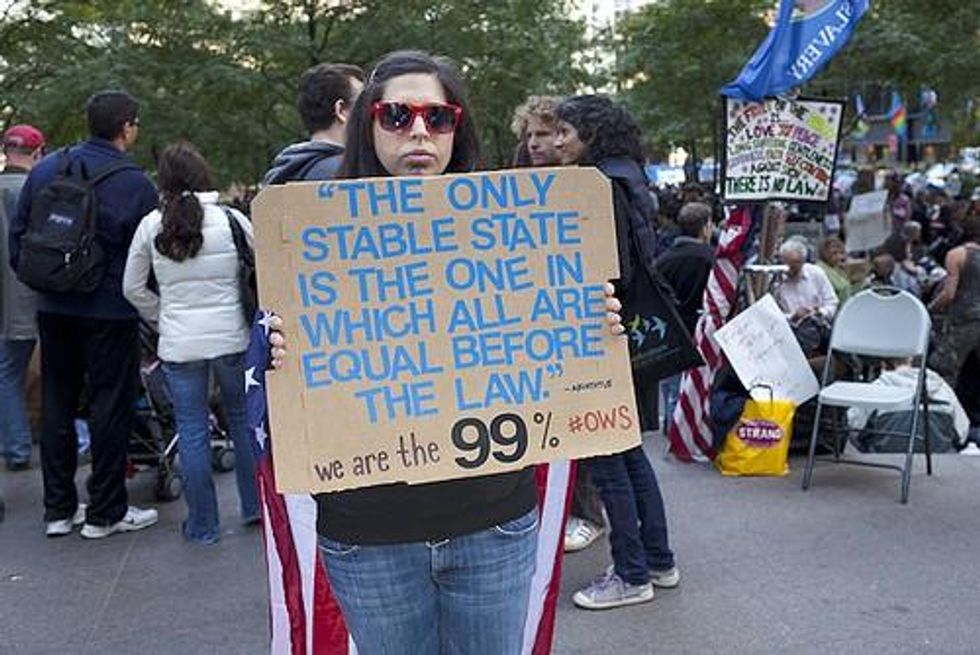
Setting up political parties is not exactly what we have become accustomed to expect from radical activists. Yet, this is precisely what some of the participants in the last few years of protest and occupations are now busying themselves with. From Spain to the US, Greece to Turkey, many protesters have been persuaded that to do away with the 1% dominating the 99%, it will not be enough simply to resort to the heroic arsenal of street politics. After taking to squares, many now feel the time has come to occupy the state.
"We believed that, following the street protests, American democracy would have reacted by changing its way of doing things," Micah White, the former editor of the radical magazine Adbusters, credited with the invention of the name Occupy Wall Street, recently declared. "Now we are realising that you also have to win elections, and you have to govern, not just work against the government."
White's comments - which came after a meeting with Beppe Grillo, the leader of Italy's Five Star movement, the anti-austerity party that won 25% of the vote in the last general election - might appear as a shot in the dark. But elsewhere this electoral turn is already in full steam. Take the enigmatically named X party (Partido X), in Spain. This political formation has emerged out of a wing of the indignados movement, and is tipped to run in the European elections of 2014. Similar to the Five Star movement, the X party's platform centres on the promise of a new electronic democracy, that chimes very well with the desire for participation expressed in the occupied squares of 2011. Other activists connected with the occupation movement wave - in countries such as Israel, Turkey and Greece - are trying to open up more traditional left parties and to use them to continue where the street movements stopped.
It is not difficult to understand the reasons behind this new interest in electoral politics. The financial crisis of 2008 has brought about a tectonic shift in public opinion. A number of impressive results for left formations, from the great showing of Syriza in the 2012 Greek elections, to the recent victory of De Blasio in New York, and the election of student leader Camila Vallejo in Chile, have shown the extent to which the electorate is looking for radical progressive alternatives.
Naturally, not everybody within the occupation movement is buying into this strategy. Many continue to see the state as the source of all evil, and in electoral politics a manifestation of despicable reformism. Yet, having to confront on a daily basis a difficult economic situation that begs for fast and realistic solutions, many have come to view new forms of engagement with political institutions favourably.
If there is something that the financial crisis and austerity politics has taught us, it is that, for all the recurring predictions about its ultimate disappearance, the state continues to deeply influence our lives. We have learned that the provision of the public services we cherish the most - education, health, public parks - is largely dependent on decisions taken at state level. Naturally, it would be foolish, in a world of global capitalism, to think that once the state is occupied, one can do as one wishes. But why shouldn't we also use the state, to secure new universal rights - free health, free education, free transportation, decent housing for all - of the type that have been prefigured in the occupied squares of 2011?
Anti-globalisation activists believed that, as asserted by Marxist scholar John Holloway, we could "change the world without taking power". Many in the new generation of activists have become painfully aware that in order to achieve real change you also need to take power; that in order to really scare the 1%, you also need to occupy the state.
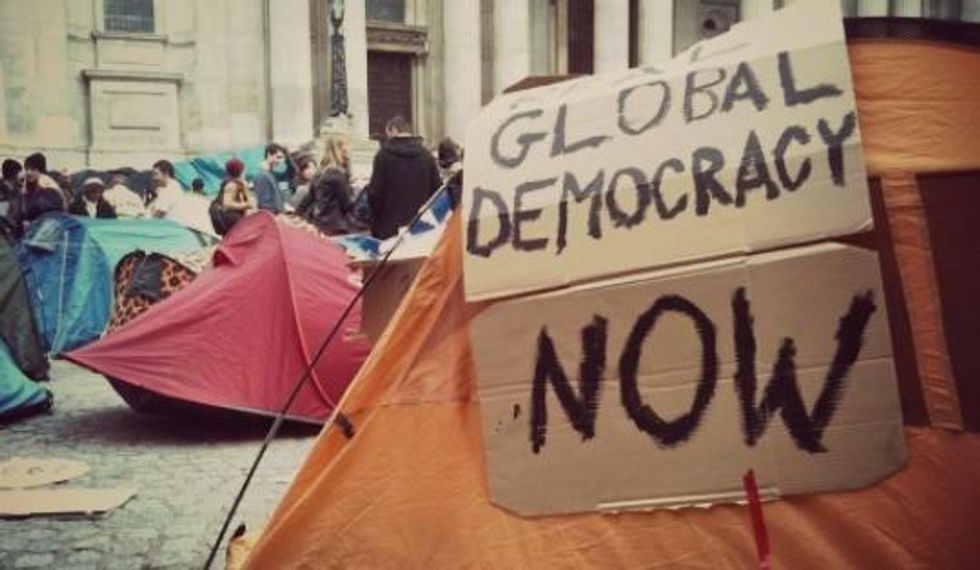
Credited as a precursor and the partial model for what became the Occupy Movement in the U.S., the indignados in Spain have continued their organizing despite the end of mass encampments in the nation's city centers.
Simmering below the surface, as The Guardian's Paul Hamilos reports from Madrid, the seeds planted amid the economic calamities of recent years are now growing into a new kind of political party that believes it is now ready to harness the energy and ideas of that movement in order to build a new kind of political and economic future for Spain.
"We have a slogan: 'Democracy, full stop.'" -Simona Levi, 'Partido X' member
So far ignored by most beyond Spain's borders, Hamilos paints a picture of the newly emergent 'Partido X' (or Party X) as an antidote to the resilient, yet destructive, politics of corruption and top-down economic policies that are hampering progress across Europe.
As Simona Levi, the equivalent of a spokesperson for the new political party, told Hamilos, "In Spain there is a political class that, at best, doesn't understand the needs of civil society, and at worst is completely corrupt and bankrupt. They have to go."
Following their official party announcement earlier this month, Joaquin Pagola, a member of the party explained to The Irish Times why a new political party and a new approach is necessary.
"We're in a situation whereby our democracy is full of holes, the system itself has failings," Pagola said. "Decisions are being taken that go against the wishes of the majority of Spaniards and as far as the economy is concerned, this is an emergency."
As The Guardian reports:
Partido X is positioning itself as a force for [...] change. Like many young parties, it is light on policy proposals in some areas, but says it has its sights set on tackling corruption with a "Nuremberg-style trial for bankers" and a dedicated anti-fraud unit, and to bring in more participatory democracy, with regular referendums.
The party promises to provide financial aid for Spain's small businesses, increase the minimum wage and introduce a maximum wage so no boss can earn more than 10 times his or her staff. These, and various other measures, may earn a shake of the head from the financial sector, but could appeal to those who have been left on the margins.
Unlike the traditional parties in Spain, Partido X understands the power of the internet, and its members have been using social media to spread their message and gather funds as well as ideas.
The party refuses to be pigeonholed as "right" or "left" but as Hamilos reports, its major policy plank is based on anti-corruption and the party broadly defines itself as "progressive," rejecting the serial malpractice performed by two-party system that currently dominates in Spain.
As Levi explained to the Irish Times: "We have a slogan: 'Democracy, full stop' which is a group of rules with which we can really control what a politician does, starting with a transparency law, which we don't have in Spain, and ending with [regular] referenda, which are almost non-existent in Spain."
And as, the Irish Times explains, the party's entrance into the arena of partisan politics is not designed as a departure from the street protest roots of their members, but an extention of it. As the Irish Times explains,
the most obvious reference point for Spain's new party is the indignados movement, which sprang up in 2011 and was a precursor to the likes of Occupy Wall Street. It was a spontaneous response to the country's rigid bi-party political system and poor handling of the economic crisis.
"The indignados was a historic moment, something akin to the French Revolution," Ms Levi told reporters [...]. "We're children of the indignados."
"Up until now no political party had managed to express the anger of the indignados," said Juan Carlos Monedero, a political scientist at Madrid's Complutense University.
"[Partido X] is a party made up of young, professional people who are closely involved in social networks and who somehow express this disenchantment - albeit from one particular angle."
And Hamilos adds:
Many have drawn comparisons with the Five Star movement led by the comedian Beppe Grillo, which stormed the Italian elections last year. Levi, who was born in Italy, agrees there are some similarities, and that the two groups have been in contact, but says Partido X is keen to avoid being led by a populist, charismatic leaderand sees itself as a "party of, and for, the citizens of this country". [...]
The sociologist Alejandro Navas, from the University of Navarra, has studied the indignados and understands the appeal in a country where youth unemployment has forced many educated Spaniards to leave. "We tell young people the world is theirs, but then the adult world doesn't allow that to happen. There is a shortage of jobs, and the ones that are out there often have low salaries and short-term contracts."
There is a contradiction inherent in Spain, said Navas: "Young people reject politicians, but they also expect a lot from the state. There is a lot of pessimism and resignation, which it will be hard to break." He is equivocal about whether Partido X can break that mood, and whether its activist base can come to terms with mainstream politics. But, he said, "change will only come from the ground up, from small parties and organisations."
In 2012, Democracy Now! host Amy Goodman interviewed Stephane Grueso, an activist and filmmaker who was making a documentary film about the indignados. In their exchange, Grueso explains why the indignados never "went away" but how they put down roots in their communities for ongoing and future political change. Watch:
________________________________________
The eurozone recession is now the longest on record for the single currency area, according to official statistics released last week, as the economy shrank again in the first quarter of this year. A comparison with the US economy may shed some light on how such a profound economic failure can occur in high-income, highly-educated countries in the 21st century.
While the US economy is still weak and vulnerable, the record 12.1 percent unemployment in the eurozone is still a lot worse than our 7.5 percent here. The most victimized countries like Spain and Greece have unemployment of about 27 percent.
The contrast between the US and Europe is all the more striking because Europe has much stronger labour unions, social democratic parties, and a more developed welfare state. Yet the eurozone has implemented policies far to the right of the US government, causing needless suffering for millions more people. How does this happen? The answers have little to do with a "debt crisis" but everything to do with macroeconomic policy, ideology, and - perhaps most importantly - democracy. As such these questions are relevant not only to the populations of both of these economic superpowers, but to most of the world.
Let's start with democracy: most of the eurozone countries have little to no control over the most important policies that the government can use to increase employment and income, including monetary, exchange rate, and increasingly, fiscal policy. They have ceded this control to the eurozone authorities - most importantly the European Central Bank (ECB). The decision makers for the more victimised countries - including Spain, Greece, Ireland, Portugal, and Italy - are now "the Troika": the ECB, European Commission, and the International Monetary Fund (IMF). They have their own agenda, and their priority is not restoring employment or even bringing about a speedy economic recovery.
Before returning to that agenda, let's contrast the economic decision makers of the eurozone with those of the United States. Our central bank, the Federal Reserve, is officially independent of the government. Like the ECB, it has often acted against the interests of the majority, favouring powerful financial interests - most recently in its enabling of the $8 trillion housing bubble that caused the Great Recession. But the Fed is still accountable in some ways. Fed Chair Ben Bernanke has to report regularly to Congress, and the Fed has some fear that Congress might reduce its autonomy if it were to ignore the public interest too flagrantly (they were not pleased about legislation approved by the US House last year that required, for the first time, an audit of the Fed's books; it remains blocked in the Senate).
The ECB, by contrast, has no such constraints. In fact, for most of the last three years, the Troika has actually used the recurrent financial crises in the eurozone to pursue a political agenda: rolling back, as much as possible in a European context, the welfare state. The ECB could have avoided most and possibly all of these crises by simply stabilising the interest rates on Spanish and Italian government bonds. But as was evident in numerous press reports, the ECB and its allies feared that to end the threat of a full-blown financial crisis would "remove the pressure" on governments to make the reforms that they wanted: cutting pensions and unemployment insurance, weakening unions' collective bargaining rights (as in Spain), and shrinking government generally.
Finally in the fall of last year, ECB President Mario Draghi made some statements indicating that the ECB would stabilise Spanish and Italian bonds. He got tired of near-death experiences, apparently; and after more than a dozen European governments (including Sarkozy's in France) had fallen, the ECB and its allies were running up against some political limits. This change in policy, which put an end to the most severe, recurring financial crises in Europe, can be partly attributed to the very slow impact of a severely limited form of democratic input. That included of course massive street protests and electoral events such as the surge of the Greek left party Syriza.
But this "democracy" is far too restricted and slow moving to save the millions of unemployed whose lives are being wasted; and most importantly, it only ended the acute crises and not the continuing recession caused by the austerity measures enforced by the Troika. This has an important lesson for any country: don't give away your economic sovereignty, on the most important macroeconomic policies that most of your nation's livelihood depends upon - unless it is transferred to a set of institutions that you can really trust. Which of course is the opposite of what was created with the eurozone, with its built-in bias towards austerity in recession, and a central bank that was religiously committed to not caring about employment.
Again, the contrast with the US is worth noting. Even if Mitt Romney had been elected, he would not have dared to implement the kind of austerity that would push the US back into recession. He would want to get re-elected. That is not to say that eurozone officials have a monopoly on macroeconomic stupidity: the sequester in the US is currently slowing the US economy and causing unnecessary harm. But it was not as easy to get this result here; it is not as severe; and it will be easier to reverse than in Europe.
What then is the hope for Europe? Another political lesson, which most union leaders know, is that it's difficult to win any concessions without bargaining power. So far, almost none of the political leaders in the most victimised countries, including Spain and Greece, are willing to simply refuse the Troika's conditions, for fear that it would lead to their exit from the euro. So the Troika doesn't see much reason to let up on the austerity. In that sense the most promising recent development has been the meteoric rise of the populist Beppe Grillo and his Five Star Movement in Italy. He has been willing to talk about a referendum on leaving the euro, and his movement got the largest number of parliamentary seats of any single political party in the February Italian elections.
The case needs to be made, and explained to the public - as economist Paul Krugman recently did for Cyprus - that years of mass unemployment are too high a price to pay for keeping the euro. Politicians do not need to propose leaving the euro, as that remains taboo. But a refusal to accept recessionary conditions would shift the burden to the European authorities as to whether they want to kick any country out of the currency union. Most likely they would not. But without a willingness to simply refuse the Troika's recessionary conditions, it's going to be a long, slow slog to reverse the continued infliction of needless suffering in what used to be one of the most democratic regions of the world.