SUBSCRIBE TO OUR FREE NEWSLETTER
Daily news & progressive opinion—funded by the people, not the corporations—delivered straight to your inbox.
5
#000000
#FFFFFF
To donate by check, phone, or other method, see our More Ways to Give page.
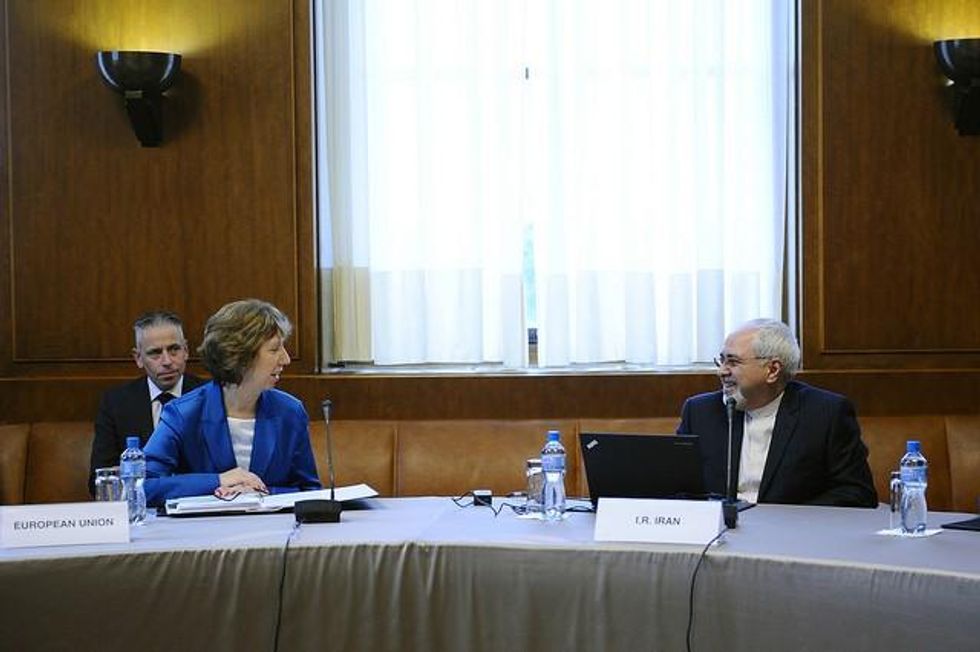
The talks involve delegates from Iran and the so-called P5+1 group: the five permanent members of the UN Security Council, the Britain, China, U.S., Russia, France plus Germany.
As NBC News reports,
Crippling U.N. and international economic sanctions have been in place against Tehran for more than 30 years. But only recently has Iran indicated it is ready agree to terms on its nuclear program in exchange for an easing of restrictions on such crucial economic engines as oil exports and international financial transactions.
At Tuesday's meeting, Iran's foreign minister, Mohammad Javad Zarif, gave a PowerPoint presentation called "Closing an unnecessary crisis: Opening new horizons." The Guardian reports that Zarif's
presentation was not made public, but it is believed to lay out a timetable for a confidence-building deal that would place limits on Iran's nuclear programme in return for relief from sanctions and international recognition of the country's right to enrich uranium.
Western powers have repeated unproven claims that Iran has a nuclear weapons program, which Iran has repeatedly denied. Ahead of the meeting, the senior Iranian negotiator and deputy foreign minister, Abbas Araqchi, told media, "We want to guarantee Iran's right to nuclear technology and assure the other side of the table that our nuclear program is peaceful."
Michael Mann, a spokesman for the EU's foreign policy head and lead negotiator at the talks Catherine Ashton, tweeted on Tuesday, "For the first time, very detailed technical discussions continued this afternoon between E3/EU+3 and Iran on the Iranian nuclear programme." A similar statement was given by an unnamed U.S. official quoted by the New York Times:
"For the first time, we had very detailed technical discussions, which carried on this afternoon," said the State Department official, who declined to be identified under the diplomatic protocol for informing the news media. "We will continue the discussions tomorrow."
Mann also described the Iranian presentation as "very useful," echoing an unnamed senior U.S. official who said, "The discussion was useful, and we look forward to continuing our discussions in tomorrow's meetings with the full P5+1and Iran." Araqchi said, "The proposal that we have introduced has the capacity to make a breakthrough." However, Araqchi told Reuters that it was "too soon to judge" whether the talks would succeed in breaking the current stalemate.
As the talks began, the Security Cabinet of Israel, believed to be the only country in the Middle East with nuclear weapons, stated, "It would be an historic mistake not to take full advantage of the sanctions, by making concessions before ensuring the dismantling of Iran's nuclear weapons program."
Speaking from Jerusalem on Tuesday, Israel's Prime Minister Benjamin Netanyahu added, "We want a peaceful world and that does not include an Iran that retains nuclear weapons capability."
___________________
The talks involve delegates from Iran and the so-called P5+1 group: the five permanent members of the UN Security Council, the Britain, China, U.S., Russia, France plus Germany.
As NBC News reports,
Crippling U.N. and international economic sanctions have been in place against Tehran for more than 30 years. But only recently has Iran indicated it is ready agree to terms on its nuclear program in exchange for an easing of restrictions on such crucial economic engines as oil exports and international financial transactions.
At Tuesday's meeting, Iran's foreign minister, Mohammad Javad Zarif, gave a PowerPoint presentation called "Closing an unnecessary crisis: Opening new horizons." The Guardian reports that Zarif's
presentation was not made public, but it is believed to lay out a timetable for a confidence-building deal that would place limits on Iran's nuclear programme in return for relief from sanctions and international recognition of the country's right to enrich uranium.
Western powers have repeated unproven claims that Iran has a nuclear weapons program, which Iran has repeatedly denied. Ahead of the meeting, the senior Iranian negotiator and deputy foreign minister, Abbas Araqchi, told media, "We want to guarantee Iran's right to nuclear technology and assure the other side of the table that our nuclear program is peaceful."
Michael Mann, a spokesman for the EU's foreign policy head and lead negotiator at the talks Catherine Ashton, tweeted on Tuesday, "For the first time, very detailed technical discussions continued this afternoon between E3/EU+3 and Iran on the Iranian nuclear programme." A similar statement was given by an unnamed U.S. official quoted by the New York Times:
"For the first time, we had very detailed technical discussions, which carried on this afternoon," said the State Department official, who declined to be identified under the diplomatic protocol for informing the news media. "We will continue the discussions tomorrow."
Mann also described the Iranian presentation as "very useful," echoing an unnamed senior U.S. official who said, "The discussion was useful, and we look forward to continuing our discussions in tomorrow's meetings with the full P5+1and Iran." Araqchi said, "The proposal that we have introduced has the capacity to make a breakthrough." However, Araqchi told Reuters that it was "too soon to judge" whether the talks would succeed in breaking the current stalemate.
As the talks began, the Security Cabinet of Israel, believed to be the only country in the Middle East with nuclear weapons, stated, "It would be an historic mistake not to take full advantage of the sanctions, by making concessions before ensuring the dismantling of Iran's nuclear weapons program."
Speaking from Jerusalem on Tuesday, Israel's Prime Minister Benjamin Netanyahu added, "We want a peaceful world and that does not include an Iran that retains nuclear weapons capability."
___________________
The talks involve delegates from Iran and the so-called P5+1 group: the five permanent members of the UN Security Council, the Britain, China, U.S., Russia, France plus Germany.
As NBC News reports,
Crippling U.N. and international economic sanctions have been in place against Tehran for more than 30 years. But only recently has Iran indicated it is ready agree to terms on its nuclear program in exchange for an easing of restrictions on such crucial economic engines as oil exports and international financial transactions.
At Tuesday's meeting, Iran's foreign minister, Mohammad Javad Zarif, gave a PowerPoint presentation called "Closing an unnecessary crisis: Opening new horizons." The Guardian reports that Zarif's
presentation was not made public, but it is believed to lay out a timetable for a confidence-building deal that would place limits on Iran's nuclear programme in return for relief from sanctions and international recognition of the country's right to enrich uranium.
Western powers have repeated unproven claims that Iran has a nuclear weapons program, which Iran has repeatedly denied. Ahead of the meeting, the senior Iranian negotiator and deputy foreign minister, Abbas Araqchi, told media, "We want to guarantee Iran's right to nuclear technology and assure the other side of the table that our nuclear program is peaceful."
Michael Mann, a spokesman for the EU's foreign policy head and lead negotiator at the talks Catherine Ashton, tweeted on Tuesday, "For the first time, very detailed technical discussions continued this afternoon between E3/EU+3 and Iran on the Iranian nuclear programme." A similar statement was given by an unnamed U.S. official quoted by the New York Times:
"For the first time, we had very detailed technical discussions, which carried on this afternoon," said the State Department official, who declined to be identified under the diplomatic protocol for informing the news media. "We will continue the discussions tomorrow."
Mann also described the Iranian presentation as "very useful," echoing an unnamed senior U.S. official who said, "The discussion was useful, and we look forward to continuing our discussions in tomorrow's meetings with the full P5+1and Iran." Araqchi said, "The proposal that we have introduced has the capacity to make a breakthrough." However, Araqchi told Reuters that it was "too soon to judge" whether the talks would succeed in breaking the current stalemate.
As the talks began, the Security Cabinet of Israel, believed to be the only country in the Middle East with nuclear weapons, stated, "It would be an historic mistake not to take full advantage of the sanctions, by making concessions before ensuring the dismantling of Iran's nuclear weapons program."
Speaking from Jerusalem on Tuesday, Israel's Prime Minister Benjamin Netanyahu added, "We want a peaceful world and that does not include an Iran that retains nuclear weapons capability."
___________________