SUBSCRIBE TO OUR FREE NEWSLETTER
Daily news & progressive opinion—funded by the people, not the corporations—delivered straight to your inbox.
5
#000000
#FFFFFF
To donate by check, phone, or other method, see our More Ways to Give page.
NEW YORK - April 23 - The four-part series America Revealed, airing on PBS stations this month, looks at big-picture economic issues, from agriculture to transportation to manufacturing. The series underwriter? The Dow Chemical Company, whose commercial interests closely track the subjects covered in the PBS series.
The first episode, entitled Food Machine (4/11/12), focused on large-scale agriculture, which is one of the industries in which Dow is a major player. The program featured an extended look at the corn industry, including efforts to control pests. As the program explained, the food industry "needed a game changer" in that fight. And it got one: The "genetically modified organism, better known as a GMO."
This positively portrayed "game changer" just happens to be the very type of product Dow sells. Indeed, Dow is among a handful of companies that dominate the genetic seed market (Pesticide Action Network, 8/10). The company has recently been trying to win approval for a new genetically modified corn that has been nicknamed "Agent Orange" for its resistance to a highly toxic herbicide. Dow's application is opposed by the Natural Resources Defense Council and the Center for Food Safety because of its toxicity, and the likelihood that it will simply create even more resistant weeds (EcoWatch, 4/10/12).
The problem with the Dow series is broader. On the company's website, Dow breaks down its interests into four categories: Agricultural, Infrastructure/Transportation, Energy and Consumer/Lifestyle.
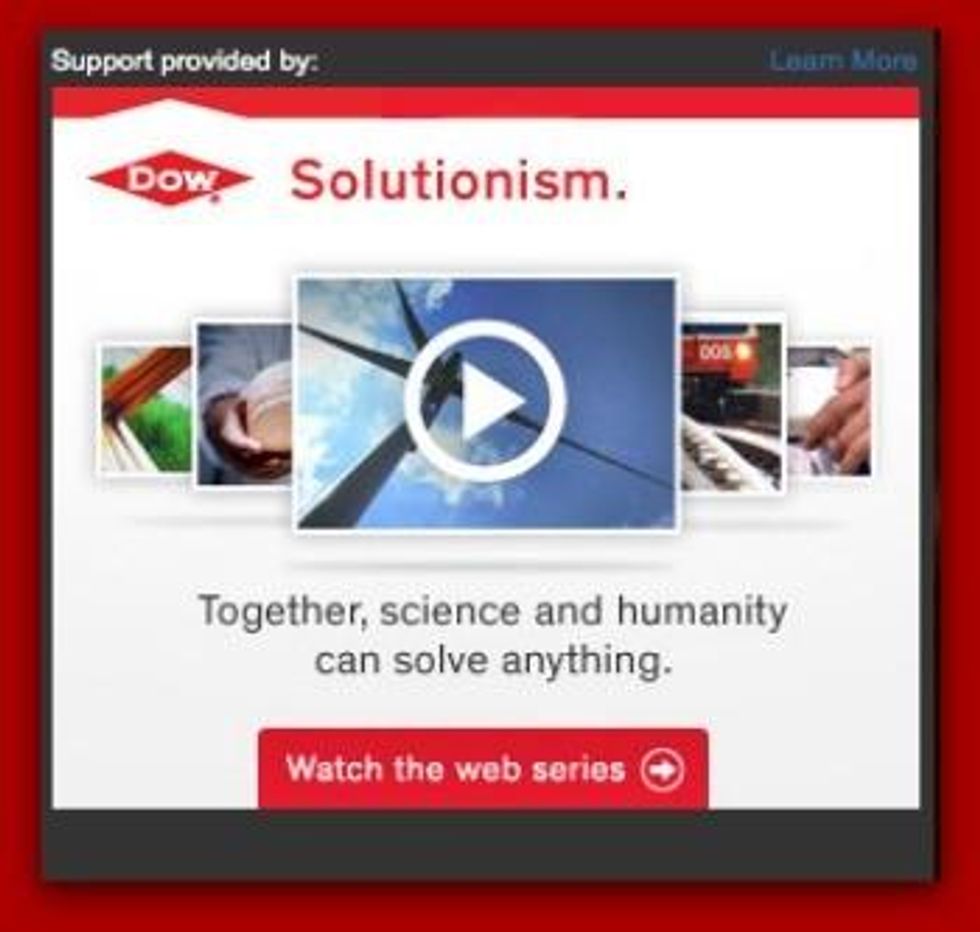
The PBS series Dow is funding addresses food and agriculture in the first episode. The second episode, which aired last week, is titled "Nation on the Move"--a look at transportation. The third episode is "Electric Nation," and the final installment will deal with American manufacturing.
In other words, Dow's interests are all over the Dow-funded public TV series.
Under PBS's underwriting guidelines, this show should never have been allowed with this sponsor. Over the years, however, PBS has shown a remarkable willingness to allow certain funding arrangements--usually when the funders were large corporations (FAIR Press Release, 4/3/02). The network outlines three tests that "are applied to every proposed funding arrangement in order to determine its acceptability":
Without knowing anything about the matter of editorial control, it would seem clear that America Revealed has problems with the perception and commercialism tests. As the PBS guidelines state of the perception test:
When there exists a clear and direct connection between the interests or products or services of a proposed funder and the subject matter of the program, the proposed funding will be deemed unacceptable regardless of the funder's actual compliance with the editorial control provisions of this policy.
On its commercialism test, PBS explains:
The policy is intended to prohibit any funding arrangement where the primary emphasis of the program is on products or services that are identical or similar to those of the underwriter.
On paper, PBS would seem to take these matters quite seriously:
Should a significant number of reasonable viewers conclude that PBS has sold its professionalism and independence to its program funders, whether or not their conclusions are justified, then the entire program service of public television will be suspect and the goal of serving the public will be unachievable.
If PBS believes that conflicts of interests are indeed that important, then why is it airing a Dow-funded series about Dow's business interests?
* * *
Watch the PBS's 'America Revealed: The Food Machine-Corn' (Episode 1, Chapter 7):
Watch the full show here.
* * *
FAIR's call to action:
Ask PBS to explain why Dow Chemical Company is permitted to fund a series about issues closely linked to Dow's business.
CONTACT:
PBS Ombud
Michael Getler
ombudsman@pbs.org
703-739-5290
(Please post copies of your letters in the comments section on the FAIR Blog)
NEW YORK - April 23 - The four-part series America Revealed, airing on PBS stations this month, looks at big-picture economic issues, from agriculture to transportation to manufacturing. The series underwriter? The Dow Chemical Company, whose commercial interests closely track the subjects covered in the PBS series.
The first episode, entitled Food Machine (4/11/12), focused on large-scale agriculture, which is one of the industries in which Dow is a major player. The program featured an extended look at the corn industry, including efforts to control pests. As the program explained, the food industry "needed a game changer" in that fight. And it got one: The "genetically modified organism, better known as a GMO."
This positively portrayed "game changer" just happens to be the very type of product Dow sells. Indeed, Dow is among a handful of companies that dominate the genetic seed market (Pesticide Action Network, 8/10). The company has recently been trying to win approval for a new genetically modified corn that has been nicknamed "Agent Orange" for its resistance to a highly toxic herbicide. Dow's application is opposed by the Natural Resources Defense Council and the Center for Food Safety because of its toxicity, and the likelihood that it will simply create even more resistant weeds (EcoWatch, 4/10/12).
The problem with the Dow series is broader. On the company's website, Dow breaks down its interests into four categories: Agricultural, Infrastructure/Transportation, Energy and Consumer/Lifestyle.
The PBS series Dow is funding addresses food and agriculture in the first episode. The second episode, which aired last week, is titled "Nation on the Move"--a look at transportation. The third episode is "Electric Nation," and the final installment will deal with American manufacturing.
In other words, Dow's interests are all over the Dow-funded public TV series.
Under PBS's underwriting guidelines, this show should never have been allowed with this sponsor. Over the years, however, PBS has shown a remarkable willingness to allow certain funding arrangements--usually when the funders were large corporations (FAIR Press Release, 4/3/02). The network outlines three tests that "are applied to every proposed funding arrangement in order to determine its acceptability":
Without knowing anything about the matter of editorial control, it would seem clear that America Revealed has problems with the perception and commercialism tests. As the PBS guidelines state of the perception test:
When there exists a clear and direct connection between the interests or products or services of a proposed funder and the subject matter of the program, the proposed funding will be deemed unacceptable regardless of the funder's actual compliance with the editorial control provisions of this policy.
On its commercialism test, PBS explains:
The policy is intended to prohibit any funding arrangement where the primary emphasis of the program is on products or services that are identical or similar to those of the underwriter.
On paper, PBS would seem to take these matters quite seriously:
Should a significant number of reasonable viewers conclude that PBS has sold its professionalism and independence to its program funders, whether or not their conclusions are justified, then the entire program service of public television will be suspect and the goal of serving the public will be unachievable.
If PBS believes that conflicts of interests are indeed that important, then why is it airing a Dow-funded series about Dow's business interests?
* * *
Watch the PBS's 'America Revealed: The Food Machine-Corn' (Episode 1, Chapter 7):
Watch the full show here.
* * *
FAIR's call to action:
Ask PBS to explain why Dow Chemical Company is permitted to fund a series about issues closely linked to Dow's business.
CONTACT:
PBS Ombud
Michael Getler
ombudsman@pbs.org
703-739-5290
(Please post copies of your letters in the comments section on the FAIR Blog)
NEW YORK - April 23 - The four-part series America Revealed, airing on PBS stations this month, looks at big-picture economic issues, from agriculture to transportation to manufacturing. The series underwriter? The Dow Chemical Company, whose commercial interests closely track the subjects covered in the PBS series.
The first episode, entitled Food Machine (4/11/12), focused on large-scale agriculture, which is one of the industries in which Dow is a major player. The program featured an extended look at the corn industry, including efforts to control pests. As the program explained, the food industry "needed a game changer" in that fight. And it got one: The "genetically modified organism, better known as a GMO."
This positively portrayed "game changer" just happens to be the very type of product Dow sells. Indeed, Dow is among a handful of companies that dominate the genetic seed market (Pesticide Action Network, 8/10). The company has recently been trying to win approval for a new genetically modified corn that has been nicknamed "Agent Orange" for its resistance to a highly toxic herbicide. Dow's application is opposed by the Natural Resources Defense Council and the Center for Food Safety because of its toxicity, and the likelihood that it will simply create even more resistant weeds (EcoWatch, 4/10/12).
The problem with the Dow series is broader. On the company's website, Dow breaks down its interests into four categories: Agricultural, Infrastructure/Transportation, Energy and Consumer/Lifestyle.
The PBS series Dow is funding addresses food and agriculture in the first episode. The second episode, which aired last week, is titled "Nation on the Move"--a look at transportation. The third episode is "Electric Nation," and the final installment will deal with American manufacturing.
In other words, Dow's interests are all over the Dow-funded public TV series.
Under PBS's underwriting guidelines, this show should never have been allowed with this sponsor. Over the years, however, PBS has shown a remarkable willingness to allow certain funding arrangements--usually when the funders were large corporations (FAIR Press Release, 4/3/02). The network outlines three tests that "are applied to every proposed funding arrangement in order to determine its acceptability":
Without knowing anything about the matter of editorial control, it would seem clear that America Revealed has problems with the perception and commercialism tests. As the PBS guidelines state of the perception test:
When there exists a clear and direct connection between the interests or products or services of a proposed funder and the subject matter of the program, the proposed funding will be deemed unacceptable regardless of the funder's actual compliance with the editorial control provisions of this policy.
On its commercialism test, PBS explains:
The policy is intended to prohibit any funding arrangement where the primary emphasis of the program is on products or services that are identical or similar to those of the underwriter.
On paper, PBS would seem to take these matters quite seriously:
Should a significant number of reasonable viewers conclude that PBS has sold its professionalism and independence to its program funders, whether or not their conclusions are justified, then the entire program service of public television will be suspect and the goal of serving the public will be unachievable.
If PBS believes that conflicts of interests are indeed that important, then why is it airing a Dow-funded series about Dow's business interests?
* * *
Watch the PBS's 'America Revealed: The Food Machine-Corn' (Episode 1, Chapter 7):
Watch the full show here.
* * *
FAIR's call to action:
Ask PBS to explain why Dow Chemical Company is permitted to fund a series about issues closely linked to Dow's business.
CONTACT:
PBS Ombud
Michael Getler
ombudsman@pbs.org
703-739-5290
(Please post copies of your letters in the comments section on the FAIR Blog)