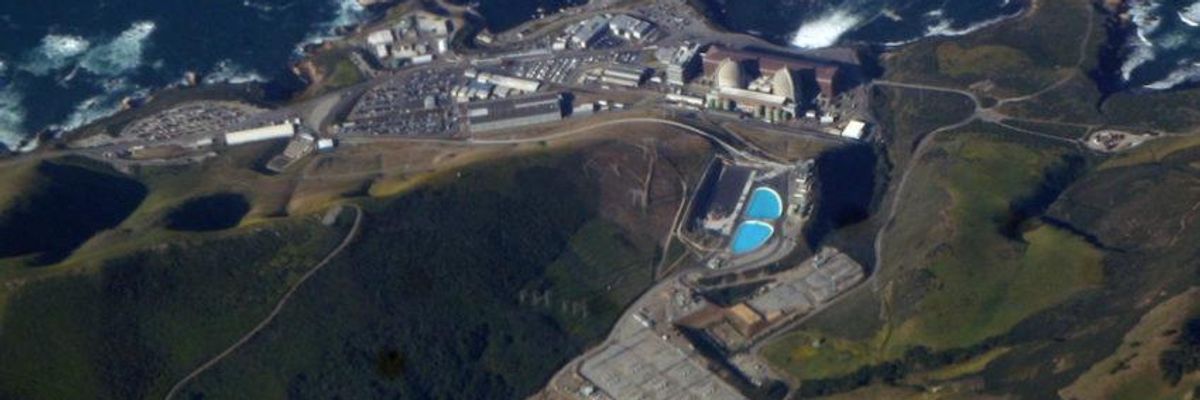
Diablo Canyon power plant in California. (Photo: Wikimedia Commons)

Earthquake Risk Keeps Heat on Vulnerable Nuclear Reactors
A proposal by a California administrative law judge has given safe energy advocates new hope
A proposal by a California administrative law judge has given safe energy advocates new hope that two Diablo Canyon nuclear reactors will be shut before an earthquake on the San Andreas fault turns them to rubble, potentially threatening millions of people.
The huge reactors--California's last--sit on a bluff above the Pacific, west of San Luis Obispo, among a dozen earthquake faults. They operate just 45 miles from the San Andreas. That's half the distance from the fault that destroyed four reactors in Fukushima, Japan, in 2011. Diablo's wind-blown emissions could irradiate the Los Angeles megalopolis in less than six hours if an earthquake destroyed the plant.
The death toll could be in the millions, the property damage in the trillions of dollars. The owner of the plant, Pacific Gas & Electric (PG&E), would not be legally liable.
Last year, a deal to shut down Diablo's two reactors in 2024 and 2025 was struck by the state, PG&E, surrounding communities and some environmental groups. Diablo's federal licenses expire in those years, and PG&E agreed not to seek renewals. The power, it said, could be replaced with wind turbines and solar panels.
But the $1.7 billion in rate hikes stipulated in the deal still must be approved by California's Public Utilities Commission (PUC). A proposed decision by administrative law Judge Peter Allen would limit them to less than $200 million.
The PUC must now factor Allen's decision into how much it allows PG&E to charge. If it honors Allen's opinion, the company must then decide whether it will continue to operate the reactors, which increasingly look like money losers.
The company's standing is not exactly sterling. Massive fires that swept through Northern California in October killed at least 43 people, turning some 5,700 structures and whole forests, rural communities and parts of Santa Rosa into smoldering ash (the Trump administration has just omitted from its latest budget any federal aid to the region).
The San Jose Mercury News has speculated that PG&E may have been responsible for the conflagration by failing to maintain power lines that were blown over in a windstorm. Local fire departments were already complaining that trees and underbrush were being sparked by poles and wires PG&E had failed to maintain, though maintenance is required by law.
PG&E now faces a firestorm of lawsuits that could soar well into the billions. Criminal prosecution is also possible.
In 2010, a fire killed eight people and torched an upscale San Bruno neighborhood. The cause was badly maintained gas lines--for which PG&E had been cited repeatedly. Fines exceeded $1.4 billion, but criminal prosecution remains unresolved.
Other costly lapses have plagued PG&E through the years. Some involve Diablo itself, which opened in the mid-1980s amid America's biggest "No Nukes" civil disobedience campaign, involving thousands of arrests.
Linda Seeley of San Luis Obispo's Mothers for Peace says the company faces impossible hurdles in dealing with its thousands of tons of radioactive waste. In addition, she notes, "Many very expensive components in the two reactors must be replaced far before the proposed 2024-5 shutdown dates. Our concern is that PG&E may try to sneak through without paying to maintain the reactors even at basic safety levels."
Michael Peck, a former Nuclear Regulatory Commission in-house inspector at Diablo, has warned that the reactors cannot survive a major earthquake and should close immediately. He has since been transferred to Chattanooga, Tenn.
"Diablo may no longer be profitable," Seeley has said on my "California Solartopia" show on radio station KPFK. "The cost of wind and solar has dropped so fast it may not pay PG&E to run those plants anymore, even without doing the basic maintenance."
Because much of Diablo's aging workforce is retiring or looking elsewhere for job security, PG&E wants subsidies to retain skilled staff to run the place. Judge Allen specifically rejected much of the rate hike designed to meet that crisis.
California's State Lands Commission is being sued by the World Business Academy, a Santa Barbara think tank, over key leases granted in the 1970s. The commission granted PG&E a waiver on conducting legally required environmental impact statements (gubernatorial candidate Gavin Newsom was among those who voted in favor). Should the business academy win its suit, or should the PUC honor Allen's decision, and PG&E alter its timetable, those leases might be revisited. Without them, Diablo would almost certainly be forced to shut.
Challenges have also been raised over approval by the California Coastal Commission of Diablo's cooling system.
Seeley and other activists have asked the public to pressure the PUC, state agencies and politicians like Newsom to shut Diablo sooner rather than later.
"Until they can specify the exact date and time the San Andreas and those other faults will go off," Seeley said in a recent phone interview, "nobody should feel safe."
Urgent. It's never been this bad.
Dear Common Dreams reader, It’s been nearly 30 years since I co-founded Common Dreams with my late wife, Lina Newhouser. We had the radical notion that journalism should serve the public good, not corporate profits. It was clear to us from the outset what it would take to build such a project. No paid advertisements. No corporate sponsors. No millionaire publisher telling us what to think or do. Many people said we wouldn't last a year, but we proved those doubters wrong. Together with a tremendous team of journalists and dedicated staff, we built an independent media outlet free from the constraints of profits and corporate control. Our mission from the outset was simple. To inform. To inspire. To ignite change for the common good. Building Common Dreams was not easy. Our survival was never guaranteed. When you take on the most powerful forces—Wall Street greed, fossil fuel industry destruction, Big Tech lobbyists, and uber-rich oligarchs who have spent billions upon billions rigging the economy and democracy in their favor—the only bulwark you have is supporters who believe in your work. But here’s the urgent message from me today. It’s never been this bad out there. And it’s never been this hard to keep us going. At the very moment Common Dreams is most needed and doing some of its best and most important work, the threats we face are intensifying. Right now, with just two days to go in our Spring Campaign, we're falling short of our make-or-break goal. When everyone does the little they can afford, we are strong. But if that support retreats or dries up, so do we. Can you make a gift right now to make sure Common Dreams not only survives but thrives? There is no backup plan or rainy day fund. There is only you. —Craig Brown, Co-founder |
A proposal by a California administrative law judge has given safe energy advocates new hope that two Diablo Canyon nuclear reactors will be shut before an earthquake on the San Andreas fault turns them to rubble, potentially threatening millions of people.
The huge reactors--California's last--sit on a bluff above the Pacific, west of San Luis Obispo, among a dozen earthquake faults. They operate just 45 miles from the San Andreas. That's half the distance from the fault that destroyed four reactors in Fukushima, Japan, in 2011. Diablo's wind-blown emissions could irradiate the Los Angeles megalopolis in less than six hours if an earthquake destroyed the plant.
The death toll could be in the millions, the property damage in the trillions of dollars. The owner of the plant, Pacific Gas & Electric (PG&E), would not be legally liable.
Last year, a deal to shut down Diablo's two reactors in 2024 and 2025 was struck by the state, PG&E, surrounding communities and some environmental groups. Diablo's federal licenses expire in those years, and PG&E agreed not to seek renewals. The power, it said, could be replaced with wind turbines and solar panels.
But the $1.7 billion in rate hikes stipulated in the deal still must be approved by California's Public Utilities Commission (PUC). A proposed decision by administrative law Judge Peter Allen would limit them to less than $200 million.
The PUC must now factor Allen's decision into how much it allows PG&E to charge. If it honors Allen's opinion, the company must then decide whether it will continue to operate the reactors, which increasingly look like money losers.
The company's standing is not exactly sterling. Massive fires that swept through Northern California in October killed at least 43 people, turning some 5,700 structures and whole forests, rural communities and parts of Santa Rosa into smoldering ash (the Trump administration has just omitted from its latest budget any federal aid to the region).
The San Jose Mercury News has speculated that PG&E may have been responsible for the conflagration by failing to maintain power lines that were blown over in a windstorm. Local fire departments were already complaining that trees and underbrush were being sparked by poles and wires PG&E had failed to maintain, though maintenance is required by law.
PG&E now faces a firestorm of lawsuits that could soar well into the billions. Criminal prosecution is also possible.
In 2010, a fire killed eight people and torched an upscale San Bruno neighborhood. The cause was badly maintained gas lines--for which PG&E had been cited repeatedly. Fines exceeded $1.4 billion, but criminal prosecution remains unresolved.
Other costly lapses have plagued PG&E through the years. Some involve Diablo itself, which opened in the mid-1980s amid America's biggest "No Nukes" civil disobedience campaign, involving thousands of arrests.
Linda Seeley of San Luis Obispo's Mothers for Peace says the company faces impossible hurdles in dealing with its thousands of tons of radioactive waste. In addition, she notes, "Many very expensive components in the two reactors must be replaced far before the proposed 2024-5 shutdown dates. Our concern is that PG&E may try to sneak through without paying to maintain the reactors even at basic safety levels."
Michael Peck, a former Nuclear Regulatory Commission in-house inspector at Diablo, has warned that the reactors cannot survive a major earthquake and should close immediately. He has since been transferred to Chattanooga, Tenn.
"Diablo may no longer be profitable," Seeley has said on my "California Solartopia" show on radio station KPFK. "The cost of wind and solar has dropped so fast it may not pay PG&E to run those plants anymore, even without doing the basic maintenance."
Because much of Diablo's aging workforce is retiring or looking elsewhere for job security, PG&E wants subsidies to retain skilled staff to run the place. Judge Allen specifically rejected much of the rate hike designed to meet that crisis.
California's State Lands Commission is being sued by the World Business Academy, a Santa Barbara think tank, over key leases granted in the 1970s. The commission granted PG&E a waiver on conducting legally required environmental impact statements (gubernatorial candidate Gavin Newsom was among those who voted in favor). Should the business academy win its suit, or should the PUC honor Allen's decision, and PG&E alter its timetable, those leases might be revisited. Without them, Diablo would almost certainly be forced to shut.
Challenges have also been raised over approval by the California Coastal Commission of Diablo's cooling system.
Seeley and other activists have asked the public to pressure the PUC, state agencies and politicians like Newsom to shut Diablo sooner rather than later.
"Until they can specify the exact date and time the San Andreas and those other faults will go off," Seeley said in a recent phone interview, "nobody should feel safe."
A proposal by a California administrative law judge has given safe energy advocates new hope that two Diablo Canyon nuclear reactors will be shut before an earthquake on the San Andreas fault turns them to rubble, potentially threatening millions of people.
The huge reactors--California's last--sit on a bluff above the Pacific, west of San Luis Obispo, among a dozen earthquake faults. They operate just 45 miles from the San Andreas. That's half the distance from the fault that destroyed four reactors in Fukushima, Japan, in 2011. Diablo's wind-blown emissions could irradiate the Los Angeles megalopolis in less than six hours if an earthquake destroyed the plant.
The death toll could be in the millions, the property damage in the trillions of dollars. The owner of the plant, Pacific Gas & Electric (PG&E), would not be legally liable.
Last year, a deal to shut down Diablo's two reactors in 2024 and 2025 was struck by the state, PG&E, surrounding communities and some environmental groups. Diablo's federal licenses expire in those years, and PG&E agreed not to seek renewals. The power, it said, could be replaced with wind turbines and solar panels.
But the $1.7 billion in rate hikes stipulated in the deal still must be approved by California's Public Utilities Commission (PUC). A proposed decision by administrative law Judge Peter Allen would limit them to less than $200 million.
The PUC must now factor Allen's decision into how much it allows PG&E to charge. If it honors Allen's opinion, the company must then decide whether it will continue to operate the reactors, which increasingly look like money losers.
The company's standing is not exactly sterling. Massive fires that swept through Northern California in October killed at least 43 people, turning some 5,700 structures and whole forests, rural communities and parts of Santa Rosa into smoldering ash (the Trump administration has just omitted from its latest budget any federal aid to the region).
The San Jose Mercury News has speculated that PG&E may have been responsible for the conflagration by failing to maintain power lines that were blown over in a windstorm. Local fire departments were already complaining that trees and underbrush were being sparked by poles and wires PG&E had failed to maintain, though maintenance is required by law.
PG&E now faces a firestorm of lawsuits that could soar well into the billions. Criminal prosecution is also possible.
In 2010, a fire killed eight people and torched an upscale San Bruno neighborhood. The cause was badly maintained gas lines--for which PG&E had been cited repeatedly. Fines exceeded $1.4 billion, but criminal prosecution remains unresolved.
Other costly lapses have plagued PG&E through the years. Some involve Diablo itself, which opened in the mid-1980s amid America's biggest "No Nukes" civil disobedience campaign, involving thousands of arrests.
Linda Seeley of San Luis Obispo's Mothers for Peace says the company faces impossible hurdles in dealing with its thousands of tons of radioactive waste. In addition, she notes, "Many very expensive components in the two reactors must be replaced far before the proposed 2024-5 shutdown dates. Our concern is that PG&E may try to sneak through without paying to maintain the reactors even at basic safety levels."
Michael Peck, a former Nuclear Regulatory Commission in-house inspector at Diablo, has warned that the reactors cannot survive a major earthquake and should close immediately. He has since been transferred to Chattanooga, Tenn.
"Diablo may no longer be profitable," Seeley has said on my "California Solartopia" show on radio station KPFK. "The cost of wind and solar has dropped so fast it may not pay PG&E to run those plants anymore, even without doing the basic maintenance."
Because much of Diablo's aging workforce is retiring or looking elsewhere for job security, PG&E wants subsidies to retain skilled staff to run the place. Judge Allen specifically rejected much of the rate hike designed to meet that crisis.
California's State Lands Commission is being sued by the World Business Academy, a Santa Barbara think tank, over key leases granted in the 1970s. The commission granted PG&E a waiver on conducting legally required environmental impact statements (gubernatorial candidate Gavin Newsom was among those who voted in favor). Should the business academy win its suit, or should the PUC honor Allen's decision, and PG&E alter its timetable, those leases might be revisited. Without them, Diablo would almost certainly be forced to shut.
Challenges have also been raised over approval by the California Coastal Commission of Diablo's cooling system.
Seeley and other activists have asked the public to pressure the PUC, state agencies and politicians like Newsom to shut Diablo sooner rather than later.
"Until they can specify the exact date and time the San Andreas and those other faults will go off," Seeley said in a recent phone interview, "nobody should feel safe."