SUBSCRIBE TO OUR FREE NEWSLETTER
Daily news & progressive opinion—funded by the people, not the corporations—delivered straight to your inbox.
5
#000000
#FFFFFF
To donate by check, phone, or other method, see our More Ways to Give page.
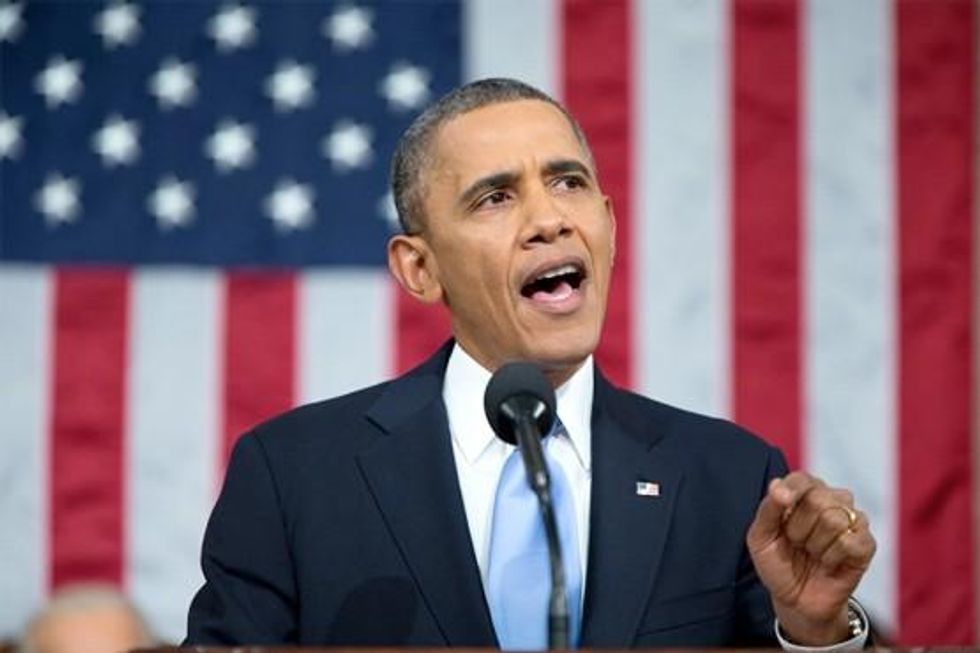
Just look at his speech. After years of saying the word "poverty" fewer times than any president in memory (and talking about the middle class more), here was Obama talking about inequality and workers stifled by low wages. That's thanks to public activism.
Many Americans are already creating worker owned co-ops, community-owned businesses, and public services that feed the stomach and the soul.
"Inequality has deepened"; "No one who works full time should ever have to raise a family in poverty." The president's best applause lines were lifted from protest signs. Now "citizens" (and would-be citizens) will have to come up with solutions too, because his won't take us very far.
Take that minimum wage hike for federal workers. Ten dollars and ten cents an hour is nice, but $20,000 a year is hardly a ticket out of poverty, even if you can find a full-time job in the public sector. The demand on the street, in case the president missed it, has been for $15 an hour, and the right to bargain collectively so workers have some power. (On Twitter that's #Fightfor15 or #raisethewage.)
Yes! Magazine held a live Twitter-fest during the president's speech. Among the messages that flew in were the following suggestions.
To stop the shrinking of the public sector, the president needs to bring jobs back home, said union members. The feds spend a reported $1.5 billion a year buying camo pants and TSA uniforms from companies overseas. Obviously the government needs to set labor standards for overseas procurement and stick to them. But instead of subcontracting to sweatshops why not buy #Americanmade? In fact, why not shop locally at all levels of government? (For more on the local procurement issue, follow #shoplocal or #localbiz on Twitter.)
The president talked about speeding approvals for infrastructure repair and high-tech "hubs." Why not do away with the middleman? Hire those workers directly and pay them a living wages with good benefits?
Good Jobs First (@GoodJobsFirst) has documented that tempting profitable businesses into "hubs" with tax breaks and incentive cash is wasteful. If government's going to invest in private businesses, why not demand an ownership share for the taxpayers? Create anchor institutions that are connected to the local economy. Better yet, invest in the businesses that are already there. (In a recent report, @GoodJobsFirst shows that ending corporate subsidies and loopholes could end state pension crises.)
Antifracking activists responded to President Obama support for natural gas as "a bridge fuel." It's a bridge to nowhere, several said. Invest now in wind and solar and it'll pay off handsomely down the road. And why not keep those companies public, so the profits, not just the risks stay with the taxpayers?
The tweet that sticks with me most came from George Goehl at National People's Action:
President Obama said, "We all owe it to the American people to say what we're for, not just what we're against." There's also a responsibility to listen. Many Americans are saying loudly what they're for, and they're making it happen: creating worker owned co-ops, community-owned businesses, and public services that feed the stomach and the soul.
At Yes! Magazine, I'm calling it "Commonomics"--as one follower described it, "people-centered economics." That's economics that serves local people and the planet first, not ever-increasing profit. As Goehl suggests, it's possible to make a fairer economy, but not if policy makers only tinker, and not if "citizens" wait for someone else to do it. As the president said, the strength of the union is built by we the people.
This article was written for YES! Magazine's Commonomics project.
Just look at his speech. After years of saying the word "poverty" fewer times than any president in memory (and talking about the middle class more), here was Obama talking about inequality and workers stifled by low wages. That's thanks to public activism.
Many Americans are already creating worker owned co-ops, community-owned businesses, and public services that feed the stomach and the soul.
"Inequality has deepened"; "No one who works full time should ever have to raise a family in poverty." The president's best applause lines were lifted from protest signs. Now "citizens" (and would-be citizens) will have to come up with solutions too, because his won't take us very far.
Take that minimum wage hike for federal workers. Ten dollars and ten cents an hour is nice, but $20,000 a year is hardly a ticket out of poverty, even if you can find a full-time job in the public sector. The demand on the street, in case the president missed it, has been for $15 an hour, and the right to bargain collectively so workers have some power. (On Twitter that's #Fightfor15 or #raisethewage.)
Yes! Magazine held a live Twitter-fest during the president's speech. Among the messages that flew in were the following suggestions.
To stop the shrinking of the public sector, the president needs to bring jobs back home, said union members. The feds spend a reported $1.5 billion a year buying camo pants and TSA uniforms from companies overseas. Obviously the government needs to set labor standards for overseas procurement and stick to them. But instead of subcontracting to sweatshops why not buy #Americanmade? In fact, why not shop locally at all levels of government? (For more on the local procurement issue, follow #shoplocal or #localbiz on Twitter.)
The president talked about speeding approvals for infrastructure repair and high-tech "hubs." Why not do away with the middleman? Hire those workers directly and pay them a living wages with good benefits?
Good Jobs First (@GoodJobsFirst) has documented that tempting profitable businesses into "hubs" with tax breaks and incentive cash is wasteful. If government's going to invest in private businesses, why not demand an ownership share for the taxpayers? Create anchor institutions that are connected to the local economy. Better yet, invest in the businesses that are already there. (In a recent report, @GoodJobsFirst shows that ending corporate subsidies and loopholes could end state pension crises.)
Antifracking activists responded to President Obama support for natural gas as "a bridge fuel." It's a bridge to nowhere, several said. Invest now in wind and solar and it'll pay off handsomely down the road. And why not keep those companies public, so the profits, not just the risks stay with the taxpayers?
The tweet that sticks with me most came from George Goehl at National People's Action:
President Obama said, "We all owe it to the American people to say what we're for, not just what we're against." There's also a responsibility to listen. Many Americans are saying loudly what they're for, and they're making it happen: creating worker owned co-ops, community-owned businesses, and public services that feed the stomach and the soul.
At Yes! Magazine, I'm calling it "Commonomics"--as one follower described it, "people-centered economics." That's economics that serves local people and the planet first, not ever-increasing profit. As Goehl suggests, it's possible to make a fairer economy, but not if policy makers only tinker, and not if "citizens" wait for someone else to do it. As the president said, the strength of the union is built by we the people.
This article was written for YES! Magazine's Commonomics project.
Just look at his speech. After years of saying the word "poverty" fewer times than any president in memory (and talking about the middle class more), here was Obama talking about inequality and workers stifled by low wages. That's thanks to public activism.
Many Americans are already creating worker owned co-ops, community-owned businesses, and public services that feed the stomach and the soul.
"Inequality has deepened"; "No one who works full time should ever have to raise a family in poverty." The president's best applause lines were lifted from protest signs. Now "citizens" (and would-be citizens) will have to come up with solutions too, because his won't take us very far.
Take that minimum wage hike for federal workers. Ten dollars and ten cents an hour is nice, but $20,000 a year is hardly a ticket out of poverty, even if you can find a full-time job in the public sector. The demand on the street, in case the president missed it, has been for $15 an hour, and the right to bargain collectively so workers have some power. (On Twitter that's #Fightfor15 or #raisethewage.)
Yes! Magazine held a live Twitter-fest during the president's speech. Among the messages that flew in were the following suggestions.
To stop the shrinking of the public sector, the president needs to bring jobs back home, said union members. The feds spend a reported $1.5 billion a year buying camo pants and TSA uniforms from companies overseas. Obviously the government needs to set labor standards for overseas procurement and stick to them. But instead of subcontracting to sweatshops why not buy #Americanmade? In fact, why not shop locally at all levels of government? (For more on the local procurement issue, follow #shoplocal or #localbiz on Twitter.)
The president talked about speeding approvals for infrastructure repair and high-tech "hubs." Why not do away with the middleman? Hire those workers directly and pay them a living wages with good benefits?
Good Jobs First (@GoodJobsFirst) has documented that tempting profitable businesses into "hubs" with tax breaks and incentive cash is wasteful. If government's going to invest in private businesses, why not demand an ownership share for the taxpayers? Create anchor institutions that are connected to the local economy. Better yet, invest in the businesses that are already there. (In a recent report, @GoodJobsFirst shows that ending corporate subsidies and loopholes could end state pension crises.)
Antifracking activists responded to President Obama support for natural gas as "a bridge fuel." It's a bridge to nowhere, several said. Invest now in wind and solar and it'll pay off handsomely down the road. And why not keep those companies public, so the profits, not just the risks stay with the taxpayers?
The tweet that sticks with me most came from George Goehl at National People's Action:
President Obama said, "We all owe it to the American people to say what we're for, not just what we're against." There's also a responsibility to listen. Many Americans are saying loudly what they're for, and they're making it happen: creating worker owned co-ops, community-owned businesses, and public services that feed the stomach and the soul.
At Yes! Magazine, I'm calling it "Commonomics"--as one follower described it, "people-centered economics." That's economics that serves local people and the planet first, not ever-increasing profit. As Goehl suggests, it's possible to make a fairer economy, but not if policy makers only tinker, and not if "citizens" wait for someone else to do it. As the president said, the strength of the union is built by we the people.
This article was written for YES! Magazine's Commonomics project.