SUBSCRIBE TO OUR FREE NEWSLETTER
Daily news & progressive opinion—funded by the people, not the corporations—delivered straight to your inbox.
5
#000000
#FFFFFF
To donate by check, phone, or other method, see our More Ways to Give page.
Thus the West collectively made a terrible mistake at the NATO summit in April 2008 by not placing Ukraine (and Georgia) on a clear path to NATO membership. Had we done so, the question of EU economic relations would doubtless have been more easily resolved. Ambiguity over Ukraine, leaving it in a no man's land between Russia and NATO, obviously didn't lead to Ukrainian stability, domestically or internationally. And the same vital question for Kiev's citizens abides: Is their future with the West or Moscow?
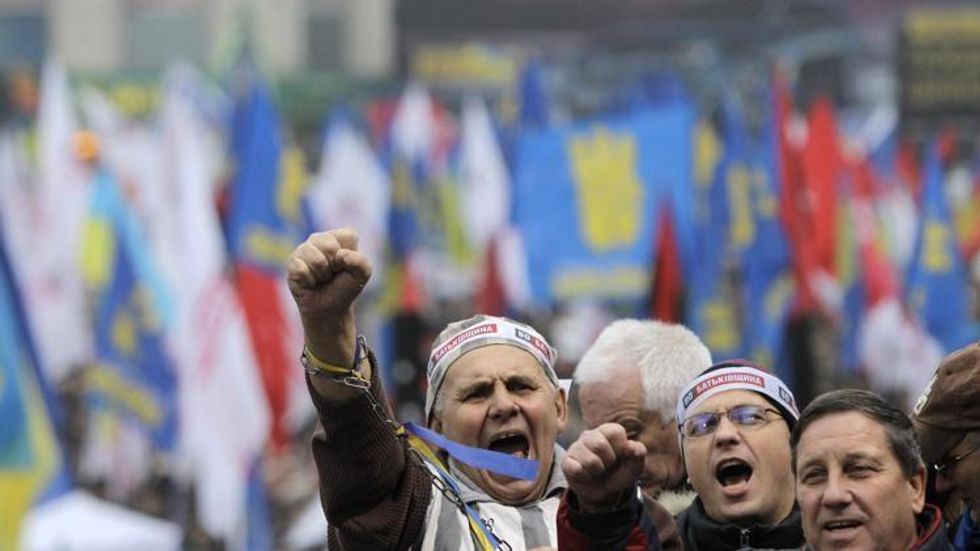
Is the push toward the EU just a step to integrate Ukraine into military alignment through NATO? There is undoubtedly an array of opinions among the protesters, but the question for someone like Bolton is not "what do the protesters want?" but "what do the powers-that-be want?" Historically, EU membership has been a step toward NATO membership, and it is also clear that the draft of the Association Agreement that the protesters seem to support includes military cooperation. Article X, section one, says:
The Parties shall explore the potential of military-technological cooperation. Ukraine and the European Defence Agency (EDA) will establish close contacts to discuss military capability improvement, including technological issues.
The right-wing think tank the Heritage Foundation has also released a policy statement on the situation in Ukraine. The author of the report, Dr. Ariel Cohen, senior research fellow for Russian and Eurasian studies and international energy policy, writes that the United States should "stand with the Ukrainian people" as part of a broader struggle against Moscow. Cohen recommends that the United States
increase coordination of Ukraine policy with its European allies, including an offer of a comprehensive economic reform package, such as a technical assistance program to repair the ailing economy, a significant increase in trade with Europe and the U.S., and the IMF loan.
Those concerned about seeing a protest movement turn into an excuse for an expansion of NATO military power ought to be vigilant against neoconservatives seeking to use the protests to justify their worldview in the wake of the failed military adventures in Iraq and Afghanistan. Activists in the United States, if they are concerned about the outcome of the protests currently underway in Ukraine, ought to defuse these attempts by neoconservatives to write their own narrative into the story.
Thus the West collectively made a terrible mistake at the NATO summit in April 2008 by not placing Ukraine (and Georgia) on a clear path to NATO membership. Had we done so, the question of EU economic relations would doubtless have been more easily resolved. Ambiguity over Ukraine, leaving it in a no man's land between Russia and NATO, obviously didn't lead to Ukrainian stability, domestically or internationally. And the same vital question for Kiev's citizens abides: Is their future with the West or Moscow?
Is the push toward the EU just a step to integrate Ukraine into military alignment through NATO? There is undoubtedly an array of opinions among the protesters, but the question for someone like Bolton is not "what do the protesters want?" but "what do the powers-that-be want?" Historically, EU membership has been a step toward NATO membership, and it is also clear that the draft of the Association Agreement that the protesters seem to support includes military cooperation. Article X, section one, says:
The Parties shall explore the potential of military-technological cooperation. Ukraine and the European Defence Agency (EDA) will establish close contacts to discuss military capability improvement, including technological issues.
The right-wing think tank the Heritage Foundation has also released a policy statement on the situation in Ukraine. The author of the report, Dr. Ariel Cohen, senior research fellow for Russian and Eurasian studies and international energy policy, writes that the United States should "stand with the Ukrainian people" as part of a broader struggle against Moscow. Cohen recommends that the United States
increase coordination of Ukraine policy with its European allies, including an offer of a comprehensive economic reform package, such as a technical assistance program to repair the ailing economy, a significant increase in trade with Europe and the U.S., and the IMF loan.
Those concerned about seeing a protest movement turn into an excuse for an expansion of NATO military power ought to be vigilant against neoconservatives seeking to use the protests to justify their worldview in the wake of the failed military adventures in Iraq and Afghanistan. Activists in the United States, if they are concerned about the outcome of the protests currently underway in Ukraine, ought to defuse these attempts by neoconservatives to write their own narrative into the story.
Thus the West collectively made a terrible mistake at the NATO summit in April 2008 by not placing Ukraine (and Georgia) on a clear path to NATO membership. Had we done so, the question of EU economic relations would doubtless have been more easily resolved. Ambiguity over Ukraine, leaving it in a no man's land between Russia and NATO, obviously didn't lead to Ukrainian stability, domestically or internationally. And the same vital question for Kiev's citizens abides: Is their future with the West or Moscow?
Is the push toward the EU just a step to integrate Ukraine into military alignment through NATO? There is undoubtedly an array of opinions among the protesters, but the question for someone like Bolton is not "what do the protesters want?" but "what do the powers-that-be want?" Historically, EU membership has been a step toward NATO membership, and it is also clear that the draft of the Association Agreement that the protesters seem to support includes military cooperation. Article X, section one, says:
The Parties shall explore the potential of military-technological cooperation. Ukraine and the European Defence Agency (EDA) will establish close contacts to discuss military capability improvement, including technological issues.
The right-wing think tank the Heritage Foundation has also released a policy statement on the situation in Ukraine. The author of the report, Dr. Ariel Cohen, senior research fellow for Russian and Eurasian studies and international energy policy, writes that the United States should "stand with the Ukrainian people" as part of a broader struggle against Moscow. Cohen recommends that the United States
increase coordination of Ukraine policy with its European allies, including an offer of a comprehensive economic reform package, such as a technical assistance program to repair the ailing economy, a significant increase in trade with Europe and the U.S., and the IMF loan.
Those concerned about seeing a protest movement turn into an excuse for an expansion of NATO military power ought to be vigilant against neoconservatives seeking to use the protests to justify their worldview in the wake of the failed military adventures in Iraq and Afghanistan. Activists in the United States, if they are concerned about the outcome of the protests currently underway in Ukraine, ought to defuse these attempts by neoconservatives to write their own narrative into the story.