
One of the great decisions we face is about drones. This train is rapidly leaving the station, and it doesn't take a crystal ball to see where it's headed. In two decades it will likely be moot, but now we can still get in front of this locomotive. There is still time to imagine -- and create -- another future.
Part of reinventing the future hinges on the present's anti-drone movement. In a few short years this effort has grown dramatically -- even as the magnitude of the drone era has only gradually begun to sink in. With this growth comes the question: What is the ask? It is not enough to challenge this new technological leap. We must find a path to a world where these weapons are taboo.
Some of us have in mind a global treaty banning drones. An anti-drones treaty, if it becomes a reality, will likely be rooted in the emergent international movement against drones.
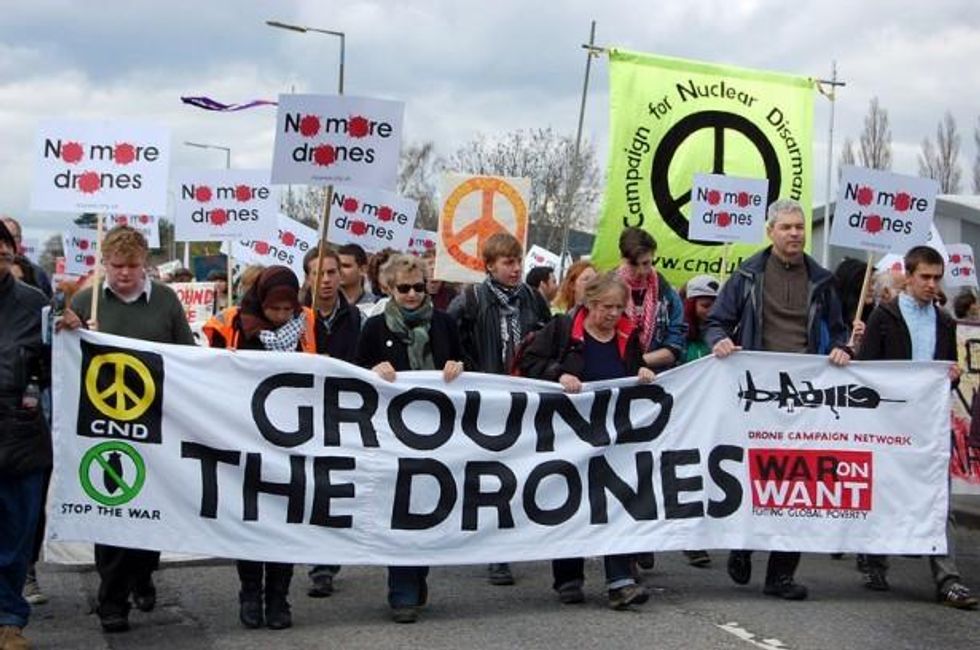
At the World Social Forum in Tunisia that took place this past March, an anti-drones workshop attended by participants from 15 nations decided to form a global anti-drones network. There is also talk about a global summit on anti-drones organizing in Britain at the end of November, where there is an increasingly vigorous movement led by the Drones Campaign Network and others. In the United States, this organizing is being advanced by Code Pink, Drones Watch, Know Drones, and the Network to Stop Drone Surveillance and Warfare, which helped sponsor a recent convergence in Syracuse, N.Y., and nationwide nonviolent actions against drones this past April.
When I was the national coordinator of an organization working to end the U.S. wars in Central America in the late 1980s, I got an impassioned letter from an activist in Louisiana arguing for a campaign focused on stopping the production of anti-personnel landmines being made in her state. The missive detailed the worldwide destruction these explosive devices were wreaking and urged that a concerted effort be launched to make them a thing of the past.
While we lent some support to this cry for help, it was not until 1991 that another Central America peace activist, Jody Williams, activated a bold and comprehensive plan to do something about landmines. Hired by the Vietnam Veterans of America Foundation to coordinate a new effort to ban the devices worldwide, Williams worked without an office or staff to stitch together a global movement that led to the promulgation of the Mine Ban Treaty in 1997, which has now been signed by 161 nations. Some of the globe's heavy hitters have refused to sign -- including the United States, China and Russia -- but that's why Williams and the effort she co-founded, The International Campaign to Ban Landmines, keep at it.
Even without universal compliance the treaty has made a difference. As the ICBL website reports, parties to the Mine Ban Treaty "must not use, develop, produce, acquire, stockpile, retain or transfer antipersonnel mines... Only a handful of states (not party to the treaty) and non-state armed groups continue to use antipersonnel landmines... Trade has come to a virtual halt."
The Mine Ban Treaty is only one of numerous international agreements that have been steadily erecting the global armature of peace, justice and sustainability. Though we have far to go (as I am reminded by my students when we study the Universal Declaration of Human Rights, one of the greatest documents of this kind, whose 30 articles are violated daily), these initiatives commit states to steer clear of behavior that a global consensus has repudiated.
Sometimes signatories ignore their commitments -- Article VI of the 1970 Nuclear Nonproliferation Treaty, which obligates nations possessing nuclear weapons to achieve nuclear disarmament, comes to mind. But sometimes they stand by them. The Comprehensive Nuclear Test Ban Treaty, for example, has been signed by 159 nations since 1996 who have abided by it, including the United States, which exploded on average one nuclear bomb in the Nevada desert every week and a half for 40 years. Though the CTBT has yet to go fully into force (and though the U.S. Senate refuses to ratify it), most of the world operates as if this is the way we will be now.
In the end, that's the ultimate power of international treaties. With few substantial options available to enforce them, international covenants rely on naming -- and making durably plausible -- a set of assumptions about how we will act and not act. The longer they exist, the stronger they resemble reality: as if can, at times, become is.
Treaties matter. They establish universal obligations. They signal the critical importance of the issue at hand. And they help build and reinforce a global constituency for yet another plank in the long-term construction of a worldwide culture of peace with justice.
The stepping stones that Jody Williams and others followed in establishing the International Mines Treaty might illuminate the roadmap to an anti-drones treaty. In the first several years of her work, Williams focused on convincing more than 1,000 non-governmental organizations from over 60 countries to support the campaign.
When a 1995 conference reviewing a limited convention on controlling landmines failed to make meaningful changes, momentum accelerated for an outright ban. At the end of the review conference, 40 nations said they supported an outright ban and began working with NGOs on this. The turning point was a meeting in Ottawa, Canada when 50 governments and 24 observers met.
Over the next year, the treaty was developed between governments and NGOs, including the ICBL, which played a major role in the drafting process. Drafted by Austria, the Mine Ban Treaty was adopted in Oslo, Norway in September 1997 and signed by 122 states in Ottawa in December 1997. It entered into force less than two years later. Both the ICBL and Jody Williams were awarded the Nobel Peace Prize in 1997.
This smooth timeline only begins to hint at everything this campaign entailed. The power of this campaign was rooted in the countless actions, strategic partnerships, and organizational projects that made the Mine Ban Treaty a reality.
While the particulars will no doubt be different, an anti-drones treaty will similarly need a concerted array of local and international movement-building efforts to help illuminate a fundamentally new course and to weld together a global consensus for pursuing it.
One of the great decisions we face is about drones. This train is rapidly leaving the station, and it doesn't take a crystal ball to see where it's headed. In two decades it will likely be moot, but now we can still get in front of this locomotive. There is still time to imagine -- and create -- another future.
Part of reinventing the future hinges on the present's anti-drone movement. In a few short years this effort has grown dramatically -- even as the magnitude of the drone era has only gradually begun to sink in. With this growth comes the question: What is the ask? It is not enough to challenge this new technological leap. We must find a path to a world where these weapons are taboo.
Some of us have in mind a global treaty banning drones. An anti-drones treaty, if it becomes a reality, will likely be rooted in the emergent international movement against drones.
At the World Social Forum in Tunisia that took place this past March, an anti-drones workshop attended by participants from 15 nations decided to form a global anti-drones network. There is also talk about a global summit on anti-drones organizing in Britain at the end of November, where there is an increasingly vigorous movement led by the Drones Campaign Network and others. In the United States, this organizing is being advanced by Code Pink, Drones Watch, Know Drones, and the Network to Stop Drone Surveillance and Warfare, which helped sponsor a recent convergence in Syracuse, N.Y., and nationwide nonviolent actions against drones this past April.
When I was the national coordinator of an organization working to end the U.S. wars in Central America in the late 1980s, I got an impassioned letter from an activist in Louisiana arguing for a campaign focused on stopping the production of anti-personnel landmines being made in her state. The missive detailed the worldwide destruction these explosive devices were wreaking and urged that a concerted effort be launched to make them a thing of the past.
While we lent some support to this cry for help, it was not until 1991 that another Central America peace activist, Jody Williams, activated a bold and comprehensive plan to do something about landmines. Hired by the Vietnam Veterans of America Foundation to coordinate a new effort to ban the devices worldwide, Williams worked without an office or staff to stitch together a global movement that led to the promulgation of the Mine Ban Treaty in 1997, which has now been signed by 161 nations. Some of the globe's heavy hitters have refused to sign -- including the United States, China and Russia -- but that's why Williams and the effort she co-founded, The International Campaign to Ban Landmines, keep at it.
Even without universal compliance the treaty has made a difference. As the ICBL website reports, parties to the Mine Ban Treaty "must not use, develop, produce, acquire, stockpile, retain or transfer antipersonnel mines... Only a handful of states (not party to the treaty) and non-state armed groups continue to use antipersonnel landmines... Trade has come to a virtual halt."
The Mine Ban Treaty is only one of numerous international agreements that have been steadily erecting the global armature of peace, justice and sustainability. Though we have far to go (as I am reminded by my students when we study the Universal Declaration of Human Rights, one of the greatest documents of this kind, whose 30 articles are violated daily), these initiatives commit states to steer clear of behavior that a global consensus has repudiated.
Sometimes signatories ignore their commitments -- Article VI of the 1970 Nuclear Nonproliferation Treaty, which obligates nations possessing nuclear weapons to achieve nuclear disarmament, comes to mind. But sometimes they stand by them. The Comprehensive Nuclear Test Ban Treaty, for example, has been signed by 159 nations since 1996 who have abided by it, including the United States, which exploded on average one nuclear bomb in the Nevada desert every week and a half for 40 years. Though the CTBT has yet to go fully into force (and though the U.S. Senate refuses to ratify it), most of the world operates as if this is the way we will be now.
In the end, that's the ultimate power of international treaties. With few substantial options available to enforce them, international covenants rely on naming -- and making durably plausible -- a set of assumptions about how we will act and not act. The longer they exist, the stronger they resemble reality: as if can, at times, become is.
Treaties matter. They establish universal obligations. They signal the critical importance of the issue at hand. And they help build and reinforce a global constituency for yet another plank in the long-term construction of a worldwide culture of peace with justice.
The stepping stones that Jody Williams and others followed in establishing the International Mines Treaty might illuminate the roadmap to an anti-drones treaty. In the first several years of her work, Williams focused on convincing more than 1,000 non-governmental organizations from over 60 countries to support the campaign.
When a 1995 conference reviewing a limited convention on controlling landmines failed to make meaningful changes, momentum accelerated for an outright ban. At the end of the review conference, 40 nations said they supported an outright ban and began working with NGOs on this. The turning point was a meeting in Ottawa, Canada when 50 governments and 24 observers met.
Over the next year, the treaty was developed between governments and NGOs, including the ICBL, which played a major role in the drafting process. Drafted by Austria, the Mine Ban Treaty was adopted in Oslo, Norway in September 1997 and signed by 122 states in Ottawa in December 1997. It entered into force less than two years later. Both the ICBL and Jody Williams were awarded the Nobel Peace Prize in 1997.
This smooth timeline only begins to hint at everything this campaign entailed. The power of this campaign was rooted in the countless actions, strategic partnerships, and organizational projects that made the Mine Ban Treaty a reality.
While the particulars will no doubt be different, an anti-drones treaty will similarly need a concerted array of local and international movement-building efforts to help illuminate a fundamentally new course and to weld together a global consensus for pursuing it.
One of the great decisions we face is about drones. This train is rapidly leaving the station, and it doesn't take a crystal ball to see where it's headed. In two decades it will likely be moot, but now we can still get in front of this locomotive. There is still time to imagine -- and create -- another future.
Part of reinventing the future hinges on the present's anti-drone movement. In a few short years this effort has grown dramatically -- even as the magnitude of the drone era has only gradually begun to sink in. With this growth comes the question: What is the ask? It is not enough to challenge this new technological leap. We must find a path to a world where these weapons are taboo.
Some of us have in mind a global treaty banning drones. An anti-drones treaty, if it becomes a reality, will likely be rooted in the emergent international movement against drones.
At the World Social Forum in Tunisia that took place this past March, an anti-drones workshop attended by participants from 15 nations decided to form a global anti-drones network. There is also talk about a global summit on anti-drones organizing in Britain at the end of November, where there is an increasingly vigorous movement led by the Drones Campaign Network and others. In the United States, this organizing is being advanced by Code Pink, Drones Watch, Know Drones, and the Network to Stop Drone Surveillance and Warfare, which helped sponsor a recent convergence in Syracuse, N.Y., and nationwide nonviolent actions against drones this past April.
When I was the national coordinator of an organization working to end the U.S. wars in Central America in the late 1980s, I got an impassioned letter from an activist in Louisiana arguing for a campaign focused on stopping the production of anti-personnel landmines being made in her state. The missive detailed the worldwide destruction these explosive devices were wreaking and urged that a concerted effort be launched to make them a thing of the past.
While we lent some support to this cry for help, it was not until 1991 that another Central America peace activist, Jody Williams, activated a bold and comprehensive plan to do something about landmines. Hired by the Vietnam Veterans of America Foundation to coordinate a new effort to ban the devices worldwide, Williams worked without an office or staff to stitch together a global movement that led to the promulgation of the Mine Ban Treaty in 1997, which has now been signed by 161 nations. Some of the globe's heavy hitters have refused to sign -- including the United States, China and Russia -- but that's why Williams and the effort she co-founded, The International Campaign to Ban Landmines, keep at it.
Even without universal compliance the treaty has made a difference. As the ICBL website reports, parties to the Mine Ban Treaty "must not use, develop, produce, acquire, stockpile, retain or transfer antipersonnel mines... Only a handful of states (not party to the treaty) and non-state armed groups continue to use antipersonnel landmines... Trade has come to a virtual halt."
The Mine Ban Treaty is only one of numerous international agreements that have been steadily erecting the global armature of peace, justice and sustainability. Though we have far to go (as I am reminded by my students when we study the Universal Declaration of Human Rights, one of the greatest documents of this kind, whose 30 articles are violated daily), these initiatives commit states to steer clear of behavior that a global consensus has repudiated.
Sometimes signatories ignore their commitments -- Article VI of the 1970 Nuclear Nonproliferation Treaty, which obligates nations possessing nuclear weapons to achieve nuclear disarmament, comes to mind. But sometimes they stand by them. The Comprehensive Nuclear Test Ban Treaty, for example, has been signed by 159 nations since 1996 who have abided by it, including the United States, which exploded on average one nuclear bomb in the Nevada desert every week and a half for 40 years. Though the CTBT has yet to go fully into force (and though the U.S. Senate refuses to ratify it), most of the world operates as if this is the way we will be now.
In the end, that's the ultimate power of international treaties. With few substantial options available to enforce them, international covenants rely on naming -- and making durably plausible -- a set of assumptions about how we will act and not act. The longer they exist, the stronger they resemble reality: as if can, at times, become is.
Treaties matter. They establish universal obligations. They signal the critical importance of the issue at hand. And they help build and reinforce a global constituency for yet another plank in the long-term construction of a worldwide culture of peace with justice.
The stepping stones that Jody Williams and others followed in establishing the International Mines Treaty might illuminate the roadmap to an anti-drones treaty. In the first several years of her work, Williams focused on convincing more than 1,000 non-governmental organizations from over 60 countries to support the campaign.
When a 1995 conference reviewing a limited convention on controlling landmines failed to make meaningful changes, momentum accelerated for an outright ban. At the end of the review conference, 40 nations said they supported an outright ban and began working with NGOs on this. The turning point was a meeting in Ottawa, Canada when 50 governments and 24 observers met.
Over the next year, the treaty was developed between governments and NGOs, including the ICBL, which played a major role in the drafting process. Drafted by Austria, the Mine Ban Treaty was adopted in Oslo, Norway in September 1997 and signed by 122 states in Ottawa in December 1997. It entered into force less than two years later. Both the ICBL and Jody Williams were awarded the Nobel Peace Prize in 1997.
This smooth timeline only begins to hint at everything this campaign entailed. The power of this campaign was rooted in the countless actions, strategic partnerships, and organizational projects that made the Mine Ban Treaty a reality.
While the particulars will no doubt be different, an anti-drones treaty will similarly need a concerted array of local and international movement-building efforts to help illuminate a fundamentally new course and to weld together a global consensus for pursuing it.