SUBSCRIBE TO OUR FREE NEWSLETTER
Daily news & progressive opinion—funded by the people, not the corporations—delivered straight to your inbox.
5
#000000
#FFFFFF
To donate by check, phone, or other method, see our More Ways to Give page.
Students of California, arise, you have nothing to lose but a crushing debt!
The corporate state of California, ever ready to seize its ideological and commercial hour during a recession, has a chokehold on California's public universities. With its tax-coddled plutocracy and a nod to further corporatization, the state government has taken the lid off tuition increases big time.
Before and right after World War II the idea of a public university included a then-called "educational fee" close to zero, from city college of New York to UC Berkeley. Old timers now look back at those days as economic life-savers toward a degree and a productive life for them and the American economy.
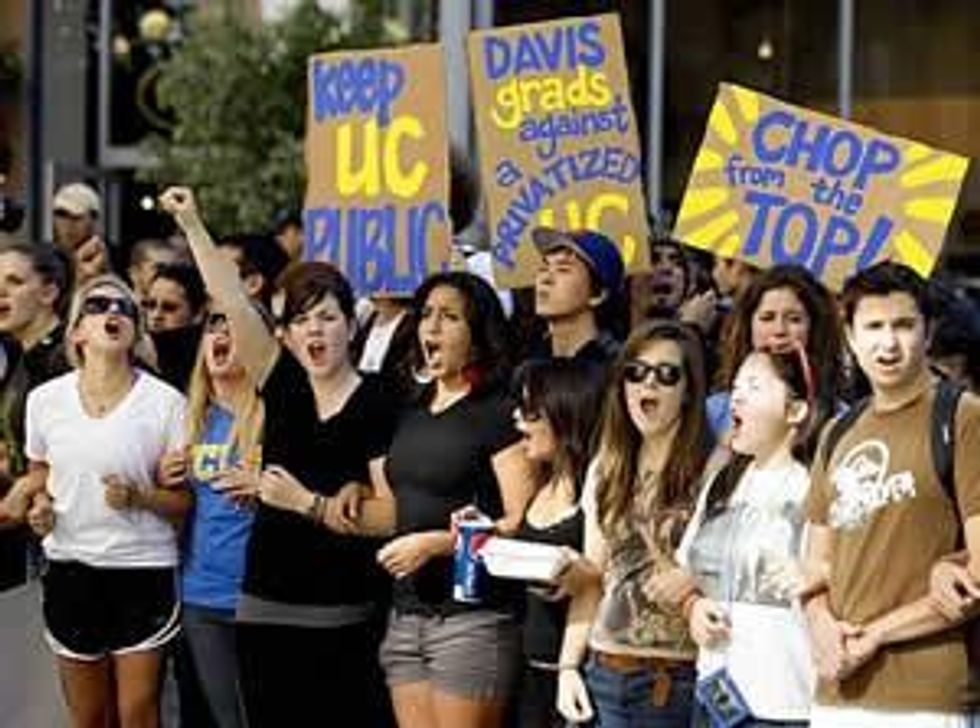
No more. Those gates of opportunity are crumbling at an accelerating pace. More street protests by students are focusing on relentless tuition hikes and years of repaying student debt loans while the rich get richer and the tax cuts for the rich are extended. As Mike Konzcal writes, "One of the Occupy movements' major objectives is combating the privatization of public higher education and its replacement with a debt-fueled economy of indenture."
So far the students have gotten nowhere in the Golden State. The Board of Regents rules with an iron hand. Their chancellors are enforcing the state government's unprecedented cutbacks of facilities, faculty, courses and maintenance-repairs.
Berkeley Professor Nancy Scheper-Hughes called the "current crisis" as being "fundamentally about privatization and the dismantling of a national public treasure."
But the students have a very powerful unused tool of direct democracy - thanks to Governor Hiram Johnson's enactment of the voters' initiative process nearly a hundred years ago. They can qualify an initiative on the ballot that would set tuition at affordable levels or even become like some leading European countries where free schooling extends through the university years.
Planning and implementing this people's legislation would be a rigorous course in law, political science and communications.
The effort invites the best minds from the faculty. The language of the initiative must be clear, persuasive and as devoid of ambiguity and openings for circumvention as possible.
Depending on whether the initiative amends the California Constitution or has statutory status, the students will have to collect as many as 810,000 or as few as 505,000 valid signatures on petitions to get on the November 2012 ballot. Ordinarily, without lots of money for paid petitioners, this can be a formidable challenge. But with millions of community college and university students reachable on campus, combined with their families, this should be a fast process and a piece of cake.
According to the eminent University of San Diego Law Professor Robert Fellmeth, there is no legal obstacle to a statutory initiative tied to the funding power of the legislature. It would stipulate, as a condition precedent to state general fund monies, specified tuition limits (perhaps at least a freeze), to provide equitable access to higher education opportunity.
Of course an initiative that is a constitutional amendment can be more supremely declarative.
There are other states where students can establish a legal protection for publically accessible universities by enacting statewide initiatives. All these tools of democracy should be obvious to any high school student were functional civics and democratic practices taught with the same fervor devoted to computer training.
So let's see if California's deteriorating public university systems can be rescued by their undergraduate and graduate students who place the priority of accessible, adequate public higher education where it belongs for the longer run.
Students of California, arise, you have nothing to lose but a crushing debt!
The corporate state of California, ever ready to seize its ideological and commercial hour during a recession, has a chokehold on California's public universities. With its tax-coddled plutocracy and a nod to further corporatization, the state government has taken the lid off tuition increases big time.
Before and right after World War II the idea of a public university included a then-called "educational fee" close to zero, from city college of New York to UC Berkeley. Old timers now look back at those days as economic life-savers toward a degree and a productive life for them and the American economy.
No more. Those gates of opportunity are crumbling at an accelerating pace. More street protests by students are focusing on relentless tuition hikes and years of repaying student debt loans while the rich get richer and the tax cuts for the rich are extended. As Mike Konzcal writes, "One of the Occupy movements' major objectives is combating the privatization of public higher education and its replacement with a debt-fueled economy of indenture."
So far the students have gotten nowhere in the Golden State. The Board of Regents rules with an iron hand. Their chancellors are enforcing the state government's unprecedented cutbacks of facilities, faculty, courses and maintenance-repairs.
Berkeley Professor Nancy Scheper-Hughes called the "current crisis" as being "fundamentally about privatization and the dismantling of a national public treasure."
But the students have a very powerful unused tool of direct democracy - thanks to Governor Hiram Johnson's enactment of the voters' initiative process nearly a hundred years ago. They can qualify an initiative on the ballot that would set tuition at affordable levels or even become like some leading European countries where free schooling extends through the university years.
Planning and implementing this people's legislation would be a rigorous course in law, political science and communications.
The effort invites the best minds from the faculty. The language of the initiative must be clear, persuasive and as devoid of ambiguity and openings for circumvention as possible.
Depending on whether the initiative amends the California Constitution or has statutory status, the students will have to collect as many as 810,000 or as few as 505,000 valid signatures on petitions to get on the November 2012 ballot. Ordinarily, without lots of money for paid petitioners, this can be a formidable challenge. But with millions of community college and university students reachable on campus, combined with their families, this should be a fast process and a piece of cake.
According to the eminent University of San Diego Law Professor Robert Fellmeth, there is no legal obstacle to a statutory initiative tied to the funding power of the legislature. It would stipulate, as a condition precedent to state general fund monies, specified tuition limits (perhaps at least a freeze), to provide equitable access to higher education opportunity.
Of course an initiative that is a constitutional amendment can be more supremely declarative.
There are other states where students can establish a legal protection for publically accessible universities by enacting statewide initiatives. All these tools of democracy should be obvious to any high school student were functional civics and democratic practices taught with the same fervor devoted to computer training.
So let's see if California's deteriorating public university systems can be rescued by their undergraduate and graduate students who place the priority of accessible, adequate public higher education where it belongs for the longer run.
Students of California, arise, you have nothing to lose but a crushing debt!
The corporate state of California, ever ready to seize its ideological and commercial hour during a recession, has a chokehold on California's public universities. With its tax-coddled plutocracy and a nod to further corporatization, the state government has taken the lid off tuition increases big time.
Before and right after World War II the idea of a public university included a then-called "educational fee" close to zero, from city college of New York to UC Berkeley. Old timers now look back at those days as economic life-savers toward a degree and a productive life for them and the American economy.
No more. Those gates of opportunity are crumbling at an accelerating pace. More street protests by students are focusing on relentless tuition hikes and years of repaying student debt loans while the rich get richer and the tax cuts for the rich are extended. As Mike Konzcal writes, "One of the Occupy movements' major objectives is combating the privatization of public higher education and its replacement with a debt-fueled economy of indenture."
So far the students have gotten nowhere in the Golden State. The Board of Regents rules with an iron hand. Their chancellors are enforcing the state government's unprecedented cutbacks of facilities, faculty, courses and maintenance-repairs.
Berkeley Professor Nancy Scheper-Hughes called the "current crisis" as being "fundamentally about privatization and the dismantling of a national public treasure."
But the students have a very powerful unused tool of direct democracy - thanks to Governor Hiram Johnson's enactment of the voters' initiative process nearly a hundred years ago. They can qualify an initiative on the ballot that would set tuition at affordable levels or even become like some leading European countries where free schooling extends through the university years.
Planning and implementing this people's legislation would be a rigorous course in law, political science and communications.
The effort invites the best minds from the faculty. The language of the initiative must be clear, persuasive and as devoid of ambiguity and openings for circumvention as possible.
Depending on whether the initiative amends the California Constitution or has statutory status, the students will have to collect as many as 810,000 or as few as 505,000 valid signatures on petitions to get on the November 2012 ballot. Ordinarily, without lots of money for paid petitioners, this can be a formidable challenge. But with millions of community college and university students reachable on campus, combined with their families, this should be a fast process and a piece of cake.
According to the eminent University of San Diego Law Professor Robert Fellmeth, there is no legal obstacle to a statutory initiative tied to the funding power of the legislature. It would stipulate, as a condition precedent to state general fund monies, specified tuition limits (perhaps at least a freeze), to provide equitable access to higher education opportunity.
Of course an initiative that is a constitutional amendment can be more supremely declarative.
There are other states where students can establish a legal protection for publically accessible universities by enacting statewide initiatives. All these tools of democracy should be obvious to any high school student were functional civics and democratic practices taught with the same fervor devoted to computer training.
So let's see if California's deteriorating public university systems can be rescued by their undergraduate and graduate students who place the priority of accessible, adequate public higher education where it belongs for the longer run.