

SUBSCRIBE TO OUR FREE NEWSLETTER
Daily news & progressive opinion—funded by the people, not the corporations—delivered straight to your inbox.
5
#000000
#FFFFFF
To donate by check, phone, or other method, see our More Ways to Give page.
Daily news & progressive opinion—funded by the people, not the corporations—delivered straight to your inbox.
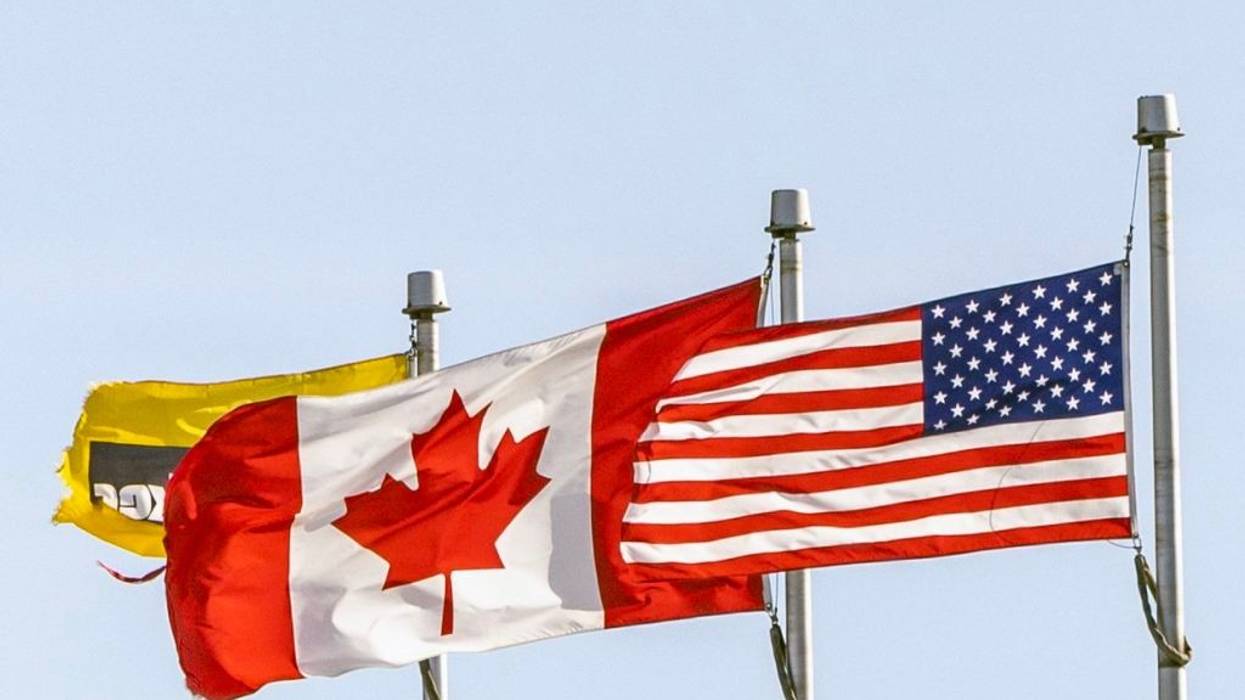
The next Canadian prime minister has said that "my government will keep our tariffs on until the Americans show us respect."
U.S. President Donald Trump escalated his North American trade war on Tuesday, announcing that he will double tariffs on aluminum and steel imports from Canada in response to Ontario's retaliatory duties on electricity.
"Based on Ontario, Canada, placing a 25% Tariff on 'Electricity' coming into the United States, I have instructed my Secretary of Commerce to add an ADDITIONAL 25% Tariff, to 50%, on all STEEL and ALUMINUM COMING INTO THE UNITED STATES FROM CANADA, ONE OF THE HIGHEST TARIFFING NATIONS ANYWHERE IN THE WORLD," Trump said on his Truth Social platform.
The new U.S. tariffs are set to take effect Wednesday, according to Trump, who started the current trade conflict with Canada and Mexico. He also said that he would declare a national emergency on electricity for the region of the United States impacted by Ontario's surcharge, which spans Minnesota, Michigan, and New York.
The U.S. president urged the Canadian government to "immediately drop their Anti-American Farmer Tariff of 250% to 390% on various U.S. dairy products," and threatened to impose tariffs next month on cars, which he said "will, essentially, permanently shut down the automobile manufacturing business in Canada."
Highlighting how the incoming tariffs threaten manufacturing hubs in Indiana, Michigan, Ohio, and Pennsylvania, Sierra Club executive director Ben Jealous said in a Tuesday statement that "Donald Trump continues to force a trade strategy that will not grow American manufacturing. Rather than lying about what tariffs will do, Trump should emphasize adopting cleaner technologies for our steel mills, allowing workers to unionize to advocate for better pay and safety, and establishing clear rules that ensure our trade partners do not violate labor and environmental standards."
"This is the hard work that the administration believes will magically happen on its own," Jealous added. "And if Trump continues to shy away from his duties, steelworkers and local communities will pay the price."
The tariff announcement came just a day after U.S. stocks plummeted on Monday, in the wake of Trump being asked on Fox News' "Sunday Morning Futures With Maria Bartiromo" whether he expected a recession this year, to which he responded: "I hate to predict things like that. There is a period of transition because what we're doing is very big."
Journalist Aaron Rupar noted on X that Tuesday viewers of Fox could "watch the stock market lose over 100 points in real time while Maria Bartiromo talks about Trump's tariffs."
Trump on Tuesday also repeated his call for Canada to join the United States, saying that "the only thing that makes sense is for Canada to become our cherished Fifty First State. This would make all Tariffs, and everything else, totally disappear."
"Canadians' taxes will be very substantially reduced, they will be more secure, militarily and otherwise, than ever before, there would no longer be a Northern Border problem, and the greatest and most powerful nation in the World will be bigger, better and stronger than ever—And Canada will be a big part of that," he claimed. "The artificial line of separation drawn many years ago will finally disappear, and we will have the safest and most beautiful Nation anywhere in the World."
After Canada's Liberal Party elected Mark Carney as its next leader on Sunday, the former central banker and prime minister-designate declared that "America is not Canada. And Canada never, ever, will be part of America in any way, shape or form."
Carney also said that Trump—whose name provoked loud boos—has put "unjustified tariffs on what we build, on what we sell, on how we make a living. He's attacking Canadian families, workers, and businesses, and we cannot let him succeed—and we won't."
"The Canadian government has rightly retaliated and is rightly retaliating with our own tariffs that will have maximum impact in the United States and minimum impact here in Canada," he added. "My government will keep our tariffs on until the Americans show us respect."
Trump's trade war seemingly has even some Republican experts baffled—as shown in an exchange that Jeff Stein, White House economics reporter for
The Washington Post, posted to X on Tuesday morning.
Trump's tariffs—expected to reach beyond Canada, China, and Mexico early next month—and other decisions since Inauguration Day, including sweeping efforts to dismantle the federal government, have some experts speculating that the president, his billionaire Cabinet, and his adviser Elon Musk, the richest person on Earth, "are intentionally crashing the economy."
Early last week, Saikat Chakrabarti, a progressive running for former House Speaker Nancy Pelosi's (D-Calif.) seat who worked on Wall Street and helped found an online payment processing company, accused Trump of "manufacturing a recession."
"It makes sense when you realize his goal is to create something like Russia where the economy is run by a few oligarchs loyal to him," Chakrabarti said. "Creating that state is hard in a large, dynamic, powerful economy with too many actors who can oppose him. So he's accelerating concentrating money and power into the hands of his loyalists while he crashes the rest out."
While Trump responded to Friday's jobs report by declaring that "the Golden Age of America has just begun," Alex Jacquez, chief of policy and advocacy at the Groundwork Collaborative, said: "Just one month on the job, warning signs are flashing across the Trump economy. Inflation is rising, consumer confidence is plummeting, business investment is pulling back, and now, the labor market is stalling."
Adding to working-class Americans' fears of the future, while Trump—aided by GOP senators—installs billionaires to lead federal departments that Musk is tearing apart, Republicans who narrowly control Congress are working to send legislation that would cut taxes for the ultrarich by robbing programs that help the poor to the president's desk.
Dean Baker, senior economist at the Center for Economic and Policy Research, wrote Monday that "while a recession may not be fully baked into the cards at this point, the risk is evident and it's almost entirely coming from Donald Trump's policies."
Baker suggested that Americans should call what lies ahead the "Donald J. Trump Recession."
This article has been updated with comment from Sierra Club.
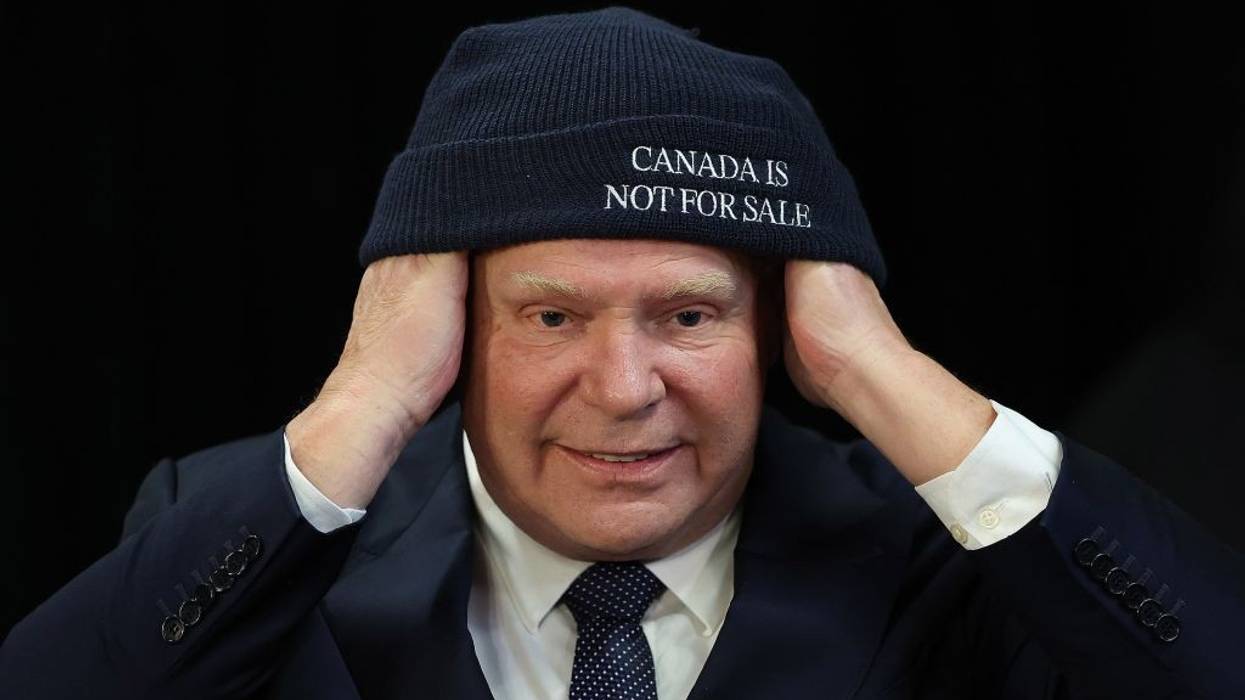
"Canada didn't start this fight with the U.S., but you better believe we're ready to win it," Ontario Premier Doug Ford said.
Ontario Premier Doug Ford said Monday that his government will exclude American companies from provincial contracts and cancel a massive deal with Elon Musk's Starlink satellite internet service in retaliation for U.S. President Donald Trump's imposition of 25% tariffs on Canadian goods.
"Starting today and until U.S. tariffs are removed, Ontario is banning American companies from provincial contracts," Ford—who leads the Progressive Conservative Party of Ontario—said on social media.
"Every year, the Ontario government and its agencies spend $30 billion on procurement, alongside our $200 billion plan to build Ontario," he continued. "U.S.-based businesses will now lose out on tens of billions of dollars in new revenues."
"They only have President Trump to blame," added Ford, who once professed his "unwavering" support for the Republican during his first White House term. "We're going one step further. We'll be ripping up the province's contract with Starlink. Ontario won't do business with people hellbent on destroying our economy. Canada didn't start this fight with the U.S., but you better believe we're ready to win it."
"I don't care if it's a toothpick. We need to purchase from Canada and Ontario."
Last November, Ontario and Starlink signed a C$100 million (USD$68.6 million) deal to provide high-speed internet service for around 15,000 eligible homes and businesses in remote rural communities in northern parts of the province by June 2025.
However, Ford on Monday accused Musk—who gave Trump's campaign tens of millions of dollars and heads the president's Department of Government Efficiency (DOGE)—of being "part of the Trump team that wants to destroy families, incomes, destroy businesses" by waging a trade war.
"He wants to take food off the table of people, hard-working people, and I'm not going to tolerate it," Ford said of the world's richest person. "We just aren't going to be using American companies."
"And no matter if we are building a hospital, if we're building anything, if we're building a dog house, I want to make sure we are using Ontario steel, Canadian products, Canadian wood, Ontario wood," he added. "I don't care if it's a toothpick. We need to purchase from Canada and Ontario."
Ford also ordered the Liquor Control Board of Ontario (LCBO) to remove U.S.-imported alcohol products from store shelves in retaliation for the tariffs.
"Every year, LCBO sells nearly $1 billion worth of American wine, beer, spirits, and seltzers," he said on Sunday. "Not anymore."
Musk reacted to the loss of the Starlink contract with Ontario with a two-word post on his X social media platform saying, "Oh well."
Ford's move followed Canadian Prime Minister Justin Trudeau's announcement Saturday of retaliatory tariffs targeting Republican-led states and Trump allies after the U.S. leader said he would impose levies of 25% on Canadian and Mexican imports and 10% on goods from China.
"Canadians understand that we need to respond to this," explained Trudeau, who is set to resign once his Liberal Party selects a new leader. "We need to respond in a way that is appropriate, that is measured but forceful, that meets the moment."
Trump singled out Canadian energy for a reduced 10% tariff. On Monday, he announced a deal with Mexican President Claudia Sheinbaum to pause U.S. tariffs for one month in exchange for the deployment of 10,000 Mexican troops to the country's northern border to target drug trafficking and, according to Trump, prevent migrants from entering the United States.
Frustration with Trump's policies and actions—which include ongoing calls to make Canada the "51st state"—was on display over the weekend as Canadian fans attending National Basketball Association and National Hockey League games against visiting U.S. rivals loudly booed pregame performances of "The Star-Spangled Banner."

A "right-wing culture war and transphobic propaganda is never just about discourse, debate, or the 'potential for violence,'" said one gender studies professor in response to the attack. "It's about actual violence."
Police in Ontario, Canada on Thursday said the stabbing of multiple people in a University of Waterloo gender studies class was a "hate-motivated incident related to gender expression and gender identity" as they charged the suspect with several crimes.
Geovanny Villalba-Aleman, a 24-year-old former student at the school, was identified by the Waterloo Regional Police Service as the suspect and has been charged with three counts of aggravated assault, four counts of assault with a weapon, and two counts of possession of a weapon for a dangerous purpose.
Villalba-Aleman is accused of stabbing a 38-year-old professor and two students, aged 19 and 20, after entering the classroom of a Philosophy 202: Gender Issues class on Wednesday afternoon and asking the professor "what the class was about," according to The Imprint, the school's student newspaper.
After the professor answered and said she was the instructor of the class, Villalba-Aleman allegedly "closed the door, took out two knives, and began attacking the professor."
A student told The Imprint that the attacker "missed the professor and 'ended up attacking one or two other people.'"
The three victims were hospitalized with non-life-threatening injuries.
The stabbing is the latest attack in Canada that was allegedly motivated by gender-related hate.
In 2018, a man killed 10 people in Toronto when he drove a van into a crowd of pedestrians, later saying he had been motivated by his anger over being rejected by women.
Wednesday's attack comes amid a surge in anti-transgender rights legislation in the United States, with right-wing lawmakers passing more than 80 bans this year on gender-affirming healthcare, discussions about LGBTQ+ issues in schools, and students playing sports and using restrooms in accordance with their gender identity.
In the Canadian province of New Brunswick this month, conservatives changed rules for public schools to "recognize the role of parents" regarding the names and pronouns children use. A previous policy, adopted in 2020, stated that teachers should respect all children's chosen names and pronouns.
"It's the first well-documented instance of Canada copying U.S. anti-trans policies, which usually focus on solving a problem that doesn't exist through blatantly discriminatory practices," wrote Nate DiCamillo at Quartz.
The attack at University of Waterloo demonstrates that a "right-wing culture war and transphobic propaganda is never just about discourse, debate, or the 'potential for violence,'" said Jeremy Johnston, a gender studies professor at Western University in Ontario. "It's about actual violence."
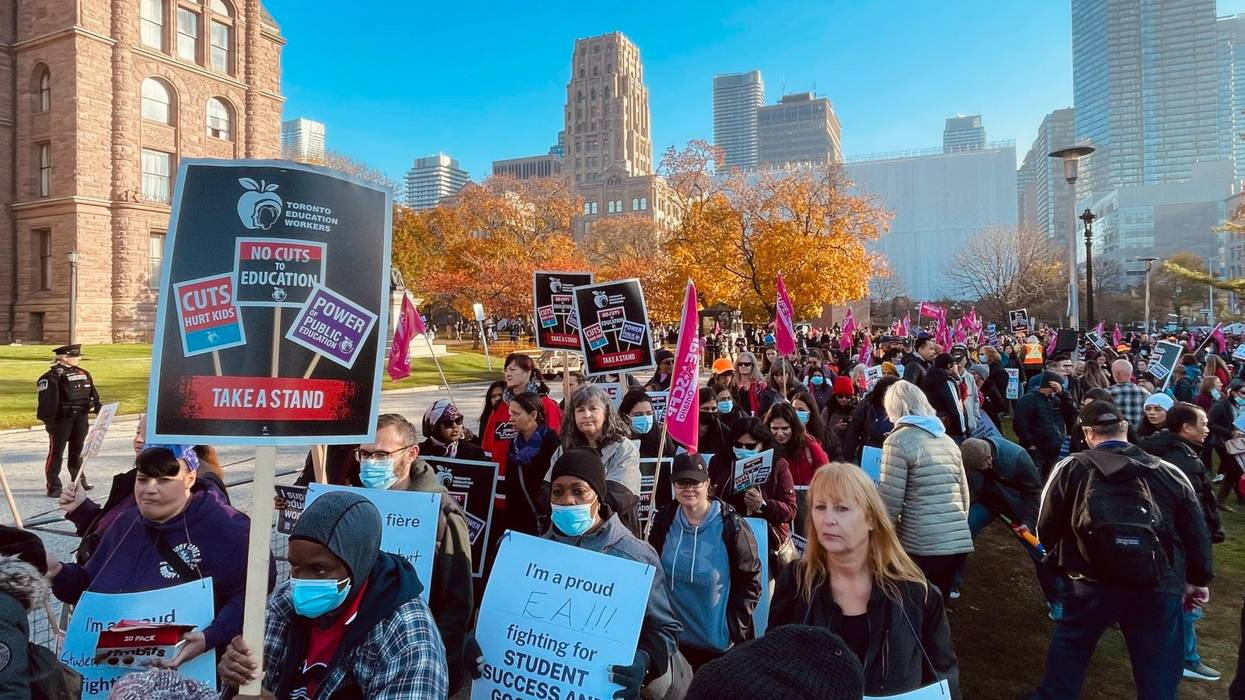
Defying new legislation fast-tracked by right-wing Ontario Premier Doug Ford outlawing strikes, more than 55,000 education workers in the Canadian province hit the picket lines Friday, vowing to stay in the streets for "as long as it takes" to secure a contract they feel is fair.
"We need our voices to be heard and for the government to realize this is not acceptable."
The Canadian Union of Public Employees (CUPE) launched what it called "a wake-up call and a call to arms for organized labor across Canada" after Ontario's Progressive Conservative government on Thursday enacted Bill 28--the Keeping Students in Class Act--which imposes contracts on CUPE members and prohibits them from striking on pain of a $3,000(USD) daily fine per employee and up to a $371,000(USD) penalty for the union.
The new law also utilizes the notwithstanding clause to shield against constitutional challenges. The controversial legal mechanism has only been invoked twice in Ontario's history--both times under Ford.
Liberal Canadian Prime Minister Justin Trudeau called Bill 28 an "attack on one of the most basic rights available, that of collective bargaining."
CUPE national president Mark Hancock said in a statement that "this isn't just about education workers, this is about the rights of all working people across the country."
"The message from our leaders here in Ontario is clear," Hancock added. "Our members are united, and they intend to fight--and they have Canada's largest union in their corner and we are going to fight alongside them."
CUPE national secretary-treasurer Candace Rennick said that "now is a moment for us to ask ourselves what kind of union we want to be, in the face of the worst piece of legislation we've ever seen leveled at the labor movement."
"Our members have spoken," she added. "They are prepared to fight. They aren't part of the largest union in the country for nothing. We are going to have their backs, and we'll stand with them for as long as it takes."
According to the Ontario Federation of Labour (OFL):
The Charter of Rights and Freedoms enshrines Canadians' right to a free and fair collective bargaining process, and the Supreme Court of Canada has found that the right to exercise economic sanctions (i.e., the right to strike) forms an integral part of that process. In addition to violating workers' constitutional right to strike, the Keeping Students in Class Act enforces a concessionary contract on Ontario's 55,000 education workers--the lowest paid workers in the education system--many of whom are women workers and workers of color.
The bill unilaterally imposes woefully low wage increases--well below inflation--on low-income employees who have previously been subjected to three years of 1% increases... inadequate protections against job cuts; no paid prep time for education workers who work directly with students; a cut to the sick leave/short-term disability plan; and many other imposed terms which penalize employees. All told the imposed compensation changes amount to a mere $200 in the pockets of workers earning on average $39,000 and facing 7% inflation.
Karen Brown, president of the Elementary Teachers' Federation of Ontario, said that by enacting a law that forces a contract on CUPE members, the Ford administration has chosen the "most draconian manner of legislating away two fundamental rights protected by the Canadian Charter of Rights and Freedoms: the right to bargain collectively, and the right to strike."
"The Ford government has signaled it is uninterested in reaching collective agreements that are negotiated freely and fairly," she added. "And its oppressive use of the notwithstanding clause is another flagrant abuse of power--one that continues to attack democracy by trampling on Ontarians' constitutional rights."
Thousands of demonstrators turned out in Toronto's Queen's Park on Friday to denounce the Ford administration and show solidarity with the striking workers.
"We need our voices to be heard and for the government to realize this is not acceptable," Maria Gallant, a school secretary, told CBC News. "We are just asking to be paid what we deserve, nothing more."
Protesters also rallied outside the office of Education Minister Stephen Lecce in Vaughan.
"You cannot rip away the rights of workers and expect... that we are just going to take it sitting down," Laura Walton, president of CUPE's Ontario School Board Council of Unions, told Global News.
Others expressed support for the strike on social media.
Birgit Uwaila Umaigba, an intensive care unit and emergency room nurse who is also clinical course director at Centennial College in Toronto, dropped by a picket line to "protect our democracy."
"Doug Ford and his retrogressive conservative government crossed the line by enacting Bill 28 and banning 55,000 CUPE members from exercising their fundamental right to strike," she tweeted.
OFL announced a "Solidarity Saturday" day of action in the province, calling Bill 28 "a full-frontal attack on basic labor freedoms in Ontario."
"Today is a dark day for Ontario workers. By introducing this legislation before education workers have even exercised their charter-protected right to strike, the Ford government is attempting to short-circuit the bargaining process and strip workers of a fundamental freedom," OFL president Patty Coates said in a statement.
"Doug Ford and his government are once again telling workers across the province that their rights don't matter," she added.
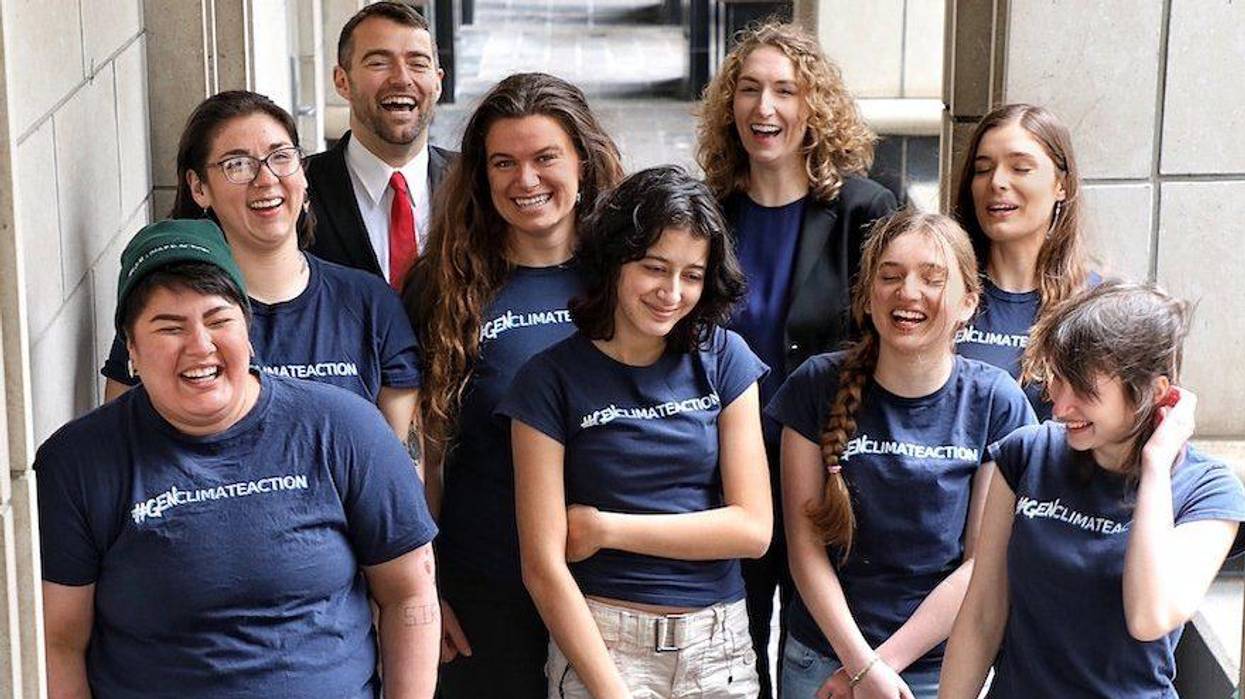
Last month, seven Ontario youths made history when they held Premier Doug Ford's government to account for its reckless climate policy in a court of law.
The case of Mathur v. Ontario -- the first climate rights lawsuit to have its day in court in Canada -- alleges that the government's rollback of its greenhouse gas emissions target is unscientific, unsustainable and unconstitutional. Legal experts from across the country have long argued that Canadian governments' woefully inadequate record on climate change is not only unacceptable, but may also be illegal in some circumstances. In particular, when government conduct like Ford's greenhouse gas target falls far short of what the science requires, it also falls foul of the Canadian Charter of Rights and Freedoms.
Representing youth and future generations, the applicants in Mathur v. Ontario argue that by failing to even attempt to achieve the emissions cuts that experts say are necessary to avoid climate catastrophe, the government has violated their constitutionally protected rights to life and security of the person under the Charter. They also argue that the government has violated their equality rights, since climate change will disproportionately harm children and youth, who are more vulnerable to the existing health effects of climate change and will live more of their lives in an era of climate crisis.
In the reams of documents and hours of oral argument presented by Ontario's lawyers -- paid by taxpayer dollars -- the government never once tried to justify the validity of its target on the basis of climate science. Instead, they tried to get the court to punt the issue. First, Ontario argued that the target was only a "communications product" and not a law. The position reveals a staggering level of hypocrisy, considering that Ontario's recent opposition to the federal carbon price relied heavily on an argument that the province was already handling climate change through its robust emissions reduction target. Second, Ontario's legal team argued that climate change is too political to be dealt with by a court of law. The problem with this argument is that it totally ignores the constitutional role of courts in our legal system.
Any first-year law student knows that where a government policy violates a person or group's Charter rights, the courts not only can but must intervene. Court supervision of government conduct -- no matter how "political" -- is a cornerstone of constitutional democracy. The raison d'etre of the Charter is to prevent government intrusions on human rights. This is why Canadian courts have intervened in areas as controversial as medical assistance in dying, access to safe injection sites and (de)criminalization of the sex trade. Any of these issues could, in theory, have been resolved by voters, but at an unacceptable cost to those whose lives and quality of life were threatened by the government policies at issue. In the case of children and youth who lack the right to vote but will disproportionately bear the harmful consequences of the climate crisis in the future, turning to courts is in fact their only hope.
Before 1982, there were cases in which Canadians had no legal recourse when their human rights were violated by government actions. Since the Charter came into force, however, we are no longer at the mercy of politics to resolve issues that implicate our most fundamental human rights. As Canadians experience increasingly frequent climate-related disasters (heat domes, wildfires, flooding and hurricanes), it has become clear that climate change constitutes an unprecedented threat to the enjoyment of human rights in this country. And since our human rights are enshrined in the Charter and supervised by an independent judiciary, it seems only reasonable to seek constitutional recourse when governments contribute to dangerous climate change through unsustainable and unscientific laws and policies. Mathur v. Ontario is just one of a rising tide of constitutional climate suits in Canada. Expect more to come.

As Ontario's premier on Friday declared a state of emergency over an ongoing trucker-led protest that has paralyzed commerce and transportation at a key crossing on the U.S. border, a judge in the Canadian province granted an injunction aimed at breaking the blockade.
"We're dealing with millions of dollars of damage each and every day."
According to the Windsor Star, Ontario Superior Court Justice Geoffrey Morawetz granted an injunction requested by the city of Windsor and the Automotive Parts Manufacturers' Association in order to resume the flow of traffic and commerce at the Ambassador Bridge between Windsor and Detroit--the busiest international crossing in North America.
"The overwhelming evidence is that there is a complete blockage of the bridge, which you have conceded cannot be tolerated," the judge said. "It therefore follows, does it not, that there has to be some form of order?"
"We're dealing with millions of dollars of damage each and every day," he added.
The injunction is set to go into effect at 7:00 pm local time. Almost immediately after the ruling, police notified the "Freedom Convoy" demonstrators "that it is a criminal offense to obstruct, interrupt, or interfere with the lawful use, enjoyment, or operation of property."
"We are providing notice that anyone blocking streets or assisting others in the blocking of streets may be committing a criminal offense and must immediately cease further unlawful activity or you may face charges," an officer announced. "You could be arrested if you are a party to the offense or assisting others in the direct or indirect commission of this offense."
Also on Friday, Ontario Premier Doug Ford declared a state of emergency over the protests, announcing he will "convene cabinet to use legal authorities to urgently enact orders that will make crystal clear it is illegal and punishable to block and impede the movement of goods, people, and services along critical infrastructure."
"Fines for noncompliance will be severe," said Ford, "with a maximum penalty of $100,000 and up to a year imprisonment."
Related Content

The nationwide protests were launched on January 22 by truck drivers who oppose Canadian and U.S. mandates requiring them to be fully vaccinated against Covid-19 if they want to cross into the United States. Unvaccinated truckers have the option of quarantining for two weeks.
The protests have since expanded, and now include people opposed to pandemic countermeasures such as mask mandates, lockdowns, and temporary bans on large gatherings. There is also a significant white supremacist presence at the demonstrations.
The Canadian Trucking Alliance, a nationwide association of truckers, says the protests do not represent the vast majority of the nation's truck drivers--90% of whom are vaccinated--and that many of the demonstrators are not truckers and "have a separate agenda beyond a disagreement over cross-border vaccine requirements."
The "Freedom Convoy" protests have garnered widespread right-wing support in North America--including from former U.S. President Donald Trump and far-right members of Congress and the media--and beyond.
On Friday, Canadian Prime Minister Justin Trudeau said that "if you joined the protests because you're tired of Covid, you now need to understand that you are breaking laws. The consequences are becoming more and more severe."
"We've heard you," he added. "It's time to go home now."

Ontario Premier Doug Ford declared a state of emergency Friday, two weeks into demonstrations in Ottawa by right-wing factions who object to Covid-19 mitigation measures, that have sibce grown to disrupt international supply chains and shut down several bridges at the U.S.-Canada border.
Ottawa residents have for several days questioned whether the so-called "Freedom Convoy," in which a small minority of Canadian commercial truckers and their supporters have occupied the city, is truly a peaceful protest, considering reports of "violence, harassment, intimidation, and hate speech."
"The failure of law enforcement agencies to respond swiftly and appropriately to reports of violence and harassment demands a prompt, thorough, and impartial public inquiry."
Ford's declaration appeared driven by a blockade of the Ambassador Bridge between Detroit and Windsor, which carries 25% of trade between the U.S. and Canada.
The premier said he would push for legislation barring people from interfering with the free flow of goods after auto parts shortages pushed manufacturers to cancel shifts for workers and shut down plants in Ontario and states including Alabama.
"Your right to make a political statement does not outweigh the right of thousands of workers to make a living," Ford said as he called for the demonstrators to disperse, threatening noncompliance penalties of up to $100,000 and a year in prison.
"We are now two weeks into the siege of Ottawa," the premier added. "It's an illegal occupation. It's no longer a protest."
Ford's announcement followed a call by Amnesty International for local, provincial, and federal officials to respond to and investigate reports of violence at the protests, which have blocked at least two other border crossings.
"The failure of law enforcement agencies to respond swiftly and appropriately to reports of violence and harassment demands a prompt, thorough, and impartial public inquiry," said Amnesty International Canada in a statement Friday. "The inquiry must also address instances of interference with residents' rights to public health and social services delivery, as well as the harassment of healthcare workers, reporters, people living with disabilities, and racialized and other marginalized persons."
The organization cited a coalition of women's and children's advocates which earlier this week condemned "the impact these protests have had on freedom of movement, the ability of women experiencing domestic violence to access services, and the ability of shelter workers and other frontline workers and first responders from carrying out their duty of keeping communities safe."
At several protests over vaccine mandates in Canada, journalists have faced threats of violence and harassment over the past two weeks, according to CBC.
"Authorities hold an equal international obligation to protect people from violence and harassment, and to respect the rights of all protesters to peaceful assembly and expression of their views. Violence and harassment however are not part of exercising the right to freedom of peaceful assembly," said Ketty Nivyabandi, secretary general of Amnesty International Canada, citing the United Nations Human Rights Committee.
Despite what advocates say are clear violations of other people's rights by the demonstrators, Ottawa police have "effectively waved a giant white flag" in response to the convoy, wrote Max Fawcett in the National Observer last week. Authorities have advised Ottawa residents to avoid the center of the city where commercial trucks and other vehicles have parked illegally, blared horns for hours on end, and driven onto sidewalks.
As Fawcett wrote, "It's not clear whether the Ottawa police are taking this ultra-permissive approach because they sympathize with the protesters or they're just scared of them":
They've yet to do much of anything about an alleged assault against a homeless person at the Shepherds of Good Hope shelter and apparently decided not to pursue an incident that involved a local service industry employee.
[...]
The images and videos circulating of police being chummy with protesters, including one where an officer gives the thumbs up and says, "The truckers have been getting their point across... they can't ignore all of this," certainly suggest some degree of bias.
The treatment of the mostly white protesters--who have been cheered on by U.S. Republican lawmakers and bankrolled by several right-wing groups in the U.S.--contrasts sharply with Canadian authorities' response to other demonstrations by people of color and Indigenous campaigners, critics have noted.
While enforcing an injunction order obtained by fossil fuel company Coastal Gaslink in November, the Royal Canadian Mounted Police arrested 29 Wet'suwet'en land defenders, supporters, and journalists in British Columbia as the Indigenous people demanded the Canadian government respect their right to self-determination in accordance with orders from the U.N. Committee on the Elimination of Racial Discrimination.
The Ontario Dump Truck Association also noted on Thursday that last April, truck drivers staged a protest over costly axle retrofitting that the Ministry of Transportation was requiring. The demonstration, largely led by people of color, was met with swift threats, according to the group.
"Amnesty International Canada notes with great concern the permissive response afforded by the Ottawa Police to a largely white-dominant protest group," said the organization. "This response is in sharp contrast with how law enforcement authorities have mistreated Indigenous and racialized protesters in the past."

Announcing plans for new labour legislation, a beaming Premier Doug Ford assured us earlier this month that "we're going to make sure we're competitive around the world."
At first glance, that statement might lead us to believe the premier, especially given his commitment to act "for the people," was vowing Ontario would make sure its workers got as good a deal, or better, than workers elsewhere in the world.
But that's not what he meant at all.
In fact, he meant just the opposite -- that he would ensure our workers got a worse deal than workers elsewhere.
That is the perverse thinking behind the economic philosophy that has dominated North American politics in recent decades: that workers must offer themselves up at the lowest possible wage with the fewest possible benefits in order to create an attractive investment climate for businesses that might otherwise move elsewhere.
Despite the persistence of this theory, there's little evidence to support it: most low-wage countries remain that way, while the high-wage nations of Europe and Scandinavia continue to excel in global competitiveness.
Undeterred, Doug Ford is rolling back labour legislation, updated last year after a two-year review with extensive public consultations, and replacing it with a bill hastily assembled behind closed doors, with heavy business input.
Gone is the minimum wage hike to $15 an hour. So, just like that, faster than you can say "for the people," Ford has cancelled what amounted to a $2,000 annual pay increase that was headed for the pockets of the lowest-paid people.
He's also cancelling the two paid sick days a year, even though 145 countries (most of the world's nations) already offer some form of paid sick leave. Think how competitive we'll be without it! That should give us a leg-up on Guatemala and Botswana!
Business commentators argued that the higher minimum wage would drive businesses elsewhere, presumably leaving Canadian customers happily ordering their coffee-to-go from far-away places. Commentators made the same argument last year, when the minimum wage was raised to $14 an hour. However, Ontario's unemployment rate fell to 5.4 per cent, its lowest level in 18 years.
Killing the $15 minimum wage is another victory in the long-running class war, sometimes called neo-liberalism, in which business-funded think-tanks have shaped the public debate, convincing us we must design our economy to please business interests.
And we've done that, slashing taxes on corporations and the rich, signing trade deals designed to protect corporate rights, weakening labour laws and making it harder for workers to organize into unions.
The result has been . . . well, pretty much what you'd expect when all economic laws have been redesigned to benefit the elite.
In his new book, The Age of Increasing Inequality, Dalhousie University economist Lars Osberg notes that the incomes of the top 1 per cent have doubled since 1982.
Meanwhile, the bottom half of Canadians, some 13.5 million people, are earning less than they did in 1982 (in inflation-adjusted dollars), Osberg shows. Only Canada's social safety net -- child, disability, welfare benefits, etc. -- prevents them from actually being worse off than they were in the early 1980s.
Of course, the neo-liberals have been shredding the safety net as well.
Ford has moved quickly to diminish Ontario's safety net, ending the Basic Income project and making cuts to social assistance. Among other things, it now reportedly takes longer for those on disability to qualify for a wheelchair. Ford is planning an additional $6 billion in spending cuts.
In an analysis done before last spring's election, economic consultant Edgardo Sepulveda projected that the NDP's platform would reduce inequality "moderately" and the Liberal platform would reduce it "slightly," but Ford's PC platform would move the province in exactly the opposite direction, increasing inequality "significantly."
Given the speed and scope of Ford's changes already, Sepulveda now believes that inequality in the province will increase "even more and faster."
So, after decades of losing ground to the elite, millions of Canadians will find themselves falling behind deeper and faster under Doug Ford.
On the bright side, think of how competitive we'll be. In the race to the bottom, nobody beats Ontario!

Just weeks after Ontario Premier Doug Ford provoked outrage by prematurely killing the province's three-year basic income pilot--which gave the 4,000 participants around $1,400 per month as financial support with no strings attached--lawyer and social worker Mike Perry on Monday filed a class-action lawsuit accusing Ford's government of "anticipatory breach of contract, negligence, and misfeasance in public office."
"We take no joy in this. It's not fun, having to have to sue the government. When we can't get justice from our elected officials, the courts stand ready to hear claims," Perry said in a statement. "That's why our courageous representative plaintiffs are bringing forward this class action lawsuit."
Perry added that if Ford wants to stop the class-action suit from moving ahead, he must allow the basic income project to continue.
While just four participants in the basic income pilot are currently named as plaintiffs in the lawsuit, Perry said he hopes to ultimately include everyone who took part in the program, which was launched in 2017 by the previous Liberal government.
Ford's decision to cancel the pilot program just months after his party vowed to keep it going was immediately condemned by anti-poverty activists and the project's participants, who have argued that it drastically improved their material circumstances.
Dana Bowman, one of the plaintiffs in the class-action suit, said the basic income program "gave me back my dignity."
"I didn't have to use food banks anymore," Bowman said.
As Huffington Post Canada notes, other participants said "the program helped them return to school, grow their small business, or move forward after leaving an abusive relationship."

Advocates of basic income are blasting the decision by Ontario's newly-elected right-wing government to kill the province's pilot project on the anti-poverty scheme.
"It is just so incredibly WRONG," tweeted writer Scott Santens in a thread denouncing the decision.
"Too costly? Unsustainable? BULLSHIT. What's unsustainable and far too costly is poverty. Not having a financial floor is unsustainable. In Ontario alone the full cost of poverty is upwards of $30 billion, which is about the cost of UBI for all of Canada."
The move was announced Tuesday by Lisa MacLeod, the province's Minister of Children, Community, and Social Services, who said, "We're going to hit the pause button on the previous government's patchwork system and replace it with a system that helps stabilize people in need and support them to succeed." The program, she asserted, is "not doing what it's intended to do and it's quite expensive."
The three-year project began in 2017 under the previous government and involved 4,000 low-income participants in five communities. Participants must have earned under C$34,000 per year if single or under $48,000 a year for a couple. Those with a disability would have received an additional $500 per month. Notably, it was "already showing extremely promising results," said Taylor Jo Isenberg, managing director at the Economic Security Project, who called the decision to scrap it "a short-sighted and irresponsible one."
"I'm in shock," said Dave Cherkewsk of Hamilton, one of the communities taking part in the experiment. "I had a three-year plan and now it's gone."
"I am angry," said Tom Cooper, director of the Hamilton Roundtable for Poverty Reduction. "I am angry on behalf of the 1,000 Hamiltonians who were promised they could participate in this pilot project. They were sold a bill of goods by the Ford government in the election. They were lied to."
Ford is Ontario's recently-elected Premier Doug Ford--a man some dub Canada's Donald Trump.
Doug Ford's government just canceled the basic income program it promised during the election to keep, then slashed income support increases in half.
Liars and thieves. https://t.co/6J7JFFwuqq
-- Billy (@BillyArmagh) July 31, 2018
Reacting to the scrapping of the basic income project as well as the announcement that planned increases in rates to the welfare programs Ontario Works and Ontario Disability Support Program Opposition would be slashed in half, opposition leader Andrea Horwarth said Ford's plan was "disgusting."
"Doug Ford's decision to slash the meager increases to social assistance is appalling, it drags Ontario backwards, and it pushes those already at a disadvantage even deeper into poverty," she said.
Among those urging Ontarians to call up officials to let them know what they think of the cuts was Roderick Benns, author of Basic Income: How a Canadian Movement Could Change the World.
He argued that "it's time to react to the unkindness. It's time to make our voices heard." He added, "Tell them to let the pilot finish and let the third-party evaluators do their job during and afterwards."
Santens also urged people to call representatives to voice support for the basic income project, and tearing down MacLeod's claim that it costs too much, he quipped: "Too costly? Unsustainable? BULLSHIT. What's unsustainable and far too costly is poverty. Not having a financial floor is unsustainable. In Ontario alone the full cost of poverty is upwards of $30 billion, which is about the cost of UBI for all of Canada."