SUBSCRIBE TO OUR FREE NEWSLETTER
Daily news & progressive opinion—funded by the people, not the corporations—delivered straight to your inbox.
5
#000000
#FFFFFF
To donate by check, phone, or other method, see our More Ways to Give page.


Daily news & progressive opinion—funded by the people, not the corporations—delivered straight to your inbox.

Yesterday, constitutional scholars and legal experts hosted a telephonic press conference to urge the Senate and their own senators to give a fair hearing and a timely vote to the forthcoming Supreme Court nomination.
The call came just as a coalition of 33 leading constitutional scholars, organized by the American Constitution Society for Law and Policy, sent an open letter to President Obama and the U.S. Senate leadership urging them to fulfill their constitutional duties with regard to the vacancy on the Supreme Court.
Click here to listen to an MP3 of the call.
Quotes from the call's participants are below:
Erwin Chemerinsky, Dean of the University of California, Irvine School of Law
"In 21 of 24 instances where Presidents have nominated Justices in their final year in office, the Senate has confirmed the nominees...The Constitution requires the Senate to provide advice and consent on judicial nominees. The Senate Judiciary Committee is in breach of that duty."
Verna L. Williams, Judge Joseph P. Kinneary Professor of Law at the University of Cincinnati College of Law
"[Senator Portman] has taken an oath to uphold and defend the Constitution. Nowhere does the Constitution authorize the Senate to go rogue and refuse to hold a hearing on Supreme Court nominees. The people of Ohio want this vacancy to be filled."
Edward Fallone, Associate Professor of Law at Marquette University Law School
"By refusing to consider any nominee put forth by President Obama for the remainder of his term, the Senate is exceeding its constitutional power by effectively asserting the authority to initiate or not initiate the nomination process. This asserted power goes far beyond any authority for the Senate contained in the Appointments Clause. ...Senator Johnson has criticized President Obama's Executive Orders on immigration and health care. We hope that Senator Johnson will also condemn the power-grab by his colleagues in Congress."
Melissa Hart, Professor of Law and Director of the Byron R. White Center at University of Colorado Boulder
"Yesterday's announcement by the Republican members of the Senate Judiciary Committee that they will not perform their constitutional duty to 'advise and consent' in the selection of a Supreme Court justice was a stunning abdication of constitutional responsibility. There is no ambiguity in the Constitution's statement that the president is obligated to nominate Supreme Court justices. ...For the Republicans to refuse to participate in this process is beyond reprehensible."
The Leadership Conference on Civil and Human Rights is a coalition charged by its diverse membership of more than 200 national organizations to promote and protect the civil and human rights of all persons in the United States. Through advocacy and outreach to targeted constituencies, The Leadership Conference works toward the goal of a more open and just society - an America as good as its ideals.
(202) 466-3311"The American people need to know if this merger was approved as a political favor," said Sen. Elizabeth Warren.

The leadership of President Donald Trump's Justice Department shut down an investigation into Paramount's widely criticized bid to acquire Warner Bros. Discovery and issued a statement supporting the merger before career antitrust attorneys could finish scrutinizing the proposal, The Wall Street Journal reported on Monday.
According to the Journal, which cited unnamed people familiar with the matter, "a team of career lawyers who had spent months scrutinizing the deal were leaning toward recommending a lawsuit challenging it on the grounds that the combination of the two movie studios would be anticompetitive and violate antitrust law." The newspaper reported that the antitrust staffers who investigated the $111 billion merger proposal "didn't participate in writing" the Justice Department statement greenlighting the deal.
“When we said this is what corruption looks like, this is what we meant," the Block the Merger coalition, an alliance of dozens of organizations opposed to the deal, said in a statement late Monday.
DOJ leadership's move to clear the deal was just the latest in a string of merger approvals that have drawn suspicion, given that the Justice Department has been accused of giving corporate lobbyists free rein over antitrust policy. The DOJ's antitrust section is currently headed by Associate Attorney General Stanley Woodward, who—according to a fired antitrust official—"perverted justice and acted inconsistent with the rule of law" during a separate merger investigation.
"The American people need to know if this merger was approved as a political favor," Sen. Elizabeth Warren (D-Mass.) wrote in response to the Journal's reporting. "This reeks of corruption."
Unreal. Justice Department staff were railroaded again by political interference in the Paramount-Warner Bros merger review.
None of the investigators on the deal had any role in writing the unprecedented clearance statement issued by DOJ last Friday. pic.twitter.com/yYcKUpuos3
— Lee Hepner (@LeeHepner) June 15, 2026
If finalized, Paramount Skydance's proposed acquisition of Warner Bros. would leave CBS, CNN, HBO, and other major media properties under the control of the son of billionaire Trump megadonor Larry Ellison, posing what one coalition called "an existential threat to the free press." David Ellison, the CEO of Paramount Skydance, dined with the president in April at an event "honoring the Trump White House."
The proposed merger is still facing antitrust scrutiny in Europe and from state attorneys general in the US.
The Journal reported that "some staffers" in the DOJ's antitrust division believe the Justice Department's statement backing the merger and getting it over a major regulatory hurdle "was designed to make it harder for state attorneys general to challenge the deal in court." In the statement, the DOJ declared that "the transaction is not likely to result in harm to competition or American consumers."
Rob Bonta, California's attorney general, said in response to the Justice Department's decision that "the merger of Warner Bros and Paramount is not a done deal and remains under investigation by my office."
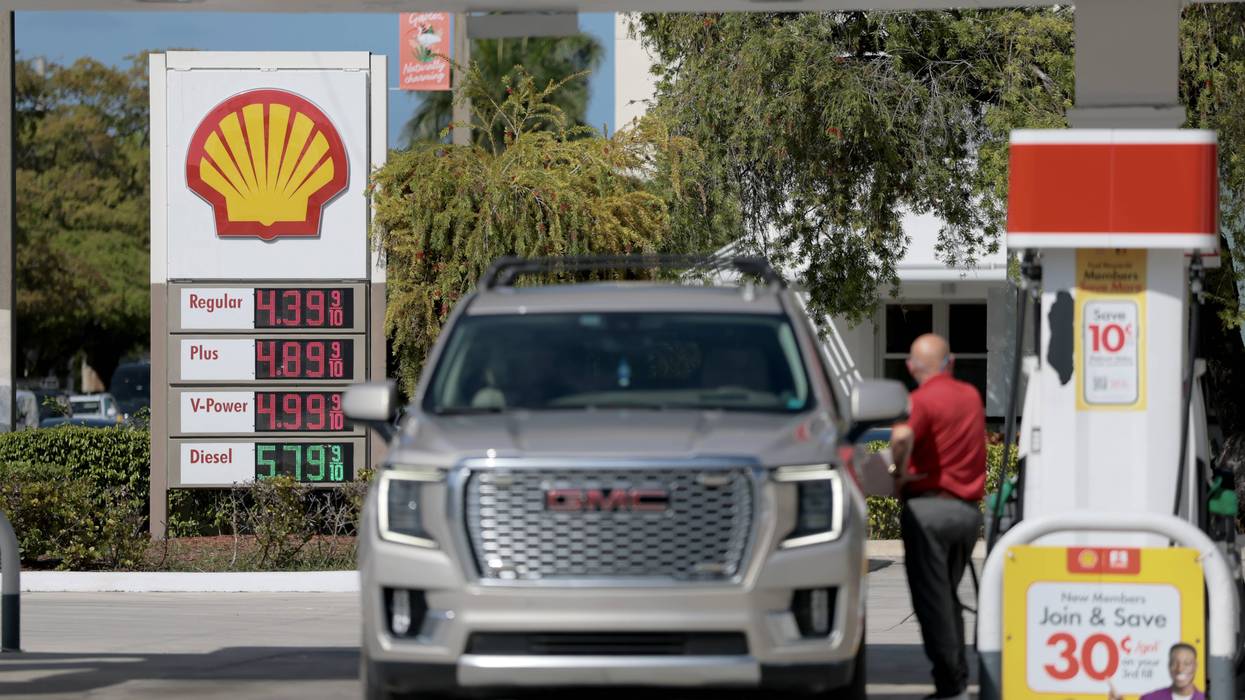
"While Americans suffer from high prices and the Iran War imposes tens of billions of dollars of new costs on the American public, the oil industry wins big."
As President Donald Trump reached an interim peace deal with the Iranian government and Oxfam International revealed that 41 energy industry tycoons collectively increased their wealth by $23.5 billion since the war was launched in late February, a pair of US senators on Monday released their letters demanding answers from fossil fuel giants about their windfall profits and soaring gasoline prices during the conflict.
Senate Banking Committee Ranking Member Elizabeth Warren (D-Mass.) and Committee on Environment and Public Works Ranking Member Sheldon Whitehouse (D-RI) last Thursday wrote to BP America chair and president Orlando Alvarez, Chevron chair and CEO Mike Wirth, ConocoPhillips chair and CEO Ryan Lance, Continental Resources president and CEO Robert Lawler, ExxonMobil chair and CEO Darren Woods, Occidental Petroleum president and CEO Richard Jackson, and Shell USA president Colette Hirstius.
"We write to question why American families are paying egregiously high prices at the pump while the fossil fuel industry collects massive windfall profits thanks to the Trump administration's war in Iran," Warren and Whitehouse wrote amid peace talks last week, noting that Iran's closure of the Strait of Hormuz, a key shipping route for fossil fuels, led to what that the International Energy Agency (IEA) called "the largest supply disruption in the history of the global oil market."
"Gasoline prices rapidly increased by as much as 52%," the pair highlighted. "Before the Iran War, oil cost $71.32 per barrel. Since then, it has cost as much as $138.21 and currently sits at $98.29 per barrel. The Iran War has allowed 27 oil and gas companies to rake in over $40 billion in profit since the Iran War began."
Warren and Whitehouse also emphasized that "the opportunity to profit from high oil prices did not occur in a political vacuum. In April 2024, then-candidate Trump solicited a billion dollars from fossil fuel executives at a private dinner at Mar-a-Lago, promising in exchange to roll back environmental regulations, issue desired permits, and expand drilling opportunities."
Also pointing to Trump's invasion of Venezuela, abduction of President Nicolás Maduro, and takeover of the country's nationalized oil industry, the senators said that "the pattern is consistent: While Americans suffer from high prices and the Iran War imposes tens of billions of dollars of new costs on the American public, the oil industry wins big."
The pair requested answers to their questions on profits, pricing, federal policy, and communications with the Trump administration about the Iran War by June 25, They explained that the information "will aid our assessment of the appropriate scope, rate structure, and enforcement mechanisms as we actively consider the Big Oil Windfall Profits Tax Act," reintroduced by Whitehouse and Rep. Ro Khanna (D-Calif.) in March, just weeks in to the war.
The information will also assist with investigations into "the extent to which Trump administration military, regulatory, and policy decisions benefited the oil industry and the extent to which any of these were the product of quid pro quo solicitations," as well as "whether oil and gas companies had advance knowledge of or ability to shape the administration's decision to go to war in Iran."
"Congress has a constitutional duty to investigate each of these matters and to legislate as necessary to protect the American people," the pair added. Both chambers are controlled by the GOP and have refused—largely along party lines—to pass war powers resolutions intended to prevent or end Trump and Israeli Prime Minister Benjamin Netanyahu's illegal assault on Iran.
In response to Trump's new deal with Iran to extend a ceasefire reached in April and reopen the strait, oil prices dropped and the stock market rallied. Specifically, as The Associated Press detailed, "the S&P 500 rose 1.7%," while "the Dow Jones Industrial Average climbed 468 points, or 0.9%, to a record, and the Nasdaq composite jumped 3.1%."
Allie Rosenbluth, US program manager at the advocacy group Oil Change International, said Monday that "any agreement that reduces further violence is welcome. But this announcement should not be mistaken as the end to the crisis, given Israel has vowed to remain in occupied areas of southern Lebanon indefinitely, while violence continues in Gaza and the West Bank. As attention turns to the reopening of the Strait of Hormuz and falling oil prices, we should not lose sight of the devastating human toll this conflict has inflicted across the region, nor the profound economic disruption it continues to cause around the world."
Rosenbluth continued:
The rapid rise and fall of oil prices in response to military escalation and diplomatic announcements is a reminder of how exposed the global economy is to fossil fuel volatility. For millions of people, this crisis has meant loss, displacement, food insecurity, and higher cost of living. For fossil fuel companies, it has meant windfall profits.
Oil Change International estimates that if US oil prices average around $90 per barrel through the end of the year, US oil companies could make an additional $38 billion in windfall revenues from crude oil exports alone as a result of Trump and Netanyahu's war on Iran. While households around the world have been hit by higher fuel, energy, and food costs, oil companies are cashing in billions.
The Strait of Hormuz may be reopening, but this crisis has once again exposed fossil fuels as a source of conflict, chaos, volatility, and disruption. While communities bear the costs, oil companies profit from the instability. Once renewables are installed, sunlight or wind does not become more expensive because of geopolitical conflict. The most durable form of energy security is reducing exposure to fossil fuels altogether, and making a just transition to renewable energy.
As Group of Seven leaders, including Trump, gathered in France on Monday, and Oxfam International released its report about how G7 energy billionaires have pocketed $300 million per day since the start of the Iran War, the organization's executive director, Amitabh Behar, argued that representatives from the other six countries, or G6, "can't plead powerlessness."
"They can cancel debt. They can tax windfall profits and extreme wealth. They can advocate for a new issuance of special drawing rights. They can provide poorer countries with aid," Behar added. "Refusing to act simply because Washington will not join them is not diplomacy, it is cowardice. And it will only accelerate the G6's slide into global irrelevance."
“The American people deserve a foreign policy that serves American interests and American values," said another critic, "not legislation that places the priorities of a foreign government above American sovereignty."
US Sen. Bernie Sanders on Monday urged congressional lawmakers to strike a highly controversial provision from next year's military spending authorization bill that is aimed at deepening integration of the US and Israeli armed forces under the guise of reducing aid.
A provision of the proposed $1.15 trillion National Defense Authorization Act (NDAA) for fiscal year 2027 originally titled Section 224 but now renumbered Section 219 would establish a formal “United States–Israel Defense Technology Cooperation Initiative” requiring the US defense secretary to designate a Pentagon executive agent responsible for coordinating and expanding US-Israel defense technology collaboration.
Israeli Prime Minister Benjamin Netanyahu—who is wanted by the International Criminal Court for alleged war crimes and crimes against humanity in Gaza—has called the section his personal plan.
"Only 16% of Americans support arming Israel without restrictions. So what is Congress doing? Burying a provision in the defense bill that would give Israel more military integration than any NATO ally," Sanders (I-Vt.) said on social media. "We must strip Section 224 from the Pentagon budget."
Earlier this month, members of the House Armed Services Committee from both parties rejected an amendment introduced by Rep. Ro Khanna (D-Calif.) to remove the integration provision from the 2027 NDAA. The committee then advanced the broader defense package. The Senate Armed Services Committee subsequently voted to advance the proposed NDAA.
Rep. Thomas Massie (R-Ky.)—an anti-interventionist libertarian who recently lost his reelection primary to a challenger backed by President Donald Trump—said Sunday that he and Khanna have submitted an amendment to strip Section 219 from the proposed NDAA. Massie's measure requires the assent of seven of the House Rules Committee's 13 members to get a vote.
In addition to Section 219, another provision of the proposed NDAA, Section 622, would "expand and enhance intelligence sharing" with Israel, including "information relating to cybersecurity threats, terrorism, sanctions evasion, plans and intentions of state and nonstate actors, adversarial technology proliferation, missile threats, unmanned aerial systems, cruise missiles, ballistic missiles, air and space domain awareness, and other aerial threats relevant to the defense of Israel, United States forces and interests in the region, and regional security partners."
Section 622, which was introduced by Sen. Tom Cotton (R-Ark.), also limits restrictions on intelligence sharing with Israel.
"This proposal is one of several recent moves by those in Washington who carry the Israeli government’s water to keep the United States tied to Israel despite plummeting support for the country among the American public," Paul Pillar wrote last week for Responsible Statecraft.
"The most salient form of US support to Israel has been more than $300 billion in economic and especially military assistance. Israeli Prime Minister Benjamin Netanyahu has tried to get ahead of the declining public support and avoid embarrassing losses by suggesting it would be fine with him to phase out the military aid," he continued.
"Israel’s strategy and that of its US supporters is now to rely on ties with, and support from, the United States that are not as salient as the military aid with its prominent price tag," Pillar added. "The strategy includes forms of military integration that are less visible than congressionally appropriated grant aid and therefore less publicly accountable. Section [219] of a defense authorization bill currently in the House of Representatives embodies this form of integration."
Sections 219 and 622 come in the wake of the Pentagon's warning of growing espionage threats posed to the United States by Israel, which has a long history of spying on the US. Recent concerns center on Israel's alleged attempts to sabotage efforts to end the Iran War.
Responding to the proposed Sections 219 and 622, Robert McCaw, director of government affairs at the Council on American-Islamic Relations, recently said in a statement that “Congress must act to block these Israel‑first bills that would force a deeper US and Israel military and intelligence merger, a merger that will weaken independent American oversight, compromise US national interests, and pull the country into foreign conflicts without democratic consent."
“The American people did not elect Congress to merge our military infrastructure, intelligence systems, defense technologies, artificial intelligence capabilities, cyber operations, and regional security architecture with a foreign government accused of genocide, apartheid, war crimes, crimes against humanity, ethnic cleansing, collective punishment, torture, starvation policies, and the unlawful targeting of civilians," he continued.
"Instead of demanding accountability... Congress is seeking to reward the Israeli government with even deeper access to American military capabilities, technologies, intelligence resources, and strategic infrastructure," McCaw added. "The American people deserve a foreign policy that serves American interests and American values, not legislation that places the priorities of a foreign government above American sovereignty, accountability, and self-government.”