
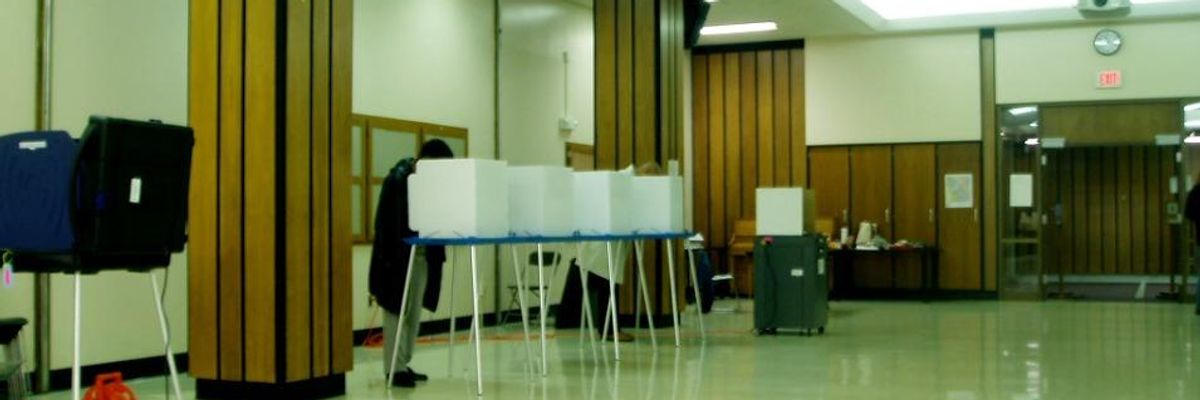
In one predominantly black Georgia county, a consultant appointed by Secretary of State and Republican gubernatorial candidate Brian Kemp advised that seven out of nine polling places be closed. (Photo: Dina-Roberts Wakulczyk/Flickr/cc)
'This Is Voter Suppression in 2018': Georgia County Under Fire for Cynical Ploy to Disenfranchise Black Voters in Name of Disability Rights
"What people with disabilities actually want, if you ask them, is measures that make it easier for them to vote, not measures that disenfranchise everyone."
Making clear its intent to disenfranchise voters, a predominantly black county in Georgia was unable on Wednesday to prove that its reason for proposing the closure of seven of its nine polling places was that the locations are not accessible for people with disabilities.
As the Huffington Post reported, Randolph County officials produced no documentation that the polling places failed to comply with the Americans with Disabilities Act (ADA), as the county claimed last week.
About 60 percent of Randolph County's residents are black, and a third live below the poverty line. The county voted for Hillary Clinton by 11 points in the 2016 presidential election.
Those factors, outraged voting rights advocates say, were what made a consultant--whose hiring was pushed by Secretary of State and Republican gubernatorial candidate Brian Kemp--suggest that the county close almost all of its polling places.
The fact that Kemp will be running against former state House Minority Leader Stacey Abrams, a Democrat who would be the country's first African-American female governor, is also behind the move, critics say.
"This is a cynical deployment of the ADA as a bludgeon against the rights of people of color to get equal access to the ballot. It should not be tolerated." --Sasha Samberg-Champion, civil rights attorneyBut the consultant, Mike Malone, claimed at a meeting with voters last week that the closures resulted from the locations' failure to provide adequate parking and safe bathroom access for voters with disabilities.
"Folks, I will tell you right now, your polling places are not ADA-compliant, period," Malone said. "You have to have compliant polling places."
The Huffington Post requested records showing that the polling places do not comply with the ADA, but Randolph County responded to the request empty-handed.
"There is no document, report, or analysis studying the handicap accessibility of polling places in Randolph County and the cost of fixing them within the time frame specified in your open records request," Hayden Hooks, an attorney with the firm that represents Randolph County, wrote in an email to the outlet.
"You'd think, if you're going to adopt a change that could potentially disenfranchise voters, that you'd have a strong justification backed by research," John Powers, an attorney with the Lawyers' Committee for Civil Rights Under Law, told the Huffington Post. "However, there's absolutely no evidence of that here."
Sean Young, legal director of the American Civil Liberties Union of Georgia, added that the county's excuse proves the effort is a "sham" and said his group has threatened to sue the county if it proceeds with the unlawful closures.
"This is not about ADA compliance," Young told the Huffington Post, "because if it were, they would have produced a study or analysis of what they believe are ADA violations and what can be done about them."
On Twitter, civil rights lawyer Sasha Samberg-Champion debunked the claim that the locations had to be closed and demanded that Malone's proposal be defeated.
What people with disabilities actually want, if you ask them, is measures that make it easier for _them_ to vote, not measures that disenfranchise everyone. They'd rather you set up a voting station curbside than shut down the polling place. pic.twitter.com/LNfSizMAID
-- Sasha Samberg-Champion (@ssamcham) August 22, 2018
Critics like Samberg-Champion are hoping a county commission will overturn the county's decision, while voting rights advocates have vowed to start a petition drive to keep the polling places open.
An Urgent Message From Our Co-Founder
Dear Common Dreams reader, It’s been nearly 30 years since I co-founded Common Dreams with my late wife, Lina Newhouser. We had the radical notion that journalism should serve the public good, not corporate profits. It was clear to us from the outset what it would take to build such a project. No paid advertisements. No corporate sponsors. No millionaire publisher telling us what to think or do. Many people said we wouldn't last a year, but we proved those doubters wrong. Together with a tremendous team of journalists and dedicated staff, we built an independent media outlet free from the constraints of profits and corporate control. Our mission has always been simple: To inform. To inspire. To ignite change for the common good. Building Common Dreams was not easy. Our survival was never guaranteed. When you take on the most powerful forces—Wall Street greed, fossil fuel industry destruction, Big Tech lobbyists, and uber-rich oligarchs who have spent billions upon billions rigging the economy and democracy in their favor—the only bulwark you have is supporters who believe in your work. But here’s the urgent message from me today. It's never been this bad out there. And it's never been this hard to keep us going. At the very moment Common Dreams is most needed, the threats we face are intensifying. We need your support now more than ever. We don't accept corporate advertising and never will. We don't have a paywall because we don't think people should be blocked from critical news based on their ability to pay. Everything we do is funded by the donations of readers like you. When everyone does the little they can afford, we are strong. But if that support retreats or dries up, so do we. Will you donate now to make sure Common Dreams not only survives but thrives? —Craig Brown, Co-founder |
Making clear its intent to disenfranchise voters, a predominantly black county in Georgia was unable on Wednesday to prove that its reason for proposing the closure of seven of its nine polling places was that the locations are not accessible for people with disabilities.
As the Huffington Post reported, Randolph County officials produced no documentation that the polling places failed to comply with the Americans with Disabilities Act (ADA), as the county claimed last week.
About 60 percent of Randolph County's residents are black, and a third live below the poverty line. The county voted for Hillary Clinton by 11 points in the 2016 presidential election.
Those factors, outraged voting rights advocates say, were what made a consultant--whose hiring was pushed by Secretary of State and Republican gubernatorial candidate Brian Kemp--suggest that the county close almost all of its polling places.
The fact that Kemp will be running against former state House Minority Leader Stacey Abrams, a Democrat who would be the country's first African-American female governor, is also behind the move, critics say.
"This is a cynical deployment of the ADA as a bludgeon against the rights of people of color to get equal access to the ballot. It should not be tolerated." --Sasha Samberg-Champion, civil rights attorneyBut the consultant, Mike Malone, claimed at a meeting with voters last week that the closures resulted from the locations' failure to provide adequate parking and safe bathroom access for voters with disabilities.
"Folks, I will tell you right now, your polling places are not ADA-compliant, period," Malone said. "You have to have compliant polling places."
The Huffington Post requested records showing that the polling places do not comply with the ADA, but Randolph County responded to the request empty-handed.
"There is no document, report, or analysis studying the handicap accessibility of polling places in Randolph County and the cost of fixing them within the time frame specified in your open records request," Hayden Hooks, an attorney with the firm that represents Randolph County, wrote in an email to the outlet.
"You'd think, if you're going to adopt a change that could potentially disenfranchise voters, that you'd have a strong justification backed by research," John Powers, an attorney with the Lawyers' Committee for Civil Rights Under Law, told the Huffington Post. "However, there's absolutely no evidence of that here."
Sean Young, legal director of the American Civil Liberties Union of Georgia, added that the county's excuse proves the effort is a "sham" and said his group has threatened to sue the county if it proceeds with the unlawful closures.
"This is not about ADA compliance," Young told the Huffington Post, "because if it were, they would have produced a study or analysis of what they believe are ADA violations and what can be done about them."
On Twitter, civil rights lawyer Sasha Samberg-Champion debunked the claim that the locations had to be closed and demanded that Malone's proposal be defeated.
What people with disabilities actually want, if you ask them, is measures that make it easier for _them_ to vote, not measures that disenfranchise everyone. They'd rather you set up a voting station curbside than shut down the polling place. pic.twitter.com/LNfSizMAID
-- Sasha Samberg-Champion (@ssamcham) August 22, 2018
Critics like Samberg-Champion are hoping a county commission will overturn the county's decision, while voting rights advocates have vowed to start a petition drive to keep the polling places open.
Making clear its intent to disenfranchise voters, a predominantly black county in Georgia was unable on Wednesday to prove that its reason for proposing the closure of seven of its nine polling places was that the locations are not accessible for people with disabilities.
As the Huffington Post reported, Randolph County officials produced no documentation that the polling places failed to comply with the Americans with Disabilities Act (ADA), as the county claimed last week.
About 60 percent of Randolph County's residents are black, and a third live below the poverty line. The county voted for Hillary Clinton by 11 points in the 2016 presidential election.
Those factors, outraged voting rights advocates say, were what made a consultant--whose hiring was pushed by Secretary of State and Republican gubernatorial candidate Brian Kemp--suggest that the county close almost all of its polling places.
The fact that Kemp will be running against former state House Minority Leader Stacey Abrams, a Democrat who would be the country's first African-American female governor, is also behind the move, critics say.
"This is a cynical deployment of the ADA as a bludgeon against the rights of people of color to get equal access to the ballot. It should not be tolerated." --Sasha Samberg-Champion, civil rights attorneyBut the consultant, Mike Malone, claimed at a meeting with voters last week that the closures resulted from the locations' failure to provide adequate parking and safe bathroom access for voters with disabilities.
"Folks, I will tell you right now, your polling places are not ADA-compliant, period," Malone said. "You have to have compliant polling places."
The Huffington Post requested records showing that the polling places do not comply with the ADA, but Randolph County responded to the request empty-handed.
"There is no document, report, or analysis studying the handicap accessibility of polling places in Randolph County and the cost of fixing them within the time frame specified in your open records request," Hayden Hooks, an attorney with the firm that represents Randolph County, wrote in an email to the outlet.
"You'd think, if you're going to adopt a change that could potentially disenfranchise voters, that you'd have a strong justification backed by research," John Powers, an attorney with the Lawyers' Committee for Civil Rights Under Law, told the Huffington Post. "However, there's absolutely no evidence of that here."
Sean Young, legal director of the American Civil Liberties Union of Georgia, added that the county's excuse proves the effort is a "sham" and said his group has threatened to sue the county if it proceeds with the unlawful closures.
"This is not about ADA compliance," Young told the Huffington Post, "because if it were, they would have produced a study or analysis of what they believe are ADA violations and what can be done about them."
On Twitter, civil rights lawyer Sasha Samberg-Champion debunked the claim that the locations had to be closed and demanded that Malone's proposal be defeated.
What people with disabilities actually want, if you ask them, is measures that make it easier for _them_ to vote, not measures that disenfranchise everyone. They'd rather you set up a voting station curbside than shut down the polling place. pic.twitter.com/LNfSizMAID
-- Sasha Samberg-Champion (@ssamcham) August 22, 2018
Critics like Samberg-Champion are hoping a county commission will overturn the county's decision, while voting rights advocates have vowed to start a petition drive to keep the polling places open.