SUBSCRIBE TO OUR FREE NEWSLETTER
Daily news & progressive opinion—funded by the people, not the corporations—delivered straight to your inbox.
5
#000000
#FFFFFF
To donate by check, phone, or other method, see our More Ways to Give page.
Daily news & progressive opinion—funded by the people, not the corporations—delivered straight to your inbox.
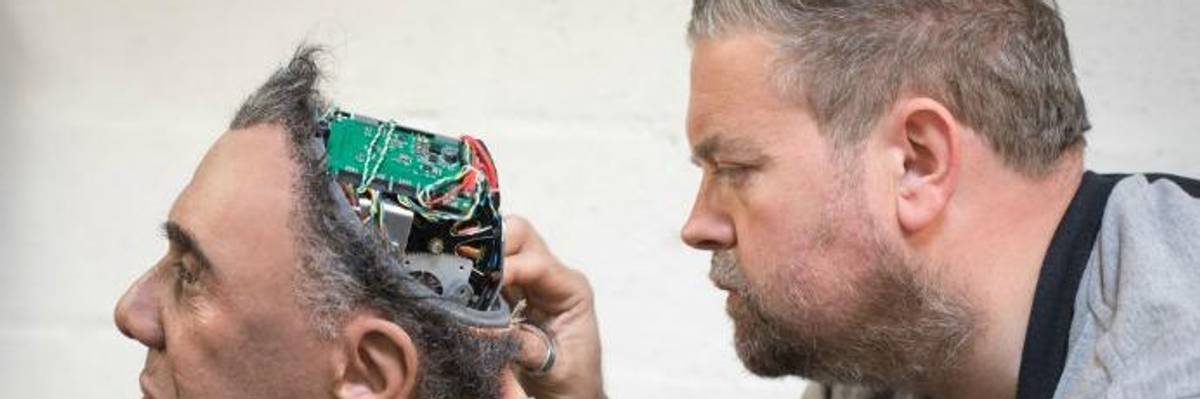
Engineered Arts prosthetic expert Mike Humphrey checks on Fred, a recently completed Mesmer robot that was built at the company's headquarters in Penryn on May 9, 2018 in Cornwall, England. (Photo: Matt Cardy/Getty Images)
While much of the world's attention is currently centered on efforts by Russian operatives to sow discord among the American electorate with fake social media posts and "troll farms" during the 2016 presidential election, an Oxford Internet Institute study published Friday found that use of social media by governments looking to "spread junk information and propaganda to voters" has become a global phenomenon.
"Social media have gone from being the natural infrastructure for sharing collective grievances and coordinating civic engagement, to being a computational tool for social control."
--Oxford study
"Social media manipulation is big business," the researchers found. "We estimate that tens of millions of dollars are being spent on social media manipulation campaigns, involving tens of thousands of professional staff."
While there is nothing new about political parties and governments using disinformation to manipulate elections at home and abroad, the Oxford researchers note that the massive, easily accessible, and lightly regulated platforms offered by Facebook and Twitter have become enormously powerful tools in the hands of political actors, who have used social media to kick their propaganda campaigns into overdrive and cast doubt on science and public institutions.
"Although closely related to some of the dirty tricks and negative campaigning we might expect in close races (and which have always played a part in political campaigning ), what makes this phenomenon unique is the deliberate use of computational propaganda to manipulate voters and shape the outcome of elections," the study notes.
In 30 of the 48 countries examined, Oxford researchers discovered "evidence of political parties using computational propaganda during elections or referenda. In emerging and Western democracies, sophisticated data analytics and political bots are being used to poison the information environment, promote skepticism and distrust, polarize voting constituencies, and undermine the integrity of democratic processes."
Despite recent efforts by Facebook, Twitter, and governments to rein in the proliferation of fake stories on social media, Oxford researchers found that the use of bots to quickly spread disinformation is growing exponentially.
"We actually found 38 countries used bots last year, compared with 17 in the year before," Philip Howard, director of the Oxford Internet Institute and co-author of the new study, told McClatchy.
"Social media have gone from being the natural infrastructure for sharing collective grievances and coordinating civic engagement, to being a computational tool for social control, manipulated by canny political consultants, and available to politicians in democracies and dictatorships alike," the study concludes. "We cannot wait for national courts to sort out the technicalities of infractions after running an election or referendum. Protecting our democracies now means setting the rules of fair play before voting day, not after."
Dear Common Dreams reader, It’s been nearly 30 years since I co-founded Common Dreams with my late wife, Lina Newhouser. We had the radical notion that journalism should serve the public good, not corporate profits. It was clear to us from the outset what it would take to build such a project. No paid advertisements. No corporate sponsors. No millionaire publisher telling us what to think or do. Many people said we wouldn't last a year, but we proved those doubters wrong. Together with a tremendous team of journalists and dedicated staff, we built an independent media outlet free from the constraints of profits and corporate control. Our mission has always been simple: To inform. To inspire. To ignite change for the common good. Building Common Dreams was not easy. Our survival was never guaranteed. When you take on the most powerful forces—Wall Street greed, fossil fuel industry destruction, Big Tech lobbyists, and uber-rich oligarchs who have spent billions upon billions rigging the economy and democracy in their favor—the only bulwark you have is supporters who believe in your work. But here’s the urgent message from me today. It's never been this bad out there. And it's never been this hard to keep us going. At the very moment Common Dreams is most needed, the threats we face are intensifying. We need your support now more than ever. We don't accept corporate advertising and never will. We don't have a paywall because we don't think people should be blocked from critical news based on their ability to pay. Everything we do is funded by the donations of readers like you. When everyone does the little they can afford, we are strong. But if that support retreats or dries up, so do we. Will you donate now to make sure Common Dreams not only survives but thrives? —Craig Brown, Co-founder |
While much of the world's attention is currently centered on efforts by Russian operatives to sow discord among the American electorate with fake social media posts and "troll farms" during the 2016 presidential election, an Oxford Internet Institute study published Friday found that use of social media by governments looking to "spread junk information and propaganda to voters" has become a global phenomenon.
"Social media have gone from being the natural infrastructure for sharing collective grievances and coordinating civic engagement, to being a computational tool for social control."
--Oxford study
"Social media manipulation is big business," the researchers found. "We estimate that tens of millions of dollars are being spent on social media manipulation campaigns, involving tens of thousands of professional staff."
While there is nothing new about political parties and governments using disinformation to manipulate elections at home and abroad, the Oxford researchers note that the massive, easily accessible, and lightly regulated platforms offered by Facebook and Twitter have become enormously powerful tools in the hands of political actors, who have used social media to kick their propaganda campaigns into overdrive and cast doubt on science and public institutions.
"Although closely related to some of the dirty tricks and negative campaigning we might expect in close races (and which have always played a part in political campaigning ), what makes this phenomenon unique is the deliberate use of computational propaganda to manipulate voters and shape the outcome of elections," the study notes.
In 30 of the 48 countries examined, Oxford researchers discovered "evidence of political parties using computational propaganda during elections or referenda. In emerging and Western democracies, sophisticated data analytics and political bots are being used to poison the information environment, promote skepticism and distrust, polarize voting constituencies, and undermine the integrity of democratic processes."
Despite recent efforts by Facebook, Twitter, and governments to rein in the proliferation of fake stories on social media, Oxford researchers found that the use of bots to quickly spread disinformation is growing exponentially.
"We actually found 38 countries used bots last year, compared with 17 in the year before," Philip Howard, director of the Oxford Internet Institute and co-author of the new study, told McClatchy.
"Social media have gone from being the natural infrastructure for sharing collective grievances and coordinating civic engagement, to being a computational tool for social control, manipulated by canny political consultants, and available to politicians in democracies and dictatorships alike," the study concludes. "We cannot wait for national courts to sort out the technicalities of infractions after running an election or referendum. Protecting our democracies now means setting the rules of fair play before voting day, not after."
While much of the world's attention is currently centered on efforts by Russian operatives to sow discord among the American electorate with fake social media posts and "troll farms" during the 2016 presidential election, an Oxford Internet Institute study published Friday found that use of social media by governments looking to "spread junk information and propaganda to voters" has become a global phenomenon.
"Social media have gone from being the natural infrastructure for sharing collective grievances and coordinating civic engagement, to being a computational tool for social control."
--Oxford study
"Social media manipulation is big business," the researchers found. "We estimate that tens of millions of dollars are being spent on social media manipulation campaigns, involving tens of thousands of professional staff."
While there is nothing new about political parties and governments using disinformation to manipulate elections at home and abroad, the Oxford researchers note that the massive, easily accessible, and lightly regulated platforms offered by Facebook and Twitter have become enormously powerful tools in the hands of political actors, who have used social media to kick their propaganda campaigns into overdrive and cast doubt on science and public institutions.
"Although closely related to some of the dirty tricks and negative campaigning we might expect in close races (and which have always played a part in political campaigning ), what makes this phenomenon unique is the deliberate use of computational propaganda to manipulate voters and shape the outcome of elections," the study notes.
In 30 of the 48 countries examined, Oxford researchers discovered "evidence of political parties using computational propaganda during elections or referenda. In emerging and Western democracies, sophisticated data analytics and political bots are being used to poison the information environment, promote skepticism and distrust, polarize voting constituencies, and undermine the integrity of democratic processes."
Despite recent efforts by Facebook, Twitter, and governments to rein in the proliferation of fake stories on social media, Oxford researchers found that the use of bots to quickly spread disinformation is growing exponentially.
"We actually found 38 countries used bots last year, compared with 17 in the year before," Philip Howard, director of the Oxford Internet Institute and co-author of the new study, told McClatchy.
"Social media have gone from being the natural infrastructure for sharing collective grievances and coordinating civic engagement, to being a computational tool for social control, manipulated by canny political consultants, and available to politicians in democracies and dictatorships alike," the study concludes. "We cannot wait for national courts to sort out the technicalities of infractions after running an election or referendum. Protecting our democracies now means setting the rules of fair play before voting day, not after."